0
Putting Your Best
Foot Forward
How to communicate your value
proposition
Rohit Shukla
Founder & CEO, Larta Institute
What We Won’t Cover*
Your specific work plan or “roadmap”
But, you need a clear, concise, short- and long-term plan
Please work closely with your PA and LM to develop this
The specifics of YOUR challenge
The competitive landscape in YOUR sub-sector
Where YOUR investment is likely to come from
As we have discussed, there are many more funding sources available
today
1
* These may be discussed in the one-on-one mentoring
What We Will Cover
The business landscape as it affects emerging companies
IT/Web/Software, Design, Materials, etc.
How to read the market, what signals do you send?
Before “approval”, pre-revenue, and post-revenue
Preparing yourself for success
“Design Thinking”: an integrated view
Developing and communicating your value proposition
2
Key Principles
 What global issue / trend are you addressing?
 A time of peril and promise
 Minimize the technological
 Science only gets you in the door – baseline credibility
 Focus on the solution, not on the details of your
technology (cost / performance)
 Does you know what needs exist?
 If not, will you be able to discuss these without a
conversation about a transaction?
 WHY do you think YOU can do this? (team, history etc.)
 WHEN are you likely to achieve milestones?
 Establish achievable targets while showing how these
targets will help the vision – for your internal team!
3
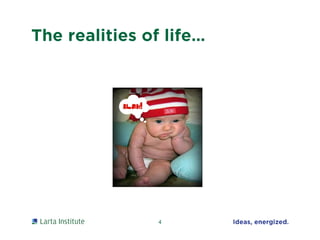
The realities of life…
4
The Business Landscape
 Nothing is as it seems: unpredictable is here to stay
 Skepticism around “new” inventions, pressure around
execution
 Hunger for innovations that improve the human condition
 Appetite for risk is diminishing
 Shifts burden of proof to smaller company, but willingness to
engage externally is higher than ever before
 For innovators:
 Science gets you in the door but not much farther
 Start-ups: realism is key
 More advanced companies: credibility based on past
performance
5
In general…
 Credibility is built over time: commit to simple, achievable
targets
 Show that you want to crawl before you walk, and walk
before you run (if you exceed this in reality, you’re a
superstar!)
 Offer a vision, not hype; show commitment, not
expectation
 Instead of saying “We expect” say, “We are committed to a
goal of…”
 Then show HOW you plan on doing so
 Make it realistic, and don’t use terms like “we estimate very
conservatively…”
6
Keep Your Integrity … Intact
 Lower barriers to entry means confusing claims
 Make clear distinctions between you and what exists: focus
on solutions, not on technology (cost/performance)
 Establish a vision and communicate the objective and the
pain
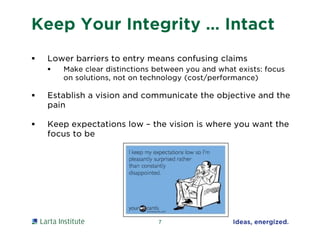
 Keep expectations low – the vision is where you want the
focus to be
7
Building the Value
Proposition
8
It Start with the Vision
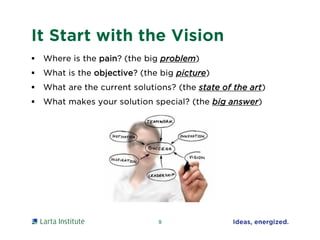
 Where is the pain? (the big problem)
 What is the objective? (the big picture)
 What are the current solutions? (the state of the art)
 What makes your solution special? (the big answer)
9
… And It Includes YOU
 Why YOU? (the entrepreneur's story)
 Why did you start to do this?
 What motivated you, your passion, intellectual curiosity, sheer
opportunism, happenstance, etc.?
 What do you want to achieve (personal, professional,
etc.)?
 Where are you heading? (Growth and excitement)
10
Value Proposition
 What is the “Market Pain” or Problem?
(Problem /Opportunity)
 How does your product address the Market Pain?
(characteristics, features / benefits)
 What is different about your product?
(vs. the Competition)
 Why would a customer buy from you?
(Differentiation / competitive advantage)
 Integration with what they currently do (Ease of adoption)
11
The Heart & Soul
Expressing the Value
(Who and what we do)
Catwalk is a social network-based solution focused on fashion advice to millennials. It is designed as a
bi-directional channel, and is integrated in a mobile app that helps users get instant fashion advice and
style inspiration in a "safe haven" environment. We target a generation that has diverse tastes,
multiple choices, and little time.
(Where we are in the development process)
We launched our proof-of-concept in September 2014 and our IOS app in March 2015. We have seen
user engagement go from 0 to 100 users and a few thousand actions in the app.
We seek to capitalize on our success, finalize our revenue model and validate user acquisition
strategies.
(Where are we going, what do we want)
We seek to capitalize on user stickiness and feedback gained from their experience to finalize our
revenue model and validate user acquisition strategies.
12
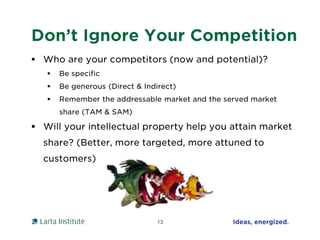
Don’t Ignore Your Competition
 Who are your competitors (now and potential)?
 Be specific
 Be generous (Direct & Indirect)
 Remember the addressable market and the served market
share (TAM & SAM)
 Will your intellectual property help you attain market
share? (Better, more targeted, more attuned to
customers)
13
Tout the Management Team
 Attention follows people (“Bet on the jockey, not the
horse”)
 Who are you working with?
 Establish their credentials and experience
 What are the roles of key team members
 Who are you talking to/consulting with (Advisory Board,
research collaborators, investors, etc.)
 Focus on how this team will execute
14
Business Model
 Considerations for every company (in developing
your value proposition):
 Who are your customers and why will they pay for your
product?
 What is your strategy? (How will you get to them?)
 What is the revenue model? (How will you make money?)
 Make a credible presentation of your addressable
market
 Revenue, cash flow, profitability
 How do you plan to grow your company?
15
Present Your Financials
 Present your financials briefly and simply
 Use graphics as much as possible
 Make them CREDIBLE!!!
 Know that detailed pro formas WILL follow in
detailed meeting
16
Step 1: Do Your Research
 How do you intend to enter/address/conquer the
market? Understand the target!
 Strategic Partner – to do what?
 Marketing, distributing, manufacturing?
 What is their pattern of collaboration or partnership?
 Why would they be interested?
 Licensing, collaborative research, buy product, acquire
your company
 Investor – “sweet spot”, track record, alignment on
fundamentals
17
Step 2: Seek to Build a Brand
 Brands build trust, loyalty, attention
 Stand for something tangible, an expression of identity
 Stand out in the crowd
 Become the visible “expert” (blogs, Web, news, etc.)
 Develop consistency: graphics, color schemes, collateral,
typestyles, fonts
 Remember everything you do should be done to represent
and enhance the brand
18
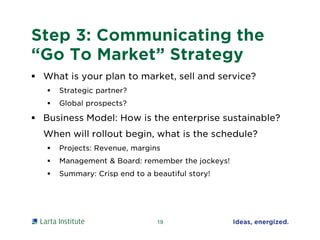
Step 3: Communicating the
“Go To Market” Strategy
 What is your plan to market, sell and service?
 Strategic partner?
 Global prospects?
 Business Model: How is the enterprise sustainable?
When will rollout begin, what is the schedule?
 Projects: Revenue, margins
 Management & Board: remember the jockeys!
 Summary: Crisp end to a beautiful story!
19
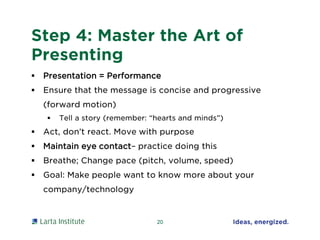
Step 4: Master the Art of
Presenting
 Presentation = Performance
 Ensure that the message is concise and progressive
(forward motion)
 Tell a story (remember: “hearts and minds”)
 Act, don’t react. Move with purpose
 Maintain eye contact– practice doing this
 Breathe; Change pace (pitch, volume, speed)
 Goal: Make people want to know more about your
company/technology
20
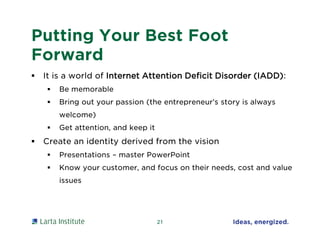
Putting Your Best Foot
Forward
 It is a world of Internet Attention Deficit Disorder (IADD):
 Be memorable
 Bring out your passion (the entrepreneur’s story is always
welcome)
 Get attention, and keep it
 Create an identity derived from the vision
 Presentations – master PowerPoint
 Know your customer, and focus on their needs, cost and value
issues
21
Thought for Today …
And Always
22
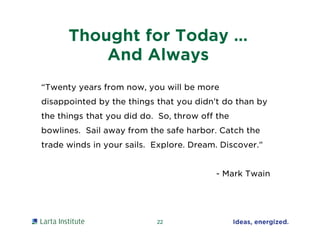
“Twenty years from now, you will be more
disappointed by the things that you didn’t do than by
the things that you did do. So, throw off the
bowlines. Sail away from the safe harbor. Catch the
trade winds in your sails. Explore. Dream. Discover.”
- Mark Twain
Thank you!
Questions?
23

How to communicate your value proposition

  • 1.
    0 Putting Your Best FootForward How to communicate your value proposition Rohit Shukla Founder & CEO, Larta Institute
  • 2.
    What We Won’tCover* Your specific work plan or “roadmap” But, you need a clear, concise, short- and long-term plan Please work closely with your PA and LM to develop this The specifics of YOUR challenge The competitive landscape in YOUR sub-sector Where YOUR investment is likely to come from As we have discussed, there are many more funding sources available today 1 * These may be discussed in the one-on-one mentoring
  • 3.
    What We WillCover The business landscape as it affects emerging companies IT/Web/Software, Design, Materials, etc. How to read the market, what signals do you send? Before “approval”, pre-revenue, and post-revenue Preparing yourself for success “Design Thinking”: an integrated view Developing and communicating your value proposition 2
  • 4.
    Key Principles  Whatglobal issue / trend are you addressing?  A time of peril and promise  Minimize the technological  Science only gets you in the door – baseline credibility  Focus on the solution, not on the details of your technology (cost / performance)  Does you know what needs exist?  If not, will you be able to discuss these without a conversation about a transaction?  WHY do you think YOU can do this? (team, history etc.)  WHEN are you likely to achieve milestones?  Establish achievable targets while showing how these targets will help the vision – for your internal team! 3
  • 5.
  • 6.
    The Business Landscape Nothing is as it seems: unpredictable is here to stay  Skepticism around “new” inventions, pressure around execution  Hunger for innovations that improve the human condition  Appetite for risk is diminishing  Shifts burden of proof to smaller company, but willingness to engage externally is higher than ever before  For innovators:  Science gets you in the door but not much farther  Start-ups: realism is key  More advanced companies: credibility based on past performance 5
  • 7.
    In general…  Credibilityis built over time: commit to simple, achievable targets  Show that you want to crawl before you walk, and walk before you run (if you exceed this in reality, you’re a superstar!)  Offer a vision, not hype; show commitment, not expectation  Instead of saying “We expect” say, “We are committed to a goal of…”  Then show HOW you plan on doing so  Make it realistic, and don’t use terms like “we estimate very conservatively…” 6
  • 8.
    Keep Your Integrity… Intact  Lower barriers to entry means confusing claims  Make clear distinctions between you and what exists: focus on solutions, not on technology (cost/performance)  Establish a vision and communicate the objective and the pain  Keep expectations low – the vision is where you want the focus to be 7
  • 9.
  • 10.
    It Start withthe Vision  Where is the pain? (the big problem)  What is the objective? (the big picture)  What are the current solutions? (the state of the art)  What makes your solution special? (the big answer) 9
  • 11.
    … And ItIncludes YOU  Why YOU? (the entrepreneur's story)  Why did you start to do this?  What motivated you, your passion, intellectual curiosity, sheer opportunism, happenstance, etc.?  What do you want to achieve (personal, professional, etc.)?  Where are you heading? (Growth and excitement) 10
  • 12.
    Value Proposition  Whatis the “Market Pain” or Problem? (Problem /Opportunity)  How does your product address the Market Pain? (characteristics, features / benefits)  What is different about your product? (vs. the Competition)  Why would a customer buy from you? (Differentiation / competitive advantage)  Integration with what they currently do (Ease of adoption) 11 The Heart & Soul
  • 13.
    Expressing the Value (Whoand what we do) Catwalk is a social network-based solution focused on fashion advice to millennials. It is designed as a bi-directional channel, and is integrated in a mobile app that helps users get instant fashion advice and style inspiration in a "safe haven" environment. We target a generation that has diverse tastes, multiple choices, and little time. (Where we are in the development process) We launched our proof-of-concept in September 2014 and our IOS app in March 2015. We have seen user engagement go from 0 to 100 users and a few thousand actions in the app. We seek to capitalize on our success, finalize our revenue model and validate user acquisition strategies. (Where are we going, what do we want) We seek to capitalize on user stickiness and feedback gained from their experience to finalize our revenue model and validate user acquisition strategies. 12
  • 14.
    Don’t Ignore YourCompetition  Who are your competitors (now and potential)?  Be specific  Be generous (Direct & Indirect)  Remember the addressable market and the served market share (TAM & SAM)  Will your intellectual property help you attain market share? (Better, more targeted, more attuned to customers) 13
  • 15.
    Tout the ManagementTeam  Attention follows people (“Bet on the jockey, not the horse”)  Who are you working with?  Establish their credentials and experience  What are the roles of key team members  Who are you talking to/consulting with (Advisory Board, research collaborators, investors, etc.)  Focus on how this team will execute 14
  • 16.
    Business Model  Considerationsfor every company (in developing your value proposition):  Who are your customers and why will they pay for your product?  What is your strategy? (How will you get to them?)  What is the revenue model? (How will you make money?)  Make a credible presentation of your addressable market  Revenue, cash flow, profitability  How do you plan to grow your company? 15
  • 17.
    Present Your Financials Present your financials briefly and simply  Use graphics as much as possible  Make them CREDIBLE!!!  Know that detailed pro formas WILL follow in detailed meeting 16
  • 18.
    Step 1: DoYour Research  How do you intend to enter/address/conquer the market? Understand the target!  Strategic Partner – to do what?  Marketing, distributing, manufacturing?  What is their pattern of collaboration or partnership?  Why would they be interested?  Licensing, collaborative research, buy product, acquire your company  Investor – “sweet spot”, track record, alignment on fundamentals 17
  • 19.
    Step 2: Seekto Build a Brand  Brands build trust, loyalty, attention  Stand for something tangible, an expression of identity  Stand out in the crowd  Become the visible “expert” (blogs, Web, news, etc.)  Develop consistency: graphics, color schemes, collateral, typestyles, fonts  Remember everything you do should be done to represent and enhance the brand 18
  • 20.
    Step 3: Communicatingthe “Go To Market” Strategy  What is your plan to market, sell and service?  Strategic partner?  Global prospects?  Business Model: How is the enterprise sustainable? When will rollout begin, what is the schedule?  Projects: Revenue, margins  Management & Board: remember the jockeys!  Summary: Crisp end to a beautiful story! 19
  • 21.
    Step 4: Masterthe Art of Presenting  Presentation = Performance  Ensure that the message is concise and progressive (forward motion)  Tell a story (remember: “hearts and minds”)  Act, don’t react. Move with purpose  Maintain eye contact– practice doing this  Breathe; Change pace (pitch, volume, speed)  Goal: Make people want to know more about your company/technology 20
  • 22.
    Putting Your BestFoot Forward  It is a world of Internet Attention Deficit Disorder (IADD):  Be memorable  Bring out your passion (the entrepreneur’s story is always welcome)  Get attention, and keep it  Create an identity derived from the vision  Presentations – master PowerPoint  Know your customer, and focus on their needs, cost and value issues 21
  • 23.
    Thought for Today… And Always 22 “Twenty years from now, you will be more disappointed by the things that you didn’t do than by the things that you did do. So, throw off the bowlines. Sail away from the safe harbor. Catch the trade winds in your sails. Explore. Dream. Discover.” - Mark Twain
  • 24.