Mastering the VC Game:
How to Raise Your First Round of Capital

               Jeffrey Bussgang
   Flybridge Capital Partners, General Partner
   Harvard Business School, Senior Lecturer

                 April 10, 2013
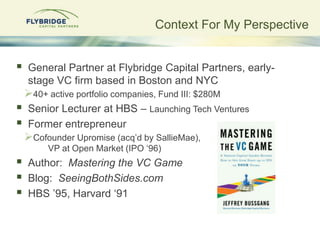
Context For My Perspective


   General Partner at Flybridge Capital Partners, early-
    stage VC firm based in Boston and NYC
    40+ active portfolio companies, Fund III: $280M
   Senior Lecturer at HBS – Launching Tech Ventures
   Former entrepreneur
    Cofounder Upromise (acq‟d by SallieMae),
         VP at Open Market (IPO „96)
   Author: Mastering the VC Game
   Blog: SeeingBothSides.com
   HBS ‟95, Harvard „91
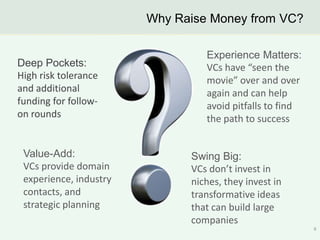
Why Raise Money from VC?

                                 Experience Matters:
Deep Pockets:                    VCs have “seen the
High risk tolerance              movie” over and over
and additional                   again and can help
funding for follow-              avoid pitfalls to find
on rounds                        the path to success


 Value-Add:                   Swing Big:
 VCs provide domain           VCs don’t invest in
 experience, industry         niches, they invest in
 contacts, and                transformative ideas
 strategic planning           that can build large
                              companies
                                                          8
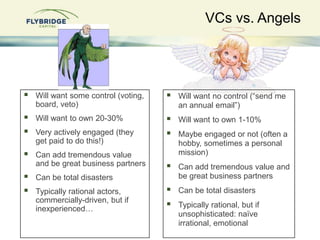
VCs vs. Angels


   Will want some control (voting,      Will want no control (“send me
    board, veto)                          an annual email”)
   Will want to own 20-30%              Will want to own 1-10%
   Very actively engaged (they          Maybe engaged or not (often a
    get paid to do this!)                 hobby, sometimes a personal
   Can add tremendous value              mission)
    and be great business partners       Can add tremendous value and
   Can be total disasters                be great business partners
   Typically rational actors,           Can be total disasters
    commercially-driven, but if
    inexperienced…                       Typically rational, but if
                                          unsophisticated: naïve
                                          irrational, emotional
Raising $ from VCs: Find the Sweet Spot

   Scope out the firm –
       size matters, as does
       the individual
      Arrange for a warm
       introduction
      Prepare, be brief
        (VCs Blink)
      Don‟t downplay risk
      Mutual due diligence
       is fair play
04/09/10                                      9      9
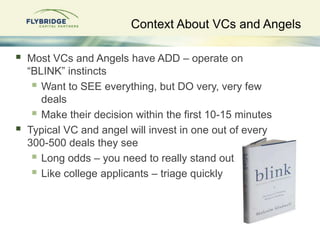
Context About VCs and Angels

   Most VCs and Angels have ADD – operate on
    “BLINK” instincts
      Want to SEE everything, but DO very, very few
       deals
      Make their decision within the first 10-15 minutes
   Typical VC and angel will invest in one out of every
    300-500 deals they see
      Long odds – you need to really stand out
      Like college applicants – triage quickly
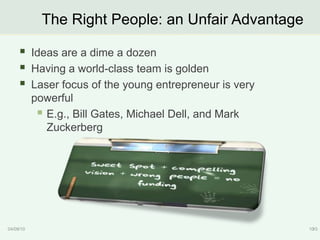
The Right People: an Unfair Advantage

          Ideas are a dime a dozen
          Having a world-class team is golden
          Laser focus of the young entrepreneur is very
           powerful
             E.g., Bill Gates, Michael Dell, and Mark
              Zuckerberg


04/09/10                                                   10
                                                            10
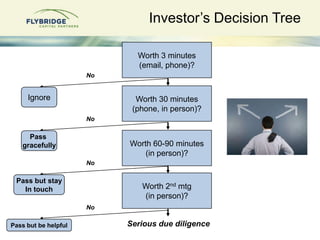
Investor‟s Decision Tree

                             Worth 3 minutes
                             (email, phone)?
                      No


     Ignore                  Worth 30 minutes
                            (phone, in person)?
                      No

     Pass
   gracefully              Worth 60-90 minutes
                               (in person)?
                      No

 Pass but stay
   In touch                   Worth 2nd mtg
                              (in person)?
                      No

Pass but be helpful        Serious due diligence
Elements of the Pitch


   Intro  who are you, why are you here and why are you special?
   Problem  what is the customer pain?
   Solution  what‟s your disruptive, breakthrough compelling
    solution? Is the “Gain vs. Pain” ratio 10x?
   Opportunity / market size  top down and bottoms up
   Competitive advantage  what is your unique differentiation?
    what‟s your “competitive moat”?
   Go to market plan  how are you going to reach the customer?
   Business model  how are you going to make money?
   Financials  what‟s the bottom line, what are your key
    assumptions? How are you going to make ME money?
   The ask  how much do you want, how long will it last you and how
    much will you achieve?

                                                                    9
Top 3 Things To Do


   Be gracious and personable
       Say something that makes you smile…authentically
       Tell your personal history, tell a story
   Be crisp and on point
       Personal intro should take < 5 minutes
       Team introduction 5-10 minutes
       Make it relevant – don‟t go off on tangents
       If you can‟t show good summarization skills,
          how will you handle a board room?
   Know your stuff
       They will push you to test you
       John Doerr/Upromise case study
Top 3 Things To Avoid


   Do not exaggerate
       Assume everything you say will be verified in due diligence
       Assume the listener is a cynic and a professional BS detector
   There‟s no “I” in team
       If you are self-aggrandizing, investors will assume you can‟t build
        teams
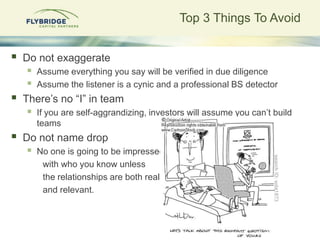
   Do not name drop
       No one is going to be impressed
         with who you know unless
         the relationships are both real
         and relevant.
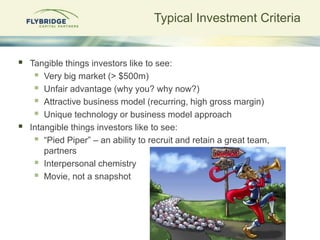
Typical Investment Criteria


   Tangible things investors like to see:
      Very big market (> $500m)
      Unfair advantage (why you? why now?)
      Attractive business model (recurring, high gross margin)
      Unique technology or business model approach
   Intangible things investors like to see:
      “Pied Piper” – an ability to recruit and retain a great team,
        partners
      Interpersonal chemistry
      Movie, not a snapshot
So You‟ve Had a Good Meeting…
                                             Then What?


   Treat fundraising like a sales process – build a pipeline,
    work people through the pipeline, build up to crescendo
   VCs get distracted – typically only pursue 2-3 high
    priority new investment opportunities at any given time
   Stay connected, top of mind, build a sense of momentum
   Need to sell the individual “champion”, then the help
    them sell the partnership
   Address objections with specific data
       Make the investment case for them
       Give them tools/materials to share with their partners


                                                                 13
Then, Expect More Due Diligence


   Customers / partners
   Team
   Technology
   Business model
   Market size / analysts

As with sales, package up the information, make it easy
 on the VC – provide reference list, financial models,
 detailed market size analysis – all in readable form


                                                           14
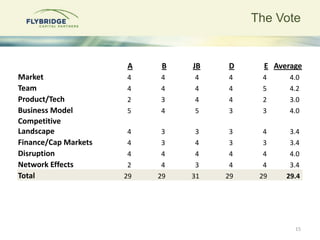
The Vote


                      A     B   JB   D      E Average
Market                4    4    4    4     4      4.0
Team                  4    4    4    4     5      4.2
Product/Tech          2    3    4    4     2      3.0
Business Model        5    4    5    3     3      4.0
Competitive
Landscape              4    3    3    3     4     3.4
Finance/Cap Markets    4    3    4    3     3     3.4
Disruption             4    4    4    4     4     4.0
Network Effects        2    4    3    4     4     3.4
Total                 29   29   31   29    29    29.4


                                                   15
Term Sheet Time
                         Frequently Asked Questions…


   Should I include VCs in my first round or just angels?
   How big should the option pool be?
   How should I think about valuation?
      “Promote” definition
   Should I do a convertible note with a cap, no cap or a
    priced round?
   How should I think about control?


                                                             16
Expectations and Milestones


   Have well-documented milestones that represent what
    you expect to achieve during the initial funding period
      Team building
      Technical progress/product development
      Customers, revenue
      Budget
   Talk to the investor about the next round before you
    close this round
      Expectations, amount, price


                                                              17
Who‟s Ready to Raise Money?
Mastering the VC Game:
   How to Raise Your First Round of Capital

                  Jeffrey Bussgang
      Flybridge Capital Partners, General Partner
      Harvard Business School, Senior Lecturer

                     April 10, 2013


Jeff@flybridge.com                    @bussgang

How To Raise Your First Round of Capital

  • 1.
    Mastering the VCGame: How to Raise Your First Round of Capital Jeffrey Bussgang Flybridge Capital Partners, General Partner Harvard Business School, Senior Lecturer April 10, 2013
  • 2.
    Context For MyPerspective  General Partner at Flybridge Capital Partners, early- stage VC firm based in Boston and NYC 40+ active portfolio companies, Fund III: $280M  Senior Lecturer at HBS – Launching Tech Ventures  Former entrepreneur Cofounder Upromise (acq‟d by SallieMae), VP at Open Market (IPO „96)  Author: Mastering the VC Game  Blog: SeeingBothSides.com  HBS ‟95, Harvard „91
  • 3.
    Why Raise Moneyfrom VC? Experience Matters: Deep Pockets: VCs have “seen the High risk tolerance movie” over and over and additional again and can help funding for follow- avoid pitfalls to find on rounds the path to success Value-Add: Swing Big: VCs provide domain VCs don’t invest in experience, industry niches, they invest in contacts, and transformative ideas strategic planning that can build large companies 8
  • 4.
    VCs vs. Angels  Will want some control (voting,  Will want no control (“send me board, veto) an annual email”)  Will want to own 20-30%  Will want to own 1-10%  Very actively engaged (they  Maybe engaged or not (often a get paid to do this!) hobby, sometimes a personal  Can add tremendous value mission) and be great business partners  Can add tremendous value and  Can be total disasters be great business partners  Typically rational actors,  Can be total disasters commercially-driven, but if inexperienced…  Typically rational, but if unsophisticated: naïve irrational, emotional
  • 5.
    Raising $ fromVCs: Find the Sweet Spot  Scope out the firm – size matters, as does the individual  Arrange for a warm introduction  Prepare, be brief (VCs Blink)  Don‟t downplay risk  Mutual due diligence is fair play 04/09/10 9 9
  • 6.
    Context About VCsand Angels  Most VCs and Angels have ADD – operate on “BLINK” instincts  Want to SEE everything, but DO very, very few deals  Make their decision within the first 10-15 minutes  Typical VC and angel will invest in one out of every 300-500 deals they see  Long odds – you need to really stand out  Like college applicants – triage quickly
  • 7.
    The Right People:an Unfair Advantage  Ideas are a dime a dozen  Having a world-class team is golden  Laser focus of the young entrepreneur is very powerful  E.g., Bill Gates, Michael Dell, and Mark Zuckerberg 04/09/10 10 10
  • 8.
    Investor‟s Decision Tree Worth 3 minutes (email, phone)? No Ignore Worth 30 minutes (phone, in person)? No Pass gracefully Worth 60-90 minutes (in person)? No Pass but stay In touch Worth 2nd mtg (in person)? No Pass but be helpful Serious due diligence
  • 9.
    Elements of thePitch  Intro  who are you, why are you here and why are you special?  Problem  what is the customer pain?  Solution  what‟s your disruptive, breakthrough compelling solution? Is the “Gain vs. Pain” ratio 10x?  Opportunity / market size  top down and bottoms up  Competitive advantage  what is your unique differentiation? what‟s your “competitive moat”?  Go to market plan  how are you going to reach the customer?  Business model  how are you going to make money?  Financials  what‟s the bottom line, what are your key assumptions? How are you going to make ME money?  The ask  how much do you want, how long will it last you and how much will you achieve? 9
  • 10.
    Top 3 ThingsTo Do  Be gracious and personable  Say something that makes you smile…authentically  Tell your personal history, tell a story  Be crisp and on point  Personal intro should take < 5 minutes  Team introduction 5-10 minutes  Make it relevant – don‟t go off on tangents  If you can‟t show good summarization skills, how will you handle a board room?  Know your stuff  They will push you to test you  John Doerr/Upromise case study
  • 11.
    Top 3 ThingsTo Avoid  Do not exaggerate  Assume everything you say will be verified in due diligence  Assume the listener is a cynic and a professional BS detector  There‟s no “I” in team  If you are self-aggrandizing, investors will assume you can‟t build teams  Do not name drop  No one is going to be impressed with who you know unless the relationships are both real and relevant.
  • 12.
    Typical Investment Criteria  Tangible things investors like to see:  Very big market (> $500m)  Unfair advantage (why you? why now?)  Attractive business model (recurring, high gross margin)  Unique technology or business model approach  Intangible things investors like to see:  “Pied Piper” – an ability to recruit and retain a great team, partners  Interpersonal chemistry  Movie, not a snapshot
  • 13.
    So You‟ve Hada Good Meeting… Then What?  Treat fundraising like a sales process – build a pipeline, work people through the pipeline, build up to crescendo  VCs get distracted – typically only pursue 2-3 high priority new investment opportunities at any given time  Stay connected, top of mind, build a sense of momentum  Need to sell the individual “champion”, then the help them sell the partnership  Address objections with specific data  Make the investment case for them  Give them tools/materials to share with their partners 13
  • 14.
    Then, Expect MoreDue Diligence  Customers / partners  Team  Technology  Business model  Market size / analysts As with sales, package up the information, make it easy on the VC – provide reference list, financial models, detailed market size analysis – all in readable form 14
  • 15.
    The Vote A B JB D E Average Market 4 4 4 4 4 4.0 Team 4 4 4 4 5 4.2 Product/Tech 2 3 4 4 2 3.0 Business Model 5 4 5 3 3 4.0 Competitive Landscape 4 3 3 3 4 3.4 Finance/Cap Markets 4 3 4 3 3 3.4 Disruption 4 4 4 4 4 4.0 Network Effects 2 4 3 4 4 3.4 Total 29 29 31 29 29 29.4 15
  • 16.
    Term Sheet Time Frequently Asked Questions…  Should I include VCs in my first round or just angels?  How big should the option pool be?  How should I think about valuation?  “Promote” definition  Should I do a convertible note with a cap, no cap or a priced round?  How should I think about control? 16
  • 17.
    Expectations and Milestones  Have well-documented milestones that represent what you expect to achieve during the initial funding period  Team building  Technical progress/product development  Customers, revenue  Budget  Talk to the investor about the next round before you close this round  Expectations, amount, price 17
  • 18.
    Who‟s Ready toRaise Money?
  • 19.
    Mastering the VCGame: How to Raise Your First Round of Capital Jeffrey Bussgang Flybridge Capital Partners, General Partner Harvard Business School, Senior Lecturer April 10, 2013 Jeff@flybridge.com @bussgang