HOW EFFECTIVE IS THE
COMBINATION OF YOUR MAIN
PRODUCT AND ANCILLARY TEXTS?
Natasha Ano
MAIN PRODUCT
 Our main product is a short social realist film
focused on gang culture/peer pressure
ANCILLARY TASKS
 Our ancillary task was to create a film poster and
film review for our main product – short film.
PLANNING ANCILLARY TASKS
 In order to get an effective main product we done
a significant amount of research and we applied
these methods of research in order to develop our
ancillary products.
 We went about this by analysing different film
posters/ film reviews to see what layouts were
used and how we could replicate something of the
same quality.
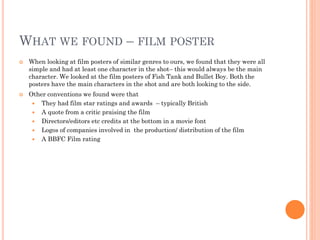
WHAT WE FOUND – FILM POSTER
 When looking at film posters of similar genres to ours, we found that they were all
simple and had at least one character in the shot– this would always be the main
character. We looked at the film posters of Fish Tank and Bullet Boy. Both the
posters have the main characters in the shot and are both looking to the side.
 Other conventions we found were that
 They had film star ratings and awards – typically British
 A quote from a critic praising the film
 Directors/editors etc credits at the bottom in a movie font
 Logos of companies involved in the production/ distribution of the film
 A BBFC Film rating
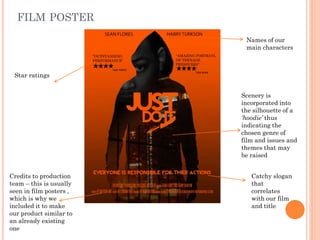
FILM POSTER
“OUTSTANDING
PERFORMANCE”
GHS TIMES
“AMAZING PORTRAYL
OF TEENAGE
PRESSURES”
THE BASE
Star ratings
Names of our
main characters
Catchy slogan
that
correlates
with our film
and title
Scenery is
incorporated into
the silhouette of a
‘hoodie’ thus
indicating the
chosen genre of
film and issues and
themes that may
be raised
Credits to production
team – this is usually
seen in film posters ,
which is why we
included it to make
our product similar to
an already existing
one
WHAT WE FOUND – FILM REVIEW
 The main conventions that we found when
looking at film reviews were –
 Action shots from the film
 Title of the film
 Writing in columns
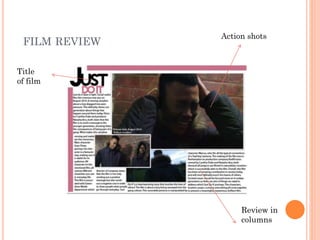
FILM REVIEW
Action shots
Review in
columns
Title
of film
HOW THE THREE PRODUCTS LINK
 Both main and ancillary tasks are aimed at our target
audience, the focus has not been diverted we have
carefully considered what elements of each product would
attract our audience.
 It reflects back on the original purpose of our production.
 All three products have an extremely strong relationship as
without one, they each would be useless. The film poster is
designed to publicize the film. The audience then go to see
the film. The film review then gives a judgment on the film,
either discouraging or encouraging more people to go and
watch it. Not including one of these factors, the others
would not have the same affect. For example; without
a film review, the audience is left only to there own
analysis of the film poster as an encouragement to watch
the film. This leaves the risk of the audience
misinterpreting it. There would be no genuine motivation
for an audience to go and see the film because they have s
lack of detail on the film to act as a driving force

How effective is the combination

  • 1.
    HOW EFFECTIVE ISTHE COMBINATION OF YOUR MAIN PRODUCT AND ANCILLARY TEXTS? Natasha Ano
  • 2.
    MAIN PRODUCT  Ourmain product is a short social realist film focused on gang culture/peer pressure ANCILLARY TASKS  Our ancillary task was to create a film poster and film review for our main product – short film.
  • 3.
    PLANNING ANCILLARY TASKS In order to get an effective main product we done a significant amount of research and we applied these methods of research in order to develop our ancillary products.  We went about this by analysing different film posters/ film reviews to see what layouts were used and how we could replicate something of the same quality.
  • 4.
    WHAT WE FOUND– FILM POSTER  When looking at film posters of similar genres to ours, we found that they were all simple and had at least one character in the shot– this would always be the main character. We looked at the film posters of Fish Tank and Bullet Boy. Both the posters have the main characters in the shot and are both looking to the side.  Other conventions we found were that  They had film star ratings and awards – typically British  A quote from a critic praising the film  Directors/editors etc credits at the bottom in a movie font  Logos of companies involved in the production/ distribution of the film  A BBFC Film rating
  • 5.
    FILM POSTER “OUTSTANDING PERFORMANCE” GHS TIMES “AMAZINGPORTRAYL OF TEENAGE PRESSURES” THE BASE Star ratings Names of our main characters Catchy slogan that correlates with our film and title Scenery is incorporated into the silhouette of a ‘hoodie’ thus indicating the chosen genre of film and issues and themes that may be raised Credits to production team – this is usually seen in film posters , which is why we included it to make our product similar to an already existing one
  • 6.
    WHAT WE FOUND– FILM REVIEW  The main conventions that we found when looking at film reviews were –  Action shots from the film  Title of the film  Writing in columns
  • 7.
    FILM REVIEW Action shots Reviewin columns Title of film
  • 8.
    HOW THE THREEPRODUCTS LINK  Both main and ancillary tasks are aimed at our target audience, the focus has not been diverted we have carefully considered what elements of each product would attract our audience.  It reflects back on the original purpose of our production.  All three products have an extremely strong relationship as without one, they each would be useless. The film poster is designed to publicize the film. The audience then go to see the film. The film review then gives a judgment on the film, either discouraging or encouraging more people to go and watch it. Not including one of these factors, the others would not have the same affect. For example; without a film review, the audience is left only to there own analysis of the film poster as an encouragement to watch the film. This leaves the risk of the audience misinterpreting it. There would be no genuine motivation for an audience to go and see the film because they have s lack of detail on the film to act as a driving force