An Introduction to
Introducing Ourselves
Padlet is a blank wall on the web
that you can post anything too.
For this activity you’ll be posting a
little bit about yourself.
In blackboard complete the,
“Introductions Activity” using
Padlet.
Introducing Ourselves 
 Name
 Email
 Favorite activities
 Countries you’ve visited
 Who was your favorite teacher and why?
In a Letter to Me…
 Tell me something about yourself that
you think is important for me to know.
 What sorts of things come easy for you?
 Which are more challenging?
 What questions/concerns do you have
about taking an online course?
 What are the qualities you like to see
in a teacher?
History Is…
"History is for human self-knowledge.
Knowing yourself means knowing, first, what it is to be a
person; secondly, knowing what it is to be the kind of
person you are; and thirdly, knowing what it is to be the
person you are and nobody else is.
Knowing yourself means knowing what you can do; and since
nobody knows what they can do until they try, the only clue
to what man can do is what man has done.
The value of history, then, is that it teaches us what man has
done and thus what man is."
- R. G. Collingwood
In This Course
 We will take a look at how the world
came to look the way it did in the 20th
century.
 How did religion, philosophy, wars and
nationalism shape the world
 What problems exist today and locate
their roots in history
Tools of a Historian
Using Primary and Secondary Sources in
the Classroom
7
A Historians Tools
PRIMARY SOURCES
SECONDARY SOURCES
What is a Primary Source
 Primary sources are
materials produced by
people or groups directly
involved in the event or
topic under consideration.
Think of them as first-hand
information.
What Is a Primary Source
 Examples of primary
sources include eyewitness
accounts, speeches, letters
and diaries, newspapers and
magazines, tax and census
data, marriage, birth and
death records, works of art,
and interviews
What is a Secondary Source
 Secondary sources construct an
explanation of the past based on primary
sources and usually in consultation with
other secondary sources.
 The best secondary sources will both
report on events in the past as well as
generalize, analyze, interpret and/or
evaluate.
The Assassination of JFK Using
Primary and Secondary Sources
Click the play button to learn more
Check for Understanding
1. In your own words, describe the
difference between a primary and
secondary source?
2. Why are these important tools
for a historian?
Can we Trust the Sources
 First, historians think about where, when
and why a document was created. They
consider whether a source was created close
in location and time to an actual historical
event.
 Historians also think about the purpose of a
source. Was it a personal diary intended to
be kept private? Was the document prepared
for the public?
 Some primary sources may be judged more
reliable than others, but every source is
biased in some way. As a result, historians
read sources skeptically and critically.
These Two Rules Help You Decide
RULE #1
Time and Place
RULE #2
Bias
This rule says the closer in
time and place a source and
its creator were to an event in
the past, the better the
source will be.
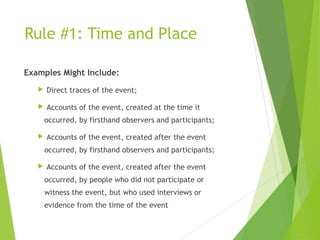
Rule #1: Time and Place
Examples Might Include:
 Direct traces of the event;
 Accounts of the event, created at the time it
occurred, by firsthand observers and participants;
 Accounts of the event, created after the event
occurred, by firsthand observers and participants;
 Accounts of the event, created after the event
occurred, by people who did not participate or
witness the event, but who used interviews or
evidence from the time of the event
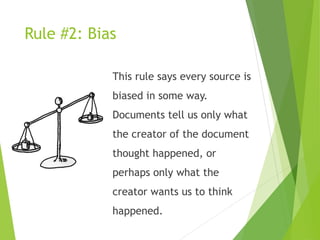
Rule #2: Bias
This rule says every source is
biased in some way.
Documents tell us only what
the creator of the document
thought happened, or
perhaps only what the
creator wants us to think
happened.
Rule #2: Bias
Examples Might Include:
 Every piece of evidence and every source must be
read or viewed skeptically and critically.
 No piece of evidence should be taken at face
value. The creator's point of view must be
considered.
 Each piece of evidence and source must be cross-
checked and compared with related sources and
pieces of evidence.
Check for Understanding
1. Why is it important to determine
the reliability of a source?
2. What rules can we use to guide
us as we determine the reliability
of a source?

How do historians study the past

  • 1.
  • 2.
    Introducing Ourselves Padlet isa blank wall on the web that you can post anything too. For this activity you’ll be posting a little bit about yourself. In blackboard complete the, “Introductions Activity” using Padlet.
  • 3.
    Introducing Ourselves  Name  Email  Favorite activities  Countries you’ve visited  Who was your favorite teacher and why?
  • 4.
    In a Letterto Me…  Tell me something about yourself that you think is important for me to know.  What sorts of things come easy for you?  Which are more challenging?  What questions/concerns do you have about taking an online course?  What are the qualities you like to see in a teacher?
  • 5.
    History Is… "History isfor human self-knowledge. Knowing yourself means knowing, first, what it is to be a person; secondly, knowing what it is to be the kind of person you are; and thirdly, knowing what it is to be the person you are and nobody else is. Knowing yourself means knowing what you can do; and since nobody knows what they can do until they try, the only clue to what man can do is what man has done. The value of history, then, is that it teaches us what man has done and thus what man is." - R. G. Collingwood
  • 6.
    In This Course We will take a look at how the world came to look the way it did in the 20th century.  How did religion, philosophy, wars and nationalism shape the world  What problems exist today and locate their roots in history
  • 7.
    Tools of aHistorian Using Primary and Secondary Sources in the Classroom 7
  • 8.
    A Historians Tools PRIMARYSOURCES SECONDARY SOURCES
  • 9.
    What is aPrimary Source  Primary sources are materials produced by people or groups directly involved in the event or topic under consideration. Think of them as first-hand information.
  • 10.
    What Is aPrimary Source  Examples of primary sources include eyewitness accounts, speeches, letters and diaries, newspapers and magazines, tax and census data, marriage, birth and death records, works of art, and interviews
  • 11.
    What is aSecondary Source  Secondary sources construct an explanation of the past based on primary sources and usually in consultation with other secondary sources.  The best secondary sources will both report on events in the past as well as generalize, analyze, interpret and/or evaluate.
  • 12.
    The Assassination ofJFK Using Primary and Secondary Sources Click the play button to learn more
  • 13.
    Check for Understanding 1.In your own words, describe the difference between a primary and secondary source? 2. Why are these important tools for a historian?
  • 14.
    Can we Trustthe Sources  First, historians think about where, when and why a document was created. They consider whether a source was created close in location and time to an actual historical event.  Historians also think about the purpose of a source. Was it a personal diary intended to be kept private? Was the document prepared for the public?  Some primary sources may be judged more reliable than others, but every source is biased in some way. As a result, historians read sources skeptically and critically.
  • 15.
    These Two RulesHelp You Decide RULE #1 Time and Place RULE #2 Bias
  • 16.
    This rule saysthe closer in time and place a source and its creator were to an event in the past, the better the source will be. Rule #1: Time and Place
  • 17.
    Rule #1: Timeand Place Examples Might Include:  Direct traces of the event;  Accounts of the event, created at the time it occurred, by firsthand observers and participants;  Accounts of the event, created after the event occurred, by firsthand observers and participants;  Accounts of the event, created after the event occurred, by people who did not participate or witness the event, but who used interviews or evidence from the time of the event
  • 18.
    Rule #2: Bias Thisrule says every source is biased in some way. Documents tell us only what the creator of the document thought happened, or perhaps only what the creator wants us to think happened.
  • 19.
    Rule #2: Bias ExamplesMight Include:  Every piece of evidence and every source must be read or viewed skeptically and critically.  No piece of evidence should be taken at face value. The creator's point of view must be considered.  Each piece of evidence and source must be cross- checked and compared with related sources and pieces of evidence.
  • 20.
    Check for Understanding 1.Why is it important to determine the reliability of a source? 2. What rules can we use to guide us as we determine the reliability of a source?

Editor's Notes

  • #10 original material may be ... prejudiced, or at least not exactly what it claims to be." Secondary sources are often subjected to peer review, can be well documented, and are often written by historians working in institutions where methodological accuracy is important to the future of the author's career and reputation A primary source such as a journal entry, at best, only reflects one person's take on events, which may or may not be truthful, accurate, or complete. Participants and eyewitnesses may misunderstand events or distort their reports (deliberately or unconsciously) to enhance their own image or importance this is why it is always important to check our sources for the possibility of bias and we will work on this step by step as we go through this class.