BMS COLLEGE OFENGINEERING
(Autonomous Institute, Affiliated to VTU, Belagavi)
DEPARTMENT OF MACHINE LEARNING
(UG Program: B.E. in Artificial Intelligence and Machine Learning)
Course :Mini Project Work Course
Code: 24AM5PWMPW
Real Estate Price Prediction
Phase - 2 Presentation
Date: 17/01/25
Faculty In-Charge:
[Dr. Jahnavi S ]
Assistant Professor
Department of Machine Learning
BMS College of Engineering
Presented By,
Student Name & USN :
Shivolen Moodley 1BM22AI123
Tejas MG 1BM22AI146
Chetan Nag 1BM22AI037
Semester & Section:
5B,5C,5A,5A
2.
Agenda
• Introduction
• LiteratureReview
• Open Issues
• Problem Statement
• Functional & Non-Functional Requirements
• Methodology
• Implementation
• Experiment results and analysis
• Conclusion
3.
Introduction
Real estate priceprediction involves the systematic estimation of property values using advanced data-
driven methodologies. This process integrates critical factors such as location, property dimensions,
amenities, prevailing market trends, and economic indicators. By leveraging statistical analysis and
machine learning techniques, these predictions achieve higher accuracy and reliability, empowering
stakeholders to make well-informed decisions.
This approach not only mitigates risks but also uncovers potential opportunities within the housing
market, benefiting buyers, sellers, and investors alike. Accurate property valuation is essential for
effective real estate planning, strategic investment, and comprehensive market analysis, ultimately
driving a more efficient and transparent real estate ecosystem.
4.
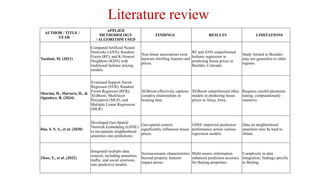
AUTHOR / TITLE/
YEAR
APPLIED
METHODOLOGY
/ ALGORITHM USED
FINDINGS RESULTS LIMITATIONS
Yazdani, M. (2021)
Compared Artificial Neural
Networks (ANN), Random
Forest (RF), and K-Nearest
Neighbors (KNN) with
traditional hedonic pricing
models.
Non-linear associations exist
between dwelling features and
prices.
RF and ANN outperformed
hedonic regression in
predicting house prices in
Boulder, Colorado.
Study limited to Boulder;
may not generalize to other
regions.
Sharma, H., Harsora, H., &
Ogunleye, B. (2024)
Evaluated Support Vector
Regressor (SVR), Random
Forest Regressor (RFR),
XGBoost, Multilayer
Perceptron (MLP), and
Multiple Linear Regression
(MLR).
XGBoost effectively captures
complex relationships in
housing data.
XGBoost outperformed other
models in predicting house
prices in Ames, Iowa.
Requires careful parameter
tuning; computationally
intensive.
Das, S. S. S., et al. (2020)
Developed Geo-Spatial
Network Embedding (GSNE)
to incorporate neighborhood
amenities into predictions.
Geo-spatial context
significantly influences house
prices.
GSNE improved prediction
performance across various
regression models.
Data on neighborhood
amenities may be hard to
obtain.
Zhao, Y., et al. (2022)
Integrated multiple data
sources, including amenities,
traffic, and social emotions,
into predictive models.
Socioeconomic characteristics
beyond property features
impact prices.
Multi-source information
enhanced prediction accuracy
for Beijing properties.
Complexity in data
integration; findings specific
to Beijing.
Literature review
5.
Bera, A. K.,et al. (2021)
Applied Bayesian inference in
spatial stochastic volatility
models.
Spatial dependencies and
volatility are crucial in price
modeling.
Improved understanding of house
price returns in Chicago.
Advanced statistical methods
may be complex for
practitioners.
Dabreo, S., et al. (2021)
Implemented machine learning
algorithms on datasets from
Boston and Melbourne.
Algorithm choice and dataset
quality significantly affect
accuracy.
Identified suitable algorithms for
real-life price prediction
applications.
Limited research on Indian real
estate markets.
Bera, A. K., et al. (2020)
Examined spatial autoregressive
models to assess impact measures.
Spatial relationships are vital in
real estate price modeling.
Provided insights into spatial
dependencies affecting prices.
Requires spatial data, which
may not be readily available.
Montes-Rojas, G., et al. (2020)
Investigated nonlinear restrictions
in econometric models.
Nonlinear factors play a role in
real estate price dynamics.
Enhanced understanding of model
specifications in price prediction.
Complex statistical methods
may limit practical application.
AUTHOR / TITLE / YEAR
APPLIED METHODOLOGY
/ ALGORITHM USED
FINDINGS RESULTS LIMITATIONS
6.
Open Issues
Data Qualityand Availability:
● Many datasets are incomplete, noisy, or outdated, which can affect the accuracy of price predictions.
● There may be inconsistencies in the data, such as missing values or misreported property features (e.g., square footage, number of
bedrooms).
● The availability of region-specific or high-quality data may limit the generalizability of the models.
Feature Selection and Engineering:
● Identifying the most relevant features influencing property prices can be difficult due to the large number of potential variables.
● Some important variables like neighborhood-specific trends, local economic conditions, and infrastructure developments may not be
captured adequately in the dataset.
Temporal Changes and Market Fluctuations:
● The real estate market is dynamic, with prices fluctuating due to economic conditions, interest rates, government policies, and other external
factors.
● Most models may struggle to predict these sudden shifts accurately, as they rely on historical data and may not adapt well to real-time changes.
Geographic Limitations:
● Real estate price models are often region-specific, meaning that a model trained on data from one city or country may not generalize well to others
due to differences in local economies, regulations, and market behavior.
● Regional data biases and lack of diversity in datasets can hinder the scalability of the model.
7.
Ethical and BiasIssues:
● Models may inadvertently incorporate biases related to location, income levels, or social factors, leading to unfair predictions or
reinforcing existing disparities.
● Addressing these biases and ensuring that the model is fair and equitable is an ongoing challenge in real estate price prediction
research.
Model Interpretability:
● Machine learning models, especially complex ones like neural networks or ensemble methods, may offer high accuracy but lack
transparency, making it hard to interpret how specific features impact predictions.
● Real estate professionals and stakeholders may be reluctant to trust models without clear reasoning behind predictions.
Overfitting and Underfitting:
● Models may overfit to the training data, leading to poor generalization to unseen data, especially if the dataset is too small or lacks
diversity.
● Conversely, models that are too simple might underfit and fail to capture complex patterns in the data.
8.
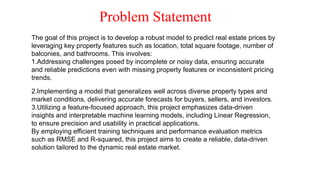
Problem Statement
The goalof this project is to develop a robust model to predict real estate prices by
leveraging key property features such as location, total square footage, number of
balconies, and bathrooms. This involves:
1.Addressing challenges posed by incomplete or noisy data, ensuring accurate
and reliable predictions even with missing property features or inconsistent pricing
trends.
2.Implementing a model that generalizes well across diverse property types and
market conditions, delivering accurate forecasts for buyers, sellers, and investors.
3.Utilizing a feature-focused approach, this project emphasizes data-driven
insights and interpretable machine learning models, including Linear Regression,
to ensure precision and usability in practical applications.
By employing efficient training techniques and performance evaluation metrics
such as RMSE and R-squared, this project aims to create a reliable, data-driven
solution tailored to the dynamic real estate market.
9.
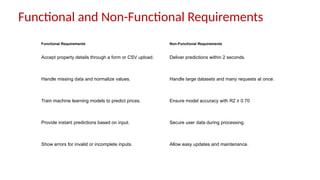
Functional and Non-FunctionalRequirements
Functional Requirements Non-Functional Requirements
Accept property details through a form or CSV upload. Deliver predictions within 2 seconds.
Handle missing data and normalize values. Handle large datasets and many requests at once.
Train machine learning models to predict prices. Ensure model accuracy with R2 ≥ 0.70
Provide instant predictions based on input. Secure user data during processing.
Show errors for invalid or incomplete inputs. Allow easy updates and maintenance.
10.
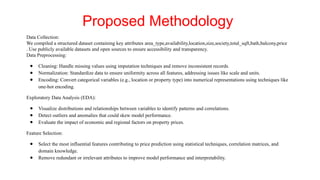
Data Collection:
We compileda structured dataset containing key attributes area_type,availability,location,size,society,total_sqft,bath,balcony,price
. Use publicly available datasets and open sources to ensure accessibility and transparency.
Data Preprocessing:
● Cleaning: Handle missing values using imputation techniques and remove inconsistent records.
● Normalization: Standardize data to ensure uniformity across all features, addressing issues like scale and units.
● Encoding: Convert categorical variables (e.g., location or property type) into numerical representations using techniques like
one-hot encoding.
Exploratory Data Analysis (EDA):
● Visualize distributions and relationships between variables to identify patterns and correlations.
● Detect outliers and anomalies that could skew model performance.
● Evaluate the impact of economic and regional factors on property prices.
Feature Selection:
● Select the most influential features contributing to price prediction using statistical techniques, correlation matrices, and
domain knowledge.
● Remove redundant or irrelevant attributes to improve model performance and interpretability.
Proposed Methodology
11.
Model Training andValidation:
● Train machine learning models - Linear Regression
● Split the dataset into training, validation, and testing subsets to ensure unbiased evaluation.
● Optimize hyperparameters through grid search or automated tuning for enhanced accuracy.
Performance Evaluation:
● Assess the models using key metrics R-squared score (R²) and Root Mean Square Error (RMSE).
● Validate the model’s ability to generalize using cross-validation techniques.
Model Deployment:
● Integrate the trained model into a user-friendly interface, allowing property details to be input through CSV uploads.
● Ensure real-time prediction capability, delivering results within seconds.
● Maintain data security and scalability to handle large datasets and multiple requests.
Iterative Improvement:
● Continuously update the model using new data to improve accuracy and adapt to changing market conditions.
● Incorporate feedback from end users to enhance functionality and usability.
Outcome:
The resulting model offers accurate price predictions, aiding stakeholders like buyers, sellers, and investors in making data-driven decisions. It
also addresses market challenges such as noisy data and fluctuating economic conditions, ensuring reliability and practicality.
12.
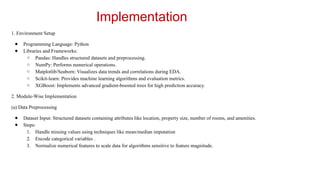
Implementation
1. Environment Setup
●Programming Language: Python
● Libraries and Frameworks:
○ Pandas: Handles structured datasets and preprocessing.
○ NumPy: Performs numerical operations.
○ Matplotlib/Seaborn: Visualizes data trends and correlations during EDA.
○ Scikit-learn: Provides machine learning algorithms and evaluation metrics.
○ XGBoost: Implements advanced gradient-boosted trees for high prediction accuracy.
2. Module-Wise Implementation
(a) Data Preprocessing
● Dataset Input: Structured datasets containing attributes like location, property size, number of rooms, and amenities.
● Steps:
1. Handle missing values using techniques like mean/median imputation
2. Encode categorical variables .
3. Normalize numerical features to scale data for algorithms sensitive to feature magnitude.
13.
(b) Exploratory DataAnalysis (EDA)
● Generate descriptive statistics and visualizations:
○ Correlation heatmaps to identify significant relationships.
○ Boxplots to detect outliers.
○ Distribution plots for understanding target variable spread.
Identify key predictive features like property location, size, and historical trends.
(c) Model Selection and Training
● Baseline Models: Start with linear regression to benchmark performance.
● Advanced Models:
○ Random Forests or Gradient Boosted Trees (e.g., XGBoost, LightGBM) for complex relationships.
● Use cross-validation to ensure model generalizability.
● Hyperparameter tuning via Grid Search or Random Search for optimal performance.
(e) Model Evaluation
● Use the following metrics to assess accuracy:
○ R² Score: Measures explained variance.
○ RMSE: Quantifies prediction errors.
○ MAE: Measures average error magnitude.
14.
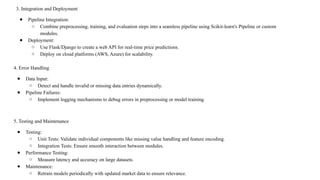
4. Error Handling
●Data Input:
○ Detect and handle invalid or missing data entries dynamically.
● Pipeline Failures:
○ Implement logging mechanisms to debug errors in preprocessing or model training.
5. Testing and Maintenance
● Testing:
○ Unit Tests: Validate individual components like missing value handling and feature encoding.
○ Integration Tests: Ensure smooth interaction between modules.
● Performance Testing:
○ Measure latency and accuracy on large datasets.
● Maintenance:
○ Retrain models periodically with updated market data to ensure relevance.
3. Integration and Deployment
● Pipeline Integration:
○ Combine preprocessing, training, and evaluation steps into a seamless pipeline using Scikit-learn's Pipeline or custom
modules.
● Deployment:
○ Use Flask/Django to create a web API for real-time price predictions.
○ Deploy on cloud platforms (AWS, Azure) for scalability.
15.
Experiment Results andAnalysis
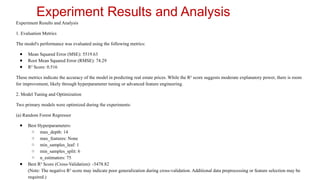
Experiment Results and Analysis
1. Evaluation Metrics
The model's performance was evaluated using the following metrics:
● Mean Squared Error (MSE): 5519.63
● Root Mean Squared Error (RMSE): 74.29
● R² Score: 0.516
These metrics indicate the accuracy of the model in predicting real estate prices. While the R² score suggests moderate explanatory power, there is room
for improvement, likely through hyperparameter tuning or advanced feature engineering.
2. Model Tuning and Optimization
Two primary models were optimized during the experiments:
(a) Random Forest Regressor
● Best Hyperparameters:
○ max_depth: 14
○ max_features: None
○ min_samples_leaf: 1
○ min_samples_split: 6
○ n_estimators: 75
● Best R² Score (Cross-Validation): -5478.82
(Note: The negative R² score may indicate poor generalization during cross-validation. Additional data preprocessing or feature selection may be
required.)
16.
(b) XGBoost Regressor
●Best Hyperparameters:
○ n_estimators: 200
○ max_depth: 5
○ learning_rate: 0.2
● Best R² Score (Cross-Validation): 0.648
XGBoost outperformed the Random Forest model, demonstrating its strength in handling structured datasets and optimizing predictive
performance.
3. Observations
● The XGBoost Regressor provided a higher R² score (0.648), indicating better predictive capability compared to the Random Forest
model.
● Feature importance analysis (if included in further steps) could help identify critical attributes, such as location, size, and amenities, that
significantly influence property prices.
4. Limitations
● The moderate R² score highlights that the model explains only part of the variability in real estate prices. Incorporating additional
features or leveraging ensemble methods could further enhance performance.
● Random Forest exhibited suboptimal results, likely due to overfitting or inadequate hyperparameter selection. Further tuning or
simplification of the model may address this.
17.
Conclusion
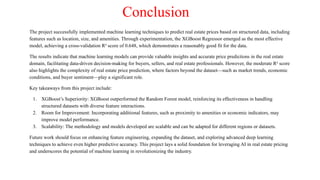
The project successfullyimplemented machine learning techniques to predict real estate prices based on structured data, including
features such as location, size, and amenities. Through experimentation, the XGBoost Regressor emerged as the most effective
model, achieving a cross-validation R² score of 0.648, which demonstrates a reasonably good fit for the data.
The results indicate that machine learning models can provide valuable insights and accurate price predictions in the real estate
domain, facilitating data-driven decision-making for buyers, sellers, and real estate professionals. However, the moderate R² score
also highlights the complexity of real estate price prediction, where factors beyond the dataset—such as market trends, economic
conditions, and buyer sentiment—play a significant role.
Key takeaways from this project include:
1. XGBoost’s Superiority: XGBoost outperformed the Random Forest model, reinforcing its effectiveness in handling
structured datasets with diverse feature interactions.
2. Room for Improvement: Incorporating additional features, such as proximity to amenities or economic indicators, may
improve model performance.
3. Scalability: The methodology and models developed are scalable and can be adapted for different regions or datasets.
Future work should focus on enhancing feature engineering, expanding the dataset, and exploring advanced deep learning
techniques to achieve even higher predictive accuracy. This project lays a solid foundation for leveraging AI in real estate pricing
and underscores the potential of machine learning in revolutionizing the industry.
![BMS COLLEGE OF ENGINEERING
(Autonomous Institute, Affiliated to VTU, Belagavi)
DEPARTMENT OF MACHINE LEARNING
(UG Program: B.E. in Artificial Intelligence and Machine Learning)
Course :Mini Project Work Course
Code: 24AM5PWMPW
Real Estate Price Prediction
Phase - 2 Presentation
Date: 17/01/25
Faculty In-Charge:
[Dr. Jahnavi S ]
Assistant Professor
Department of Machine Learning
BMS College of Engineering
Presented By,
Student Name & USN :
Shivolen Moodley 1BM22AI123
Tejas MG 1BM22AI146
Chetan Nag 1BM22AI037
Semester & Section:
5B,5C,5A,5A](https://image.slidesharecdn.com/pptreview2-250520160845-5e4c54a4/85/powerpoint-2-presentation-based-on-data-analytics-1-320.jpg)











![[DSC Europe 25] Ekaterina Bubenko - Behind the Curtain: How Data Roles Collab...](https://cdn.slidesharecdn.com/ss_thumbnails/anmv6x8dstqbbzchoklr-ekaterina-bubenko-behind-the-curtain-how-data-roles-collaborate-in-the-ai-era-a-260123083019-4b252ec7-thumbnail.jpg?width=640&height=640&fit=bounds)


