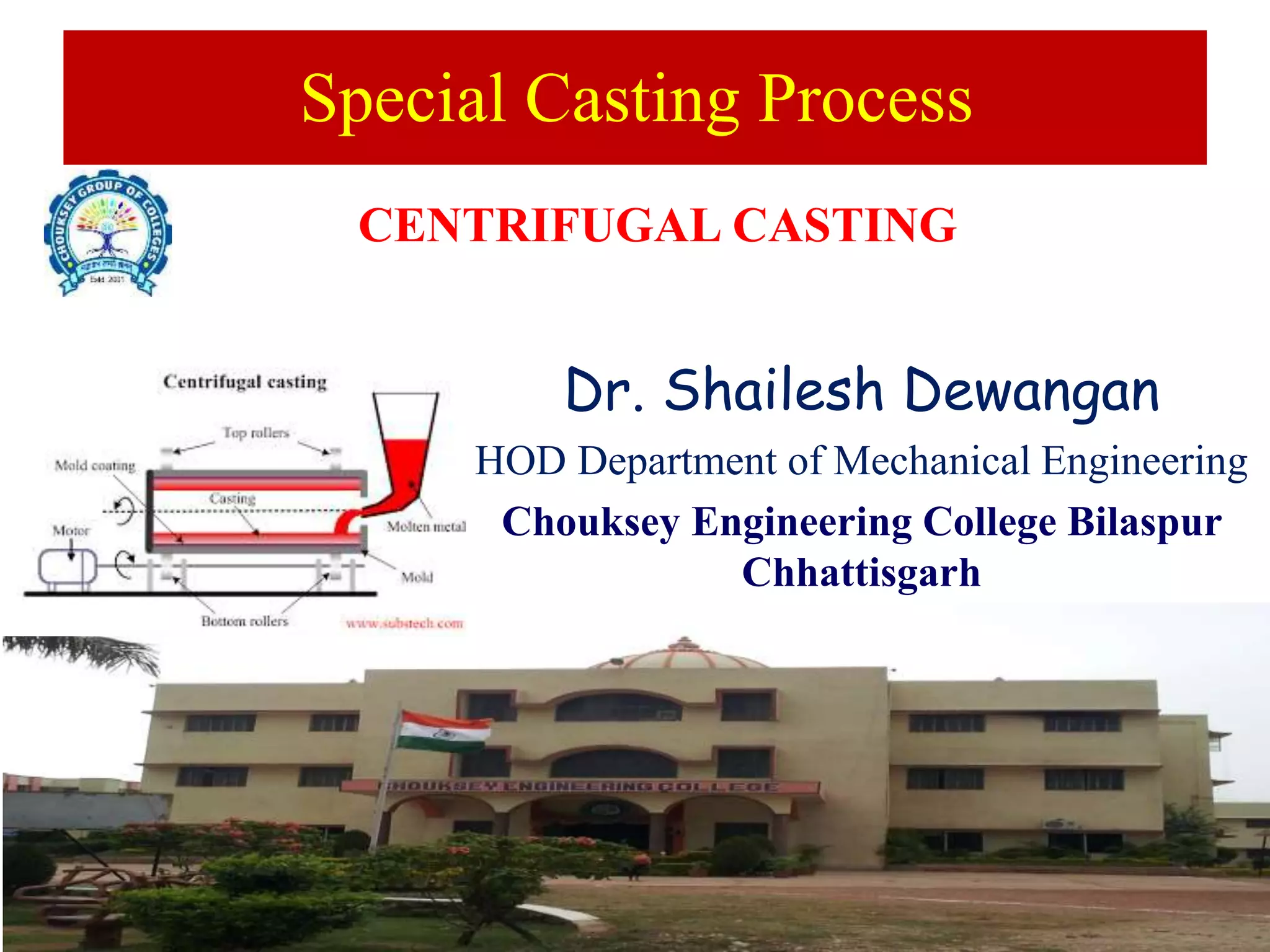
Special Casting Process
CENTRIFUGAL CASTING
Dr. Shailesh Dewangan
HOD Department of Mechanical Engineering
Chouksey Engineering College Bilaspur
Chhattisgarh
INTRODUCTION
 Developed by A G Eckhardt in England during
1809.
 It utilizes the centrifugal forces caused by rotation
to distribute the molten metal to the mold cavities.
Types of Centrifugal Casting
• True Centrifugal
• Semi-Centrifugal
• Centrifuge
TRUE CENTRIFUGAL
 The mold is rotated about a horizontal or a vertical
axis and the molten metal is held against the walls
of the mold by centrifugal force until it solidifies.
 True centrifugal casting is used for the production
of cylindrical hollow parts like Pipes.
PRINCIPLE
SETUP
REVIEW
VERTICAL CENTRIFUGAL
REVIEW
STEPS INVOLVED IN CASTING
 Apply the ceramic slurry to the mould walls
because it is possible that the molten metal may
stick to the metallic mould, so that should not
happen. To prevent this we apply a ceramic slur
slurry to the mould wall and it should be dried and
also it should be baked.
 Rotation of the mould at a predetermined speed
and it can start from 300 rpm to and it can go
upto 3000 rpm.
 The mould is stopped after the casting has
solidified till that time the mould has to rotate.
 Extraction of the casting from the mould.
 Removal of impurities.
ADVANTAGES
 Large parts can be manufactured
 Core is not required
 Designing of Gating system: not required
 Lighter impurities moves inwards resulting in easy
removal
 Less Scrap
CASTING YEILD
Yield =
𝑊𝑡.𝑜𝑓 𝐶𝑎𝑠𝑡𝑖𝑛𝑔
𝑊𝑡.𝑜𝑓 𝑀𝑒𝑡𝑎𝑙 𝑃𝑜𝑢𝑟𝑒𝑑
× 100
 In case of centrifugal casting Yield is
approximately 100
DISADVANTAGE
 Suitable for axial symmetrical products.
 More segregation in alloying components.
 Machining is required for inner diameter
 High investment cost
 Inaccurate internal diameter
 Skilled labor needed
SEMI CENTRIFUGAL
 The main difference is that in semi centrifugal
casting process the mould is filled completely with
molten metal which is supplied to the casting
through a central sprue.
 In case of the true centrifugal casting process yes
no doubt the what is there is a cylindrical mould
and it is rotated, but finally, the cast component
will be hollow there will be a hole inside
 In the case of the semi centrifugal casting
process we will not get the hollow components
that is the main difference.
PRINCIPLE
ADVANTAGE
 Number of moulds can be stacked together one
mould over the other can be fed by a common
central sprue in order to produce more than one
casting at a time.
 It ensures purity. Poorer structure forms at the
center of the casting, so this can be machined.
CENTRIFUGE
 The desired castings are arranged around a
central sprue here several castings are
manufactured at a time.
 If it is the true centrifugal casting process or the
semi centrifugal casting process only one casting
in a one mould, but here within a single mould
there will be more castings.
 These moulds contain all the necessary geometry
for the cast parts as well as the gating system.
 Centrifugal casting (Spinning) is often used in
conjunction with investment casting process
because investment casting process involves
manufacturing of tiny castings, in which it is very
difficult for the molten metal to enter.
 Because of the centrifugal force that is falling on
the molten metal pushes the metal through tiny
details.
ADVANTAGE
 Better quality
 High Casting yield
 Denser Casting have similar properties of forged
products
 Rejection is less
 Economical
REVIEW
Centrigugal casting Shailesh.pptx

Centrigugal casting Shailesh.pptx

  • 1.
    Special Casting Process CENTRIFUGALCASTING Dr. Shailesh Dewangan HOD Department of Mechanical Engineering Chouksey Engineering College Bilaspur Chhattisgarh
  • 2.
    INTRODUCTION  Developed byA G Eckhardt in England during 1809.  It utilizes the centrifugal forces caused by rotation to distribute the molten metal to the mold cavities. Types of Centrifugal Casting • True Centrifugal • Semi-Centrifugal • Centrifuge
  • 3.
    TRUE CENTRIFUGAL  Themold is rotated about a horizontal or a vertical axis and the molten metal is held against the walls of the mold by centrifugal force until it solidifies.  True centrifugal casting is used for the production of cylindrical hollow parts like Pipes.
  • 4.
  • 5.
  • 6.
  • 7.
  • 8.
  • 9.
    STEPS INVOLVED INCASTING  Apply the ceramic slurry to the mould walls because it is possible that the molten metal may stick to the metallic mould, so that should not happen. To prevent this we apply a ceramic slur slurry to the mould wall and it should be dried and also it should be baked.  Rotation of the mould at a predetermined speed and it can start from 300 rpm to and it can go upto 3000 rpm.  The mould is stopped after the casting has solidified till that time the mould has to rotate.
  • 10.
     Extraction ofthe casting from the mould.  Removal of impurities.
  • 11.
    ADVANTAGES  Large partscan be manufactured  Core is not required  Designing of Gating system: not required  Lighter impurities moves inwards resulting in easy removal  Less Scrap
  • 12.
    CASTING YEILD Yield = 𝑊𝑡.𝑜𝑓𝐶𝑎𝑠𝑡𝑖𝑛𝑔 𝑊𝑡.𝑜𝑓 𝑀𝑒𝑡𝑎𝑙 𝑃𝑜𝑢𝑟𝑒𝑑 × 100  In case of centrifugal casting Yield is approximately 100
  • 13.
    DISADVANTAGE  Suitable foraxial symmetrical products.  More segregation in alloying components.  Machining is required for inner diameter  High investment cost  Inaccurate internal diameter  Skilled labor needed
  • 14.
    SEMI CENTRIFUGAL  Themain difference is that in semi centrifugal casting process the mould is filled completely with molten metal which is supplied to the casting through a central sprue.  In case of the true centrifugal casting process yes no doubt the what is there is a cylindrical mould and it is rotated, but finally, the cast component will be hollow there will be a hole inside  In the case of the semi centrifugal casting process we will not get the hollow components that is the main difference.
  • 15.
  • 18.
    ADVANTAGE  Number ofmoulds can be stacked together one mould over the other can be fed by a common central sprue in order to produce more than one casting at a time.  It ensures purity. Poorer structure forms at the center of the casting, so this can be machined.
  • 19.
    CENTRIFUGE  The desiredcastings are arranged around a central sprue here several castings are manufactured at a time.  If it is the true centrifugal casting process or the semi centrifugal casting process only one casting in a one mould, but here within a single mould there will be more castings.  These moulds contain all the necessary geometry for the cast parts as well as the gating system.
  • 20.
     Centrifugal casting(Spinning) is often used in conjunction with investment casting process because investment casting process involves manufacturing of tiny castings, in which it is very difficult for the molten metal to enter.  Because of the centrifugal force that is falling on the molten metal pushes the metal through tiny details.
  • 23.
    ADVANTAGE  Better quality High Casting yield  Denser Casting have similar properties of forged products  Rejection is less  Economical
  • 24.