Intake and output charting
Presented by E. Chauluka
Fluid Balance
Fluid intake should equal fluid output.
Intake = what you take in
Output = what you excrete
Intake and Output
 INTAKE:
 •In hospital, the amount of fluid ingested or infused in a given
period by a patient or health care professionals is recorded.
Its include:
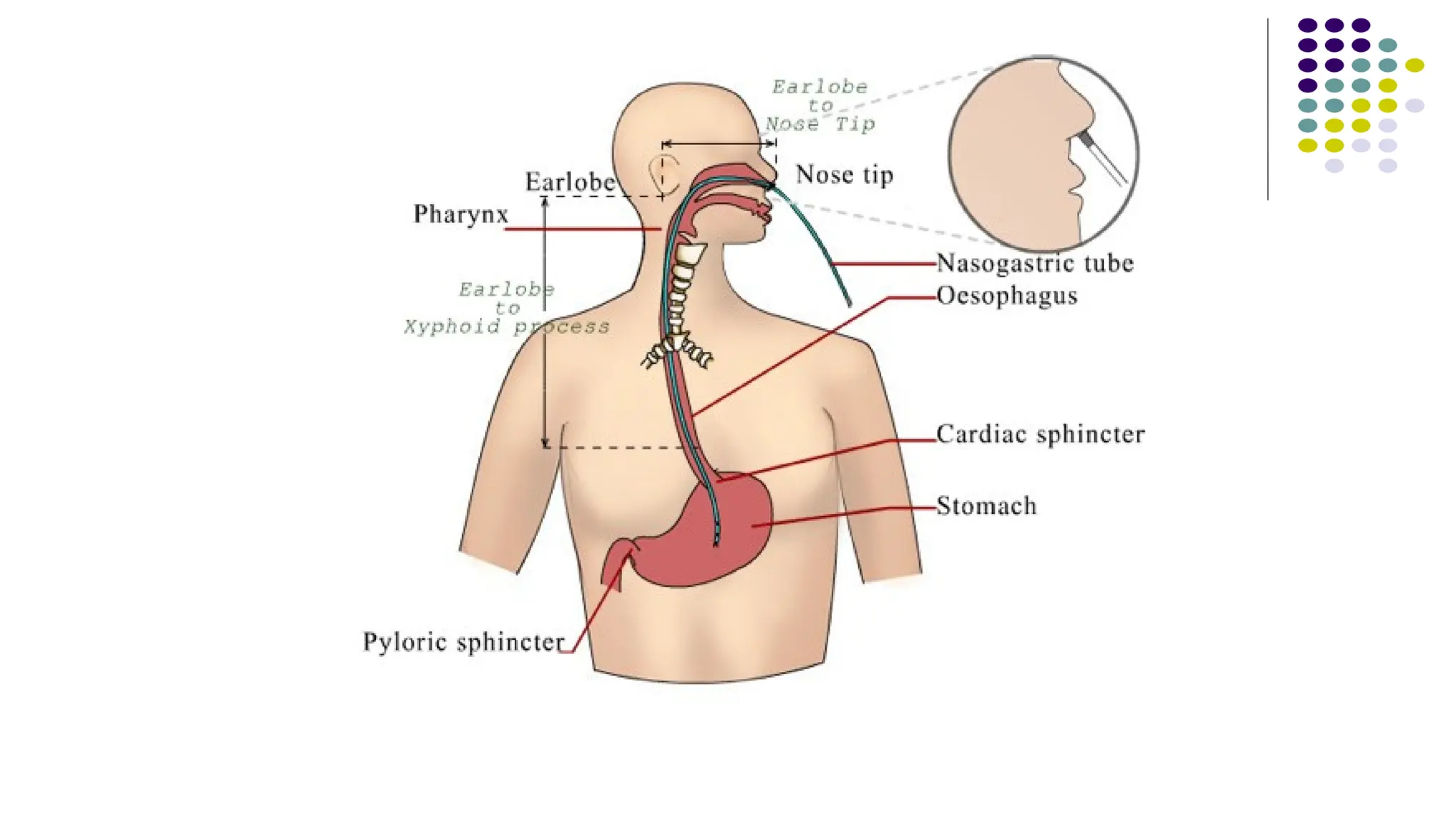
 1.Nasogastric tube or percutaneous endoscopic gastrostomy
 2.Per oral
 3.Intravenous infusion or blood product.
 • Intake is measured and noted in milliliters
Output
Average urine output = 1500 cc’s
Water is also lost from:
Skin: 200-500 ccs / day
Lungs: 400 cc’s
Gastrointestinal tract: 100 cc’s
Intake and Output
Chart any fluid taken in and any fluid that is
eliminated. Record in cubic centimeters (cc).
To convert ounces to cc’s:
1 oz. = 30 cc’s
30X (number of ounces) = number of cc’s
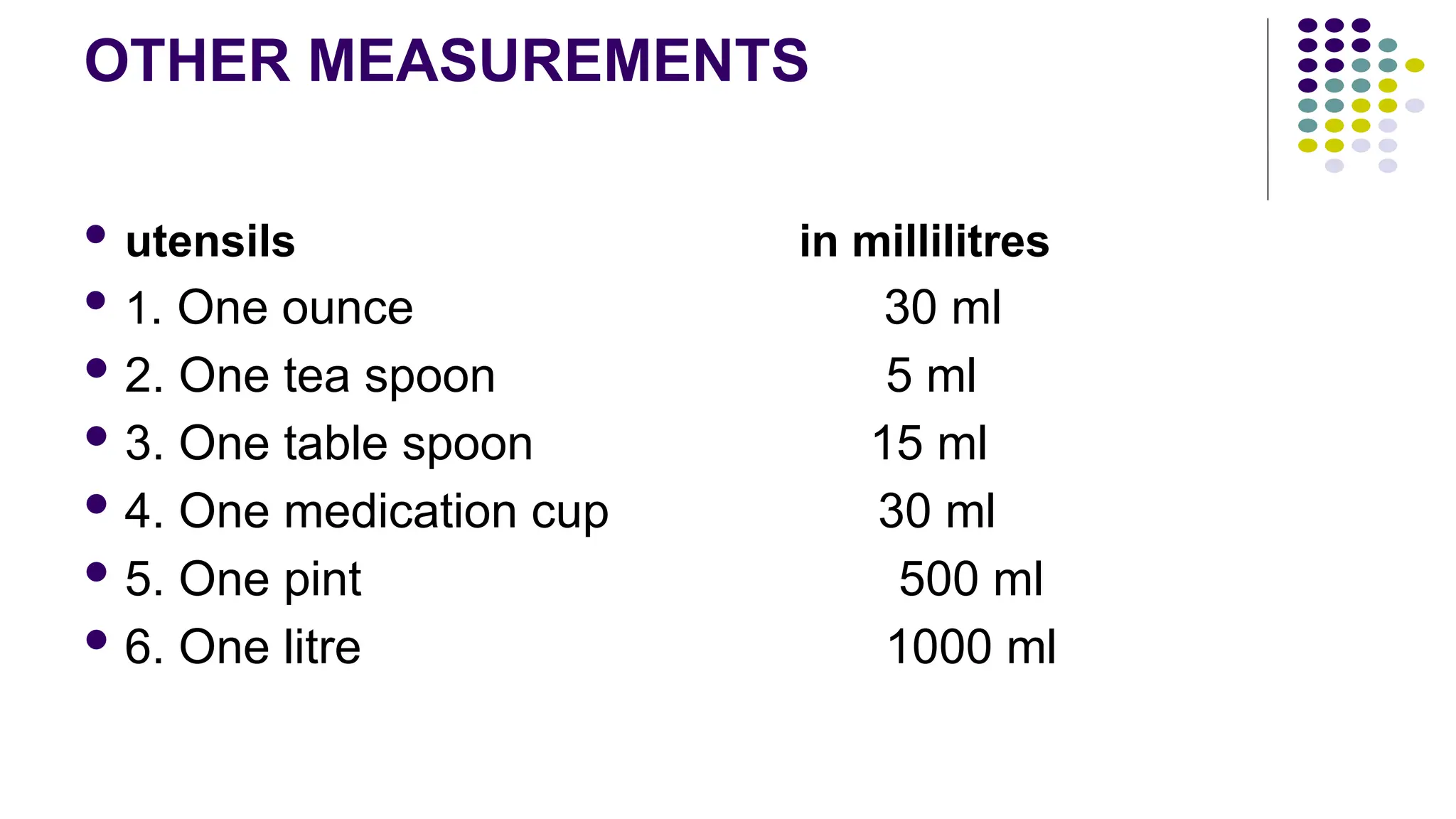
OTHER MEASUREMENTS
 utensils in millilitres
 1. One ounce 30 ml
 2. One tea spoon 5 ml
 3. One table spoon 15 ml
 4. One medication cup 30 ml
 5. One pint 500 ml
 6. One litre 1000 ml
Intake
All liquid taken by mouth: water, coffee, tea,
milk, juices, and other beverages.
Any food item that turns to liquid at room
temperature (ex: gelatin, ice cream, ice, etc.)
All fluid taken by IV or tube
feeding.
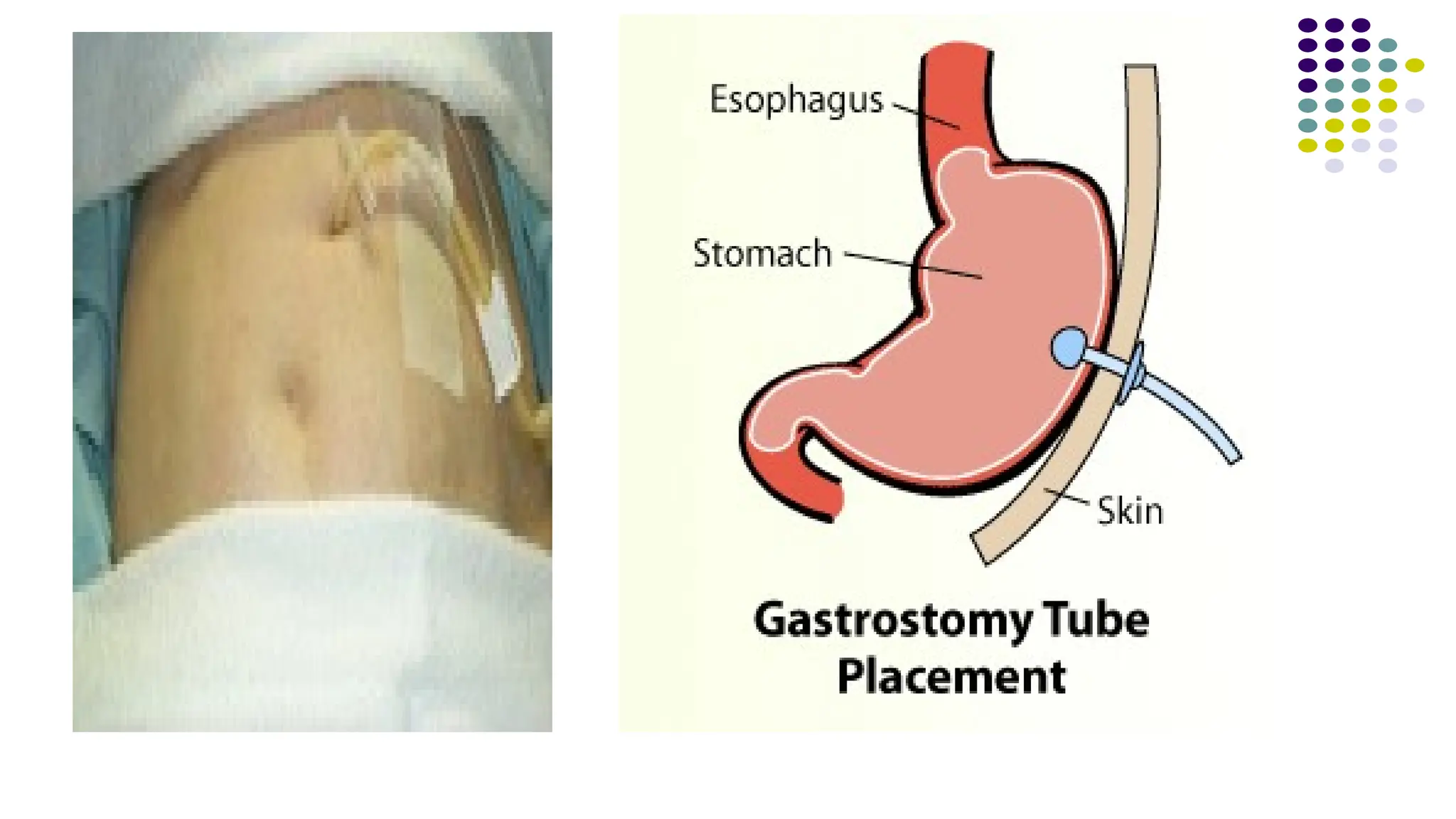
Tube feedings, or enteral
feedings, are recorded as oral
intake or in a special column.
They are used for patients who
are unable to swallow; examples:
nasogastric tube, gastrostomy
tube
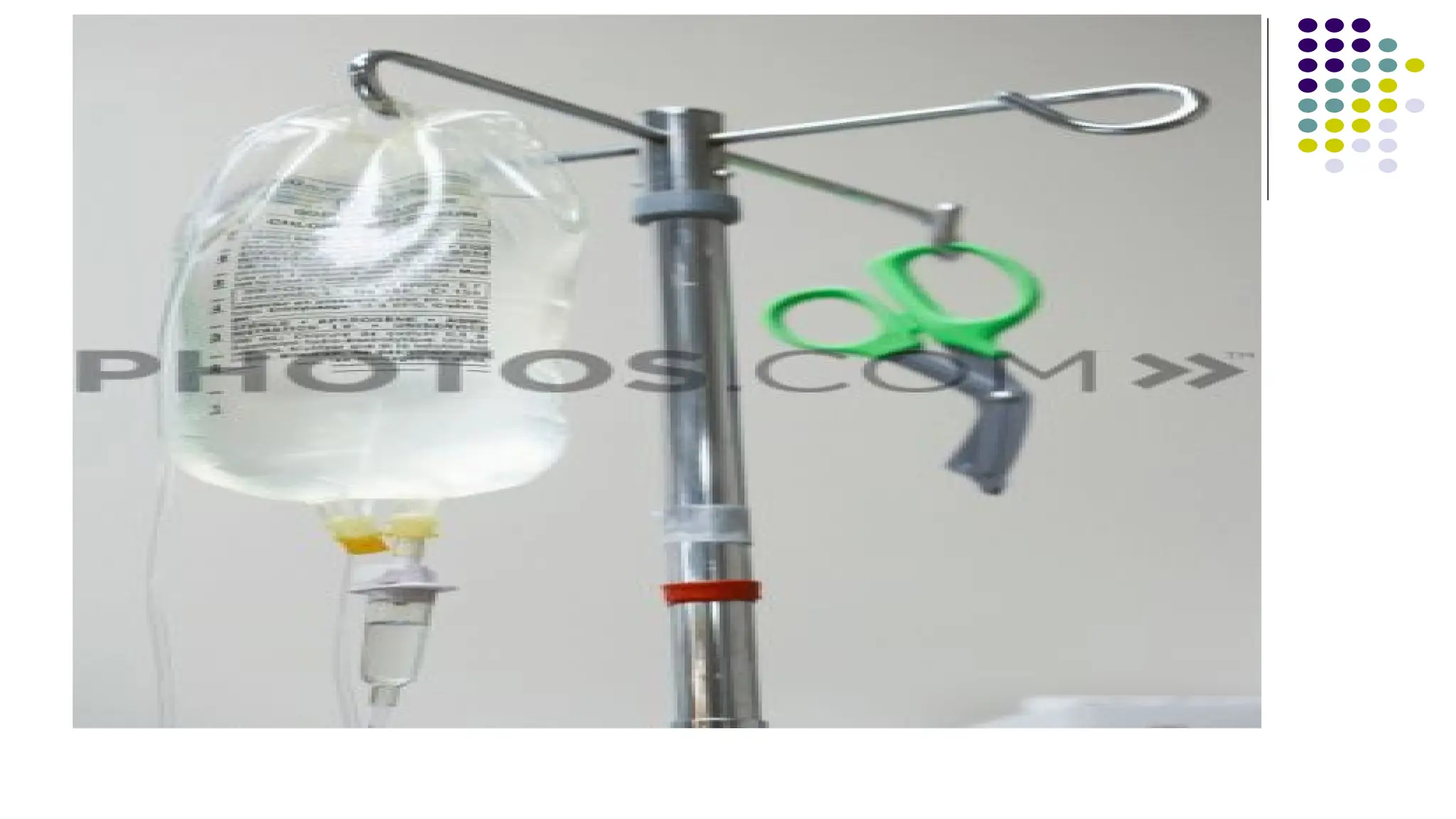
Intravenous (IV) refers to fluids given
into a vein.
Blood units, plasma and other
intravenous solutions are measured.
This measurement is the
responsibility of the nurse or other
authorized team member.
Output
Urine
Emesis (vomit)
Suctioned secretion
Drainage
Excessive perspiration
Bowel movement
Bowel movement (BM) – Liquid
bowel movements are usually
measured and recorded.
A solid or formed BM is usually noted
in the remarks column.
Emesis – anything that is vomited is
measured and recorded.
Color, type, and other facts are noted
in the remarks column.
Urine – All urine voided or drained
via a catheter is measured and
recorded.
Irrigation – Any irrigation or suction
drainage, including drainage from NG
tubes, hemo-vacs, chest tubes, and
other drainage tubes, is measured.
The type, amount, color and other
facts are noted in the remarks column
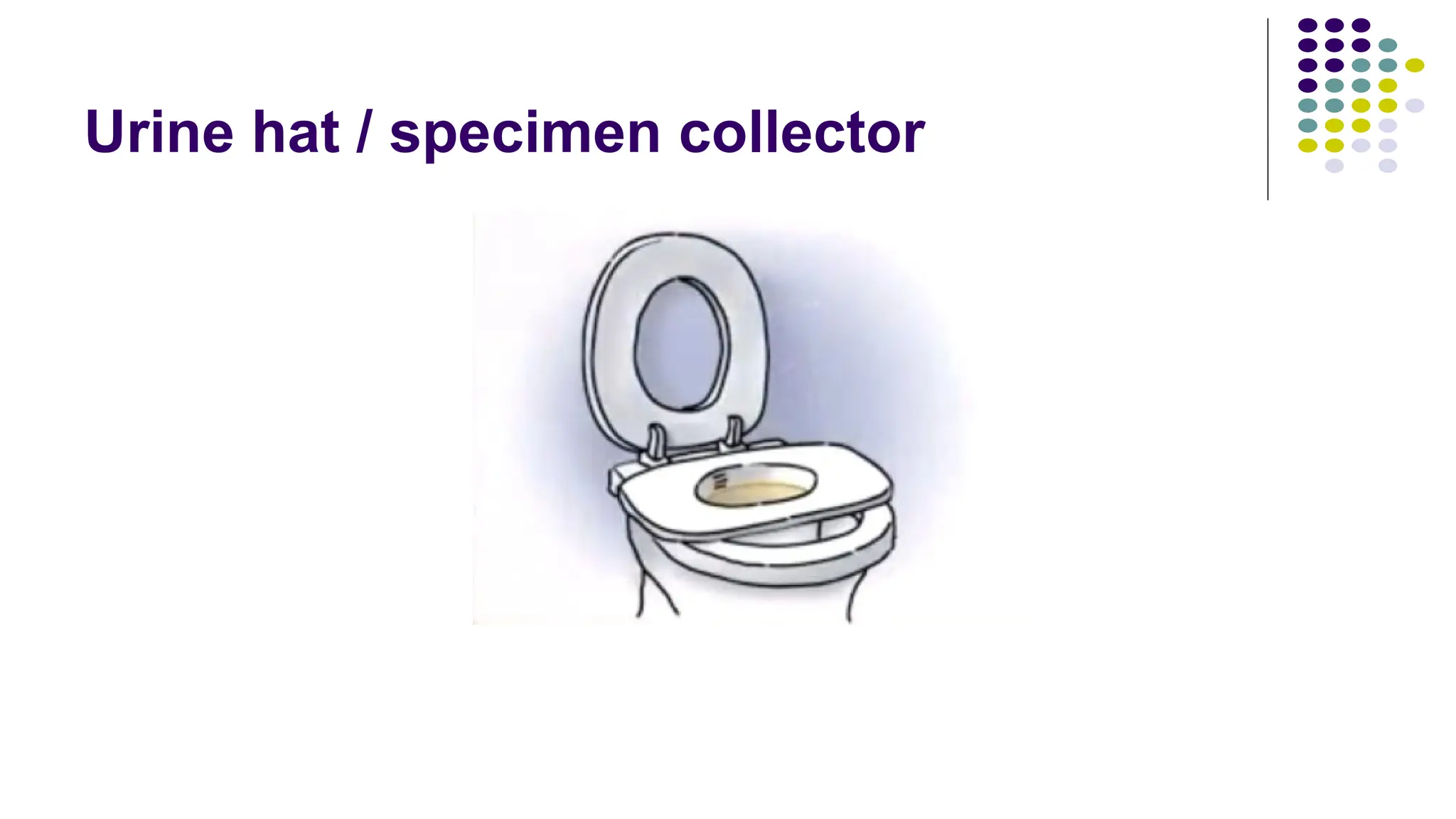
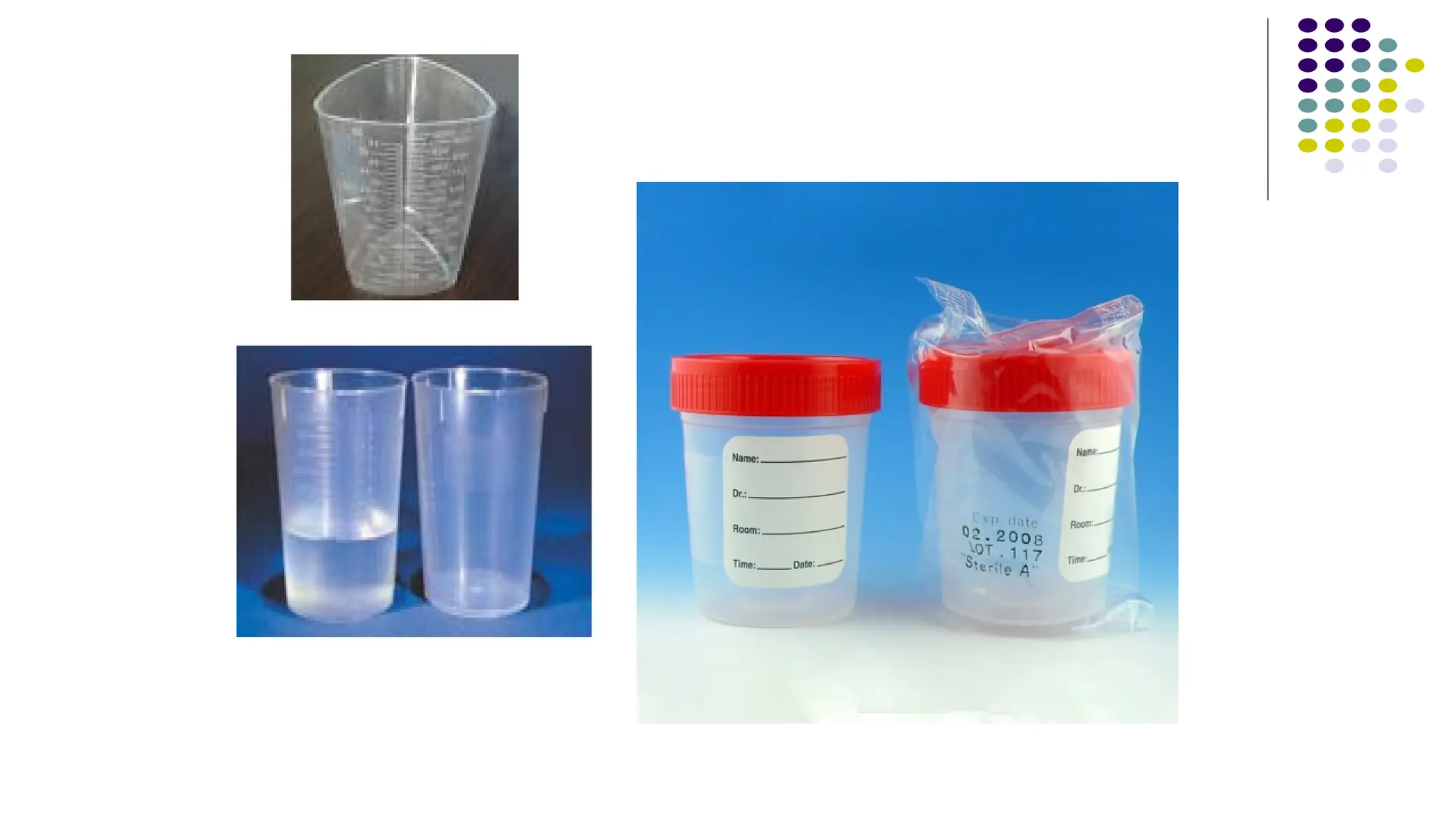
Urine hat / specimen collector
If an irrigating solution is injected into
a tube and more solution returns, the
excess is considered output.
All amounts must be measured in
graduates.
A graduate is a container that is
made of plastic and has calibrations
for milliliters / cc’s or ounces on the
side. (1 ml = 1 cc)
In addition, the graduate must be held
at eye level to accurately record
amounts.
Care must be taken when adding or
totaling the columns on the I&O
record.
Most records contain totals for 8-hour
and 24-hour periods.
Measuring I&O
Patients should be given careful instructions when
an I&O record is being kept.
The patient must inform health care providers when
he or she drinks fluids not provided by the health
care team.
Standard precautions must be
followed at all times when body fluids
are measured for I&O records.
Gloves must be worn while the fluids
are being measured and discarded.
If splashing or spraying of fluids is
possible, a mask, eye protection, and
gown must be worn.
Some Important Info
 Clinical Do's and Dont's
 DO- Identify whether your patient has undergone
surgery or if he has a medical condition or takes
medication that can affect fluid intake or loss.
 Measure and record all intake and output. If you
delegate this task, make sure you know the totals and
the fluid sources.
 At least every 8 hours, record the type and amount of
all fluids he's received and describe the route as oral,
parenteral, rectal, or by enteric tube.
Some Important Info
 Record ice chips as fluid at approximately half
their volume.
 Record the type and amount of all fluids the
patient has lost and the route.
 Describe them as urine, liquid stool, vomitus,
tube drainage and any fluid aspirated from a
body cavity.
 If irrigating a nasogastric or another tube or the
bladder, measure the amount instilled and
subtract it from total output.
Some Important Info
 DO- For an accurate measurement, keep toilet
paper out of your patient's urine.
 Measure drainage in a calibrated container.
 Observe it at eye level.
 Evaluate patterns and values outside the normal
range, keeping in mind the typical 24 – hour
intake and output.
Some Important Info
 DO- When looking at 8 – hour urine output, ask how many
times the patient voided, to identify problems.
 Regard intake and output holistically because age, diagnosis,
medical problem, and type of surgical procedure can affect
the amounts.
 Evaluate trends over 24 to 48 hours.
Some Important Info
 Don't delegate the task of recording intake and output until
you're sure the person who's going to do it understands its
importance. Don't assess output by amount only. Consider
color, color changes, and odor too. Don't use the same
graduated container for more than one patient.
POSITIVE AND NEGATIVE BALANCE CONCEPT:
 If input is greater than output so, its called positive balance. E.G :
Total intake is 2000 ml and Total output is 1600 ml
2000 – 1600 = 400
 400 is positive balance.
 If output is greater than input so, its called negative balance. E.G :
Total intake is 1500 ml and Total output is 2000 ml
 1500 – 2000 = - 500
 - 500 is negative balance.
 •The difference of 500ml or less than 500ml between input and
output is normal but if it is more than 500 ml so, need to be inform
to concern doctor.
Intake and Output
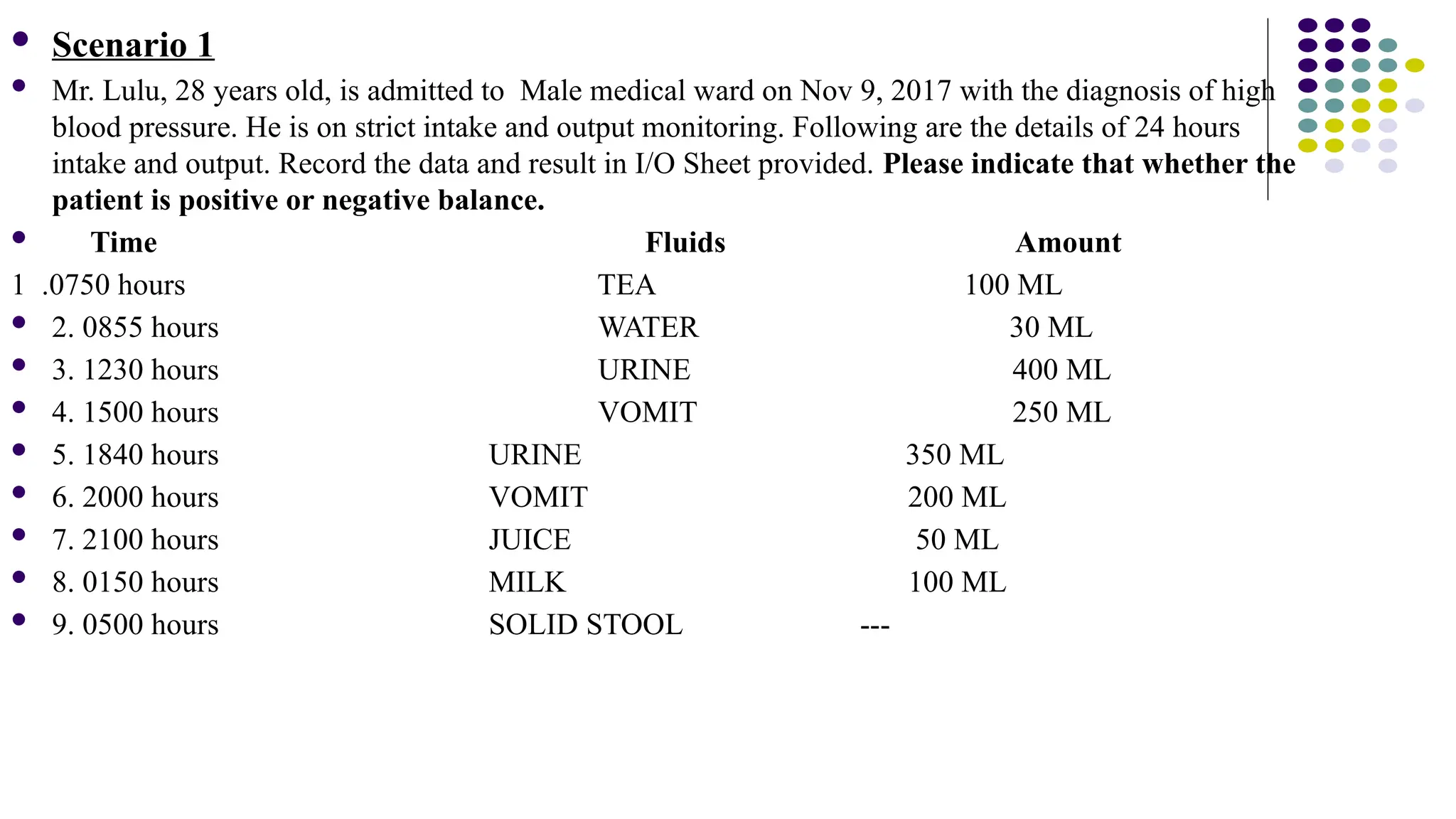
 Scenario 1
 Mr. Lulu, 28 years old, is admitted to Male medical ward on Nov 9, 2017 with the diagnosis of high
blood pressure. He is on strict intake and output monitoring. Following are the details of 24 hours
intake and output. Record the data and result in I/O Sheet provided. Please indicate that whether the
patient is positive or negative balance.
 Time Fluids Amount
1 .0750 hours TEA 100 ML
 2. 0855 hours WATER 30 ML
 3. 1230 hours URINE 400 ML
 4. 1500 hours VOMIT 250 ML
 5. 1840 hours URINE 350 ML
 6. 2000 hours VOMIT 200 ML
 7. 2100 hours JUICE 50 ML
 8. 0150 hours MILK 100 ML
 9. 0500 hours SOLID STOOL ---
TAKE HOME EXERCISE
Intake and output charting in nursing care

Intake and output charting in nursing care

  • 1.
    Intake and outputcharting Presented by E. Chauluka
  • 2.
    Fluid Balance Fluid intakeshould equal fluid output. Intake = what you take in Output = what you excrete
  • 3.
    Intake and Output INTAKE:  •In hospital, the amount of fluid ingested or infused in a given period by a patient or health care professionals is recorded. Its include:  1.Nasogastric tube or percutaneous endoscopic gastrostomy  2.Per oral  3.Intravenous infusion or blood product.  • Intake is measured and noted in milliliters
  • 4.
    Output Average urine output= 1500 cc’s Water is also lost from: Skin: 200-500 ccs / day Lungs: 400 cc’s Gastrointestinal tract: 100 cc’s
  • 5.
    Intake and Output Chartany fluid taken in and any fluid that is eliminated. Record in cubic centimeters (cc). To convert ounces to cc’s: 1 oz. = 30 cc’s 30X (number of ounces) = number of cc’s
  • 6.
    OTHER MEASUREMENTS  utensilsin millilitres  1. One ounce 30 ml  2. One tea spoon 5 ml  3. One table spoon 15 ml  4. One medication cup 30 ml  5. One pint 500 ml  6. One litre 1000 ml
  • 7.
    Intake All liquid takenby mouth: water, coffee, tea, milk, juices, and other beverages. Any food item that turns to liquid at room temperature (ex: gelatin, ice cream, ice, etc.)
  • 8.
    All fluid takenby IV or tube feeding. Tube feedings, or enteral feedings, are recorded as oral intake or in a special column. They are used for patients who are unable to swallow; examples: nasogastric tube, gastrostomy tube
  • 11.
    Intravenous (IV) refersto fluids given into a vein. Blood units, plasma and other intravenous solutions are measured. This measurement is the responsibility of the nurse or other authorized team member.
  • 13.
  • 14.
    Bowel movement (BM)– Liquid bowel movements are usually measured and recorded. A solid or formed BM is usually noted in the remarks column. Emesis – anything that is vomited is measured and recorded. Color, type, and other facts are noted in the remarks column.
  • 15.
    Urine – Allurine voided or drained via a catheter is measured and recorded. Irrigation – Any irrigation or suction drainage, including drainage from NG tubes, hemo-vacs, chest tubes, and other drainage tubes, is measured. The type, amount, color and other facts are noted in the remarks column
  • 16.
    Urine hat /specimen collector
  • 17.
    If an irrigatingsolution is injected into a tube and more solution returns, the excess is considered output. All amounts must be measured in graduates. A graduate is a container that is made of plastic and has calibrations for milliliters / cc’s or ounces on the side. (1 ml = 1 cc)
  • 19.
    In addition, thegraduate must be held at eye level to accurately record amounts. Care must be taken when adding or totaling the columns on the I&O record. Most records contain totals for 8-hour and 24-hour periods.
  • 20.
    Measuring I&O Patients shouldbe given careful instructions when an I&O record is being kept. The patient must inform health care providers when he or she drinks fluids not provided by the health care team.
  • 21.
    Standard precautions mustbe followed at all times when body fluids are measured for I&O records. Gloves must be worn while the fluids are being measured and discarded. If splashing or spraying of fluids is possible, a mask, eye protection, and gown must be worn.
  • 22.
    Some Important Info Clinical Do's and Dont's  DO- Identify whether your patient has undergone surgery or if he has a medical condition or takes medication that can affect fluid intake or loss.  Measure and record all intake and output. If you delegate this task, make sure you know the totals and the fluid sources.  At least every 8 hours, record the type and amount of all fluids he's received and describe the route as oral, parenteral, rectal, or by enteric tube.
  • 23.
    Some Important Info Record ice chips as fluid at approximately half their volume.  Record the type and amount of all fluids the patient has lost and the route.  Describe them as urine, liquid stool, vomitus, tube drainage and any fluid aspirated from a body cavity.  If irrigating a nasogastric or another tube or the bladder, measure the amount instilled and subtract it from total output.
  • 24.
    Some Important Info DO- For an accurate measurement, keep toilet paper out of your patient's urine.  Measure drainage in a calibrated container.  Observe it at eye level.  Evaluate patterns and values outside the normal range, keeping in mind the typical 24 – hour intake and output.
  • 25.
    Some Important Info DO- When looking at 8 – hour urine output, ask how many times the patient voided, to identify problems.  Regard intake and output holistically because age, diagnosis, medical problem, and type of surgical procedure can affect the amounts.  Evaluate trends over 24 to 48 hours.
  • 26.
    Some Important Info Don't delegate the task of recording intake and output until you're sure the person who's going to do it understands its importance. Don't assess output by amount only. Consider color, color changes, and odor too. Don't use the same graduated container for more than one patient.
  • 27.
    POSITIVE AND NEGATIVEBALANCE CONCEPT:  If input is greater than output so, its called positive balance. E.G : Total intake is 2000 ml and Total output is 1600 ml 2000 – 1600 = 400  400 is positive balance.  If output is greater than input so, its called negative balance. E.G : Total intake is 1500 ml and Total output is 2000 ml  1500 – 2000 = - 500  - 500 is negative balance.  •The difference of 500ml or less than 500ml between input and output is normal but if it is more than 500 ml so, need to be inform to concern doctor.
  • 28.
  • 29.
     Scenario 1 Mr. Lulu, 28 years old, is admitted to Male medical ward on Nov 9, 2017 with the diagnosis of high blood pressure. He is on strict intake and output monitoring. Following are the details of 24 hours intake and output. Record the data and result in I/O Sheet provided. Please indicate that whether the patient is positive or negative balance.  Time Fluids Amount 1 .0750 hours TEA 100 ML  2. 0855 hours WATER 30 ML  3. 1230 hours URINE 400 ML  4. 1500 hours VOMIT 250 ML  5. 1840 hours URINE 350 ML  6. 2000 hours VOMIT 200 ML  7. 2100 hours JUICE 50 ML  8. 0150 hours MILK 100 ML  9. 0500 hours SOLID STOOL ---
  • 30.