Medical AuditPresented by:-
Dr Shubhankar Biswas
Dr. Mirajul Islam
Dr. Debanjan Sahu
Mrs. Anita Ghosh
Definition
Medical Audit is a planned programme
 which objectively monitors and evaluates the clinical
performance of all practitioners
 which identifies opportunities for improvement
 provides mechanism through which action is taken to
make and sustain those improvements.
Medical Audit vs. Clinical
Audit
• Medical audit is defined as the review of the clinical care
of patients provided by the medical staff only.
• Clinical audit is the review of the activity of all aspects of
the clinical care of patients by medical and paramedical
staff.
• By 1994, the term ‘clinical audit’ appeared to have largely
replaced the earlier term ‘medical audit
History of
Medical Audit
History
• 1750 BC: the 6th king of Babylon, Hammurabi instigated
audits for the clinicians.
• Modern medicine (1853–1855): Florence Nightingale
conducted first clinical audit during the Crimean War. She
applied strict sanitary routine & hygiene standards that
decreased the mortality rates from 40% to 2%.
• 1869–1940: Ernest Codman became known as the first
true medical auditor following his work in 1912 on
monitoring surgical outcomes. Codman's "end result idea"
was to follow every patient's case history after surgery to
identify errors made by individual surgeons on specific
patients
History
• A growing requirement for more formal audit in the middle
1980s was accelerated by publication of the Confidential
Enquiry into Perioperative Deaths (CEPOD) in 1987 and
the Government White Paper, entitled ‘Working for
Patients’ in 1989.
• 1961: Report of Mudaliar committee stressed on
encouragement of medical audit in India.
• 1969: Then Health Minister of India Dr Sushila Nayyar
introduced medical audit in India.
• But it became operational only in 2007, after the
establishment of National Accreditation Board for Hospitals
and Healthcare Providers (NABH) in 2005.
Need & Purpose of
Medical Audit
Need of Medical Audit
1. To plan future course of action
• it is necessary to obtain baseline information
through evaluation of achievements for comparison
purpose with a view to improve the services.
2. Regulatory in nature
• ensures full & effective utilisation of staff and
facilities available.
3. Assess the effectiveness of efficiency of health
programmes & services put into practice
Purpose of Medical Audit
1. Professional motives- Health care providers can identify
their lacunae & deficiencies and make necessary
corrections.
2. Social motives- To ensure safety of public and protect
them from care that is inappropriate, suboptimal &
harmful.
3. Pragmative motives- To reduce patient sufferings and
avoid the possibility of denial to the patients of available
services; or injury by excessive or inappropriate service
Prerequisites of
Medical Audit
Prerequisites
1. Hospital Operational Statistics.
a. Hospital Resources: Bed compliment, diagnostic &
treatment facilities, Staff available
b. Hospital Utilization Rates: Days of care, operations,
deliveries, deaths, OPD investigations, Laboratory
investigations etc.
c. Admission Data: Information on patients, i.e. hospital
morbidity statistics, avg length of stay [ALS],post
operative morbidity, operation outcome etc.
Prerequisites
2. Standardized hospital statistics collection and
tabulation.
3. Medical Record should be accurate and
complete.
4. Medical record librarian.
5. Medical audit committee .
6. Hospital Planning and Research cell at State
level
Audit committee
• Medical audit committee should consist of hospital
consultants, who are committed to Medical audit.
• The committee should meet once in a month and submit
the report to medical superintendent (MS) as confidential.
• It should be constituted of
• Senior clinical consultant Chairman
• Medical record officer Member Secretary
• Consultants from concerned Members
clinical departments
• Representative of MS Member
• Representative of NS Member
Principles of
Medical Audit
Principles
1. Health authorities and medical staff should define
explicitly their respective responsibilities for the quality of
patient care.
2. Medical staff should organise themselves in order to
fulfil responsibilities for audit and for taking action to
improve clinical performance.
3. Each hospital and specialty should agree a regular
programme of audit in which doctors in all grades
participate.
Principles
4. The process of audit should be relevant, objective,
quantified, repeatable, and able to effect appropriate
change in organisation of the service and clinical
practice.
5. Clinicians should be provided with the resources for
medical audit.
6. The process and outcome of medical audit should be
documented.
7. Medical audit should be subject to evaluation
Types of
Medical Audit
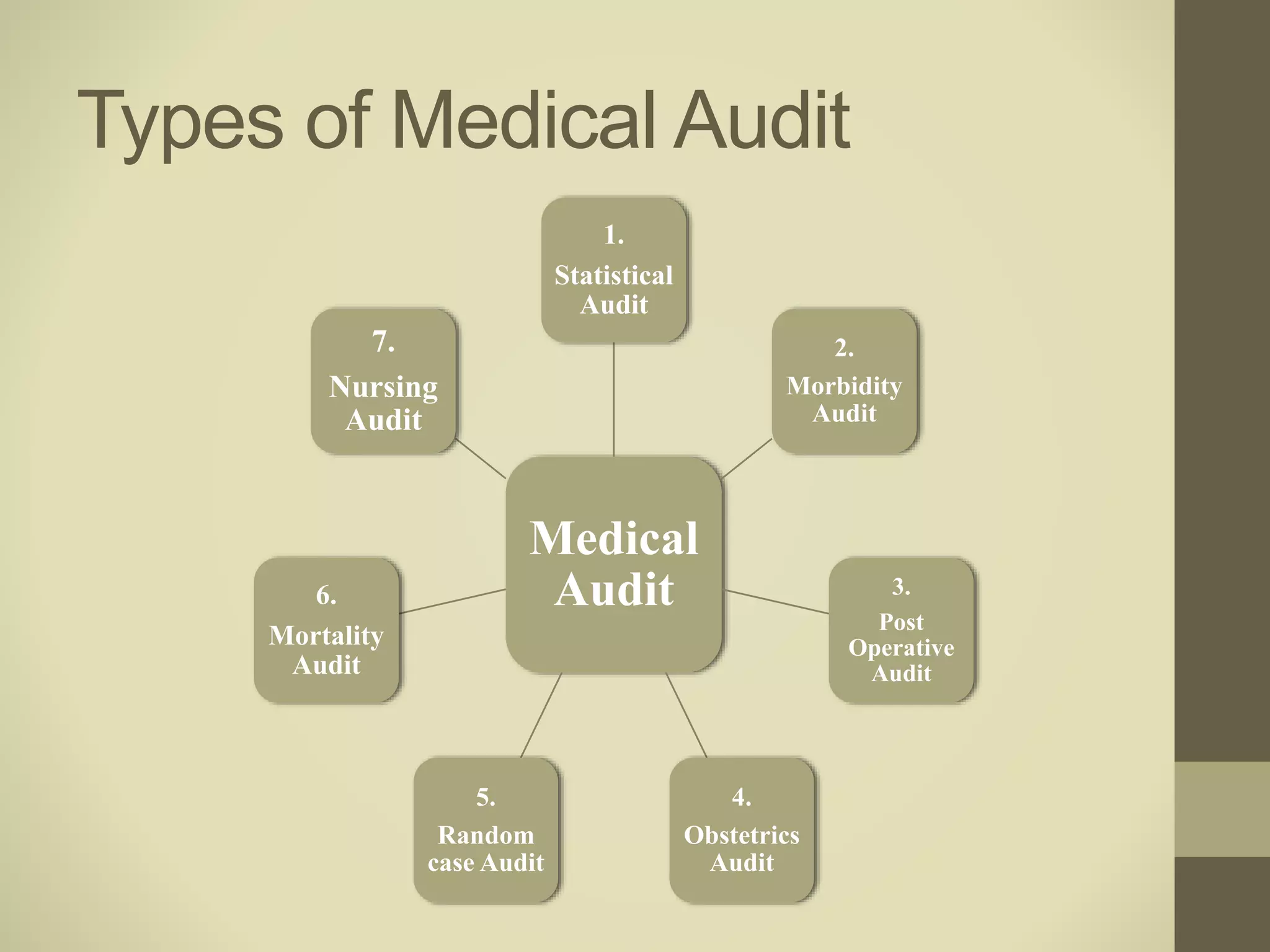
Types of Medical Audit
Medical
Audit
1.
Statistical
Audit
2.
Morbidity
Audit
3.
Post
Operative
Audit
4.
Obstetrics
Audit
5.
Random
case Audit
6.
Mortality
Audit
7.
Nursing
Audit
Types of Medical Audit
Statistical Audit
i. Data on different indicators set by audit committee are
prepared unit wise on monthly basis
ii. A standard norm is evolved taking into consideration of
available facilities, services, resources by an expert
committee
iii. The data so obtained is critically examined & compared
against the standard norm
iv. Deviation from standard norm dictates investigation to find
out possible causes & remedial actions
v. The data are generated, compiled & presented by the MRD
Types of Medical Audit
MORBIDITY AUDIT
• A simple method of doing medical audit of a
group of cases suffering from a disease category.
• Findings are matched with predetermined norms
and standards of care laid down by medical staff
for this disease category.
• It is done ward/unit wise.
Types of Medical Audit
POST OPERATIVE AUDIT
i. Patients are grouped based on similar surgical
procedures done on them.
ii. A group of experts study:-
Diagnosis confirmed by surgery, pre
anaesthetic check up, post op complications,
anaesthetic complications, safety checks,
antibiotics used etc.
iii. the shortcomings are noted and intimidated for
future precaution & rectification.
Types of Medical Audit
OBSTETRIC AUDIT
The indicators are similar to surgical cases but also
includes
⁻ No of CS done with indications
⁻ No of forceps or vacuum application &
indications
⁻ No of maternal complications
⁻ No of maternal & neonatal deaths
Types of Medical Audit
RANDOM CASE AUDIT
Done to determine the quality of record maintenance, diagnostic
deficiency, treatment and outcome while the patient is still in
hospital
The parameters include
History, physical examinations diagnostic skills
Investigations done, treatment given
Initial diagnosis & final diagnosis.
Treatment along the standard norm or not
Any deviations from standard norms are noted and intimidated
for improvement.
Types of Medical Audit
AUDIT OF DEATH CASES IN THE HOSPITAL
(MORTALITY REVIEW)
• All the deaths which takes place after 48 hrs. of admission
to the hospital are normally subjected to a review by a
committee
• also useful to review the deaths within 48 hrs (especially
death in emergency department)
• Case sheets are examined for quantitative as well as
qualitative adequacies
Types of Medical Audit
NURSING AUDIT
• Review of the nursing care based on standard criteria
• Seeks to identify areas of service improvement, develop
& carry out actions to rectify or improve the service.
• Special care, Input Output charts, O2 inhalation, daily
nursing note etc. are studied.
• The can be retrospective or introspective.
Stages of
Medical Audit
Stages
Stages
STAGE1. PREPARING FOR AUDIT
1. Involving users
2. Selecting a topic
3. Defining the purpose
4. Planning
Stages
STAGE 2. SELECTION OF CRITERIA
Defining criteria
• Statistical (empirical) criteria
• Normative (consensus) criteria
• Optimal care (general consensus)
• Essential (critical)
• Scientific (validated) criteria
2. Sources of evidence
3. Appraising the evidence
Stages
STAGE 3. MEASURING LEVEL OF
PERFORMANCE
1. Data collection
2. Data analysis
3. Comparing with standards set
4. Dissemination of feedback findings
Stages
STAGE 4. MAKING IMPROVEMENTS
1. Identifying barriers to change
2. Implementing change
Stages
STAGE 5. SUSTAINING
IMPROVEMENTS
1. Monitoring and evaluation
2. Re-audit
3. Maintaining and reinforcing improvement
Limitations of
Medical Audit
Limitations
1. The major loopholes are on the part of commitment,
participation and seriousness for the audits. Audits in
Indian scenario are still more or less considered as an
obligation and are done only to fulfil the requirement of
various accreditation or other external agencies rather
than for the improvement of hospital processes and
quality in actual.
2. Low number of auditors is also a concern for hospital
audit in this country.
Limitations
3. The techniques for doing this are imperfect and
are not standardized, despite the seemingly clear
cut methods described in official publications.
4. Being retrospective and dependent entirely on
information contained in the record, auditing can
only assess limited aspects of the technical quality
of care.
Medical Audit in
Hospital
Medical Audit in Hospital
Medical audit is far more important to a
hospital than financial audit. Financial
deficits can be met eventually but medical
deficiencies can cost lives, or loss of health
thereby resulting in unwanted agony.
Medical audit

Medical audit

  • 1.
    Medical AuditPresented by:- DrShubhankar Biswas Dr. Mirajul Islam Dr. Debanjan Sahu Mrs. Anita Ghosh
  • 2.
    Definition Medical Audit isa planned programme  which objectively monitors and evaluates the clinical performance of all practitioners  which identifies opportunities for improvement  provides mechanism through which action is taken to make and sustain those improvements.
  • 3.
    Medical Audit vs.Clinical Audit • Medical audit is defined as the review of the clinical care of patients provided by the medical staff only. • Clinical audit is the review of the activity of all aspects of the clinical care of patients by medical and paramedical staff. • By 1994, the term ‘clinical audit’ appeared to have largely replaced the earlier term ‘medical audit
  • 4.
  • 5.
    History • 1750 BC:the 6th king of Babylon, Hammurabi instigated audits for the clinicians. • Modern medicine (1853–1855): Florence Nightingale conducted first clinical audit during the Crimean War. She applied strict sanitary routine & hygiene standards that decreased the mortality rates from 40% to 2%. • 1869–1940: Ernest Codman became known as the first true medical auditor following his work in 1912 on monitoring surgical outcomes. Codman's "end result idea" was to follow every patient's case history after surgery to identify errors made by individual surgeons on specific patients
  • 6.
    History • A growingrequirement for more formal audit in the middle 1980s was accelerated by publication of the Confidential Enquiry into Perioperative Deaths (CEPOD) in 1987 and the Government White Paper, entitled ‘Working for Patients’ in 1989. • 1961: Report of Mudaliar committee stressed on encouragement of medical audit in India. • 1969: Then Health Minister of India Dr Sushila Nayyar introduced medical audit in India. • But it became operational only in 2007, after the establishment of National Accreditation Board for Hospitals and Healthcare Providers (NABH) in 2005.
  • 7.
    Need & Purposeof Medical Audit
  • 8.
    Need of MedicalAudit 1. To plan future course of action • it is necessary to obtain baseline information through evaluation of achievements for comparison purpose with a view to improve the services. 2. Regulatory in nature • ensures full & effective utilisation of staff and facilities available. 3. Assess the effectiveness of efficiency of health programmes & services put into practice
  • 9.
    Purpose of MedicalAudit 1. Professional motives- Health care providers can identify their lacunae & deficiencies and make necessary corrections. 2. Social motives- To ensure safety of public and protect them from care that is inappropriate, suboptimal & harmful. 3. Pragmative motives- To reduce patient sufferings and avoid the possibility of denial to the patients of available services; or injury by excessive or inappropriate service
  • 10.
  • 11.
    Prerequisites 1. Hospital OperationalStatistics. a. Hospital Resources: Bed compliment, diagnostic & treatment facilities, Staff available b. Hospital Utilization Rates: Days of care, operations, deliveries, deaths, OPD investigations, Laboratory investigations etc. c. Admission Data: Information on patients, i.e. hospital morbidity statistics, avg length of stay [ALS],post operative morbidity, operation outcome etc.
  • 12.
    Prerequisites 2. Standardized hospitalstatistics collection and tabulation. 3. Medical Record should be accurate and complete. 4. Medical record librarian. 5. Medical audit committee . 6. Hospital Planning and Research cell at State level
  • 13.
    Audit committee • Medicalaudit committee should consist of hospital consultants, who are committed to Medical audit. • The committee should meet once in a month and submit the report to medical superintendent (MS) as confidential. • It should be constituted of • Senior clinical consultant Chairman • Medical record officer Member Secretary • Consultants from concerned Members clinical departments • Representative of MS Member • Representative of NS Member
  • 14.
  • 15.
    Principles 1. Health authoritiesand medical staff should define explicitly their respective responsibilities for the quality of patient care. 2. Medical staff should organise themselves in order to fulfil responsibilities for audit and for taking action to improve clinical performance. 3. Each hospital and specialty should agree a regular programme of audit in which doctors in all grades participate.
  • 16.
    Principles 4. The processof audit should be relevant, objective, quantified, repeatable, and able to effect appropriate change in organisation of the service and clinical practice. 5. Clinicians should be provided with the resources for medical audit. 6. The process and outcome of medical audit should be documented. 7. Medical audit should be subject to evaluation
  • 17.
  • 18.
    Types of MedicalAudit Medical Audit 1. Statistical Audit 2. Morbidity Audit 3. Post Operative Audit 4. Obstetrics Audit 5. Random case Audit 6. Mortality Audit 7. Nursing Audit
  • 19.
    Types of MedicalAudit Statistical Audit i. Data on different indicators set by audit committee are prepared unit wise on monthly basis ii. A standard norm is evolved taking into consideration of available facilities, services, resources by an expert committee iii. The data so obtained is critically examined & compared against the standard norm iv. Deviation from standard norm dictates investigation to find out possible causes & remedial actions v. The data are generated, compiled & presented by the MRD
  • 20.
    Types of MedicalAudit MORBIDITY AUDIT • A simple method of doing medical audit of a group of cases suffering from a disease category. • Findings are matched with predetermined norms and standards of care laid down by medical staff for this disease category. • It is done ward/unit wise.
  • 21.
    Types of MedicalAudit POST OPERATIVE AUDIT i. Patients are grouped based on similar surgical procedures done on them. ii. A group of experts study:- Diagnosis confirmed by surgery, pre anaesthetic check up, post op complications, anaesthetic complications, safety checks, antibiotics used etc. iii. the shortcomings are noted and intimidated for future precaution & rectification.
  • 22.
    Types of MedicalAudit OBSTETRIC AUDIT The indicators are similar to surgical cases but also includes ⁻ No of CS done with indications ⁻ No of forceps or vacuum application & indications ⁻ No of maternal complications ⁻ No of maternal & neonatal deaths
  • 23.
    Types of MedicalAudit RANDOM CASE AUDIT Done to determine the quality of record maintenance, diagnostic deficiency, treatment and outcome while the patient is still in hospital The parameters include History, physical examinations diagnostic skills Investigations done, treatment given Initial diagnosis & final diagnosis. Treatment along the standard norm or not Any deviations from standard norms are noted and intimidated for improvement.
  • 24.
    Types of MedicalAudit AUDIT OF DEATH CASES IN THE HOSPITAL (MORTALITY REVIEW) • All the deaths which takes place after 48 hrs. of admission to the hospital are normally subjected to a review by a committee • also useful to review the deaths within 48 hrs (especially death in emergency department) • Case sheets are examined for quantitative as well as qualitative adequacies
  • 25.
    Types of MedicalAudit NURSING AUDIT • Review of the nursing care based on standard criteria • Seeks to identify areas of service improvement, develop & carry out actions to rectify or improve the service. • Special care, Input Output charts, O2 inhalation, daily nursing note etc. are studied. • The can be retrospective or introspective.
  • 26.
  • 27.
  • 28.
    Stages STAGE1. PREPARING FORAUDIT 1. Involving users 2. Selecting a topic 3. Defining the purpose 4. Planning
  • 29.
    Stages STAGE 2. SELECTIONOF CRITERIA Defining criteria • Statistical (empirical) criteria • Normative (consensus) criteria • Optimal care (general consensus) • Essential (critical) • Scientific (validated) criteria 2. Sources of evidence 3. Appraising the evidence
  • 30.
    Stages STAGE 3. MEASURINGLEVEL OF PERFORMANCE 1. Data collection 2. Data analysis 3. Comparing with standards set 4. Dissemination of feedback findings
  • 31.
    Stages STAGE 4. MAKINGIMPROVEMENTS 1. Identifying barriers to change 2. Implementing change
  • 32.
    Stages STAGE 5. SUSTAINING IMPROVEMENTS 1.Monitoring and evaluation 2. Re-audit 3. Maintaining and reinforcing improvement
  • 33.
  • 34.
    Limitations 1. The majorloopholes are on the part of commitment, participation and seriousness for the audits. Audits in Indian scenario are still more or less considered as an obligation and are done only to fulfil the requirement of various accreditation or other external agencies rather than for the improvement of hospital processes and quality in actual. 2. Low number of auditors is also a concern for hospital audit in this country.
  • 35.
    Limitations 3. The techniquesfor doing this are imperfect and are not standardized, despite the seemingly clear cut methods described in official publications. 4. Being retrospective and dependent entirely on information contained in the record, auditing can only assess limited aspects of the technical quality of care.
  • 36.
  • 37.
    Medical Audit inHospital Medical audit is far more important to a hospital than financial audit. Financial deficits can be met eventually but medical deficiencies can cost lives, or loss of health thereby resulting in unwanted agony.