HORSE
           RIDING
By Alina G-D
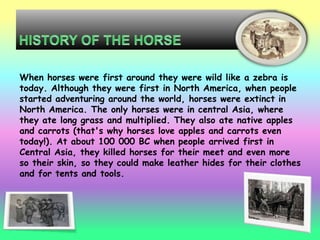
When horses were first around they were wild like a zebra is
today. Although they were first in North America, when people
started adventuring around the world, horses were extinct in
North America. The only horses were in central Asia, where
they ate long grass and multiplied. They also ate native apples
and carrots (that's why horses love apples and carrots even
today!). At about 100 000 BC when people arrived first in
Central Asia, they killed horses for their meet and even more
so their skin, so they could make leather hides for their clothes
and for tents and tools.
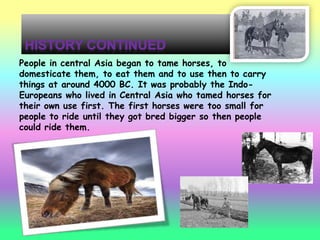
People in central Asia began to tame horses, to
domesticate them, to eat them and to use then to carry
things at around 4000 BC. It was probably the Indo-
Europeans who lived in Central Asia who tamed horses for
their own use first. The first horses were too small for
people to ride until they got bred bigger so then people
could ride them.
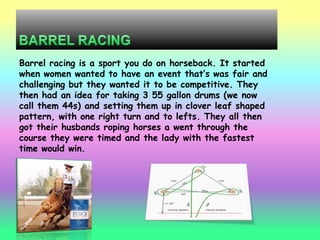
Barrel racing is a sport you do on horseback. It started
when women wanted to have an event that‟s was fair and
challenging but they wanted it to be competitive. They
then had an idea for taking 3 55 gallon drums (we now
call them 44s) and setting them up in clover leaf shaped
pattern, with one right turn and to lefts. They all then
got their husbands roping horses a went through the
course they were timed and the lady with the fastest
time would win.
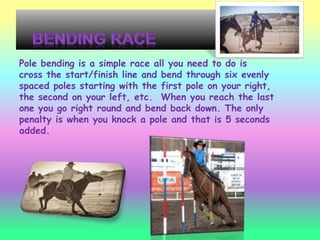
Pole bending is a simple race all you need to do is
cross the start/finish line and bend through six evenly
spaced poles starting with the first pole on your right,
the second on your left, etc. When you reach the last
one you go right round and bend back down. The only
penalty is when you knock a pole and that is 5 seconds
added.
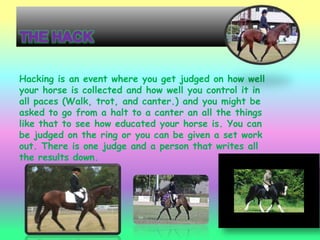
Hacking is an event where you get judged on how well
your horse is collected and how well you control it in
all paces (Walk, trot, and canter.) and you might be
asked to go from a halt to a canter an all the things
like that to see how educated your horse is. You can
be judged on the ring or you can be given a set work
out. There is one judge and a person that writes all
the results down.
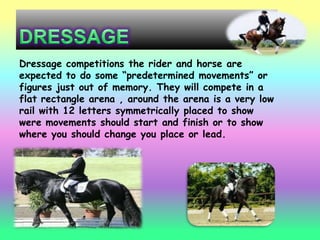
Dressage competitions the rider and horse are
expected to do some “predetermined movements” or
figures just out of memory. They will compete in a
flat rectangle arena , around the arena is a very low
rail with 12 letters symmetrically placed to show
were movements should start and finish or to show
where you should change you place or lead.
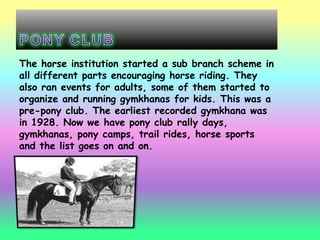
The horse institution started a sub branch scheme in
all different parts encouraging horse riding. They
also ran events for adults, some of them started to
organize and running gymkhanas for kids. This was a
pre-pony club. The earliest recorded gymkhana was
in 1928. Now we have pony club rally days,
gymkhanas, pony camps, trail rides, horse sports
and the list goes on and on.
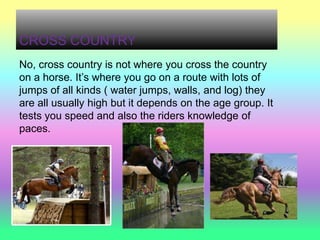
CROSS COUNTRY
No, cross country is not where you cross the country
on a horse. It’s where you go on a route with lots of
jumps of all kinds ( water jumps, walls, and log) they
are all usually high but it depends on the age group. It
tests you speed and also the riders knowledge of
paces.
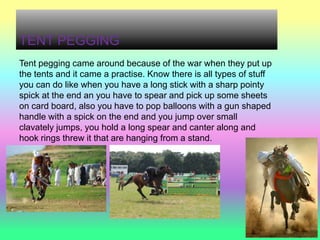
TENT PEGGING
Tent pegging came around because of the war when they put up
the tents and it came a practise. Know there is all types of stuff
you can do like when you have a long stick with a sharp pointy
spick at the end an you have to spear and pick up some sheets
on card board, also you have to pop balloons with a gun shaped
handle with a spick on the end and you jump over small
clavately jumps, you hold a long spear and canter along and
hook rings threw it that are hanging from a stand.
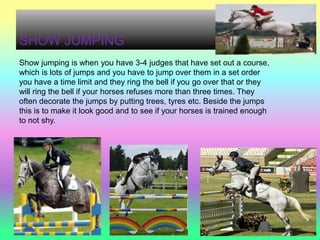
SHOW JUMPING
Show jumping is when you have 3-4 judges that have set out a course,
which is lots of jumps and you have to jump over them in a set order
you have a time limit and they ring the bell if you go over that or they
will ring the bell if your horses refuses more than three times. They
often decorate the jumps by putting trees, tyres etc. Beside the jumps
this is to make it look good and to see if your horses is trained enough
to not shy.
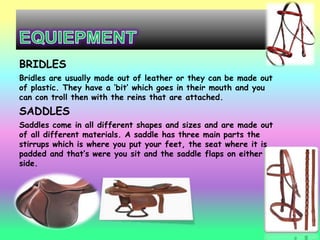
BRIDLES
Bridles are usually made out of leather or they can be made out
of plastic. They have a „bit‟ which goes in their mouth and you
can con troll then with the reins that are attached.
SADDLES
Saddles come in all different shapes and sizes and are made out
of all different materials. A saddle has three main parts the
stirrups which is where you put your feet, the seat where it is
padded and that‟s were you sit and the saddle flaps on either
side.
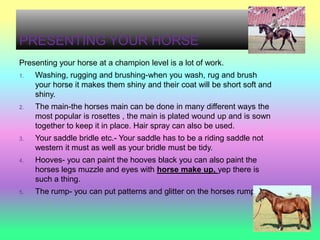
PRESENTING YOUR HORSE
Presenting your horse at a champion level is a lot of work.
1.   Washing, rugging and brushing-when you wash, rug and brush
     your horse it makes them shiny and their coat will be short soft and
     shiny.
2.   The main-the horses main can be done in many different ways the
     most popular is rosettes , the main is plated wound up and is sown
     together to keep it in place. Hair spray can also be used.
3.   Your saddle bridle etc.- Your saddle has to be a riding saddle not
     western it must as well as your bridle must be tidy.
4.   Hooves- you can paint the hooves black you can also paint the
     horses legs muzzle and eyes with horse make up, yep there is
     such a thing.
5.   The rump- you can put patterns and glitter on the horses rumps.
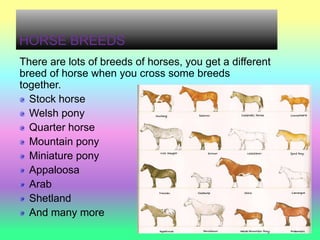
HORSE BREEDS
There are lots of breeds of horses, you get a different
breed of horse when you cross some breeds
together.
  Stock horse
  Welsh pony
  Quarter horse
  Mountain pony
  Miniature pony
  Appaloosa
  Arab
  Shetland
  And many more
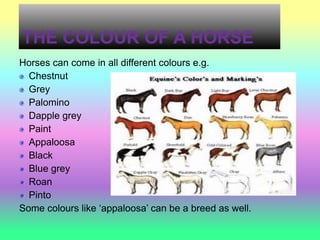
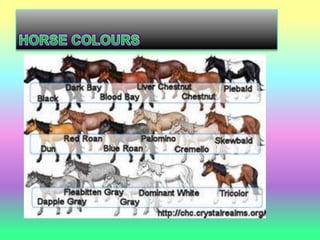
THE COLOUR OF A HORSE
Horses can come in all different colours e.g.
  Chestnut
  Grey
  Palomino
  Dapple grey
  Paint
  Appaloosa
  Black
  Blue grey
  Roan
  Pinto
Some colours like ‘appaloosa’ can be a breed as well.
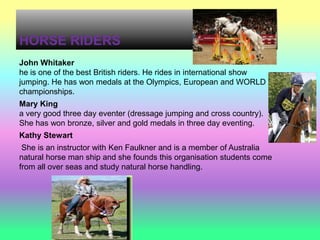
HORSE RIDERS
John Whitaker
he is one of the best British riders. He rides in international show
jumping. He has won medals at the Olympics, European and WORLD
championships.
Mary King
a very good three day eventer (dressage jumping and cross country).
She has won bronze, silver and gold medals in three day eventing.
Kathy Stewart
 She is an instructor with Ken Faulkner and is a member of Australia
natural horse man ship and she founds this organisation students come
from all over seas and study natural horse handling.
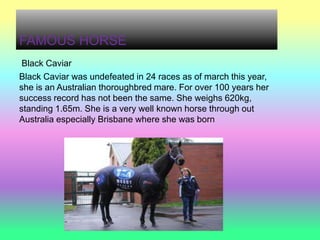
FAMOUS HORSE
 Black Caviar
Black Caviar was undefeated in 24 races as of march this year,
she is an Australian thoroughbred mare. For over 100 years her
success record has not been the same. She weighs 620kg,
standing 1.65m. She is a very well known horse through out
Australia especially Brisbane where she was born
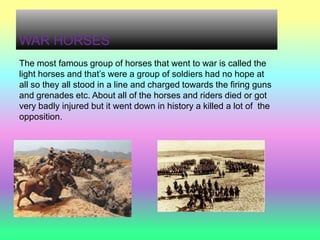
WAR HORSES
The most famous group of horses that went to war is called the
light horses and that’s were a group of soldiers had no hope at
all so they all stood in a line and charged towards the firing guns
and grenades etc. About all of the horses and riders died or got
very badly injured but it went down in history a killed a lot of the
opposition.
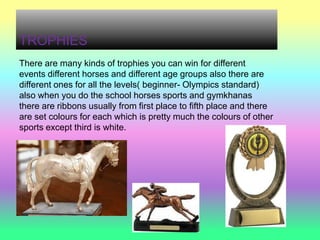
TROPHIES
There are many kinds of trophies you can win for different
events different horses and different age groups also there are
different ones for all the levels( beginner- Olympics standard)
also when you do the school horses sports and gymkhanas
there are ribbons usually from first place to fifth place and there
are set colours for each which is pretty much the colours of other
sports except third is white.
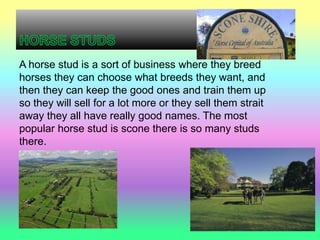
A horse stud is a sort of business where they breed
horses they can choose what breeds they want, and
then they can keep the good ones and train them up
so they will sell for a lot more or they sell them strait
away they all have really good names. The most
popular horse stud is scone there is so many studs
there.
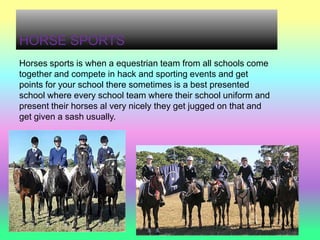
HORSE SPORTS
Horses sports is when a equestrian team from all schools come
together and compete in hack and sporting events and get
points for your school there sometimes is a best presented
school where every school team where their school uniform and
present their horses al very nicely they get jugged on that and
get given a sash usually.
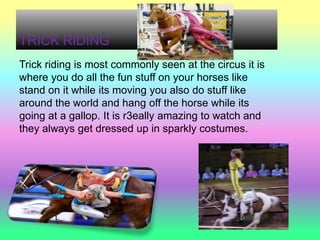
TRICK RIDING
Trick riding is most commonly seen at the circus it is
where you do all the fun stuff on your horses like
stand on it while its moving you also do stuff like
around the world and hang off the horse while its
going at a gallop. It is r3eally amazing to watch and
they always get dressed up in sparkly costumes.
At pony club standard there are 4 main paces halt, walk, trot, canter.
But there is a hand gallop and a bol5t which is where you horse takes
off and goes really (very) fast.
  Halt- No movement at all.
  Walk-All four legs tread on the ground in regular succession in this
  sequence- left fore, right hind, right fore, left hind. This is called a four
  beat gait
  Trot-This is a two beat gait the diagonal feet fall at the exact same
  time, left fore with right hind and right fore with left hind.
HORSE GAITS CONTINUED
 Canter- At the canter the for leg (can be whatever side) leads
 while the other fore leg and the diagonal move together and
 the other hind leg moves by itself - a left fore lead) of right
 hind, then left hind with right fore, followed by left fore. This is
 a three beat gait.
 Gallop-At the gallop the stride is lengthened and the period
 when the horse is airborne is increased- with a left fore
 lead, right hind, followed by left hind slightly before right
 fore, followed by left fore. This is a four beat gait.
 Bolt-going flat out.
   http://horses.about.com/od/GymkhanaGames/a/Pole-Bending-Basics-For-
    Beginners.htm
   http://www.horseshowcentral.com/flex/pole_bending/454/1
   http://www.historyforkids.org/learn/environment/horses.htm
   http://www.equestrian.org.au/default.asp?MenuID=Sports/11757/0,Dressage/11732/0
   http://www.pcuk.org/index.php/about/history/
   http://www.equestrianandhorse.com/rider/introduction.htm
   http://www.google.com.au/#hl=en&output=search&sclient=psy-
    ab&q=black+caviar&oq=black+ca&gs_l=hp.1.0.0i3j0l3.21758.33574.0.37629.12.9.2.1.1.3.
    2112.6558.2-6j7-1j1j1.9.0...0.0...1c.1.7.psy-
    ab.5R0BFqUELQM&pbx=1&bav=on.2,or.r_qf.&bvm=bv.44158598,d.dGY&fp=4ff5f5d1
    a8e50751&biw=1920&bih=985&safe=active
   http://en.wikipedia.org/wiki/Cross-country_equestrianism
   http://www.horses-and-horse-information.com/articles/horse-gaits.shtml

Horse Riding

  • 1.
    HORSE RIDING By Alina G-D
  • 2.
    When horses werefirst around they were wild like a zebra is today. Although they were first in North America, when people started adventuring around the world, horses were extinct in North America. The only horses were in central Asia, where they ate long grass and multiplied. They also ate native apples and carrots (that's why horses love apples and carrots even today!). At about 100 000 BC when people arrived first in Central Asia, they killed horses for their meet and even more so their skin, so they could make leather hides for their clothes and for tents and tools.
  • 3.
    People in centralAsia began to tame horses, to domesticate them, to eat them and to use then to carry things at around 4000 BC. It was probably the Indo- Europeans who lived in Central Asia who tamed horses for their own use first. The first horses were too small for people to ride until they got bred bigger so then people could ride them.
  • 4.
    Barrel racing isa sport you do on horseback. It started when women wanted to have an event that‟s was fair and challenging but they wanted it to be competitive. They then had an idea for taking 3 55 gallon drums (we now call them 44s) and setting them up in clover leaf shaped pattern, with one right turn and to lefts. They all then got their husbands roping horses a went through the course they were timed and the lady with the fastest time would win.
  • 5.
    Pole bending isa simple race all you need to do is cross the start/finish line and bend through six evenly spaced poles starting with the first pole on your right, the second on your left, etc. When you reach the last one you go right round and bend back down. The only penalty is when you knock a pole and that is 5 seconds added.
  • 6.
    Hacking is anevent where you get judged on how well your horse is collected and how well you control it in all paces (Walk, trot, and canter.) and you might be asked to go from a halt to a canter an all the things like that to see how educated your horse is. You can be judged on the ring or you can be given a set work out. There is one judge and a person that writes all the results down.
  • 7.
    Dressage competitions therider and horse are expected to do some “predetermined movements” or figures just out of memory. They will compete in a flat rectangle arena , around the arena is a very low rail with 12 letters symmetrically placed to show were movements should start and finish or to show where you should change you place or lead.
  • 8.
    The horse institutionstarted a sub branch scheme in all different parts encouraging horse riding. They also ran events for adults, some of them started to organize and running gymkhanas for kids. This was a pre-pony club. The earliest recorded gymkhana was in 1928. Now we have pony club rally days, gymkhanas, pony camps, trail rides, horse sports and the list goes on and on.
  • 9.
    CROSS COUNTRY No, crosscountry is not where you cross the country on a horse. It’s where you go on a route with lots of jumps of all kinds ( water jumps, walls, and log) they are all usually high but it depends on the age group. It tests you speed and also the riders knowledge of paces.
  • 10.
    TENT PEGGING Tent peggingcame around because of the war when they put up the tents and it came a practise. Know there is all types of stuff you can do like when you have a long stick with a sharp pointy spick at the end an you have to spear and pick up some sheets on card board, also you have to pop balloons with a gun shaped handle with a spick on the end and you jump over small clavately jumps, you hold a long spear and canter along and hook rings threw it that are hanging from a stand.
  • 11.
    SHOW JUMPING Show jumpingis when you have 3-4 judges that have set out a course, which is lots of jumps and you have to jump over them in a set order you have a time limit and they ring the bell if you go over that or they will ring the bell if your horses refuses more than three times. They often decorate the jumps by putting trees, tyres etc. Beside the jumps this is to make it look good and to see if your horses is trained enough to not shy.
  • 12.
    BRIDLES Bridles are usuallymade out of leather or they can be made out of plastic. They have a „bit‟ which goes in their mouth and you can con troll then with the reins that are attached. SADDLES Saddles come in all different shapes and sizes and are made out of all different materials. A saddle has three main parts the stirrups which is where you put your feet, the seat where it is padded and that‟s were you sit and the saddle flaps on either side.
  • 13.
    PRESENTING YOUR HORSE Presentingyour horse at a champion level is a lot of work. 1. Washing, rugging and brushing-when you wash, rug and brush your horse it makes them shiny and their coat will be short soft and shiny. 2. The main-the horses main can be done in many different ways the most popular is rosettes , the main is plated wound up and is sown together to keep it in place. Hair spray can also be used. 3. Your saddle bridle etc.- Your saddle has to be a riding saddle not western it must as well as your bridle must be tidy. 4. Hooves- you can paint the hooves black you can also paint the horses legs muzzle and eyes with horse make up, yep there is such a thing. 5. The rump- you can put patterns and glitter on the horses rumps.
  • 14.
    HORSE BREEDS There arelots of breeds of horses, you get a different breed of horse when you cross some breeds together. Stock horse Welsh pony Quarter horse Mountain pony Miniature pony Appaloosa Arab Shetland And many more
  • 15.
    THE COLOUR OFA HORSE Horses can come in all different colours e.g. Chestnut Grey Palomino Dapple grey Paint Appaloosa Black Blue grey Roan Pinto Some colours like ‘appaloosa’ can be a breed as well.
  • 17.
    HORSE RIDERS John Whitaker heis one of the best British riders. He rides in international show jumping. He has won medals at the Olympics, European and WORLD championships. Mary King a very good three day eventer (dressage jumping and cross country). She has won bronze, silver and gold medals in three day eventing. Kathy Stewart She is an instructor with Ken Faulkner and is a member of Australia natural horse man ship and she founds this organisation students come from all over seas and study natural horse handling.
  • 18.
    FAMOUS HORSE BlackCaviar Black Caviar was undefeated in 24 races as of march this year, she is an Australian thoroughbred mare. For over 100 years her success record has not been the same. She weighs 620kg, standing 1.65m. She is a very well known horse through out Australia especially Brisbane where she was born
  • 19.
    WAR HORSES The mostfamous group of horses that went to war is called the light horses and that’s were a group of soldiers had no hope at all so they all stood in a line and charged towards the firing guns and grenades etc. About all of the horses and riders died or got very badly injured but it went down in history a killed a lot of the opposition.
  • 20.
    TROPHIES There are manykinds of trophies you can win for different events different horses and different age groups also there are different ones for all the levels( beginner- Olympics standard) also when you do the school horses sports and gymkhanas there are ribbons usually from first place to fifth place and there are set colours for each which is pretty much the colours of other sports except third is white.
  • 21.
    A horse studis a sort of business where they breed horses they can choose what breeds they want, and then they can keep the good ones and train them up so they will sell for a lot more or they sell them strait away they all have really good names. The most popular horse stud is scone there is so many studs there.
  • 22.
    HORSE SPORTS Horses sportsis when a equestrian team from all schools come together and compete in hack and sporting events and get points for your school there sometimes is a best presented school where every school team where their school uniform and present their horses al very nicely they get jugged on that and get given a sash usually.
  • 23.
    TRICK RIDING Trick ridingis most commonly seen at the circus it is where you do all the fun stuff on your horses like stand on it while its moving you also do stuff like around the world and hang off the horse while its going at a gallop. It is r3eally amazing to watch and they always get dressed up in sparkly costumes.
  • 24.
    At pony clubstandard there are 4 main paces halt, walk, trot, canter. But there is a hand gallop and a bol5t which is where you horse takes off and goes really (very) fast. Halt- No movement at all. Walk-All four legs tread on the ground in regular succession in this sequence- left fore, right hind, right fore, left hind. This is called a four beat gait Trot-This is a two beat gait the diagonal feet fall at the exact same time, left fore with right hind and right fore with left hind.
  • 25.
    HORSE GAITS CONTINUED Canter- At the canter the for leg (can be whatever side) leads while the other fore leg and the diagonal move together and the other hind leg moves by itself - a left fore lead) of right hind, then left hind with right fore, followed by left fore. This is a three beat gait. Gallop-At the gallop the stride is lengthened and the period when the horse is airborne is increased- with a left fore lead, right hind, followed by left hind slightly before right fore, followed by left fore. This is a four beat gait. Bolt-going flat out.
  • 26.
    http://horses.about.com/od/GymkhanaGames/a/Pole-Bending-Basics-For- Beginners.htm  http://www.horseshowcentral.com/flex/pole_bending/454/1  http://www.historyforkids.org/learn/environment/horses.htm  http://www.equestrian.org.au/default.asp?MenuID=Sports/11757/0,Dressage/11732/0  http://www.pcuk.org/index.php/about/history/  http://www.equestrianandhorse.com/rider/introduction.htm  http://www.google.com.au/#hl=en&output=search&sclient=psy- ab&q=black+caviar&oq=black+ca&gs_l=hp.1.0.0i3j0l3.21758.33574.0.37629.12.9.2.1.1.3. 2112.6558.2-6j7-1j1j1.9.0...0.0...1c.1.7.psy- ab.5R0BFqUELQM&pbx=1&bav=on.2,or.r_qf.&bvm=bv.44158598,d.dGY&fp=4ff5f5d1 a8e50751&biw=1920&bih=985&safe=active  http://en.wikipedia.org/wiki/Cross-country_equestrianism  http://www.horses-and-horse-information.com/articles/horse-gaits.shtml