Stress Physiology
Is everything we know about stress wrong?
What is stress and is it necessarily
bad?
Stress = Nervous system and endocrine system
working together to prepare the body for a
challenge. It’s fundamentally life-sustaining.
Stressors: positive, tolerable, or
toxic?
your job
my job
sickness
starvation
lack of sleep
scary movies
anxieties
injury
job interview
sex
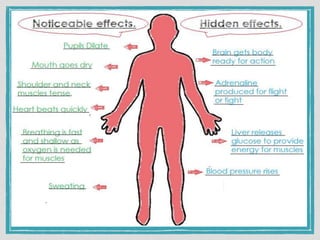
Physiological response to stress
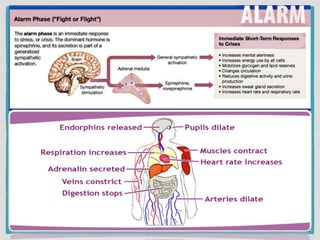
The fight-or-flight sympathetic nervous system
response works beautifully to keep you alive.
Brain — heightened awareness, release of
endorphins, dopamine, and other neurotransmitters
Skeletal muscle primed for activity
Not negative or unpleasant — we pay $$ for it
Acute versus Chronic Stress
Good stress is transient. A roller coaster
ride that lasts 3 weeks, I would likely pay
to get OFF.
Long-term stress is THE problem.
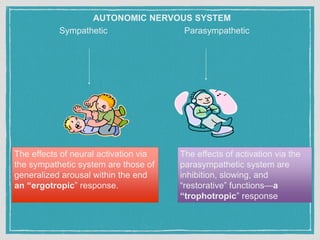
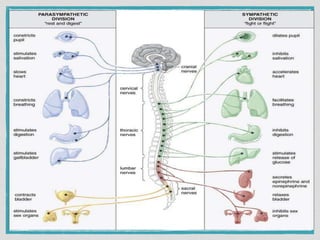
AUTONOMIC NERVOUS SYSTEM
Sympathetic Parasympathetic
The effects of activation via the
parasympathetic system are
inhibition, slowing, and
“restorative” functions—a
“trophotropic” response
The effects of neural activation via
the sympathetic system are those of
generalized arousal within the end
an “ergotropic” response.
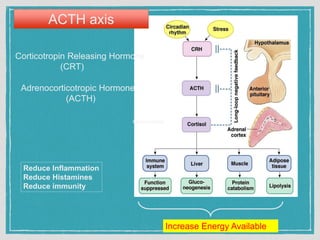
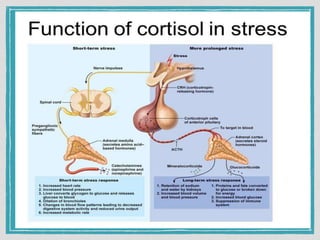
Adrenocorticotropic Hormone
(ACTH)
Corticotropin Releasing Hormone
(CRT)
Glucocortoid
Increase Energy Available
Reduce Inflammation
Reduce Histamines
Reduce immunity
ACTH axis
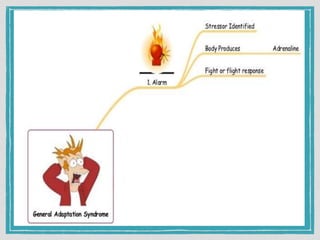
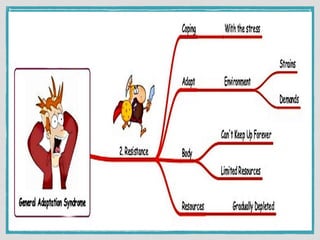
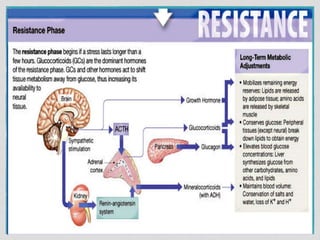
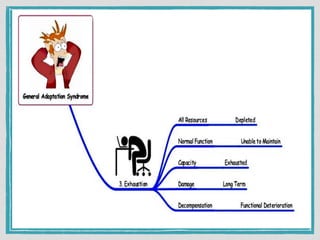
The “General Adaptation Syndrome”
• Hans Seyle ( 1956 ) proposed an integrative model for the
stress response, known as the “General Adaptation
Syndrome” (GAS).
The GAS is a tri-
phasic phenomenon
which involves
“alarm”, ”resistance”
and “exhaustion”
phase
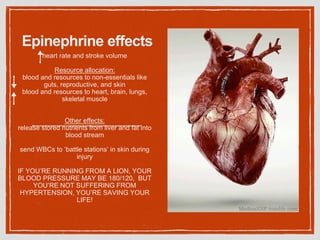
Epinephrine effects
heart rate and stroke volume
Resource allocation:
blood and resources to non-essentials like
guts, reproductive, and skin
blood and resources to heart, brain, lungs,
skeletal muscle
Other effects:
release stored nutrients from liver and fat into
blood stream
send WBCs to ‘battle stations’ in skin during
injury
IF YOU’RE RUNNING FROM A LION, YOUR
BLOOD PRESSURE MAY BE 180/120, BUT
YOU’RE NOT SUFFERING FROM
HYPERTENSION, YOU’RE SAVING YOUR
LIFE!
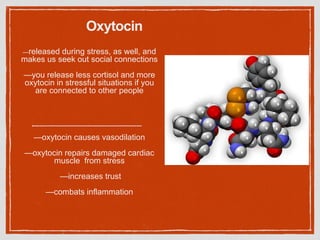
Oxytocin
—released during stress, as well, and
makes us seek out social connections
—you release less cortisol and more
oxytocin in stressful situations if you
are connected to other people
—oxytocin causes vasodilation
—oxytocin repairs damaged cardiac
muscle from stress
—increases trust
—combats inflammation
References
• Physiology and Neurobiology of Stress and Adaptation: Central Role
of the Brain.. Physiol Rev 87: 873–904, 2007
• Physiology of stress. Jones Bartlett publishers pg no. 35-48
• http://www.gulfbend.org/poc/view_doc.php?type=doc&id=15644&cn=
117
• https://www.psychologistworld.com/stress/general-adaptation-
syndrome.php
Presented By: Vasu Kamboj &
Anand Acharya
(Group 2)
Stress (Physiology)

Stress (Physiology)

  • 1.
    Stress Physiology Is everythingwe know about stress wrong?
  • 2.
    What is stressand is it necessarily bad? Stress = Nervous system and endocrine system working together to prepare the body for a challenge. It’s fundamentally life-sustaining.
  • 3.
    Stressors: positive, tolerable,or toxic? your job my job sickness starvation lack of sleep scary movies anxieties injury job interview sex
  • 4.
    Physiological response tostress The fight-or-flight sympathetic nervous system response works beautifully to keep you alive. Brain — heightened awareness, release of endorphins, dopamine, and other neurotransmitters Skeletal muscle primed for activity Not negative or unpleasant — we pay $$ for it
  • 7.
    Acute versus ChronicStress Good stress is transient. A roller coaster ride that lasts 3 weeks, I would likely pay to get OFF. Long-term stress is THE problem.
  • 8.
    AUTONOMIC NERVOUS SYSTEM SympatheticParasympathetic The effects of activation via the parasympathetic system are inhibition, slowing, and “restorative” functions—a “trophotropic” response The effects of neural activation via the sympathetic system are those of generalized arousal within the end an “ergotropic” response.
  • 9.
    Adrenocorticotropic Hormone (ACTH) Corticotropin ReleasingHormone (CRT) Glucocortoid Increase Energy Available Reduce Inflammation Reduce Histamines Reduce immunity ACTH axis
  • 10.
    The “General AdaptationSyndrome” • Hans Seyle ( 1956 ) proposed an integrative model for the stress response, known as the “General Adaptation Syndrome” (GAS). The GAS is a tri- phasic phenomenon which involves “alarm”, ”resistance” and “exhaustion” phase
  • 13.
    Epinephrine effects heart rateand stroke volume Resource allocation: blood and resources to non-essentials like guts, reproductive, and skin blood and resources to heart, brain, lungs, skeletal muscle Other effects: release stored nutrients from liver and fat into blood stream send WBCs to ‘battle stations’ in skin during injury IF YOU’RE RUNNING FROM A LION, YOUR BLOOD PRESSURE MAY BE 180/120, BUT YOU’RE NOT SUFFERING FROM HYPERTENSION, YOU’RE SAVING YOUR LIFE!
  • 17.
    Oxytocin —released during stress,as well, and makes us seek out social connections —you release less cortisol and more oxytocin in stressful situations if you are connected to other people —oxytocin causes vasodilation —oxytocin repairs damaged cardiac muscle from stress —increases trust —combats inflammation
  • 22.
    References • Physiology andNeurobiology of Stress and Adaptation: Central Role of the Brain.. Physiol Rev 87: 873–904, 2007 • Physiology of stress. Jones Bartlett publishers pg no. 35-48 • http://www.gulfbend.org/poc/view_doc.php?type=doc&id=15644&cn= 117 • https://www.psychologistworld.com/stress/general-adaptation- syndrome.php
  • 23.
    Presented By: VasuKamboj & Anand Acharya (Group 2)

Editor's Notes

  • #2 Throughout human evolution, our survival has been contingent on an ability to survive life-threatening situations — from being hunted by predators to recovering from illnesses.
  • #3 Physiological or biological stress is an organism's response to a stressor such as an environmental condition. Stress is a body's method of reacting to a challenge. According to the stressful event, the body's way to respond to stress is by sympathetic nervous system activation which results in the fight-or-flight response. Because the body can not keep this state for long periods of time, the parasympathetic system returns the body's physiological conditions to normal (homeostasis).
  • #4 STRESSOR- stuffs which tell you have to be stressful (**Make it dramatic(**is my info. for the way you must act)) explain some of them be like anxieties ?
  • #5 During stressful situtations 1.Muscles contract.. 2. blood flow in body incresase 3. cardiac output increases.(**The cardiac output is simply the amount of blood pumped by the heart per minute. ) 4. breathing becomes fast and alveloies contract the most
  • #6 Blood pressure rises because arteries dilate I during stress in response to stress.
  • #7 These are some short tern stress examples roller coastal. Sky diving and skiing in turn . Not actually harmful for body.
  • #8 Acute Stress is short-lived. It can be beneficial and create motivation. For example, when a deadline is approaching, stress may help you to focus and complete your task before the deadline.  Chronic, or long-term stress, comes about as the result of a situation that has not been resolved or continued for many years prior to being resolved. This might be a traumatic event that happened during childhood. 
  • #9 Ergotropic one which expends energy Trophotropic promoting rest n reconstituite energy stores
  • #11 ARE….
  • #12 Fight or flight. The body prepares to defend itself. It takes about 90 minutes for the metabolism to return to normal when the response is over. sympathetic branch of the ANS is activated — the adrenal gland secretes the stress hormone cortisol, along with adrenaline,  Primarily an epinephrine/adrenaline response; nervous and hormonal Objective: survival Body’s needs: higher blood flow, oxygen, and nutrient needs to specific places in the body; less nutrients and oxygen to other places
  • #15 resistance stage, during which body's Autonomic Nervous System (ANS) resists the impact of the stressful stimulus parasympathetic branch of the ANS counteracts the changes that the stressful stimulus has produced, and attempts to restore a state of homeostasis Primarily a cortisol response; hormonal Cortisol’s objective: keep you alive until things get better, at almost any cost Released every night, OR under long-term stress
  • #17 he final phase of general adaptation syndrome is the exhaustion stage, in which the body has depleted resources following its attempt to repair itself during the preceding resistance stage. If the original threat has passed, it will continue its recovery. However, the body no longer has the energy to cope with continued stress in the long term, and should it continue, it begins to show signs of exhaustion, gradually deteriorating as it persists. Net Effect? anxious person high BP no energy reserves no sex no sleep higher probability of cancer higher probability of ulcers higher probability of MI catches every germ that comes around how would this affect a child in his/her growing years?  
  • #18 Is there any role of oxytocin?
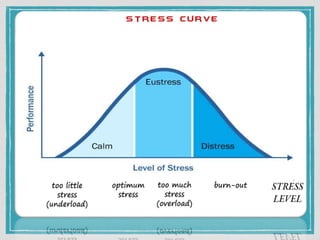
  • #21 Eustress: Stress in daily life that has positive conotations : Marriage, Promotion, Baby, Winning Money, New Friends  Eustress, or positive stress, has the following characteristics:  Motivates, focuses energy Is short-term Is perceived as within our coping abilities Feels exciting Improves performance Distress: Stress in daily life that has negative conotations : Divorce, Punishment, Injury, Negative feelings, Financial Problems, Work Difficulties Causes anxiety or concern Can be short- or long-term Is perceived as outside of our coping abilities Feels unpleasant Decreases performance Can lead to mental and physical problems
  • #22 Learn the location of amygalada , Hippocampus and prefrontal cortex.