HORMONES
SECRETION:
FEEDBACK
MECHANISM
Shahri Mammadova
HORMONES:
INTRODUCTION
Our body is a perfect mechanism that regulates itself in response to external
and internal signals and keeps the internal environment stable. The body’s self-
regulation and maintenance of its internal environment is called homeostasis.
There are some chemicals that regulate the growth, development, metabolism,
and many vital functions of an organism. These are called hormones.
Hormones are secreted by the endocrine glands. Examples are the adrenal
glands and thyroid gland. The pituitary and hypothalamus regulate their
hormone secretion. These are implemented by various mechanisms, one of
which is negative feedback. Negative feedback is a reaction that causes a
decrease in function. It occurs in response to some kind of stimulus.
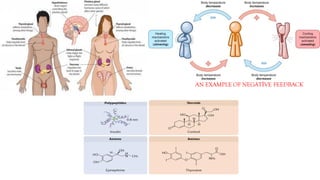
AN EXAMPLE OF NEGATİVE FEEDBACK
THE NEGATIVE FEEDBACK REGULATION
OF THYROXINE (T4) AND
TRIIODOTHYRONINE (T3)
• T3 and T4 hormones are release by thyroid gland. Thyroid is an
endocrine gland in the neck that consist two lobs: left and right. T3
and T4 hormones regulate vital functions in our body. Such as
bioenergetics, blood pressure, heart rate, muscle tone, digestive
and reproductive system Thus this hormone directly affects the
functions of life. Therefore, it is very important to regulate their
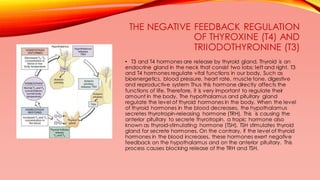
amount in the body. The hypothalamus and pituitary gland
regulate the level of thyroid hormones in the body. When the level
of thyroid hormones in the blood decreases, the hypothalamus
secretes thyrotropin-releasing hormone (TRH). This is causing the
anterior pituitary to secrete thyrotropin, a tropic hormone also
known as thyroid-stimulating hormone (TSH). TSH stimulates thyroid
gland for secrete hormones. On the contrary, if the level of thyroid
hormones in the blood increases, these hormones exert negative
feedback on the hypothalamus and on the anterior pituitary. This
process causes blocking release of the TRH and TSH.
THE NEGATIVE FEEDBACK REGULATION OF
ADRENAL GLAND HORMONES
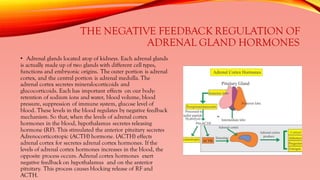
• Adrenal glands located atop of kidneys. Each adrenal glands
is actually made up of two glands with different cell types,
functions and embryonic origins. The outer portion is adrenal
cortex, and the central portion is adrenal medulla. The
adrenal cortex secretes mineralocorticoids and
glucocorticoids. Each has important effects on our body:
retention of sodium ions and water, blood volume, blood
pressure, suppression of immune system, glucose level of
blood. These levels in the blood regulates by negative feedback
mechanism. So that, when the levels of adrenal cortex
hormones in the blood, hypothalamus secretes releasing
hormone (RF). This stimulated the anterior pituitary secretes
Adrenocorticotropic (ACTH) hormone. (ACTH) effects
adrenal cortex for secretes adrenal cortex hormones. If the
levels of adrenal cortex hormones increases in the blood, the
opposite process occurs. Adrenal cortex hormones exert
negative feedback on hypothalamus and on the anterior
pituitary. This process causes blocking release of RF and
ACTH.
THE NEGATIVE FEEDBACK REGULATION OF SEX
HORMONES
The sex hormones secreted by gonads, ovaries in females and testes in males. Sex hormones affect
growth, development, reproductive cycles, and development of secondary sex characteristics. There are
three types of steroid sex hormones secreted by gonads: androgens, estrogens, and progesterone. All
this hormones are found in both males and females. But the levels of these hormones different in
males and females. The testes primarily synthesize androgens, which one of the most important
representatives is testosterone. Estrogens and progesterone are responsible for the maintenance of
female reproductive system. The secretion of these hormones controlled by gonadotropins and
gonadotropin releasing hormone (GnRH) which secreted accordingly by pituitary gland and
hypothalamus. Follicle-stimulating hormone (FSH) and luteinizing hormone (LH) are gonadotropins.
Gonadotropin secretion is controlled by gonadotropin releasing hormone (GnRH).
THE HORMONAL CONTROL OF
TESTOSTERONE
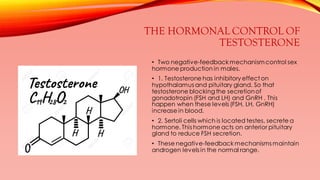
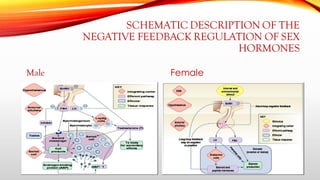
• Two negative-feedback mechanismcontrol sex
hormone production in males.
• 1. Testosterone has inhibitory effect on
hypothalamus and pituitary gland. So that
testosterone blocking the secretionof
gonadotropin (FSH and LH) and GnRH . This
happen when these levels (FSH, LH, GnRH)
increase in blood.
• 2. Sertoli cells which is located testes, secrete a
hormone. This hormone acts on anterior pituitary
gland to reduce FSH secretion.
• These negative-feedback mechanisms maintain
androgen levels in the normal range.
THE HORMONAL CONTROL OF
ESTROGEN
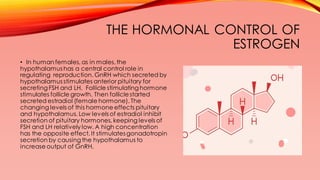
• In human females, as in males,the
hypothalamus has a central control role in
regulating reproduction. GnRH which secreted by
hypothalamus stimulates anterior pituitary for
secreting FSH and LH. Follicle stimulating hormone
stimulates follicle growth. Then folliclestarted
secreted estradiol (female hormone). The
changing levels of this hormone effects pituitary
and hypothalamus. Low levels of estradiol inhibit
secretion of pituitary hormones, keeping levels of
FSH and LH relatively low. A high concentration
has the opposite effect. It stimulates gonadotropin
secretion by causing the hypothalamus to
increase output of GnRH.
SCHEMATIC DESCRIPTION OF THE
NEGATIVE FEEDBACK REGULATION OF SEX
HORMONES
Male Female

Hormone secretion 1

  • 1.
  • 2.
    HORMONES: INTRODUCTION Our body isa perfect mechanism that regulates itself in response to external and internal signals and keeps the internal environment stable. The body’s self- regulation and maintenance of its internal environment is called homeostasis. There are some chemicals that regulate the growth, development, metabolism, and many vital functions of an organism. These are called hormones. Hormones are secreted by the endocrine glands. Examples are the adrenal glands and thyroid gland. The pituitary and hypothalamus regulate their hormone secretion. These are implemented by various mechanisms, one of which is negative feedback. Negative feedback is a reaction that causes a decrease in function. It occurs in response to some kind of stimulus.
  • 3.
    AN EXAMPLE OFNEGATİVE FEEDBACK
  • 4.
    THE NEGATIVE FEEDBACKREGULATION OF THYROXINE (T4) AND TRIIODOTHYRONINE (T3) • T3 and T4 hormones are release by thyroid gland. Thyroid is an endocrine gland in the neck that consist two lobs: left and right. T3 and T4 hormones regulate vital functions in our body. Such as bioenergetics, blood pressure, heart rate, muscle tone, digestive and reproductive system Thus this hormone directly affects the functions of life. Therefore, it is very important to regulate their amount in the body. The hypothalamus and pituitary gland regulate the level of thyroid hormones in the body. When the level of thyroid hormones in the blood decreases, the hypothalamus secretes thyrotropin-releasing hormone (TRH). This is causing the anterior pituitary to secrete thyrotropin, a tropic hormone also known as thyroid-stimulating hormone (TSH). TSH stimulates thyroid gland for secrete hormones. On the contrary, if the level of thyroid hormones in the blood increases, these hormones exert negative feedback on the hypothalamus and on the anterior pituitary. This process causes blocking release of the TRH and TSH.
  • 5.
    THE NEGATIVE FEEDBACKREGULATION OF ADRENAL GLAND HORMONES • Adrenal glands located atop of kidneys. Each adrenal glands is actually made up of two glands with different cell types, functions and embryonic origins. The outer portion is adrenal cortex, and the central portion is adrenal medulla. The adrenal cortex secretes mineralocorticoids and glucocorticoids. Each has important effects on our body: retention of sodium ions and water, blood volume, blood pressure, suppression of immune system, glucose level of blood. These levels in the blood regulates by negative feedback mechanism. So that, when the levels of adrenal cortex hormones in the blood, hypothalamus secretes releasing hormone (RF). This stimulated the anterior pituitary secretes Adrenocorticotropic (ACTH) hormone. (ACTH) effects adrenal cortex for secretes adrenal cortex hormones. If the levels of adrenal cortex hormones increases in the blood, the opposite process occurs. Adrenal cortex hormones exert negative feedback on hypothalamus and on the anterior pituitary. This process causes blocking release of RF and ACTH.
  • 6.
    THE NEGATIVE FEEDBACKREGULATION OF SEX HORMONES The sex hormones secreted by gonads, ovaries in females and testes in males. Sex hormones affect growth, development, reproductive cycles, and development of secondary sex characteristics. There are three types of steroid sex hormones secreted by gonads: androgens, estrogens, and progesterone. All this hormones are found in both males and females. But the levels of these hormones different in males and females. The testes primarily synthesize androgens, which one of the most important representatives is testosterone. Estrogens and progesterone are responsible for the maintenance of female reproductive system. The secretion of these hormones controlled by gonadotropins and gonadotropin releasing hormone (GnRH) which secreted accordingly by pituitary gland and hypothalamus. Follicle-stimulating hormone (FSH) and luteinizing hormone (LH) are gonadotropins. Gonadotropin secretion is controlled by gonadotropin releasing hormone (GnRH).
  • 7.
    THE HORMONAL CONTROLOF TESTOSTERONE • Two negative-feedback mechanismcontrol sex hormone production in males. • 1. Testosterone has inhibitory effect on hypothalamus and pituitary gland. So that testosterone blocking the secretionof gonadotropin (FSH and LH) and GnRH . This happen when these levels (FSH, LH, GnRH) increase in blood. • 2. Sertoli cells which is located testes, secrete a hormone. This hormone acts on anterior pituitary gland to reduce FSH secretion. • These negative-feedback mechanisms maintain androgen levels in the normal range.
  • 8.
    THE HORMONAL CONTROLOF ESTROGEN • In human females, as in males,the hypothalamus has a central control role in regulating reproduction. GnRH which secreted by hypothalamus stimulates anterior pituitary for secreting FSH and LH. Follicle stimulating hormone stimulates follicle growth. Then folliclestarted secreted estradiol (female hormone). The changing levels of this hormone effects pituitary and hypothalamus. Low levels of estradiol inhibit secretion of pituitary hormones, keeping levels of FSH and LH relatively low. A high concentration has the opposite effect. It stimulates gonadotropin secretion by causing the hypothalamus to increase output of GnRH.
  • 9.
    SCHEMATIC DESCRIPTION OFTHE NEGATIVE FEEDBACK REGULATION OF SEX HORMONES Male Female