Weeding
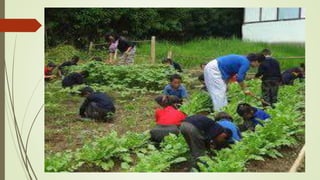
Weeds are many home gardeners’
biggest enemy. Herbicides and other
chemicals may seem like the best
weapon in the arsenal against weeds;
however, many experts discourage
the use of chemicals. They can leach
into fruits and vegetables. They can
also runoff and trickle down into
groundwater.
Types of
weeds
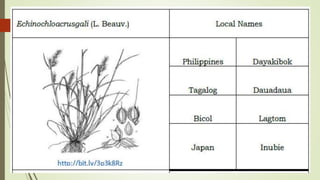
1. Grasses
are monocotyledonous plants, which
have long, narrow, two-ranked, usually
flat leaves with parallel veins and round,
hollow stems. The common examples of
grasses are:
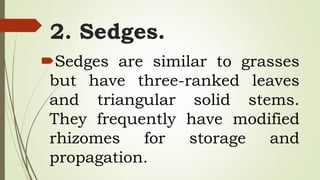
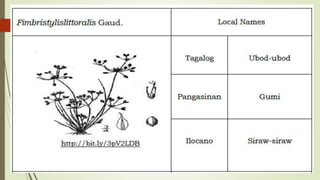
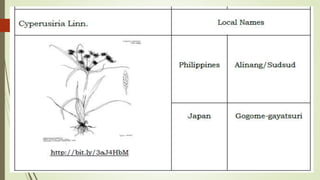
2. Sedges.
Sedges are similar to grasses
but have three-ranked leaves
and triangular solid stems.
They frequently have modified
rhizomes for storage and
propagation.
3. Broadleaves.
These are dicotyledonous
plants with net-veined leaves
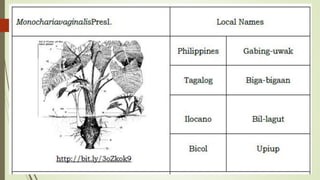
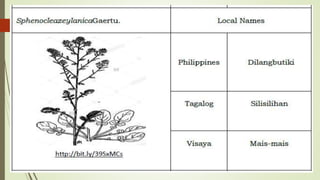
Examples of broad-leaf weeds.
Methods of
weed control
1. Start with prevention
Prevention is also known as exclusion
begins with securing clean seeds and feed
sources. Every opportunity should be
taken to prevent new weeds from being
introduced to the farm. Care should be
taken to select seeds and feed sources that
are free of weed species that are not
currently present on the farm, particularly
invasive or noxious.
1. Start with prevention
currently present on the farm, particularly
invasive or noxious.
Build healthy soil with compost and mulch
– soil organisms protect plants from many
diseases and insect pests’ problems.
Select pest-resistant plants, and place them
under the sun or shade with a proper
growing medium.
1. Start with prevention
Clean up disease-infected plants, and
compost dead plants to reduce hiding
places for insect pests.
Pull weeds before they produce seeds and
spread.
Use a variety of plants, so if pests attack
one plant, others can fill its place.
2. Biological control
Natural predators often bring pests under
control, but they need time to work. Most bugs
are good bugs: only about 5% of the bugs in
your yard are pests. “Good bugs” like ground
beetles, ladybugs, and lacewings help control
pests. Do not spray at the first sign of damage
– nature may control it for you, or plants often
just outgrow the damage.
3. Use chemical pesticides as the last
resort.
you use a chemical pesticide, use the least toxic
product, and spot applies it. Do not spread it all
over the yard to kill a few weeds or bugs. It may
be best to have a professional who has all the
protective gear do the application but doesn’t use
services that spread chemicals over the whole
yard or spray on a calendar schedule. You want
to apply pesticides only when and where you
have a problem.
Think twice before using pesticides
Pesticides (weed and bug killers) can
damage soil and plant health, poison
wildlife like birds and salmon, and harm our
family’s health. The good news is that we do
not need those chemicals to grow a healthy
and attractive landscape. Try these natural
methods.
4. Cultural methods
a. Replace problem plants with pest-resistant ones. If
a plant, even a tree, has insect pest or disease
problems every year, it is time to replace it with a
more pest-resistant, site-adapted variety or another
type of plant that does not have these problems.
b. Crop rotation is the planting of different crops in
succession in the same field.
4. Cultural methods
c. Field sanitation. Sanitation from the perspective of weed
management refers to the practice of minimizing the
movement of weeds that are found on the farm to other
parts of the farm. The primary activities of sanitation involve
keeping equipment free of seed or other reproductive parts
of weeds, and ensuring that field boundaries and other non-
crop areas are kept free of weeds capable of reproducing.
There is significant overlap between the activities carried out
in both prevention and sanitation.”
5. Mechanical/Physical control
This method of weed control is done by
depriving the weeds of complete sunlight,
cutting them, and burning them. The practices
involved are hand pulling, hoeing, cultivation,
mulching, and smothering.
Why should we
control weeds?
According to Reyes (1977), we control weeds
because
• Weeds cause a decrease in crop production
because they compete for nutrients, moisture,
light, and space.
• Weeds increase labor and production cost.
• Some weeds harbor plant pests, which may
affect plant growth and yield.
According to Reyes (1977), we control weeds
because
• Weeds clog irrigation and drainage canals or
ditches thus hampering the flow of water
which results in overflow and waste of water
resources.
• Some weeds are injurious to men and
animals.
• Weeds lower land value.
According to Reyes (1977), we control weeds
because
• Roots of weeds interlace with roots
of plants which makes cultivation and
weeding difficult.
• Weeds cause the wear and tear of
farm implements or equipment.
Cultivation
Benefits of cultivation:
1. Control the growth of weeds. Weeds are
referred to as the chief plant competitor. There is
a saying that goes, “The best way to control
weeds is to remove the bitter roots,” and this is
only accomplished through cultivation.
Benefits of cultivation:
2. Cultivation aerates the soil to facilitate the
respiration of plant roots and microorganisms as well
as to supply nitrogen for nitrogen-fixing organisms.
During the rainy season, the soil lacks air because
spaces in between soil particles are filled with water. If
you drain the soil, soil air can circulate in between soil
particles. Cultivation also creates more spaces
between soil particles to accommodate air.
Benefits of cultivation:
3. Cultivation helps conserve food materials in the
soil. It is generally known, however, that when
cultivation control weeds, moisture is conserved
because dead weeds have no more chance to use the
soil moisture as well as food nutrients in the soil.
4. Cultivation makes the topsoil lose to increase its
capacity to absorb water.
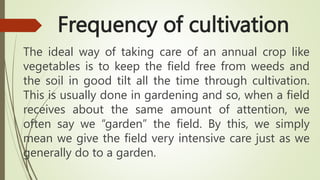
Frequency of cultivation
The ideal way of taking care of an annual crop like
vegetables is to keep the field free from weeds and
the soil in good tilt all the time through cultivation.
This is usually done in gardening and so, when a field
receives about the same amount of attention, we
often say we “garden” the field. By this, we simply
mean we give the field very intensive care just as we
generally do to a garden.
Depth of cultivation
As a rule, cultivation should be done at a depth
of about 5 centimeters. It should be deep to
control weeds. It is not advisable to cultivate
deeper than it is necessary to kill the weeds
because the roots of the cultivated plants may
be injured. The depth varies according to crops.
Time of cultivation
Cultivation is done after planting and before
the crops cover the ground. Since
cultivation is a process of working the soil,
the rules governing plowing concerning the
condition of the soil should apply to
cultivation.
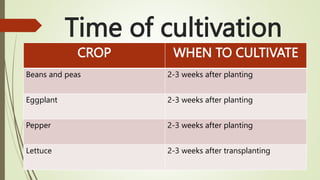
Time of cultivation
CROP WHEN TO CULTIVATE
Beans and peas 2-3 weeks after planting
Eggplant 2-3 weeks after planting
Pepper 2-3 weeks after planting
Lettuce 2-3 weeks after transplanting
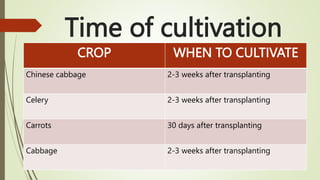
Time of cultivation
CROP WHEN TO CULTIVATE
Chinese cabbage 2-3 weeks after transplanting
Celery 2-3 weeks after transplanting
Carrots 30 days after transplanting
Cabbage 2-3 weeks after transplanting
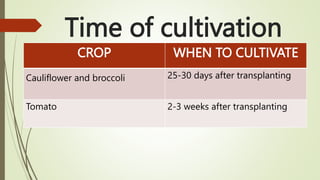
Time of cultivation
CROP WHEN TO CULTIVATE
Cauliflower and broccoli 25-30 days after transplanting
Tomato 2-3 weeks after transplanting
Weeding Methods in Agriculture and Crop.pptx

Weeding Methods in Agriculture and Crop.pptx

  • 1.
  • 2.
    Weeds are manyhome gardeners’ biggest enemy. Herbicides and other chemicals may seem like the best weapon in the arsenal against weeds; however, many experts discourage the use of chemicals. They can leach into fruits and vegetables. They can also runoff and trickle down into groundwater.
  • 4.
  • 5.
    1. Grasses are monocotyledonousplants, which have long, narrow, two-ranked, usually flat leaves with parallel veins and round, hollow stems. The common examples of grasses are:
  • 8.
    2. Sedges. Sedges aresimilar to grasses but have three-ranked leaves and triangular solid stems. They frequently have modified rhizomes for storage and propagation.
  • 11.
    3. Broadleaves. These aredicotyledonous plants with net-veined leaves Examples of broad-leaf weeds.
  • 14.
  • 15.
    1. Start withprevention Prevention is also known as exclusion begins with securing clean seeds and feed sources. Every opportunity should be taken to prevent new weeds from being introduced to the farm. Care should be taken to select seeds and feed sources that are free of weed species that are not currently present on the farm, particularly invasive or noxious.
  • 16.
    1. Start withprevention currently present on the farm, particularly invasive or noxious. Build healthy soil with compost and mulch – soil organisms protect plants from many diseases and insect pests’ problems. Select pest-resistant plants, and place them under the sun or shade with a proper growing medium.
  • 17.
    1. Start withprevention Clean up disease-infected plants, and compost dead plants to reduce hiding places for insect pests. Pull weeds before they produce seeds and spread. Use a variety of plants, so if pests attack one plant, others can fill its place.
  • 18.
    2. Biological control Naturalpredators often bring pests under control, but they need time to work. Most bugs are good bugs: only about 5% of the bugs in your yard are pests. “Good bugs” like ground beetles, ladybugs, and lacewings help control pests. Do not spray at the first sign of damage – nature may control it for you, or plants often just outgrow the damage.
  • 19.
    3. Use chemicalpesticides as the last resort. you use a chemical pesticide, use the least toxic product, and spot applies it. Do not spread it all over the yard to kill a few weeds or bugs. It may be best to have a professional who has all the protective gear do the application but doesn’t use services that spread chemicals over the whole yard or spray on a calendar schedule. You want to apply pesticides only when and where you have a problem.
  • 20.
    Think twice beforeusing pesticides Pesticides (weed and bug killers) can damage soil and plant health, poison wildlife like birds and salmon, and harm our family’s health. The good news is that we do not need those chemicals to grow a healthy and attractive landscape. Try these natural methods.
  • 21.
    4. Cultural methods a.Replace problem plants with pest-resistant ones. If a plant, even a tree, has insect pest or disease problems every year, it is time to replace it with a more pest-resistant, site-adapted variety or another type of plant that does not have these problems. b. Crop rotation is the planting of different crops in succession in the same field.
  • 22.
    4. Cultural methods c.Field sanitation. Sanitation from the perspective of weed management refers to the practice of minimizing the movement of weeds that are found on the farm to other parts of the farm. The primary activities of sanitation involve keeping equipment free of seed or other reproductive parts of weeds, and ensuring that field boundaries and other non- crop areas are kept free of weeds capable of reproducing. There is significant overlap between the activities carried out in both prevention and sanitation.”
  • 23.
    5. Mechanical/Physical control Thismethod of weed control is done by depriving the weeds of complete sunlight, cutting them, and burning them. The practices involved are hand pulling, hoeing, cultivation, mulching, and smothering.
  • 24.
  • 25.
    According to Reyes(1977), we control weeds because • Weeds cause a decrease in crop production because they compete for nutrients, moisture, light, and space. • Weeds increase labor and production cost. • Some weeds harbor plant pests, which may affect plant growth and yield.
  • 26.
    According to Reyes(1977), we control weeds because • Weeds clog irrigation and drainage canals or ditches thus hampering the flow of water which results in overflow and waste of water resources. • Some weeds are injurious to men and animals. • Weeds lower land value.
  • 27.
    According to Reyes(1977), we control weeds because • Roots of weeds interlace with roots of plants which makes cultivation and weeding difficult. • Weeds cause the wear and tear of farm implements or equipment.
  • 28.
  • 29.
    Benefits of cultivation: 1.Control the growth of weeds. Weeds are referred to as the chief plant competitor. There is a saying that goes, “The best way to control weeds is to remove the bitter roots,” and this is only accomplished through cultivation.
  • 30.
    Benefits of cultivation: 2.Cultivation aerates the soil to facilitate the respiration of plant roots and microorganisms as well as to supply nitrogen for nitrogen-fixing organisms. During the rainy season, the soil lacks air because spaces in between soil particles are filled with water. If you drain the soil, soil air can circulate in between soil particles. Cultivation also creates more spaces between soil particles to accommodate air.
  • 31.
    Benefits of cultivation: 3.Cultivation helps conserve food materials in the soil. It is generally known, however, that when cultivation control weeds, moisture is conserved because dead weeds have no more chance to use the soil moisture as well as food nutrients in the soil. 4. Cultivation makes the topsoil lose to increase its capacity to absorb water.
  • 32.
    Frequency of cultivation Theideal way of taking care of an annual crop like vegetables is to keep the field free from weeds and the soil in good tilt all the time through cultivation. This is usually done in gardening and so, when a field receives about the same amount of attention, we often say we “garden” the field. By this, we simply mean we give the field very intensive care just as we generally do to a garden.
  • 33.
    Depth of cultivation Asa rule, cultivation should be done at a depth of about 5 centimeters. It should be deep to control weeds. It is not advisable to cultivate deeper than it is necessary to kill the weeds because the roots of the cultivated plants may be injured. The depth varies according to crops.
  • 34.

    Time of cultivation Cultivationis done after planting and before the crops cover the ground. Since cultivation is a process of working the soil, the rules governing plowing concerning the condition of the soil should apply to cultivation.
  • 35.
    Time of cultivation CROPWHEN TO CULTIVATE Beans and peas 2-3 weeks after planting Eggplant 2-3 weeks after planting Pepper 2-3 weeks after planting Lettuce 2-3 weeks after transplanting
  • 36.
    Time of cultivation CROPWHEN TO CULTIVATE Chinese cabbage 2-3 weeks after transplanting Celery 2-3 weeks after transplanting Carrots 30 days after transplanting Cabbage 2-3 weeks after transplanting
  • 37.
    Time of cultivation CROPWHEN TO CULTIVATE Cauliflower and broccoli 25-30 days after transplanting Tomato 2-3 weeks after transplanting