HOMOGENEOUS DIFFERENTIAL
LINEAR EQUATION
NAME-SURAJ DHAKAL
ROLL NO-231711007527
COLLEGE NAME-GB PANT
OKHLA PHASE-3
BATCH-CIVIL SECTION B
SEMESTER-2
INTRODUCTION
Definition
Differential equations involving homogeneous functions are
called homogeneous differential equations. For a non-zero
constant δ, the function f(x, y) is called a homogeneous
function if f(δx, δy) = δnf(x, y). The general form of the
homogeneous differential equation is f(x, y).dy + g(x, y).dx =
0. Homogeneous differential equation The x, y variables in
the equation have the same degree.
EXAMPLES-
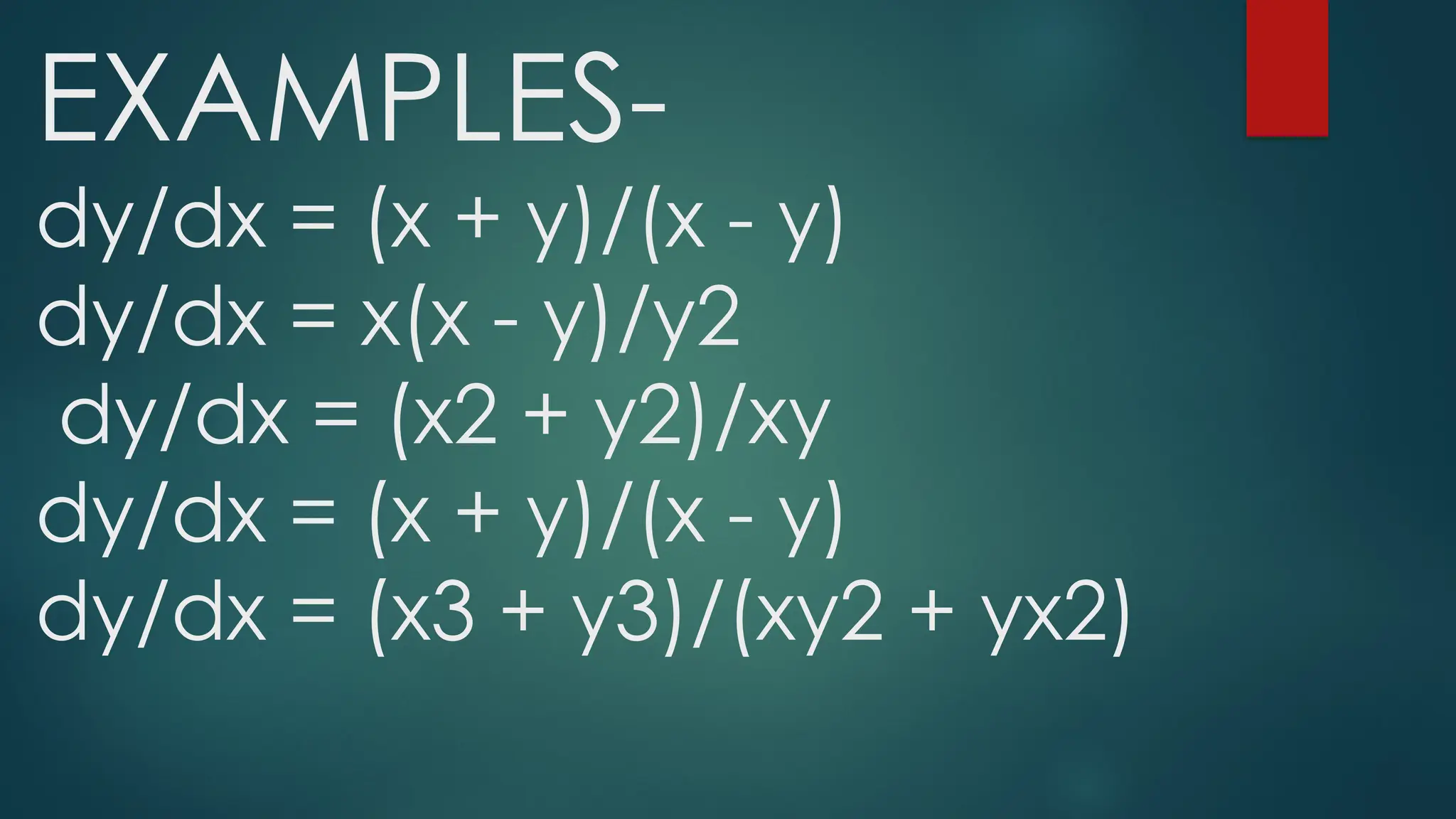
dy/dx = (x + y)/(x - y)
dy/dx = x(x - y)/y2
dy/dx = (x2 + y2)/xy
dy/dx = (x + y)/(x - y)
dy/dx = (x3 + y3)/(xy2 + yx2)
How To Solve a Homogeneous
Differential Equation
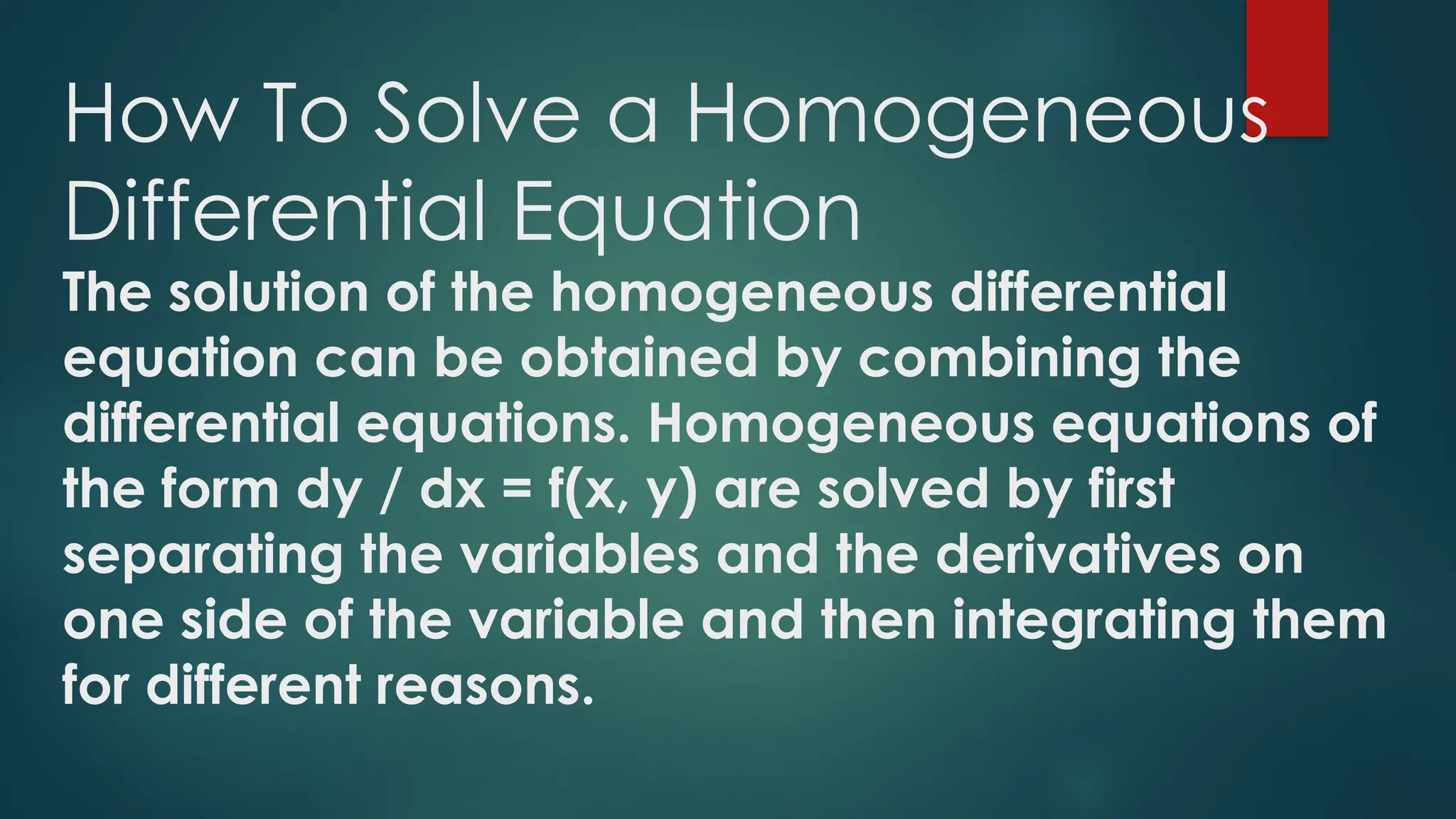
The solution of the homogeneous differential
equation can be obtained by combining the
differential equations. Homogeneous equations of
the form dy / dx = f(x, y) are solved by first
separating the variables and the derivatives on
one side of the variable and then integrating them
for different reasons.
EXAMPLE-1 Show that the differential equation
(x - y).dy/dx = (x + 2y) is a homogeneous differential
equation.
SOL-(x - y).dy/dx = (x + 2y) is the given differential
equation. To prove that the above differential
equation is a homogeneous differential equation, let
us substitute x = λx, and y = λy. Here we have F(x, y)
= ( x + 2 y ) ( x − y ) F(λx, λy) = ( λ x + 2 λ y ) ( λ x − λ y
) F(λx, λy) = λ ( x + 2 y ) λ ( x − y ) = λ0f(x, y)
Therefore, the given differential equation is a
homogeneous differential equation.
First order differential
equation
The first equation is homogeneous
if it takes the form: dydx = F (yx),
where F (yx) F ( y x ) is a
homogeneous function.
HOMOGENEOUS DIFFERENTIAL LINEAR EQUATION.pptx

  • 1.
    HOMOGENEOUS DIFFERENTIAL LINEAR EQUATION NAME-SURAJDHAKAL ROLL NO-231711007527 COLLEGE NAME-GB PANT OKHLA PHASE-3 BATCH-CIVIL SECTION B SEMESTER-2
  • 2.
  • 3.
    Definition Differential equations involvinghomogeneous functions are called homogeneous differential equations. For a non-zero constant δ, the function f(x, y) is called a homogeneous function if f(δx, δy) = δnf(x, y). The general form of the homogeneous differential equation is f(x, y).dy + g(x, y).dx = 0. Homogeneous differential equation The x, y variables in the equation have the same degree.
  • 4.
    EXAMPLES- dy/dx = (x+ y)/(x - y) dy/dx = x(x - y)/y2 dy/dx = (x2 + y2)/xy dy/dx = (x + y)/(x - y) dy/dx = (x3 + y3)/(xy2 + yx2)
  • 5.
    How To Solvea Homogeneous Differential Equation The solution of the homogeneous differential equation can be obtained by combining the differential equations. Homogeneous equations of the form dy / dx = f(x, y) are solved by first separating the variables and the derivatives on one side of the variable and then integrating them for different reasons.
  • 6.
    EXAMPLE-1 Show thatthe differential equation (x - y).dy/dx = (x + 2y) is a homogeneous differential equation. SOL-(x - y).dy/dx = (x + 2y) is the given differential equation. To prove that the above differential equation is a homogeneous differential equation, let us substitute x = λx, and y = λy. Here we have F(x, y) = ( x + 2 y ) ( x − y ) F(λx, λy) = ( λ x + 2 λ y ) ( λ x − λ y ) F(λx, λy) = λ ( x + 2 y ) λ ( x − y ) = λ0f(x, y) Therefore, the given differential equation is a homogeneous differential equation.
  • 7.
    First order differential equation Thefirst equation is homogeneous if it takes the form: dydx = F (yx), where F (yx) F ( y x ) is a homogeneous function.