Departamento de Geografía e Historia 
UNIT 1. THE PLACE WE LIVE IN. 
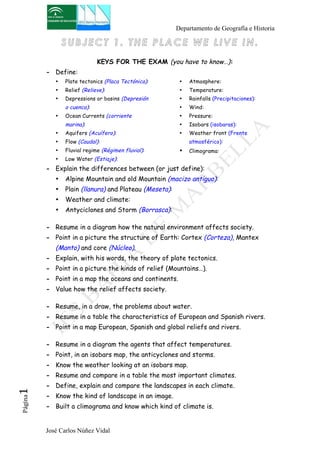
KEYS FOR THE EXAM (you have to know…): 
- Define: 
• Plate tectonics (Placa Tectónica): 
• Relief (Relieve): 
• Depressions or basins (Depresión 
o cuenca): 
• Ocean Currents (corriente 
marina): 
• Aquifers (Acuífero): 
• Flow (Caudal): 
• Fluvial regime (Régimen fluvial): 
• Low Water (Estiaje): 
José Carlos Núñez Vidal Página1 
• Atmosphere: 
• Temperature: 
• Rainfalls (Precipitaciones): 
• Wind: 
• Pressure: 
• Isobars (isobaras): 
• Weather front (Frente 
atmosférico): 
• Climograma: 
- Explain the differences between (or just define): 
• Alpine Mountain and old Mountain (macizo antiguo): 
• Plain (llanura) and Plateau (Meseta): 
• Weather and climate: 
• Antyciclones and Storm (Borrasca): 
- Resume in a diagram how the natural environment affects society. 
- Point in a picture the structure of Earth: Cortex (Corteza), Mantex 
(Manto) and core (Núcleo). 
- Explain, with his words, the theory of plate tectonics. 
- Point in a picture the kinds of relief (Mountains…). 
- Point in a map the oceans and continents. 
- Value how the relief affects society. 
- Resume, in a draw, the problems about water. 
- Resume in a table the characteristics of European and Spanish rivers. 
- Point in a map European, Spanish and global reliefs and rivers. 
- Resume in a diagram the agents that affect temperatures. 
- Point, in an isobars map, the anticyclones and storms. 
- Know the weather looking at an isobars map. 
- Resume and compare in a table the most important climates. 
- Define, explain and compare the landscapes in each climate. 
- Know the kind of landscape in an image. 
- Built a climograma and know which kind of climate is.
Departamento de Geografía e Historia 
ACTIVITIES: HOW THE NATURAL ENVIRONMENT AFFECTS 
José Carlos Núñez Vidal Página2 
SOCIETY? 
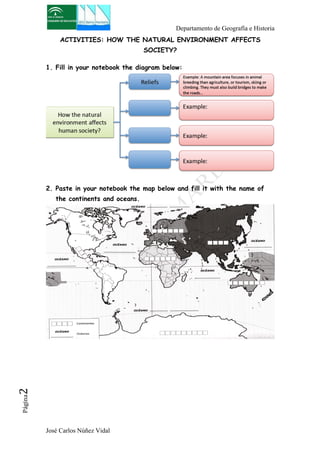
1. Fill in your notebook the diagram below: 
2. Paste in your notebook the map below and fill it with the name of 
the continents and oceans.
Departamento de Geografía e Historia 
José Carlos Núñez Vidal Página3 
ACTIVITIES: THE RELIEF. 
1. Define in your notebook and with your own words: 
a) Relief: 
b) Plate Tectonic: 
2. Write the name of each plate tectonic in the map below: 
[Search it in an atlas, internet, textbook…] 
3. Fill in your notebook the diagram below and point in the picture each 
kind of relief.
Departamento de Geografía e Historia 
ACTIVITIES: THE RELIEFS IN THE WORLD. 
1. Answer the next questions. [First, read the resume] 
a) How has the relief come up in the Earth? Can the relief change yet? 
b) What kind of relief helps the life of the people? Why? 
c) Can poor countries paid the facilities that need in order to save the 
barriers relief? What will be the consequences? 
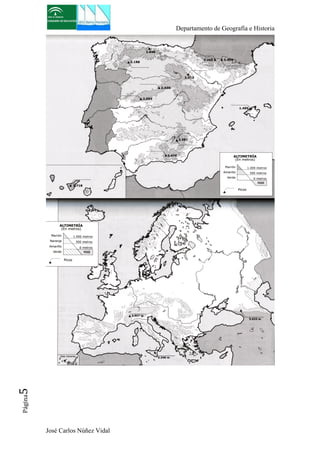
2. Paste in your notebook (or draw) the mas below, fill them and point 
the reliefs of the table. 
European 
Map 
Montes Escandinavos 
Montes Urales 
Gran Llanura Europea 
Alpes 
Cárpatos 
Balcanes 
Cáucaso 
Monte Elbrus 
José Carlos Núñez Vidal Página4 
Spanish 
Map 
Duero Valley 
South Plateau 
Sistema Central 
Macizo Galaico 
Cordillera Cantábrica 
Sistema Ibérico 
Sierra Morena 
Pirineos 
Cordillera Costero Catalana 
Cordillera Penibética 
Cordillera subbética 
Valle del Ebro 
Valle del Guadalquivir 
World 
Map 
Montañas Rocosas 
Cordillera de los Andes 
Cuenca del Missisipi 
Montes Apalaches 
Cuenca del Amazonas 
Meseta de Siberia 
Cordillera del Himalaya 
Monte Everest 
Cordillera del Atlas 
Sahara 
Kalahari 
Kilimanjaro
Departamento de Geografía e Historia 
José Carlos Núñez Vidal Página5
Departamento de Geografía e Historia 
José Carlos Núñez Vidal Página6 
ACTIVITIES: THE WATER. 
[We will do it in class, as extension activities] 
1. Read the page 3 of the resume and built a diagram titled: Why is 
water a problem? 
[The graphic below can help you] 
2. Remind the water cycle and try to complete the different stages in 
the box.
Departamento de Geografía e Historia 
ACTIVITIES: THE RIVERS OF THE WORLD. 
1. Define: 
a) Ocean Currents: 
b) Aquifers: 
c) Flow (Caudal): 
d) Fluvial regime (Régimen fluvial): 
e) Low Water (Estiaje): 
2. Complete the table below in your notebook. 
Are they Short 
or long? Why? 
José Carlos Núñez Vidal Página7 
Are they 
mighty? Why? 
Are they 
regular? 
Why? 
The most 
important are… 
Rivers of 
Atlantic Ocean 
Rivers of 
Mediterranean 
Sea 
Rivers of 
Cantabrian Sea 
Rivers of Black 
and Caspian 
Seas 
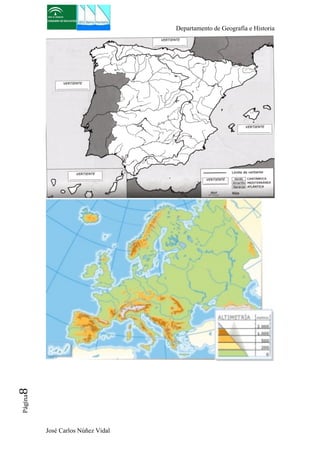
3. Paste in your Notebook (or Draw) the maps below and complete them 
with rivers, seas and lakes of the table up and colour them 
according to the map legend. [Help yourself with textbook]
Departamento de Geografía e Historia 
José Carlos Núñez Vidal Página8
Departamento de Geografía e Historia 
ACTIVITIES: WEATHER AND CLIMATE 
1. Explain the differences between: 
a) Weather and Climate: 
b) Anticyclone and Storm: 
2. Define: 
a) Atmosphere: 
b) Temperature: 
c) Weather Front: 
José Carlos Núñez Vidal Página9 
d) Pressure: 
e) Isobars: 
f) Wind: 
3. Complete, in your notebook, the diagram below [Read before the page 4 
of resume] 
4. Look at the Isobars map and answer in your notebook: 
a) What number is Anticyclone of the Azores, Iceland Depression and 
Polar front? 
b) Will it be sunny, cloudy or rainy? ¿Will it be windy? Why?
Departamento de Geografía e Historia 
WORKS ABOUT HOT CLIMATES AND LANDSCAPES 
1. Paste in your notebook (or draw) the map below and complete it 
according to the map legend. [Help yourself with the textbook] 
2. Answer the questions about the climograma: [Help yourself with textbook] 
a) What is a climograma? 
b) Do these climogramas belong to North or South Hemisphere? 
3. Complete, in your notebook, the table below: [Page 5 of the resume] 
José Carlos Núñez Vidal Página10 
Hot Climates 
Kind of climate Where is it? Temperatures Rains Landscapes 
Equatorial Climate 
Tropical Climate 
Desert climate
Departamento de Geografía e Historia 
WORKS ABOUT WARM CLIMATES AND LANDSCAPES. 
1. Complete the climogramas in your notebook and answer the 
questions. [Is better you draw the graphic] 
a) What is a climograma? 
b) Do these climogramas belong to North or South Hemisphere? 
c) At what kind of climate belongs each of them? 
2. Complete, in your notebook, the table below: [Page 5 of the resume] 
José Carlos Núñez Vidal Página11 
Warm Climates 
Kind of climate Where is it? Temperatures Rains Landscapes 
Oceanic 
Climate 
Mediterranean 
Climate 
Continental 
climate 
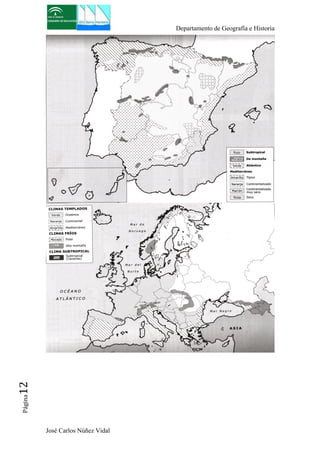
3. Paste in your notebook (or draw) the map below and complete it 
according to the map legend. [Help yourself with the textbook]
Departamento de Geografía e Historia 
José Carlos Núñez Vidal Página12
Departamento de Geografía e Historia 
WORKS ABOUT COLD CLIMATES AND LANDSCAPES. 
1. Answer the questions about the climogramas. 
[One of them is built yet, the other have to be built for you] 
a) What is a climograma? 
b) Do these climogramas belong to North or South Hemisphere? 
c) At what kind of climate belongs each of them? 
2. Complete, in your notebook, the table below: [Page 5 of the resume] 
José Carlos Núñez Vidal Página13 
Cold Climates 
Kind of climate Where is it? Temperatures Rains Landscapes 
Polar Climate 
Mountain Climate 
3. Paste in your notebook (or draw) the map below and complete it 
according to the map legend. [Help yourself with the textbook]
Departamento de Geografía e Historia 
José Carlos Núñez Vidal Página14 
REVIEW ACTIVITIES. 
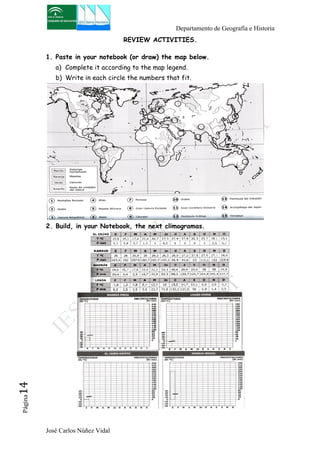
1. Paste in your notebook (or draw) the map below. 
a) Complete it according to the map legend. 
b) Write in each circle the numbers that fit. 
2. Build, in your Notebook, the next climogramas.
Departamento de Geografía e Historia 
José Carlos Núñez Vidal Página15 
EXTENSION ACTIVITIES. 
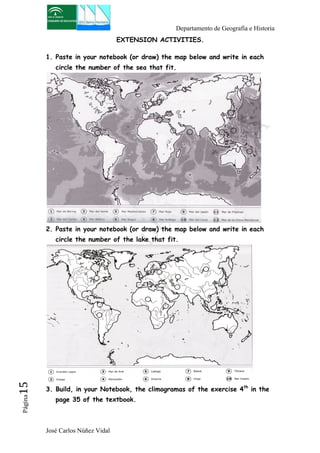
1. Paste in your notebook (or draw) the map below and write in each 
circle the number of the sea that fit. 
2. Paste in your notebook (or draw) the map below and write in each 
circle the number of the lake that fit. 
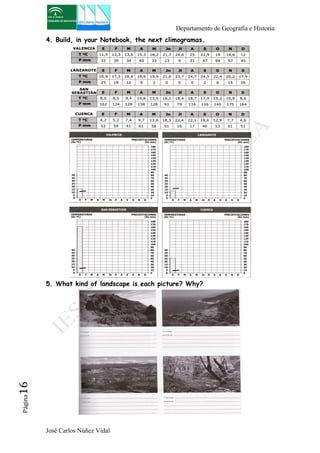
3. Build, in your Notebook, the climogramas of the exercise 4th in the 
page 35 of the textbook.
Departamento de Geografía e Historia 
4. Build, in your Notebook, the next climogramas. 
5. What kind of landscape is each picture? Why? 
José Carlos Núñez Vidal Página16

Homeworks 1 NATURAL ENVIRONMENT

  • 1.
    Departamento de Geografíae Historia UNIT 1. THE PLACE WE LIVE IN. KEYS FOR THE EXAM (you have to know…): - Define: • Plate tectonics (Placa Tectónica): • Relief (Relieve): • Depressions or basins (Depresión o cuenca): • Ocean Currents (corriente marina): • Aquifers (Acuífero): • Flow (Caudal): • Fluvial regime (Régimen fluvial): • Low Water (Estiaje): José Carlos Núñez Vidal Página1 • Atmosphere: • Temperature: • Rainfalls (Precipitaciones): • Wind: • Pressure: • Isobars (isobaras): • Weather front (Frente atmosférico): • Climograma: - Explain the differences between (or just define): • Alpine Mountain and old Mountain (macizo antiguo): • Plain (llanura) and Plateau (Meseta): • Weather and climate: • Antyciclones and Storm (Borrasca): - Resume in a diagram how the natural environment affects society. - Point in a picture the structure of Earth: Cortex (Corteza), Mantex (Manto) and core (Núcleo). - Explain, with his words, the theory of plate tectonics. - Point in a picture the kinds of relief (Mountains…). - Point in a map the oceans and continents. - Value how the relief affects society. - Resume, in a draw, the problems about water. - Resume in a table the characteristics of European and Spanish rivers. - Point in a map European, Spanish and global reliefs and rivers. - Resume in a diagram the agents that affect temperatures. - Point, in an isobars map, the anticyclones and storms. - Know the weather looking at an isobars map. - Resume and compare in a table the most important climates. - Define, explain and compare the landscapes in each climate. - Know the kind of landscape in an image. - Built a climograma and know which kind of climate is.
  • 2.
    Departamento de Geografíae Historia ACTIVITIES: HOW THE NATURAL ENVIRONMENT AFFECTS José Carlos Núñez Vidal Página2 SOCIETY? 1. Fill in your notebook the diagram below: 2. Paste in your notebook the map below and fill it with the name of the continents and oceans.
  • 3.
    Departamento de Geografíae Historia José Carlos Núñez Vidal Página3 ACTIVITIES: THE RELIEF. 1. Define in your notebook and with your own words: a) Relief: b) Plate Tectonic: 2. Write the name of each plate tectonic in the map below: [Search it in an atlas, internet, textbook…] 3. Fill in your notebook the diagram below and point in the picture each kind of relief.
  • 4.
    Departamento de Geografíae Historia ACTIVITIES: THE RELIEFS IN THE WORLD. 1. Answer the next questions. [First, read the resume] a) How has the relief come up in the Earth? Can the relief change yet? b) What kind of relief helps the life of the people? Why? c) Can poor countries paid the facilities that need in order to save the barriers relief? What will be the consequences? 2. Paste in your notebook (or draw) the mas below, fill them and point the reliefs of the table. European Map Montes Escandinavos Montes Urales Gran Llanura Europea Alpes Cárpatos Balcanes Cáucaso Monte Elbrus José Carlos Núñez Vidal Página4 Spanish Map Duero Valley South Plateau Sistema Central Macizo Galaico Cordillera Cantábrica Sistema Ibérico Sierra Morena Pirineos Cordillera Costero Catalana Cordillera Penibética Cordillera subbética Valle del Ebro Valle del Guadalquivir World Map Montañas Rocosas Cordillera de los Andes Cuenca del Missisipi Montes Apalaches Cuenca del Amazonas Meseta de Siberia Cordillera del Himalaya Monte Everest Cordillera del Atlas Sahara Kalahari Kilimanjaro
  • 5.
    Departamento de Geografíae Historia José Carlos Núñez Vidal Página5
  • 6.
    Departamento de Geografíae Historia José Carlos Núñez Vidal Página6 ACTIVITIES: THE WATER. [We will do it in class, as extension activities] 1. Read the page 3 of the resume and built a diagram titled: Why is water a problem? [The graphic below can help you] 2. Remind the water cycle and try to complete the different stages in the box.
  • 7.
    Departamento de Geografíae Historia ACTIVITIES: THE RIVERS OF THE WORLD. 1. Define: a) Ocean Currents: b) Aquifers: c) Flow (Caudal): d) Fluvial regime (Régimen fluvial): e) Low Water (Estiaje): 2. Complete the table below in your notebook. Are they Short or long? Why? José Carlos Núñez Vidal Página7 Are they mighty? Why? Are they regular? Why? The most important are… Rivers of Atlantic Ocean Rivers of Mediterranean Sea Rivers of Cantabrian Sea Rivers of Black and Caspian Seas 3. Paste in your Notebook (or Draw) the maps below and complete them with rivers, seas and lakes of the table up and colour them according to the map legend. [Help yourself with textbook]
  • 8.
    Departamento de Geografíae Historia José Carlos Núñez Vidal Página8
  • 9.
    Departamento de Geografíae Historia ACTIVITIES: WEATHER AND CLIMATE 1. Explain the differences between: a) Weather and Climate: b) Anticyclone and Storm: 2. Define: a) Atmosphere: b) Temperature: c) Weather Front: José Carlos Núñez Vidal Página9 d) Pressure: e) Isobars: f) Wind: 3. Complete, in your notebook, the diagram below [Read before the page 4 of resume] 4. Look at the Isobars map and answer in your notebook: a) What number is Anticyclone of the Azores, Iceland Depression and Polar front? b) Will it be sunny, cloudy or rainy? ¿Will it be windy? Why?
  • 10.
    Departamento de Geografíae Historia WORKS ABOUT HOT CLIMATES AND LANDSCAPES 1. Paste in your notebook (or draw) the map below and complete it according to the map legend. [Help yourself with the textbook] 2. Answer the questions about the climograma: [Help yourself with textbook] a) What is a climograma? b) Do these climogramas belong to North or South Hemisphere? 3. Complete, in your notebook, the table below: [Page 5 of the resume] José Carlos Núñez Vidal Página10 Hot Climates Kind of climate Where is it? Temperatures Rains Landscapes Equatorial Climate Tropical Climate Desert climate
  • 11.
    Departamento de Geografíae Historia WORKS ABOUT WARM CLIMATES AND LANDSCAPES. 1. Complete the climogramas in your notebook and answer the questions. [Is better you draw the graphic] a) What is a climograma? b) Do these climogramas belong to North or South Hemisphere? c) At what kind of climate belongs each of them? 2. Complete, in your notebook, the table below: [Page 5 of the resume] José Carlos Núñez Vidal Página11 Warm Climates Kind of climate Where is it? Temperatures Rains Landscapes Oceanic Climate Mediterranean Climate Continental climate 3. Paste in your notebook (or draw) the map below and complete it according to the map legend. [Help yourself with the textbook]
  • 12.
    Departamento de Geografíae Historia José Carlos Núñez Vidal Página12
  • 13.
    Departamento de Geografíae Historia WORKS ABOUT COLD CLIMATES AND LANDSCAPES. 1. Answer the questions about the climogramas. [One of them is built yet, the other have to be built for you] a) What is a climograma? b) Do these climogramas belong to North or South Hemisphere? c) At what kind of climate belongs each of them? 2. Complete, in your notebook, the table below: [Page 5 of the resume] José Carlos Núñez Vidal Página13 Cold Climates Kind of climate Where is it? Temperatures Rains Landscapes Polar Climate Mountain Climate 3. Paste in your notebook (or draw) the map below and complete it according to the map legend. [Help yourself with the textbook]
  • 14.
    Departamento de Geografíae Historia José Carlos Núñez Vidal Página14 REVIEW ACTIVITIES. 1. Paste in your notebook (or draw) the map below. a) Complete it according to the map legend. b) Write in each circle the numbers that fit. 2. Build, in your Notebook, the next climogramas.
  • 15.
    Departamento de Geografíae Historia José Carlos Núñez Vidal Página15 EXTENSION ACTIVITIES. 1. Paste in your notebook (or draw) the map below and write in each circle the number of the sea that fit. 2. Paste in your notebook (or draw) the map below and write in each circle the number of the lake that fit. 3. Build, in your Notebook, the climogramas of the exercise 4th in the page 35 of the textbook.
  • 16.
    Departamento de Geografíae Historia 4. Build, in your Notebook, the next climogramas. 5. What kind of landscape is each picture? Why? José Carlos Núñez Vidal Página16