Departamento de Geografía e Historia 
UNIT 2. THE RELIEF. 
KEYS FOR THE EXAM (you have to know…): 
- Know the basic characteristics (Thikness, material state) of each layer 
of the interior of the Earth. 
- Define Pangea. 
Define Plate Tectonics. 
Define Volcano. 
Define Earthquake. 
Define Hypocentre. 
Define each form of relief (plateau, plain…). 
- Explain, in his words, the theory of continental drift and plate tectonics. 
Explain, in his words, as acts each of the relief agents. 
Explain, in his words, as each kind of relief influences humans. 
Explain, in his own words, the geological History of Spain and Andalusia. 
- Recognize in a picture and draw each layer of the interior of the Earth: 
Cortex (Corteza), Mantex (Manto) and core (Núcleo). 
Recognize and identify in a photo the different kinds of relief 
(Mountain, plateau, plain, peninsula…) 
Recognize in a photo the action of the agents of the relief. 
- Locate on a map the continents and oceans. 
Locate on a map the main reliefs of Spain, Europe and the world, 
respectively. 
José Carlos Núñez Vidal Página1
Departamento de Geografía e Historia 
ACTIVITIES: THE LAYERS OF THE EARTH. 
1. Colour each of the layers of the Earth. Then fill in the legend of 
the right. Finally, answer the questions. 
a) What is the thicker layer? 
b) What is the main component of the core? 
c) Do the rocks beneath seas and oceans form part of the cortex? 
d) What is the main characteristic that identifies each of theses 
layers? Define Each. 
2. Complete, in your notebook, the table Below: 
[Look for the information in the textbook] 
Depth Material ¿Is it solid or liquid? Thickness 
Cortex 
Mantex 
Core 
3. Define the following concepts: 
a) Pangea: 
b) Plate Tectonics: 
c) Oceanic crust: 
d) Continental cortex: 
4. Complete the map below. 
[You can help yourself with the map on the textbook] 
José Carlos Núñez Vidal Página2
Departamento de Geografía e Historia 
5. Explain, in your own words, the theory of continental drift. 
ACTIVITIES: THE FORMATION OF THE RELIEF. 
1. Complete, in your notebook, the diagram below: 
2. Define: 
a) Relief: 
b) Hypocentre: 
c) Epicentre: 
d) Volcano: 
José Carlos Núñez Vidal Página3 
e) Earthquake: 
f) Lava: 
g) Delta: 
h) Gulf: 
3. What happens to the relief with each of the following elements: 
a) Water: 
b) Wind: 
c) Vegetation: 
d) Human Beings:
Departamento de Geografía e Historia 
ACTIVITIES: FORMS OF RELIEF. 
1. What means forms of Relief? 
2. Define these forms of Continental Relief: 
a) Mountain: 
b) Sierra: 
c) Range (Cordillera): 
José Carlos Núñez Vidal Página4 
d) Depression: 
e) Valley: 
3. Explain the differences between: 
a) Old Mountain (Macizo Antiguo) and alpine Mountain: 
b) Plateau and Plain: 
c) River Valley and glacier Valley: 
4. Define these forms of coastal relief: 
a) Peninsula: 
b) Island: 
c) Gulf: 
d) Ría: 
e) Cape: 
5. Define these forms of undersea relief: 
a) Continental shelf: 
b) Continental slope: 
c) Dorsal oceanic: 
d) Abyssal plain: 
e) Marina trench: 
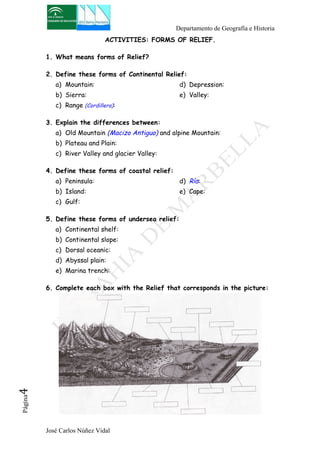
6. Complete each box with the Relief that corresponds in the picture:
Departamento de Geografía e Historia 
ACTIVITIES: THE RELIEF OF EUROPE AND SPAIN. 
1. Define: 
a) Continents: 
b) Oceans: 
2. Complete, in your notebook, the map with the name of each 
continent in the boxes and every ocean in the stripes. 
(If you do not know, search in atlas or map… Get a life!) 
3. Answer the following questions about the map above: 
a) What hemisphere has more continents? 
b) What is the continent placed at higher latitude? 
c) Which has more islands? 
d) Which is colder? 
4. Write sentences about the geographical location of the continents: 
a) Africa is located south of the Mediterranean Sea between Atlantic 
and Indian Oceans. 
b) Asia: 
c) Europe: 
d) Oceania: 
e) Antarctic: 
José Carlos Núñez Vidal Página5
Departamento de Geografía e Historia 
ACTIVITIES: RELIEF OS SPAIN. 
1. Draw in your Notebook a map of Spain and locate in it the following 
reliefs: 
Coast 
Relief 
Gulf of Lions. 
Gulf of Valencia. 
Gulf of Cadiz. 
Galician Rias. 
Cape Finisterre. 
Cape San Vicente. 
José Carlos Núñez Vidal Página6 
Strait of Gibraltar. 
Cape Gata. 
Cape Palos. 
Cape Nao. 
Delta of Ebro River. 
Cape Creus. 
Great 
Reliefs 
Cantabrian Mountains. 
Galician Massif. 
Iberian Mountain System. 
Sierra Morena. 
Pirineos. 
Cordilleras Béticas. 
Cordillera Costero Catalana. 
Depresión del Ebro. 
Depresión del Guadalquivir. 
Valle del Duero. 
Valle del Tajo. 
Islands Baleares 
Canarias 
Others 
reliefs 
Despeñaperros. 
Sierra Nevada. 
Mulhacen. 
Aneto. 
Teide.
Departamento de Geografía e Historia 
ACTIVITIES: THE RELIEF OF EUROPE. 
1. Draw in your Notebook a map of Europe and locate in it the 
following reliefs: 
Great 
Reliefs. 
José Carlos Núñez Vidal Página7 
Escandinavians Mountains 
Great European Plain. 
Macizo Central 
Cárpatos. 
Balcanes 
Alpes 
Apeninos 
Others 
Reliefs 
Jutlandia. 
Mont Blanc
Departamento de Geografía e Historia 
ACTIVITIES: THE RELIEFS OF THE WORLD. 
1. Draw in your Notebook a map of the world and locate in it the 
following reliefs: 
América Montañas Rocosas 
Cordillera de los Andes 
Escudo Canadiense 
Cuenca del Missisippi-Missouri 
Montes Apalaches 
Cuenca del Amazonas 
Meseta Brasileña 
Asia Urales 
Siberia 
Cáucaso 
Himalaya 
Everest 
África Atlas 
Sahara 
Rift Valley 
Kalahari 
Kilimanjaro 
José Carlos Núñez Vidal Página8
Departamento de Geografía e Historia 
José Carlos Núñez Vidal Página9 
REVIEW ACTIVITIES. 
1. Complete the map with the two thinks I ask you [You have help on 
the map in the textbook] 
a) Colour each kind of Relief according to legend. 
b) Put in each circle the number of relief that corresponds. 
2. Using the dates below, built a graphic about the surface of the 
continents and the total surface of the emerged lands. 
Asia: 44. 513.313 Km2 
América: 42.035.238 Km2 
África: 30.180.808 Km2 
Antártica: 13.176.727 Km2 
Europa: 10.522.140 Km2 
Oceanía: 8. 945.728 Km2 
3. Compare it with the graphic to the oceans and say if it is true that: 
a) Oceans and seas occupy two-thirds of the Earth. 
b) The Pacific Ocean is greater than all the landmasses together.

Homeworks 2 The Relief

  • 1.
    Departamento de Geografíae Historia UNIT 2. THE RELIEF. KEYS FOR THE EXAM (you have to know…): - Know the basic characteristics (Thikness, material state) of each layer of the interior of the Earth. - Define Pangea. Define Plate Tectonics. Define Volcano. Define Earthquake. Define Hypocentre. Define each form of relief (plateau, plain…). - Explain, in his words, the theory of continental drift and plate tectonics. Explain, in his words, as acts each of the relief agents. Explain, in his words, as each kind of relief influences humans. Explain, in his own words, the geological History of Spain and Andalusia. - Recognize in a picture and draw each layer of the interior of the Earth: Cortex (Corteza), Mantex (Manto) and core (Núcleo). Recognize and identify in a photo the different kinds of relief (Mountain, plateau, plain, peninsula…) Recognize in a photo the action of the agents of the relief. - Locate on a map the continents and oceans. Locate on a map the main reliefs of Spain, Europe and the world, respectively. José Carlos Núñez Vidal Página1
  • 2.
    Departamento de Geografíae Historia ACTIVITIES: THE LAYERS OF THE EARTH. 1. Colour each of the layers of the Earth. Then fill in the legend of the right. Finally, answer the questions. a) What is the thicker layer? b) What is the main component of the core? c) Do the rocks beneath seas and oceans form part of the cortex? d) What is the main characteristic that identifies each of theses layers? Define Each. 2. Complete, in your notebook, the table Below: [Look for the information in the textbook] Depth Material ¿Is it solid or liquid? Thickness Cortex Mantex Core 3. Define the following concepts: a) Pangea: b) Plate Tectonics: c) Oceanic crust: d) Continental cortex: 4. Complete the map below. [You can help yourself with the map on the textbook] José Carlos Núñez Vidal Página2
  • 3.
    Departamento de Geografíae Historia 5. Explain, in your own words, the theory of continental drift. ACTIVITIES: THE FORMATION OF THE RELIEF. 1. Complete, in your notebook, the diagram below: 2. Define: a) Relief: b) Hypocentre: c) Epicentre: d) Volcano: José Carlos Núñez Vidal Página3 e) Earthquake: f) Lava: g) Delta: h) Gulf: 3. What happens to the relief with each of the following elements: a) Water: b) Wind: c) Vegetation: d) Human Beings:
  • 4.
    Departamento de Geografíae Historia ACTIVITIES: FORMS OF RELIEF. 1. What means forms of Relief? 2. Define these forms of Continental Relief: a) Mountain: b) Sierra: c) Range (Cordillera): José Carlos Núñez Vidal Página4 d) Depression: e) Valley: 3. Explain the differences between: a) Old Mountain (Macizo Antiguo) and alpine Mountain: b) Plateau and Plain: c) River Valley and glacier Valley: 4. Define these forms of coastal relief: a) Peninsula: b) Island: c) Gulf: d) Ría: e) Cape: 5. Define these forms of undersea relief: a) Continental shelf: b) Continental slope: c) Dorsal oceanic: d) Abyssal plain: e) Marina trench: 6. Complete each box with the Relief that corresponds in the picture:
  • 5.
    Departamento de Geografíae Historia ACTIVITIES: THE RELIEF OF EUROPE AND SPAIN. 1. Define: a) Continents: b) Oceans: 2. Complete, in your notebook, the map with the name of each continent in the boxes and every ocean in the stripes. (If you do not know, search in atlas or map… Get a life!) 3. Answer the following questions about the map above: a) What hemisphere has more continents? b) What is the continent placed at higher latitude? c) Which has more islands? d) Which is colder? 4. Write sentences about the geographical location of the continents: a) Africa is located south of the Mediterranean Sea between Atlantic and Indian Oceans. b) Asia: c) Europe: d) Oceania: e) Antarctic: José Carlos Núñez Vidal Página5
  • 6.
    Departamento de Geografíae Historia ACTIVITIES: RELIEF OS SPAIN. 1. Draw in your Notebook a map of Spain and locate in it the following reliefs: Coast Relief Gulf of Lions. Gulf of Valencia. Gulf of Cadiz. Galician Rias. Cape Finisterre. Cape San Vicente. José Carlos Núñez Vidal Página6 Strait of Gibraltar. Cape Gata. Cape Palos. Cape Nao. Delta of Ebro River. Cape Creus. Great Reliefs Cantabrian Mountains. Galician Massif. Iberian Mountain System. Sierra Morena. Pirineos. Cordilleras Béticas. Cordillera Costero Catalana. Depresión del Ebro. Depresión del Guadalquivir. Valle del Duero. Valle del Tajo. Islands Baleares Canarias Others reliefs Despeñaperros. Sierra Nevada. Mulhacen. Aneto. Teide.
  • 7.
    Departamento de Geografíae Historia ACTIVITIES: THE RELIEF OF EUROPE. 1. Draw in your Notebook a map of Europe and locate in it the following reliefs: Great Reliefs. José Carlos Núñez Vidal Página7 Escandinavians Mountains Great European Plain. Macizo Central Cárpatos. Balcanes Alpes Apeninos Others Reliefs Jutlandia. Mont Blanc
  • 8.
    Departamento de Geografíae Historia ACTIVITIES: THE RELIEFS OF THE WORLD. 1. Draw in your Notebook a map of the world and locate in it the following reliefs: América Montañas Rocosas Cordillera de los Andes Escudo Canadiense Cuenca del Missisippi-Missouri Montes Apalaches Cuenca del Amazonas Meseta Brasileña Asia Urales Siberia Cáucaso Himalaya Everest África Atlas Sahara Rift Valley Kalahari Kilimanjaro José Carlos Núñez Vidal Página8
  • 9.
    Departamento de Geografíae Historia José Carlos Núñez Vidal Página9 REVIEW ACTIVITIES. 1. Complete the map with the two thinks I ask you [You have help on the map in the textbook] a) Colour each kind of Relief according to legend. b) Put in each circle the number of relief that corresponds. 2. Using the dates below, built a graphic about the surface of the continents and the total surface of the emerged lands. Asia: 44. 513.313 Km2 América: 42.035.238 Km2 África: 30.180.808 Km2 Antártica: 13.176.727 Km2 Europa: 10.522.140 Km2 Oceanía: 8. 945.728 Km2 3. Compare it with the graphic to the oceans and say if it is true that: a) Oceans and seas occupy two-thirds of the Earth. b) The Pacific Ocean is greater than all the landmasses together.