UNIT 2
THE NATURAL ENVIRONMENT
INTRODUCTORY ACTIVITY
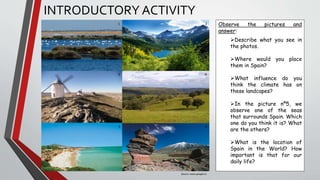
1 2
3 4
5 6
Observe the pictures and
answer:
Describe what you see in
the photos.
Where would you place
them in Spain?
What influence do you
think the climate has on
these landcapes?
In the picture nº5, we
observe one of the seas
that surrounds Spain. Which
one do you think it is? What
are the others?
What is the location of
Spain in the World? How
important is that for our
daily life?
Source: www.google.es
CONTENTS
AND
ACTIVITIES
GLOSSARY
• Mountain range
• Plateau
• Plain
• Hill
• Valley
• Depression
• Archipelago
• Ria
• Peninsula
• Gulf
• Bay
• Cape
• Marsh
• Delta
• Estuary
• Cliff
• River basin
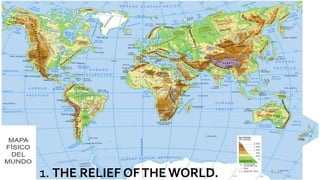
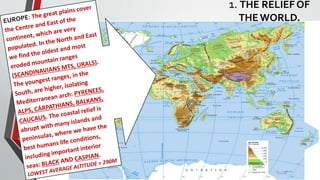
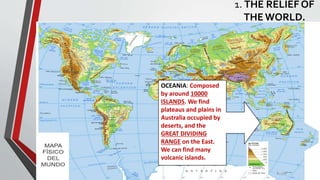
1. THE RELIEF OFTHE WORLD.
1. THE RELIEF OF
THE WORLD.
1. THE RELIEF OF
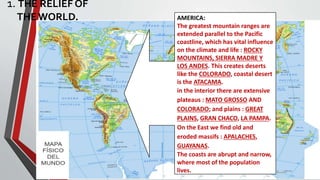
THEWORLD. AMERICA:
The greatest mountain ranges are
extended parallel to the Pacific
coastline, which has vital influence
on the climate and life : ROCKY
MOUNTAINS, SIERRA MADRE Y
LOS ANDES. This creates deserts
like the COLORADO, coastal desert
is the ATACAMA.
in the interior there are extensive
plateaus : MATO GROSSO AND
COLORADO; and plains : GREAT
PLAINS, GRAN CHACO, LA PAMPA.
On the East we find old and
eroded massifs : APALACHES,
GUAYANAS.
The coasts are abrupt and narrow,
where most of the population
lives.
1. THE RELIEF OF
THEWORLD.
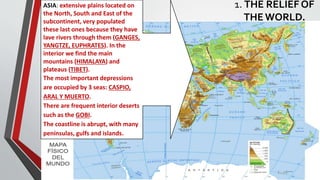
ASIA: extensive plains located on
the North, South and East of the
subcontinent, very populated
these last ones because they have
lave rivers through them (GANGES,
YANGTZE, EUPHRATES). In the
interior we find the main
mountains (HIMALAYA) and
plateaus (TIBET).
The most important depressions
are occupied by 3 seas: CASPIO,
ARAL Y MUERTO.
There are frequent interior deserts
such as the GOBI.
The coastline is abrupt, with many
penínsulas, gulfs and islands.
1. THE RELIEF OF
THEWORLD.
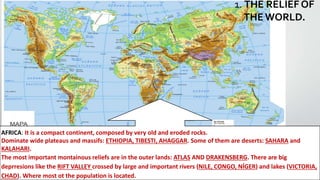
AFRICA: It is a compact continent, composed by very old and eroded rocks.
Dominate wide plateaus and massifs: ETHIOPIA, TIBESTI, AHAGGAR. Some of them are deserts: SAHARA and
KALAHARI.
The most important montainous reliefs are in the outer lands: ATLAS AND DRAKENSBERG. There are big
deprresions like the RIFT VALLEY crossed by large and important rivers (NILE, CONGO, NÍGER) and lakes (VICTORIA,
CHAD). Where most ot the population is located.
OCEANIA: Composed
by around 10000
ISLANDS. We find
plateaus and plains in
Australia occupied by
deserts, and the
GREAT DIVIDING
RANGE on the East.
We can find many
volcanic islands.
1. THE RELIEF OF
THEWORLD.
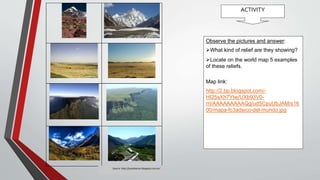
ACTIVITY
Fuente: http://juanbascon.blogspot.com.es/
Observe the pictures and answer:
What kind of relief are they showing?
Locate on the world map 5 examples
of these reliefs.
Map link:
http://2.bp.blogspot.com/-
HI25sXh7Ytw/UXb93V0-
rrI/AAAAAAAAAQg/ud5CpuUbJAM/s16
00/mapa-fc3adsico-del-mundo.jpg
Source: http://juanbascon.blogspot.com.es/
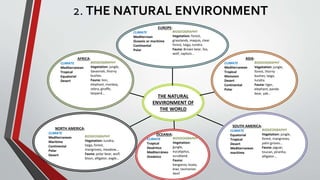
2. THE NATURAL ENVIRONMENT
THE NATURAL
ENVIRONMENT OF
THE WORLD
EUROPE:
CLIMATE
Mediterrean
Oceanic or maritime
Continental
Polar
BIOGEOGRAPHY
Vegetation: forest,
grasslands, maquis, clear
forest, taiga, tundra.
Fauna: Brown bear, fox,
wolf, raptors…
ASIA:
CLIMATE
Mediterranean
Tropical
Monsoon
Desert
Continental
Polar
BIOGEOGRAPHY
Vegetation: jungle,
forest, thorny
bushes, taiga,
tundra.
Fauna: tiger,
elephant, panda
bear, yak…
SOUTH AMERICA:
CLIMATE
Equatorial
Tropical
Desert
Mediterranean
maritime
BIOGEOGRAPHY
Vegetation: jungle,
forest, mangroves,
palm groves...
Fauna: jaguar,
toucan, piranha,
alligator…
OCEANIA:
CLIMATE
Tropical
Desértico
Mediterráneo
Oceánico
BIOGEOGRAPHY
Vegetation:
jungle,
eucalyptus,
scrubland.
Fauna:
kangaroo, koala,
kiwi, tasmanian
devil
NORTH AMERICA:
CLIMATE
Mediterranean
Maritime
Continental
Polar
Desert
BIOGEOGRAPHY
Vegetation: tundra,
taiga, forest,
mangroves, meadow…
Fauna: polar bear, wolf,
bison, alligator, eagle…
AFRICA:
CLIMATE
Mediterranean
Tropical
Equatorial
Desert
BIOGEOGRAPHY
Vegetation: jungle,
Savannah, thorny
bushes.
Fauna: lion,
elephant, monkey,
zebra, giraffe,
leopard…
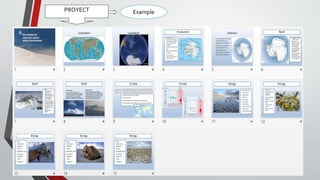
PROYECT
GROUPWORK:
Divide the classroon in groups and choose 1 continent (Europe,
Asia, Africa, Oceanía, North America, South America), you must
create a presentation that contains all the information about the
continent that we have seen (10-15min. aprox). The contents of the
Project are the following:
1. COVER (INCLUDING NAMES)
2. LOCATION
3. INTRODUCTION > EXTENSION AND GEOGRAPHICAL
CURIOSITIES OF THE COTINENT.
4. MAIN UNITS OF RELIEF (INCLUDING PICTURES AND
LOCALIZATION ON A MAP)
5. BIOGEOGRAPHY (INCLUDING PICTURES).
The Project will be handed over after its exposition in a digital format
for being evaluated. The ítems taken into account will be :
-Clear and accurate exposition.
-Appopiate contents.
-Atractive presentation of the contents.
PROYECT Example
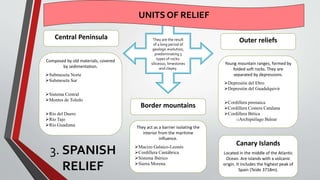
They are the result
of a long period of
geologic evolution,
predominating 3
types of rocks:
siliceous, limestones
and clayey.
3. SPANISH
RELIEF
UNITS OF RELIEF
Composed by old materials, covered
by sedimentation.
Submeseta Norte
Submeseta Sur
Sistema Central
Montes de Toledo
Río del Duero
Río Tajo
Río Guadiana
Central Peninsula
Border mountains
They act as a barrier isolating the
interior from the maritime
influence.
Macizo Galaico-Leonés
Cordillera Cantábrica
Sistema Ibérico
Sierra Morena
Outer reliefs
Young mountain ranges, formed by
folded soft rocks. They are
separated by depressions.
Depresión del Ebro
Depresión del Guadalquivir
Cordillera pirenaica
Cordillera Costera Catalana
Cordillera Bética
oArchipiélago Balear
Canary Islands
Located in the middle of the Atlantic
Ocean. Are islands with a volcanic
origin. It includes the highest peak of
Spain (Teide 3718m).
Spanish
relief
evolution
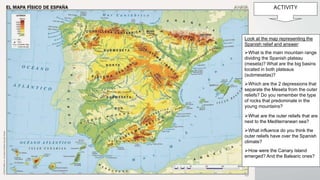
ACTIVITY
Look at the map representing the
Spanish relief and answer:
What is the main mountain range
dividing the Spanish plateau
(meseta)? What are the big basins
located in both plateaus
(submesetas)?
Which are the 2 depressions that
separate the Meseta from the outer
reliefs? Do you remember the type
of rocks that predominate in the
young mountains?
What are the outer reliefs that are
next to the Mediterranean sea?
What influence do you think the
outer reliefs have over the Spanish
climate?
How were the Canary Island
emerged? And the Balearic ones?
4. SPANISH
CLIMATE
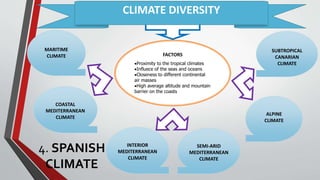
CLIMATE DIVERSITY
MARITIME
CLIMATE
COASTAL
MEDITERRANEAN
CLIMATE
INTERIOR
MEDITERRANEAN
CLIMATE
SEMI-ARID
MEDITERRANEAN
CLIMATE
ALPINE
CLIMATE
SUBTROPICAL
CANARIAN
CLIMATE
FACTORS
Proximity to the tropical climates
Influece of the seas and oceans
Closeness to different continental
air masses
High average altitude and mountain
barrier on the coasts
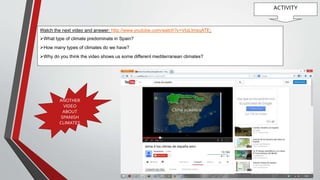
ACTIVITY
Watch the next video and answer: http://www.youtube.com/watch?v=VIqLlmsqATE:
What type of climate predominate in Spain?
How many types of climates do we have?
Why do you think the video shows us some different mediterranean climates?
ANOTHER
VIDEO
ABOUT
SPANISH
CLIMATES
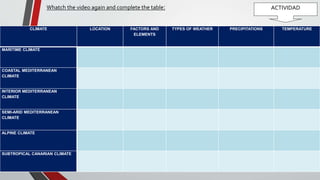
Whatch the video again and complete the table: ACTIVIDAD
CLIMATE LOCATION FACTORS AND
ELEMENTS
TYPES OF WEATHER PRECIPITATIONS TEMPERATURE
MARITIME CLIMATE
COASTAL MEDITERRANEAN
CLIMATE
INTERIOR MEDITERRANEAN
CLIMATE
SEMI-ARID MEDITERRANEAN
CLIMATE
ALPINE CLIMATE
SUBTROPICAL CANARIAN CLIMATE
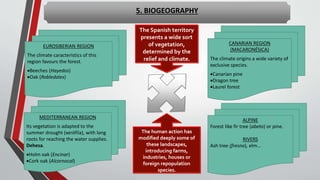
5. BIOGEOGRAPHY
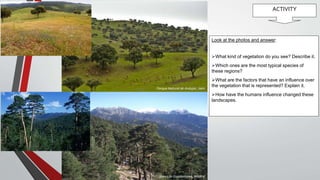
The Spanish territory
presents a wide sort
of vegetation,
determined by the
relief and climate.
The human action has
modified deeply some of
these landscapes,
introducing farms,
industries, houses or
foreign repopulation
species.
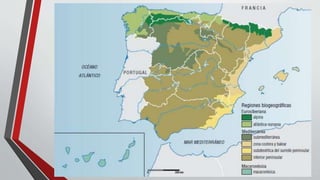
EUROSIBERIAN REGION
The climate caracteristics of this
region favours the forest.
Beeches (Hayedos)
Oak (Robledales)
MEDITERRANEAN REGION
Its vegetation is adapted to the
summer drought (xerófila), with long
roots for reaching the water supplies.
Dehesa.
Holm oak (Encinar)
Cork oak (Alcornocal)
CANARIAN REGION
(MACARONÉSICA)
The climate origins a wide variety of
exclusive species.
Canarian pine
Dragon tree
Laurel forest
ALPINE
Forest like fir tree (abeto) or pine.
RIVERS
Ash tree (fresno), elm…
ACTIVITY
Parque Natural de Andújar, Jaén
Sierra de Guadarrama, Madrid
Look at the photos and answer:
What kind of vegetation do you see? Describe it.
Which ones are the most typical species of
these regions?
What are the factors that have an influence over
the vegetation that is represented? Explain it.
How have the humans influence changed these
landscapes.
VOCABULARY
• Mountain range
• Plateau
• Plain
• Hill
• Valley
• Depression
• Archipelago
• Ria
• Peninsula
• Gulf
• Bay
• Cape
• Marsh
• Delta
• Estuary
• Cliff
• River basin
• FranciscoJavier Montaño Fernández
Geography and History teacher

Unit 2. the natural environment

  • 1.
    UNIT 2 THE NATURALENVIRONMENT
  • 2.
    INTRODUCTORY ACTIVITY 1 2 34 5 6 Observe the pictures and answer: Describe what you see in the photos. Where would you place them in Spain? What influence do you think the climate has on these landcapes? In the picture nº5, we observe one of the seas that surrounds Spain. Which one do you think it is? What are the others? What is the location of Spain in the World? How important is that for our daily life? Source: www.google.es
  • 3.
  • 4.
    GLOSSARY • Mountain range •Plateau • Plain • Hill • Valley • Depression • Archipelago • Ria • Peninsula • Gulf • Bay • Cape • Marsh • Delta • Estuary • Cliff • River basin
  • 5.
    1. THE RELIEFOFTHE WORLD.
  • 6.
    1. THE RELIEFOF THE WORLD.
  • 7.
    1. THE RELIEFOF THEWORLD. AMERICA: The greatest mountain ranges are extended parallel to the Pacific coastline, which has vital influence on the climate and life : ROCKY MOUNTAINS, SIERRA MADRE Y LOS ANDES. This creates deserts like the COLORADO, coastal desert is the ATACAMA. in the interior there are extensive plateaus : MATO GROSSO AND COLORADO; and plains : GREAT PLAINS, GRAN CHACO, LA PAMPA. On the East we find old and eroded massifs : APALACHES, GUAYANAS. The coasts are abrupt and narrow, where most of the population lives.
  • 8.
    1. THE RELIEFOF THEWORLD. ASIA: extensive plains located on the North, South and East of the subcontinent, very populated these last ones because they have lave rivers through them (GANGES, YANGTZE, EUPHRATES). In the interior we find the main mountains (HIMALAYA) and plateaus (TIBET). The most important depressions are occupied by 3 seas: CASPIO, ARAL Y MUERTO. There are frequent interior deserts such as the GOBI. The coastline is abrupt, with many penínsulas, gulfs and islands.
  • 9.
    1. THE RELIEFOF THEWORLD. AFRICA: It is a compact continent, composed by very old and eroded rocks. Dominate wide plateaus and massifs: ETHIOPIA, TIBESTI, AHAGGAR. Some of them are deserts: SAHARA and KALAHARI. The most important montainous reliefs are in the outer lands: ATLAS AND DRAKENSBERG. There are big deprresions like the RIFT VALLEY crossed by large and important rivers (NILE, CONGO, NÍGER) and lakes (VICTORIA, CHAD). Where most ot the population is located.
  • 10.
    OCEANIA: Composed by around10000 ISLANDS. We find plateaus and plains in Australia occupied by deserts, and the GREAT DIVIDING RANGE on the East. We can find many volcanic islands. 1. THE RELIEF OF THEWORLD.
  • 11.
    ACTIVITY Fuente: http://juanbascon.blogspot.com.es/ Observe thepictures and answer: What kind of relief are they showing? Locate on the world map 5 examples of these reliefs. Map link: http://2.bp.blogspot.com/- HI25sXh7Ytw/UXb93V0- rrI/AAAAAAAAAQg/ud5CpuUbJAM/s16 00/mapa-fc3adsico-del-mundo.jpg Source: http://juanbascon.blogspot.com.es/
  • 12.
    2. THE NATURALENVIRONMENT THE NATURAL ENVIRONMENT OF THE WORLD EUROPE: CLIMATE Mediterrean Oceanic or maritime Continental Polar BIOGEOGRAPHY Vegetation: forest, grasslands, maquis, clear forest, taiga, tundra. Fauna: Brown bear, fox, wolf, raptors… ASIA: CLIMATE Mediterranean Tropical Monsoon Desert Continental Polar BIOGEOGRAPHY Vegetation: jungle, forest, thorny bushes, taiga, tundra. Fauna: tiger, elephant, panda bear, yak… SOUTH AMERICA: CLIMATE Equatorial Tropical Desert Mediterranean maritime BIOGEOGRAPHY Vegetation: jungle, forest, mangroves, palm groves... Fauna: jaguar, toucan, piranha, alligator… OCEANIA: CLIMATE Tropical Desértico Mediterráneo Oceánico BIOGEOGRAPHY Vegetation: jungle, eucalyptus, scrubland. Fauna: kangaroo, koala, kiwi, tasmanian devil NORTH AMERICA: CLIMATE Mediterranean Maritime Continental Polar Desert BIOGEOGRAPHY Vegetation: tundra, taiga, forest, mangroves, meadow… Fauna: polar bear, wolf, bison, alligator, eagle… AFRICA: CLIMATE Mediterranean Tropical Equatorial Desert BIOGEOGRAPHY Vegetation: jungle, Savannah, thorny bushes. Fauna: lion, elephant, monkey, zebra, giraffe, leopard…
  • 13.
    PROYECT GROUPWORK: Divide the classroonin groups and choose 1 continent (Europe, Asia, Africa, Oceanía, North America, South America), you must create a presentation that contains all the information about the continent that we have seen (10-15min. aprox). The contents of the Project are the following: 1. COVER (INCLUDING NAMES) 2. LOCATION 3. INTRODUCTION > EXTENSION AND GEOGRAPHICAL CURIOSITIES OF THE COTINENT. 4. MAIN UNITS OF RELIEF (INCLUDING PICTURES AND LOCALIZATION ON A MAP) 5. BIOGEOGRAPHY (INCLUDING PICTURES). The Project will be handed over after its exposition in a digital format for being evaluated. The ítems taken into account will be : -Clear and accurate exposition. -Appopiate contents. -Atractive presentation of the contents.
  • 14.
  • 15.
    They are theresult of a long period of geologic evolution, predominating 3 types of rocks: siliceous, limestones and clayey. 3. SPANISH RELIEF UNITS OF RELIEF Composed by old materials, covered by sedimentation. Submeseta Norte Submeseta Sur Sistema Central Montes de Toledo Río del Duero Río Tajo Río Guadiana Central Peninsula Border mountains They act as a barrier isolating the interior from the maritime influence. Macizo Galaico-Leonés Cordillera Cantábrica Sistema Ibérico Sierra Morena Outer reliefs Young mountain ranges, formed by folded soft rocks. They are separated by depressions. Depresión del Ebro Depresión del Guadalquivir Cordillera pirenaica Cordillera Costera Catalana Cordillera Bética oArchipiélago Balear Canary Islands Located in the middle of the Atlantic Ocean. Are islands with a volcanic origin. It includes the highest peak of Spain (Teide 3718m).
  • 16.
  • 17.
    ACTIVITY Look at themap representing the Spanish relief and answer: What is the main mountain range dividing the Spanish plateau (meseta)? What are the big basins located in both plateaus (submesetas)? Which are the 2 depressions that separate the Meseta from the outer reliefs? Do you remember the type of rocks that predominate in the young mountains? What are the outer reliefs that are next to the Mediterranean sea? What influence do you think the outer reliefs have over the Spanish climate? How were the Canary Island emerged? And the Balearic ones?
  • 18.
    4. SPANISH CLIMATE CLIMATE DIVERSITY MARITIME CLIMATE COASTAL MEDITERRANEAN CLIMATE INTERIOR MEDITERRANEAN CLIMATE SEMI-ARID MEDITERRANEAN CLIMATE ALPINE CLIMATE SUBTROPICAL CANARIAN CLIMATE FACTORS Proximityto the tropical climates Influece of the seas and oceans Closeness to different continental air masses High average altitude and mountain barrier on the coasts
  • 19.
    ACTIVITY Watch the nextvideo and answer: http://www.youtube.com/watch?v=VIqLlmsqATE: What type of climate predominate in Spain? How many types of climates do we have? Why do you think the video shows us some different mediterranean climates? ANOTHER VIDEO ABOUT SPANISH CLIMATES
  • 20.
    Whatch the videoagain and complete the table: ACTIVIDAD CLIMATE LOCATION FACTORS AND ELEMENTS TYPES OF WEATHER PRECIPITATIONS TEMPERATURE MARITIME CLIMATE COASTAL MEDITERRANEAN CLIMATE INTERIOR MEDITERRANEAN CLIMATE SEMI-ARID MEDITERRANEAN CLIMATE ALPINE CLIMATE SUBTROPICAL CANARIAN CLIMATE
  • 21.
    5. BIOGEOGRAPHY The Spanishterritory presents a wide sort of vegetation, determined by the relief and climate. The human action has modified deeply some of these landscapes, introducing farms, industries, houses or foreign repopulation species. EUROSIBERIAN REGION The climate caracteristics of this region favours the forest. Beeches (Hayedos) Oak (Robledales) MEDITERRANEAN REGION Its vegetation is adapted to the summer drought (xerófila), with long roots for reaching the water supplies. Dehesa. Holm oak (Encinar) Cork oak (Alcornocal) CANARIAN REGION (MACARONÉSICA) The climate origins a wide variety of exclusive species. Canarian pine Dragon tree Laurel forest ALPINE Forest like fir tree (abeto) or pine. RIVERS Ash tree (fresno), elm…
  • 23.
    ACTIVITY Parque Natural deAndújar, Jaén Sierra de Guadarrama, Madrid Look at the photos and answer: What kind of vegetation do you see? Describe it. Which ones are the most typical species of these regions? What are the factors that have an influence over the vegetation that is represented? Explain it. How have the humans influence changed these landscapes.
  • 24.
    VOCABULARY • Mountain range •Plateau • Plain • Hill • Valley • Depression • Archipelago • Ria • Peninsula • Gulf • Bay • Cape • Marsh • Delta • Estuary • Cliff • River basin
  • 25.
    • FranciscoJavier MontañoFernández Geography and History teacher