Departamento de Geografía e Historia 
UNIT 3. THE WATER. 
KEYS FOR THE EXAM (you have to know…): 
- Define: 
• Hydrosphere. 
• Water cicle and each of their processes (Evaporation, condensation, 
infiltration…). 
• Wave, tides (Mareas) and sea currents (Corrientes marinas). 
• Dam/reservoir (Embalse/presa). 
• Basin (Cuenca), flow (Caudal), river system (Régimen fluvial). 
• Planta potabilizadora/desaladora. 
- Define and/or compare: 
• Seas and oceans. 
• Lakes and rivers. 
• Drought (estiaje) and flood (Crecida). 
- Resume and compare in a table the characteristics of the spanish rivers. 
- Explain the effets of: 
• Waves, tides and cold or warm sea currents. 
• Relief in each different sector of a river. 
- Explain the posibilities of use fresh water and salt water. 
- Analyse graphics about: 
• Water distribution on Earth. 
• Annual variation of river flow. 
• Water uses. 
- Recognize the kind of river in graphics, estatistics, phrases… 
- Apreciate the problem of water and the different access to it for 
population. 
- Point in a map: 
• Oceans and main seas. 
• Main rivers and lakes of the world, Europe and Spain. 
José Carlos Núñez Vidal Página1
Departamento de Geografía e Historia 
ACTIVITIES. WATER IN NATURAL ENVIROMENT. 
1. What is the Hydrosphere? 
2. Describe the following diagram explaining each step of the water 
cycle. 
[You can hel yourself with the resume] 
3. What is the water cycle? 
[Search the meaning on the textbook and the resume but write it in 
your own words] 
José Carlos Núñez Vidal Página2
Departamento de Geografía e Historia 
ACTIVITIES: THE WATER OF THE OCEANS AND SEAS. 
1. Define: 
a) Seas: 
b) Oceans: 
c) Waves: 
d) Tides: 
e) Ocean current: 
2. Look at the map and answer the questions: 
[You have help in the textbook 
a) Are cold current directed toward the poles or to Ecuador? 
b) Where are warm currents directed generally? 
c) Why doesn´t snow in the coast of Spain when is snowing in New York, 
which is on the same latitude? 
d) Why does not rain in the coast near to a cold current? Is cold water 
evaporated? 
José Carlos Núñez Vidal Página3
Departamento de Geografía e Historia 
ACTIVITIES: RIVERS AND LAKES. 
1. Define: 
a) River: 
b) Lake: 
c) Cauce o Cuenca: 
d) Flow (Caudal): 
José Carlos Núñez Vidal Página4 
e) Fluvial Regime: 
f) Flood: 
g) Low Water: 
h) Delta: 
2. Explain the differences between: 
a) Seas and oceans: 
b) Pluvial regime and snowy regime: 
c) Erosion and sedimentation: 
3. What means that a river is regular? 
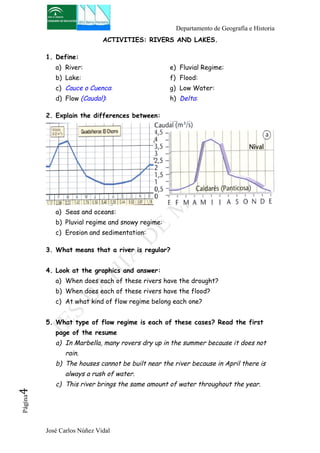
4. Look at the graphics and answer: 
a) When does each of these rivers have the drought? 
b) When does each of these rivers have the flood? 
c) At what kind of flow regime belong each one? 
5. What type of flow regime is each of these cases? Read the first 
page of the resume 
a) In Marbella, many rovers dry up in the summer because it does not 
rain. 
b) The houses cannot be built near the river because in April there is 
always a rush of water. 
c) This river brings the same amount of water throughout the year.
Departamento de Geografía e Historia 
ACTIVITIES: THE PROBLEM OF WATER. 
1. Look at the graphic and answer: 
a) What is most abundant on Earth: fresh or salt water? At what rate? 
b) Why do we say that water is a problem? 
2. What is the drinking water? 
3. Look at the graphic below and answer. 
[You can find help on the textbook and resume] 
a) How has the global consume of water changed? 
b) What is water used mostly? 
c) Do you think that this use is equal in poor countries and rich 
countries? Why? 
4. Define: 
a) Water treatment plant (Planta Potabilizadora): 
b) Reservoir/dam (Embalse o presa): 
José Carlos Núñez Vidal Página5
Departamento de Geografía e Historia 
ACTIVITIES: RIVERS OF THE WORLD. 
1. Draw in your notebook a world map and locate on it the following: 
América Alaska. 
Islas Aleutianas. 
Estrecho de Bering 
Grandes Lagos 
Península de California. 
Península del Labrador. 
Río Missisippi 
Península de Florida. 
Península del Yucatán. 
José Carlos Núñez Vidal Página6 
Antillas. 
Golfo de México. 
Mar Caribe 
Río de la plata. 
Amazonas 
Orinoco 
Cabo de Hornos 
Estrecho de Magallanes. 
Asia Península de la India 
Mar Arábigo. 
Península Arábiga 
Indochina 
Río Rojo. 
Río Amarillo. 
Golfo Pérsico 
Filipinas. 
Mar Caspio 
África Mar Rojo 
Golfo de Guinea 
Cabo de Buena Esperanza. 
Madagascar 
Península de Somalia. 
Río Nilo. 
Río Níger. 
Río Congo 
Lago Victoria. 
Oceanía Australia. 
Melanesia 
Polinesia. 
Micronesia. 
Nueva Zelanda
Departamento de Geografía e Historia 
ACTIVITIES: RIVERS OF EUROPE. 
1. Draw in your notebook a European map and locate on it the 
following: 
Seas Mar de Barents 
José Carlos Núñez Vidal Página7 
Mar Báltico 
Mar del Norte 
Mar Tirreno. 
Mar Adriático. 
Mar Jónico. 
Mar Egeo. 
Rivers Loira. 
Sena. 
Rin 
Elba. 
Po. 
Danubio. 
Dniéster. 
Dnieper. 
Don 
Volga. 
2. Complete the table comparing the rivers of Europe. [Use the resume] 
¿Are they 
long or 
short? 
Why? 
Are they 
plentiful? 
Why? 
Are they 
regular? 
Why? 
Which are the 
most 
important? 
Atlantic rivers 
Mediterranean 
rivers
Departamento de Geografía e Historia 
ACTIVITIES: RIVERS OF SPAIN. 
1. Draw in your notebook a Spanish map and locate on it the following: 
Rivers - Miño. 
- Duero. 
- Tajo. 
- Guadiana. 
- Guadalquivir. 
- Segura. 
José Carlos Núñez Vidal Página8 
- Júcar. 
- Turia. 
- Ebro. 
- Ter. 
- Llobregat. 
Seas 
and 
oceans 
- Cantábrico. 
- Atlántico. 
- Mediterráneo. 
2. Complete the table comparing the rivers of Spain. [Use the resume] 
¿Are they 
long or 
short? 
Why? 
Are they 
plentiful? 
Why? 
Are they 
regular? 
Why? 
Which are the 
most 
important? 
Atlantic rivers 
Mediterranean 
rivers 
Cantabrico 
Rivers

Homeworks 3 WATER

  • 1.
    Departamento de Geografíae Historia UNIT 3. THE WATER. KEYS FOR THE EXAM (you have to know…): - Define: • Hydrosphere. • Water cicle and each of their processes (Evaporation, condensation, infiltration…). • Wave, tides (Mareas) and sea currents (Corrientes marinas). • Dam/reservoir (Embalse/presa). • Basin (Cuenca), flow (Caudal), river system (Régimen fluvial). • Planta potabilizadora/desaladora. - Define and/or compare: • Seas and oceans. • Lakes and rivers. • Drought (estiaje) and flood (Crecida). - Resume and compare in a table the characteristics of the spanish rivers. - Explain the effets of: • Waves, tides and cold or warm sea currents. • Relief in each different sector of a river. - Explain the posibilities of use fresh water and salt water. - Analyse graphics about: • Water distribution on Earth. • Annual variation of river flow. • Water uses. - Recognize the kind of river in graphics, estatistics, phrases… - Apreciate the problem of water and the different access to it for population. - Point in a map: • Oceans and main seas. • Main rivers and lakes of the world, Europe and Spain. José Carlos Núñez Vidal Página1
  • 2.
    Departamento de Geografíae Historia ACTIVITIES. WATER IN NATURAL ENVIROMENT. 1. What is the Hydrosphere? 2. Describe the following diagram explaining each step of the water cycle. [You can hel yourself with the resume] 3. What is the water cycle? [Search the meaning on the textbook and the resume but write it in your own words] José Carlos Núñez Vidal Página2
  • 3.
    Departamento de Geografíae Historia ACTIVITIES: THE WATER OF THE OCEANS AND SEAS. 1. Define: a) Seas: b) Oceans: c) Waves: d) Tides: e) Ocean current: 2. Look at the map and answer the questions: [You have help in the textbook a) Are cold current directed toward the poles or to Ecuador? b) Where are warm currents directed generally? c) Why doesn´t snow in the coast of Spain when is snowing in New York, which is on the same latitude? d) Why does not rain in the coast near to a cold current? Is cold water evaporated? José Carlos Núñez Vidal Página3
  • 4.
    Departamento de Geografíae Historia ACTIVITIES: RIVERS AND LAKES. 1. Define: a) River: b) Lake: c) Cauce o Cuenca: d) Flow (Caudal): José Carlos Núñez Vidal Página4 e) Fluvial Regime: f) Flood: g) Low Water: h) Delta: 2. Explain the differences between: a) Seas and oceans: b) Pluvial regime and snowy regime: c) Erosion and sedimentation: 3. What means that a river is regular? 4. Look at the graphics and answer: a) When does each of these rivers have the drought? b) When does each of these rivers have the flood? c) At what kind of flow regime belong each one? 5. What type of flow regime is each of these cases? Read the first page of the resume a) In Marbella, many rovers dry up in the summer because it does not rain. b) The houses cannot be built near the river because in April there is always a rush of water. c) This river brings the same amount of water throughout the year.
  • 5.
    Departamento de Geografíae Historia ACTIVITIES: THE PROBLEM OF WATER. 1. Look at the graphic and answer: a) What is most abundant on Earth: fresh or salt water? At what rate? b) Why do we say that water is a problem? 2. What is the drinking water? 3. Look at the graphic below and answer. [You can find help on the textbook and resume] a) How has the global consume of water changed? b) What is water used mostly? c) Do you think that this use is equal in poor countries and rich countries? Why? 4. Define: a) Water treatment plant (Planta Potabilizadora): b) Reservoir/dam (Embalse o presa): José Carlos Núñez Vidal Página5
  • 6.
    Departamento de Geografíae Historia ACTIVITIES: RIVERS OF THE WORLD. 1. Draw in your notebook a world map and locate on it the following: América Alaska. Islas Aleutianas. Estrecho de Bering Grandes Lagos Península de California. Península del Labrador. Río Missisippi Península de Florida. Península del Yucatán. José Carlos Núñez Vidal Página6 Antillas. Golfo de México. Mar Caribe Río de la plata. Amazonas Orinoco Cabo de Hornos Estrecho de Magallanes. Asia Península de la India Mar Arábigo. Península Arábiga Indochina Río Rojo. Río Amarillo. Golfo Pérsico Filipinas. Mar Caspio África Mar Rojo Golfo de Guinea Cabo de Buena Esperanza. Madagascar Península de Somalia. Río Nilo. Río Níger. Río Congo Lago Victoria. Oceanía Australia. Melanesia Polinesia. Micronesia. Nueva Zelanda
  • 7.
    Departamento de Geografíae Historia ACTIVITIES: RIVERS OF EUROPE. 1. Draw in your notebook a European map and locate on it the following: Seas Mar de Barents José Carlos Núñez Vidal Página7 Mar Báltico Mar del Norte Mar Tirreno. Mar Adriático. Mar Jónico. Mar Egeo. Rivers Loira. Sena. Rin Elba. Po. Danubio. Dniéster. Dnieper. Don Volga. 2. Complete the table comparing the rivers of Europe. [Use the resume] ¿Are they long or short? Why? Are they plentiful? Why? Are they regular? Why? Which are the most important? Atlantic rivers Mediterranean rivers
  • 8.
    Departamento de Geografíae Historia ACTIVITIES: RIVERS OF SPAIN. 1. Draw in your notebook a Spanish map and locate on it the following: Rivers - Miño. - Duero. - Tajo. - Guadiana. - Guadalquivir. - Segura. José Carlos Núñez Vidal Página8 - Júcar. - Turia. - Ebro. - Ter. - Llobregat. Seas and oceans - Cantábrico. - Atlántico. - Mediterráneo. 2. Complete the table comparing the rivers of Spain. [Use the resume] ¿Are they long or short? Why? Are they plentiful? Why? Are they regular? Why? Which are the most important? Atlantic rivers Mediterranean rivers Cantabrico Rivers