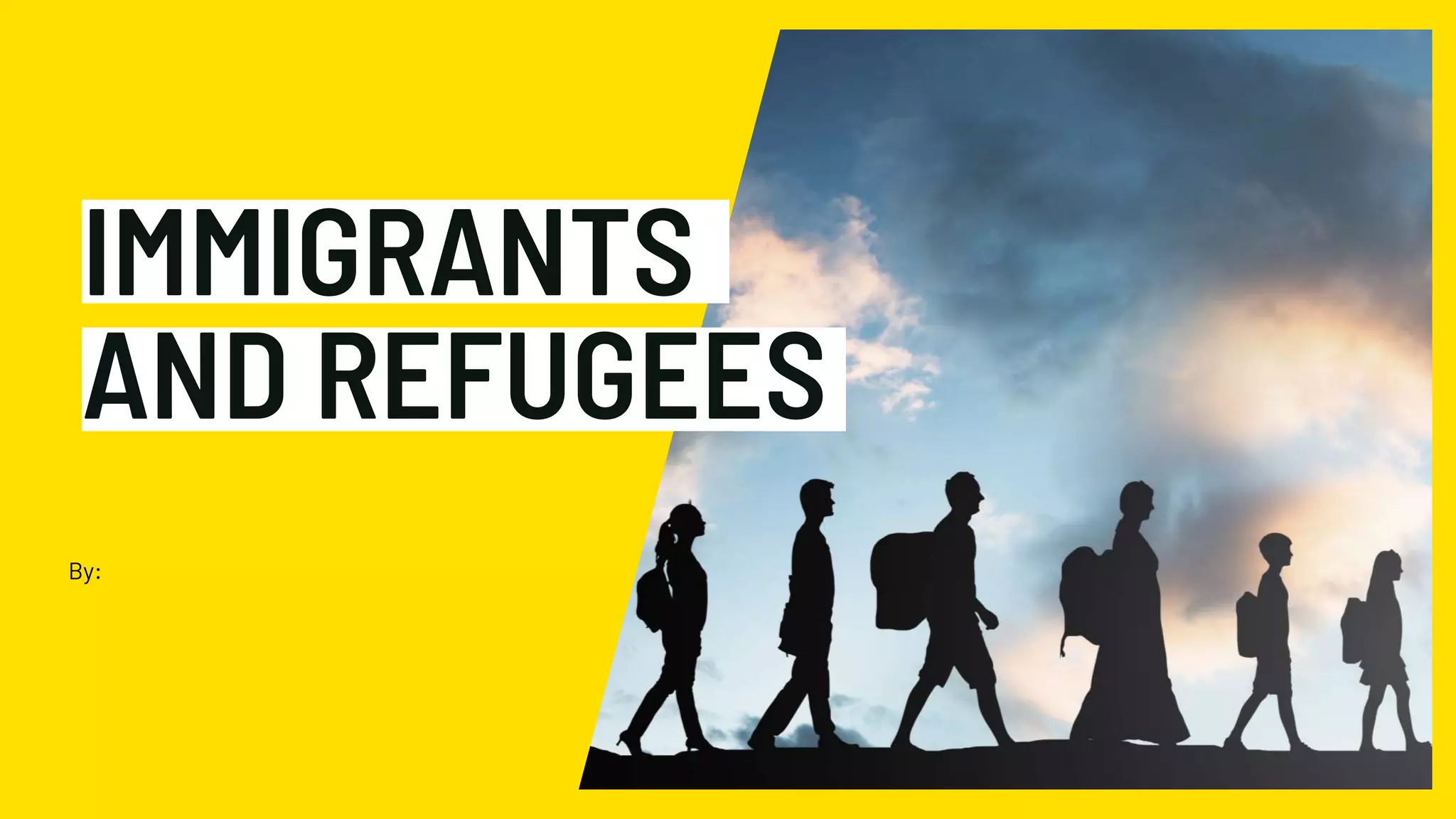
IMMIGRANTS
AND REFUGEES
By:
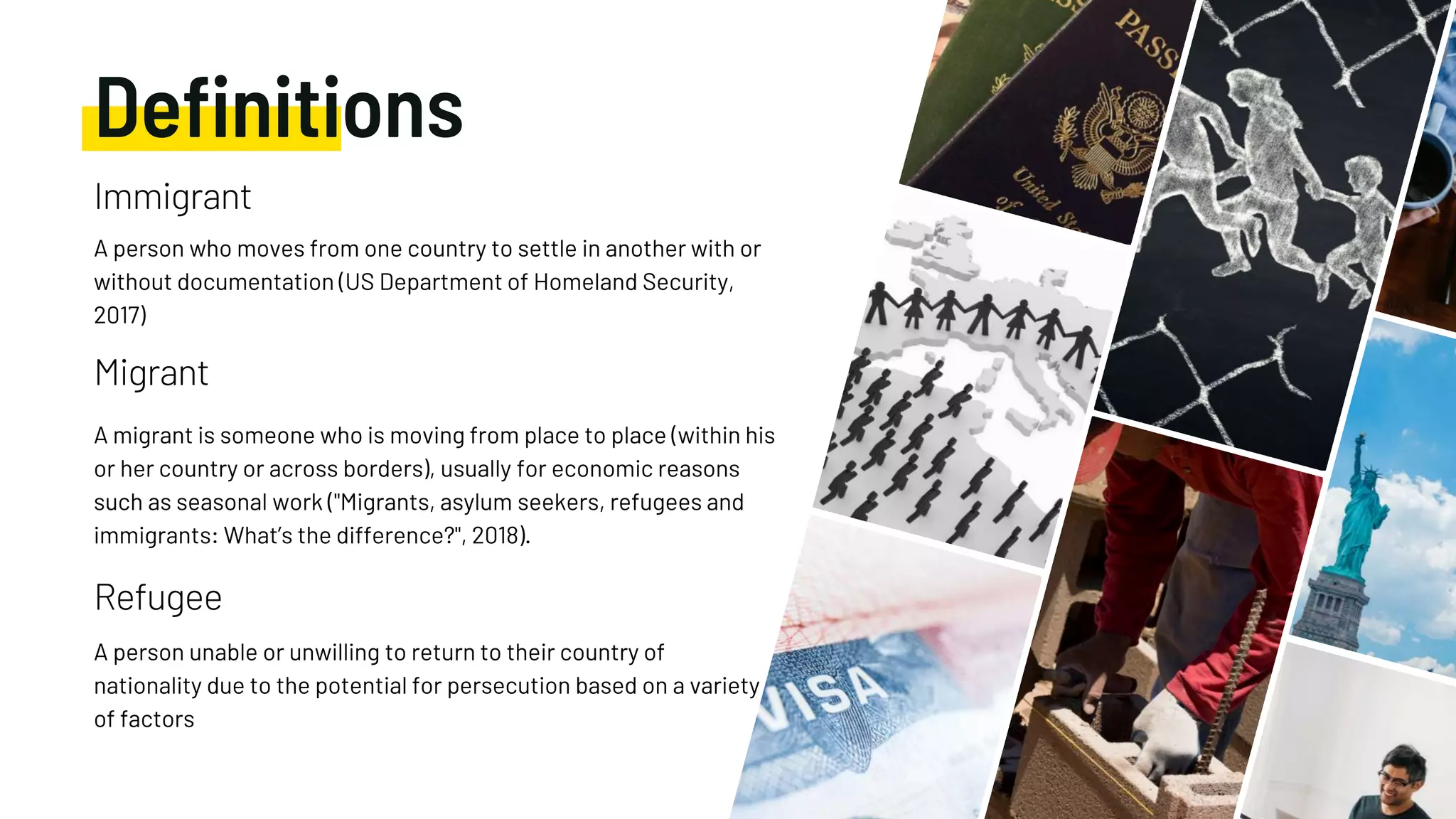
Definitions
Immigrant
A person who moves from one country to settle in another with or
without documentation (US Department of Homeland Security,
2017)
Migrant
A migrant is someone who is moving from place to place (within his
or her country or across borders), usually for economic reasons
such as seasonal work ("Migrants, asylum seekers, refugees and
immigrants: What’s the difference?", 2018).
A person unable or unwilling to return to their country of
nationality due to the potential for persecution based on a variety
of factors
Refugee
Deferred Action for Childhood Arrivals
(DACA) and Deferred Action for
Parents of Americans and Lawful
Permanent Residents (DAPA)
• DACA - President Barack Obama signed an executive action to grant protected status to
undocumented individuals who were brought to the US by their parents before the age of 16
⚬ President-elect Biden promised an expansion of the benefits under the program. The plan will
make recipients eligible for student loans and Pell grants.
• DAPA - designed to limit the risk of deportation of the parents of DACA eligible.
⚬ DAPA was blocked by the Supreme Court
Immigration Enforcement,
Detention, and Deportation
• U.S. Immigration and Customs Enforcement (ICE) removed 185,884 aliens in FY 2020 ("ICE annual
report; Fiscal year 2020", 2020).
• Detention can precipitate family breakup, negatively affect mental health, and result in poor child
welfare outcomes (Human Rights Watch, 2015)
• Negative and enduring biopsychosocial impacts of detention compound the trauma and violence
many experience before and during migration.
Unaccompanied
Migrant Children
Reached a crisis stage in 2014 when
close to 70,000 children crossed the
US-Mexican border, dropped to
40,000 in 2015, but rose to 59,000 in
2016 (US Customs and Border
Protection, 2016)
Exploitation and
Human Trafficking
• Undocumented immigrants are vulnerable to exploitative
work environments.
• Estimates suggest there may be 2.4 million undocumented
Mexican immigrants trafficked in labor settings alone -
construction, janitorial, agricultural
• Challenges faced by immigrants of color; lesbian, gay,
bisexual transgender, and queer community are often
aggravated or overlooked.
Policy Statement
NASW supports the following:
• education and awareness of global migration dynamics
• promotion of social justice
• human rights of day laborers, migrant workers, sex
workers
• development of comprehensive immigration laws
• federal and state services and programs
• providing adequate contributions to refugee
assistance
• providing comprehensive refugee resettlement
programs
• ensuring access to emergency humanitarian aid
• ensuring biophysical, legal, healthcare and education
needs
• providing support for victims of displacement,
exploitation & violence
Policy Statement continued...
NASW supports the following:
• ensuring access to language -appropriate services
• appropriate services to undocumented minors in foster care
• removal of penalties on dreamers' parents' status
• protection from gender-specific forms of violence
• allowing local jurisdictions the ability to remove certain offenses from the category of
automatically deportable offenses
• access to English as a second language (ESOL) education
• fair refugee admissions policies and priorities
• ensuring due process and access to legal counsel on all immigrants and refugees
• elimination of backlogs and lengthy delays in processing immigration status
• judicial review and modifications
Policy Statement
NASW supports the following:
• immunity from deportation for those who were victims of
violence, abuses and exploitation
• opposing mandatory reporting of status by health, mental health,
social service, education, police and other public service
providers
• providing reasonable student, temporary, and transit visa and
encourage international intellectual exchange
• guarantee of citizen for those born in the United States
• supporting the training of social workers and other human
services providers on immigration
• expanding research on the dynamics of migration, as it relates to
social work
Issues
1 What important issues have been raised in the subject area?
• Some Americans describe immigrants and refugees as threats and at risk of committing domestic terrorism or
creating financial drain on the economy.
• Recent steps taken by the executive branch to ban immigrants and refugees from certain countries is both legally
questionable and antithetical
• Approximately 9 million children in the US have parents who are not documented, and about half are US citizens
living in mixed-status families and incurring negative biopsychosocial and economic repercussions of living
under the radar.
• Negative and enduring biopsychosocial impacts of detention compound the trauma and violence many
immigrants have experienced before and during migration
• Exploitation and human trafficking
2 Are the issues critical?
Yes. In 2020, we had 185, 884 aliens removed by Immigration and Customs Enforcement which likely caused
family breakup, negatively affected mental health, and resulted in poor child welfare outcomes (Human Rights
Watch, 2015). Negative and enduring biopsychosocial impacts of detention compound the trauma and violence
may have also experienced by many during detention.
Issues continued...
4
5
Do you agree with the policy of NASW?
Yes. NASW's policy statements are comprehensive, it covers a very important and critical immigration
topic. These statements are a collective thinking of thousands of social workers across all field of
practice.
Do you know of other groups that have a similar or dissimilar position?
6 How would you change the statements to be improved.
There is nothing to improve. The policy statements are stated clearly.
3 Are there issues which were not considered on this topic?
There are many topics you can cover under immigration. This specific topic of Social Worker Speaks
covered many issues related to immigrant justice and humanitarian services.
There is one group in Ohio called Social Workers for Immigrant Justice. It is a peer networking and consultation group for social
workers and related professionals put together to consult on ethical questions, share resource and opportunities and collectively
advocate for an effective social work response to the humanitarian crises caused by the United States’ unjust immigration policies.
Their currect project includes the following:
• Immigrant Friendly Criteria Project – advocating from within to make social work services more accessible to undocumented
clients
• Interdisciplinary learning – peer consultation for therapists looking to provide mental health evaluations for asylum-seekers
• Organizing grassroots social work responses to ICE raids ("NASW advocacy on immigration", n.d.)
References
Migrants, asylum seekers, refugees and immigrants: What’s
the difference?. International Rescue Committee (IRC). (2018).
Retrieved from https://www.rescue.org/article/mig rants-
asylum-seekers-refugees-and-immigrants-whats-difference.
https://www.dhs.gov/immigration-statistics/data-standards-and-
definitions/definition-terms#permanent_resident_alien.
Department of Homeland Security. Retrieved
from
NASW advocacy on immigration. NASW Ohio Chapter. Retrieved from
https://www.naswoh.org/general/custom.asp?page=immigration
.

Immigrants and refugees

  • 1.
  • 2.
    Definitions Immigrant A person whomoves from one country to settle in another with or without documentation (US Department of Homeland Security, 2017) Migrant A migrant is someone who is moving from place to place (within his or her country or across borders), usually for economic reasons such as seasonal work ("Migrants, asylum seekers, refugees and immigrants: What’s the difference?", 2018). A person unable or unwilling to return to their country of nationality due to the potential for persecution based on a variety of factors Refugee
  • 3.
    Deferred Action forChildhood Arrivals (DACA) and Deferred Action for Parents of Americans and Lawful Permanent Residents (DAPA) • DACA - President Barack Obama signed an executive action to grant protected status to undocumented individuals who were brought to the US by their parents before the age of 16 ⚬ President-elect Biden promised an expansion of the benefits under the program. The plan will make recipients eligible for student loans and Pell grants. • DAPA - designed to limit the risk of deportation of the parents of DACA eligible. ⚬ DAPA was blocked by the Supreme Court
  • 4.
    Immigration Enforcement, Detention, andDeportation • U.S. Immigration and Customs Enforcement (ICE) removed 185,884 aliens in FY 2020 ("ICE annual report; Fiscal year 2020", 2020). • Detention can precipitate family breakup, negatively affect mental health, and result in poor child welfare outcomes (Human Rights Watch, 2015) • Negative and enduring biopsychosocial impacts of detention compound the trauma and violence many experience before and during migration.
  • 5.
    Unaccompanied Migrant Children Reached acrisis stage in 2014 when close to 70,000 children crossed the US-Mexican border, dropped to 40,000 in 2015, but rose to 59,000 in 2016 (US Customs and Border Protection, 2016)
  • 6.
    Exploitation and Human Trafficking •Undocumented immigrants are vulnerable to exploitative work environments. • Estimates suggest there may be 2.4 million undocumented Mexican immigrants trafficked in labor settings alone - construction, janitorial, agricultural • Challenges faced by immigrants of color; lesbian, gay, bisexual transgender, and queer community are often aggravated or overlooked.
  • 7.
    Policy Statement NASW supportsthe following: • education and awareness of global migration dynamics • promotion of social justice • human rights of day laborers, migrant workers, sex workers • development of comprehensive immigration laws • federal and state services and programs • providing adequate contributions to refugee assistance • providing comprehensive refugee resettlement programs • ensuring access to emergency humanitarian aid • ensuring biophysical, legal, healthcare and education needs • providing support for victims of displacement, exploitation & violence
  • 8.
    Policy Statement continued... NASWsupports the following: • ensuring access to language -appropriate services • appropriate services to undocumented minors in foster care • removal of penalties on dreamers' parents' status • protection from gender-specific forms of violence • allowing local jurisdictions the ability to remove certain offenses from the category of automatically deportable offenses • access to English as a second language (ESOL) education • fair refugee admissions policies and priorities • ensuring due process and access to legal counsel on all immigrants and refugees • elimination of backlogs and lengthy delays in processing immigration status • judicial review and modifications
  • 9.
    Policy Statement NASW supportsthe following: • immunity from deportation for those who were victims of violence, abuses and exploitation • opposing mandatory reporting of status by health, mental health, social service, education, police and other public service providers • providing reasonable student, temporary, and transit visa and encourage international intellectual exchange • guarantee of citizen for those born in the United States • supporting the training of social workers and other human services providers on immigration • expanding research on the dynamics of migration, as it relates to social work
  • 10.
    Issues 1 What importantissues have been raised in the subject area? • Some Americans describe immigrants and refugees as threats and at risk of committing domestic terrorism or creating financial drain on the economy. • Recent steps taken by the executive branch to ban immigrants and refugees from certain countries is both legally questionable and antithetical • Approximately 9 million children in the US have parents who are not documented, and about half are US citizens living in mixed-status families and incurring negative biopsychosocial and economic repercussions of living under the radar. • Negative and enduring biopsychosocial impacts of detention compound the trauma and violence many immigrants have experienced before and during migration • Exploitation and human trafficking 2 Are the issues critical? Yes. In 2020, we had 185, 884 aliens removed by Immigration and Customs Enforcement which likely caused family breakup, negatively affected mental health, and resulted in poor child welfare outcomes (Human Rights Watch, 2015). Negative and enduring biopsychosocial impacts of detention compound the trauma and violence may have also experienced by many during detention.
  • 11.
    Issues continued... 4 5 Do youagree with the policy of NASW? Yes. NASW's policy statements are comprehensive, it covers a very important and critical immigration topic. These statements are a collective thinking of thousands of social workers across all field of practice. Do you know of other groups that have a similar or dissimilar position? 6 How would you change the statements to be improved. There is nothing to improve. The policy statements are stated clearly. 3 Are there issues which were not considered on this topic? There are many topics you can cover under immigration. This specific topic of Social Worker Speaks covered many issues related to immigrant justice and humanitarian services. There is one group in Ohio called Social Workers for Immigrant Justice. It is a peer networking and consultation group for social workers and related professionals put together to consult on ethical questions, share resource and opportunities and collectively advocate for an effective social work response to the humanitarian crises caused by the United States’ unjust immigration policies. Their currect project includes the following: • Immigrant Friendly Criteria Project – advocating from within to make social work services more accessible to undocumented clients • Interdisciplinary learning – peer consultation for therapists looking to provide mental health evaluations for asylum-seekers • Organizing grassroots social work responses to ICE raids ("NASW advocacy on immigration", n.d.)
  • 12.
    References Migrants, asylum seekers,refugees and immigrants: What’s the difference?. International Rescue Committee (IRC). (2018). Retrieved from https://www.rescue.org/article/mig rants- asylum-seekers-refugees-and-immigrants-whats-difference. https://www.dhs.gov/immigration-statistics/data-standards-and- definitions/definition-terms#permanent_resident_alien. Department of Homeland Security. Retrieved from NASW advocacy on immigration. NASW Ohio Chapter. Retrieved from https://www.naswoh.org/general/custom.asp?page=immigration .