Catholic Social Teaching Dignity and Community
Biblical themes of justice God is active in human history Creation  Covenant relationship  Community Anawim -- "the widows, orphans and aliens” The example of Jesus – reign of God, healing In biblical faith, the doing of justice  is the primary expectation of Yahweh. Walter Brueggeman
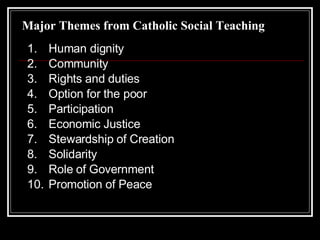
Major Themes from Catholic Social Teaching Human dignity Community Rights and duties Option for the poor Participation  Economic Justice Stewardship of Creation Solidarity Role of Government Promotion of Peace
1.  Human dignity   The person is sacred, made in the image of God. The foundational principle of all Catholic Social Teaching is the sanctity of human life and the inherent dignity of the human person. Human life must be valued infinitely above material possessions.  War, the death penalty, racism, and discrimination must almost always be opposed
2.  Community / Common Good      The social nature of the human person The fact that human beings are social by nature indicates that the betterment of the person and the improvement of society depend on each other.…humanity by its very nature stands completely in need of life in society. Vatican II,  The Church in the Modern World “ Every man for himself,” said the elephant  as he danced among the chickens. Charles Dickens
3.  Rights and duties Civil/political Economic/social Every person has a right to the basic material necessities that are required to live a decent life.
4.  Option for the Poor Remember the “widows, orphans, and aliens.” A necessary element of the common good
5.  Participation All people have a right to  a minimum level of participation  in the economic, political, and  cultural life of society.
6.  Economic Justice The economy must serve people, not the other way around. People are more important than things; labor is more important than capital.    All workers have a right to productive work, to decent wages, to safe working conditions; and they have a right to organize and join unions. People have a right to economic initiative and private property, but these rights have limits. No one is allowed to amass excessive wealth when others lack the  basic necessities of life.
7.  Stewardship of Creation The goods of the earth are gifts.  We hold them in trust, as stewards. “ God destined the earth and all it contains for all people and nations so that all created things would be shared fairly by all humankind under the guidance of justice tempered by charity.”  On the Development of Peoples
8.  The Virtue of Solidarity “ It is a firm and persevering determination to commit oneself to the common good; that is to say, to the good of all ...because we are all really responsible for all.” Pope John Paul II,  On Social Concern,  1987   "Solidarity is undoubtedly a Christian virtue. It seeks to go beyond itself to total gratuity, forgiveness, and reconciliation.  All the peoples of the world belong to one human family. We must be our brother's keeper, though we may be separated by distance, language or culture.  Jesus teaches that we must each love our neighbors as ourselves and in the parable of the Good Samaritan we see that our compassion should extend to all people. Solidarity at the international level primarily concerns the Global South. For example, the Church has habitually insisted that loans be forgiven on many occasions, particularly during Jubilee years. Charity to individuals or groups must be accompanied by transforming unjust structures.
Role of Government The state has a positive moral function. It is an instrument to promote human dignity, protect human rights, and build  the common good   Subsidiarity As small as possible As big as necessary
10. Promotion of Peace Peace is not just the absence of war   “If you want peace, work for justice.” Pope Paul VI, 1972, World Day of Peace Message
Major Themes from Catholic Social Teaching Human dignity Community Rights and duties Option for the poor  Participation Economic Justice Stewardship of Creation Solidarity Role of Government Promotion of Peace
1891 Rerum Novarum Leo XIII 1931 Quadragesimo Anno Pius XI 1961 Mother and Teacher John XXIII 1963 Peace on Earth John XXIII 1965 Church in the Modern World Vatican II 1967 The Development of Peoples Paul VI 1971 A Call to Action Paul VI 1971 Justice in the World Synod of Bishops 1979 Redeemer of Humanity John Paul II 1981 On Human Work John Paul II 1988 On Social Concern John Paul II 1991 The One Hundredth Year John Paul II 1995 The Gospel of Life John Paul II Modern Catholic Social Teaching Modern Catholic Social Teaching
Society Individual Individual Commutative (Contractual) Distributive Contributive Justice Social

Catholic Social Teaching Ppt

  • 1.
    Catholic Social TeachingDignity and Community
  • 2.
    Biblical themes ofjustice God is active in human history Creation Covenant relationship Community Anawim -- "the widows, orphans and aliens” The example of Jesus – reign of God, healing In biblical faith, the doing of justice is the primary expectation of Yahweh. Walter Brueggeman
  • 3.
    Major Themes fromCatholic Social Teaching Human dignity Community Rights and duties Option for the poor Participation Economic Justice Stewardship of Creation Solidarity Role of Government Promotion of Peace
  • 4.
    1. Humandignity The person is sacred, made in the image of God. The foundational principle of all Catholic Social Teaching is the sanctity of human life and the inherent dignity of the human person. Human life must be valued infinitely above material possessions. War, the death penalty, racism, and discrimination must almost always be opposed
  • 5.
    2. Community/ Common Good The social nature of the human person The fact that human beings are social by nature indicates that the betterment of the person and the improvement of society depend on each other.…humanity by its very nature stands completely in need of life in society. Vatican II, The Church in the Modern World “ Every man for himself,” said the elephant as he danced among the chickens. Charles Dickens
  • 6.
    3. Rightsand duties Civil/political Economic/social Every person has a right to the basic material necessities that are required to live a decent life.
  • 7.
    4. Optionfor the Poor Remember the “widows, orphans, and aliens.” A necessary element of the common good
  • 8.
    5. ParticipationAll people have a right to a minimum level of participation in the economic, political, and cultural life of society.
  • 9.
    6. EconomicJustice The economy must serve people, not the other way around. People are more important than things; labor is more important than capital. All workers have a right to productive work, to decent wages, to safe working conditions; and they have a right to organize and join unions. People have a right to economic initiative and private property, but these rights have limits. No one is allowed to amass excessive wealth when others lack the basic necessities of life.
  • 10.
    7. Stewardshipof Creation The goods of the earth are gifts. We hold them in trust, as stewards. “ God destined the earth and all it contains for all people and nations so that all created things would be shared fairly by all humankind under the guidance of justice tempered by charity.” On the Development of Peoples
  • 11.
    8. TheVirtue of Solidarity “ It is a firm and persevering determination to commit oneself to the common good; that is to say, to the good of all ...because we are all really responsible for all.” Pope John Paul II, On Social Concern, 1987 "Solidarity is undoubtedly a Christian virtue. It seeks to go beyond itself to total gratuity, forgiveness, and reconciliation. All the peoples of the world belong to one human family. We must be our brother's keeper, though we may be separated by distance, language or culture. Jesus teaches that we must each love our neighbors as ourselves and in the parable of the Good Samaritan we see that our compassion should extend to all people. Solidarity at the international level primarily concerns the Global South. For example, the Church has habitually insisted that loans be forgiven on many occasions, particularly during Jubilee years. Charity to individuals or groups must be accompanied by transforming unjust structures.
  • 12.
    Role of GovernmentThe state has a positive moral function. It is an instrument to promote human dignity, protect human rights, and build the common good Subsidiarity As small as possible As big as necessary
  • 13.
    10. Promotion ofPeace Peace is not just the absence of war “If you want peace, work for justice.” Pope Paul VI, 1972, World Day of Peace Message
  • 14.
    Major Themes fromCatholic Social Teaching Human dignity Community Rights and duties Option for the poor Participation Economic Justice Stewardship of Creation Solidarity Role of Government Promotion of Peace
  • 15.
    1891 Rerum NovarumLeo XIII 1931 Quadragesimo Anno Pius XI 1961 Mother and Teacher John XXIII 1963 Peace on Earth John XXIII 1965 Church in the Modern World Vatican II 1967 The Development of Peoples Paul VI 1971 A Call to Action Paul VI 1971 Justice in the World Synod of Bishops 1979 Redeemer of Humanity John Paul II 1981 On Human Work John Paul II 1988 On Social Concern John Paul II 1991 The One Hundredth Year John Paul II 1995 The Gospel of Life John Paul II Modern Catholic Social Teaching Modern Catholic Social Teaching
  • 16.
    Society Individual IndividualCommutative (Contractual) Distributive Contributive Justice Social