Presented by: Hifsah Atiq
Have you ever thought of making a 3D
photograph without the use of lenses???
or
Is it possible to create such image???
The answer is:
Yes it’s possible by using a technique called
“Holography”
H O L O G R A P H Y
Holography is a technique that allows the light scattered from
an object to be recorded and later reconstructed.
A 3D image obtained by this method is called “Hologram”
The word “Hologram” is derived from two Latin words
i.e, “Holo” which means “whole view” and “graphy”
means “to write” or “to note”
Laser light is used in this process because of its coherent nature.
HISTORY OF HOLOGRAPHY
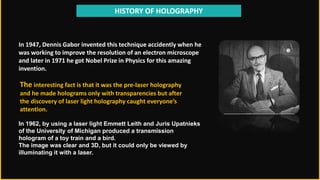
In 1947, Dennis Gabor invented this technique accidently when he
was working to improve the resolution of an electron microscope
and later in 1971 he got Nobel Prize in Physics for this amazing
invention.
The interesting fact is that it was the pre-laser holography
and he made holograms only with transparencies but after
the discovery of laser light holography caught everyone’s
attention.
In 1962, by using a laser light Emmett Leith and Juris Upatnieks
of the University of Michigan produced a transmission
hologram of a toy train and a bird.
The image was clear and 3D, but it could only be viewed by
illuminating it with a laser.
Properties of a Hologram
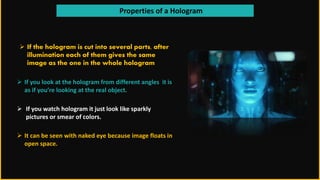
 If the hologram is cut into several parts, after
illumination each of them gives the same
image as the one in the whole hologram
 If you look at the hologram from different angles it is
as if you’re looking at the real object.
 If you watch hologram it just look like sparkly
pictures or smear of colors.
 It can be seen with naked eye because image floats in
open space.
What are
the things
require to
make a
hologram??
Components required
to make a hologram:
• Laser light
Red Laser usually HeNe lasers
are common in Holography.
• Beam Splitter
This is a device that uses mirrors
and prisms to split laser light into
two beams:
Object beam and Reference
beam.
• Mirrors
They directs beam of light into
accurate location.
• Holographic Film
It is used to record light at a very
high resolution to make a
hologram.
Process of making Hologram
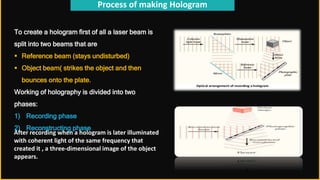
To create a hologram first of all a laser beam is
split into two beams that are
 Reference beam (stays undisturbed)
 Object beam( strikes the object and then
bounces onto the plate.
Working of holography is divided into two
phases:
1) Recording phase
2) Reconstructing phase
After recording when a hologram is later illuminated
with coherent light of the same frequency that
created it , a three-dimensional image of the object
appears.
Applications of Holography
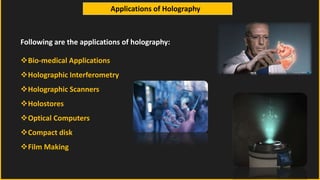
Following are the applications of holography:
Bio-medical Applications
Holographic Interferometry
Holographic Scanners
Holostores
Optical Computers
Compact disk
Film Making
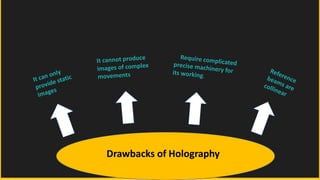
Drawbacks of Holography
Conclusion
Holographic technology has endless applications as
far as human mind can imagine. It seems like in
near future holographic displays will be replacing
all present displays in all sizes, from smart phones
to large projectors. This is not very much obvious
presently but the future of holography is bright.
Holography or Hologram

Holography or Hologram

  • 1.
  • 2.
    Have you everthought of making a 3D photograph without the use of lenses??? or Is it possible to create such image??? The answer is: Yes it’s possible by using a technique called “Holography”
  • 3.
    H O LO G R A P H Y Holography is a technique that allows the light scattered from an object to be recorded and later reconstructed. A 3D image obtained by this method is called “Hologram” The word “Hologram” is derived from two Latin words i.e, “Holo” which means “whole view” and “graphy” means “to write” or “to note” Laser light is used in this process because of its coherent nature.
  • 4.
    HISTORY OF HOLOGRAPHY In1947, Dennis Gabor invented this technique accidently when he was working to improve the resolution of an electron microscope and later in 1971 he got Nobel Prize in Physics for this amazing invention. The interesting fact is that it was the pre-laser holography and he made holograms only with transparencies but after the discovery of laser light holography caught everyone’s attention. In 1962, by using a laser light Emmett Leith and Juris Upatnieks of the University of Michigan produced a transmission hologram of a toy train and a bird. The image was clear and 3D, but it could only be viewed by illuminating it with a laser.
  • 5.
    Properties of aHologram  If the hologram is cut into several parts, after illumination each of them gives the same image as the one in the whole hologram  If you look at the hologram from different angles it is as if you’re looking at the real object.  If you watch hologram it just look like sparkly pictures or smear of colors.  It can be seen with naked eye because image floats in open space.
  • 6.
    What are the things requireto make a hologram?? Components required to make a hologram: • Laser light Red Laser usually HeNe lasers are common in Holography. • Beam Splitter This is a device that uses mirrors and prisms to split laser light into two beams: Object beam and Reference beam. • Mirrors They directs beam of light into accurate location. • Holographic Film It is used to record light at a very high resolution to make a hologram.
  • 7.
    Process of makingHologram To create a hologram first of all a laser beam is split into two beams that are  Reference beam (stays undisturbed)  Object beam( strikes the object and then bounces onto the plate. Working of holography is divided into two phases: 1) Recording phase 2) Reconstructing phase After recording when a hologram is later illuminated with coherent light of the same frequency that created it , a three-dimensional image of the object appears.
  • 8.
    Applications of Holography Followingare the applications of holography: Bio-medical Applications Holographic Interferometry Holographic Scanners Holostores Optical Computers Compact disk Film Making
  • 9.
  • 10.
    Conclusion Holographic technology hasendless applications as far as human mind can imagine. It seems like in near future holographic displays will be replacing all present displays in all sizes, from smart phones to large projectors. This is not very much obvious presently but the future of holography is bright.