HOLLAND
By Georgina
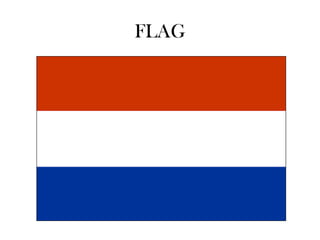
FLAG
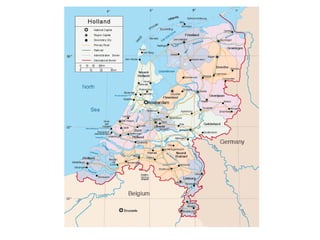
• HollandHolland is a name in common usage given to a region in theis a name in common usage given to a region in the
western part of thewestern part of the NetherlandsNetherlands. The term. The term HollandHolland is alsois also
frequently used to refer to the whole of the Netherlands.frequently used to refer to the whole of the Netherlands.
• Capital: AmsterdamCapital: Amsterdam
• Seat of Government: HagueSeat of Government: Hague
• Rotterdam: Europe’s largest portRotterdam: Europe’s largest port
• Population: around 6 million- one of thePopulation: around 6 million- one of the most denselymost densely
populated countries in the worldpopulated countries in the world
• Language: Dutch (mainly Hollandic dialects)Language: Dutch (mainly Hollandic dialects)
• Currency: EuroCurrency: Euro
• Timezone: GMT + 1Timezone: GMT + 1
• History:History:
http://www.holland.com/global/aboutholland/generalinformahttp://www.holland.com/global/aboutholland/generalinforma
• A quarter of The Netherlands is under sea level.A quarter of The Netherlands is under sea level.
Dutch People
 The Dutch are known for their professionalism
and for being level-headed and down-to-earth.
They frown upon boasting and bragging.
 "Act normally and you will be conspicuous
enough“
 The Dutch are also very direct and they consider
it a sign of honesty and openness.
 The Dutch are also known as a tolerant people,
particularly to those of different opinions and
persuasions.
 Freedom is a cherished virtue in the Netherlands.
They are used to discussing differences of opinion
and admire those who stand up for themselves,
their ideas and ideals.
Society
 The Netherlands is a multicultural society.
 You will find more than two hundred
different nationalities in the city of
Amsterdam alone.
 The largest minority groups in the
Netherlands are Turkish, Surinamese,
Moroccans and Antilleans from the Dutch
Caribbean.
Public Holidays
 New Year’s Day: 1 January
 Good Friday: 22 April
 Easter: 24 and 25 April
 Queen Beatrix’s birthday: 30 April
 Liberation Day: 2 June
 Ascension Day: 13 May
 Whitsun Weekend: 12 and 13 June
 Christmas: 25 and 26 December
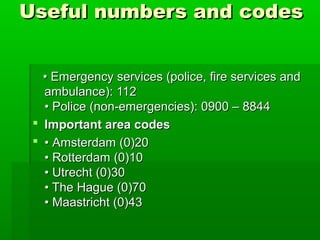
Useful numbers and codesUseful numbers and codes
•• Emergency services (police, fire services andEmergency services (police, fire services and
ambulance): 112ambulance): 112
• Police (non-emergencies): 0900 – 8844• Police (non-emergencies): 0900 – 8844
 Important area codesImportant area codes
 •• Amsterdam (0)20Amsterdam (0)20
• Rotterdam (0)10• Rotterdam (0)10
• Utrecht (0)30• Utrecht (0)30
• The Hague (0)70• The Hague (0)70
• Maastricht (0)43• Maastricht (0)43
Is Holland safe?Is Holland safe?
 Holland is a safe countryHolland is a safe country andand ranks high inranks high in
Europe with respect to traffic safety.Europe with respect to traffic safety.
 BUT:BUT: YYou must account for street crime,ou must account for street crime,
and always be watchful of pickpockets.and always be watchful of pickpockets.
TIPS to keep safeTIPS to keep safe
 • • Avoid isolated underground stations and poorlyAvoid isolated underground stations and poorly
lit tram and bus stops, especially at night.lit tram and bus stops, especially at night.
• Avoid isolated train carriages.• Avoid isolated train carriages.
• Sit as closely as possible near the driver or• Sit as closely as possible near the driver or
guard.guard.
• Use licensed taxis only. You recognise these• Use licensed taxis only. You recognise these
by the blue registration plate.by the blue registration plate.
• Avoid confrontational situations.• Avoid confrontational situations.
• Always cross the road at a zebra crossing, if• Always cross the road at a zebra crossing, if
possible. Make sure you look both ways, aspossible. Make sure you look both ways, as
traffic in Holland drives and rides on the right!traffic in Holland drives and rides on the right!
Dutch Drug Policy
 The Netherlands is famous for its tolerant drugs
policy. But a lot of people don’t realize that drugs
are illegal in the Netherlands.
 Coffeeshops may only sell soft drugs and not
more than five grams of cannabis a person a day.
Coffeeshops have strict laws that control the
amount of admitted soft drugs, the conditions in
which it is sold and the use.
 the government designed a strict and controlled
drug policy that enables and tolerates smoking
cannabis.
 The Dutch policy on drugs has been reasonably
successful compared to the policies pursued in
other countries, especially when it comes to
prevention and care.
Utilities & services
 Electricity: The voltage used in Holland
is 220 volts, so you should take a
power transformer and an adaptor for
two-pin, round-pin plugs with side
grounding contacts.
 Water: The tap water in Holland is of
excellent quality and you may drink
from any tap.
Business Hours
 Most shops are opened every day from
around 9 a.m. till 5.30 p.m. Monday morning
shops often open around noon. Thursday is
usually a shopping night till 9 p.m. About
Sunday ask at a local tourist information
office.
 Supermarkets: open every day till 10 p.m,
except for Sunday’s when they close around
6 p.m.
 Most banks open from Tuesday till
Friday.
 Post offices are open from Monday till
Friday. Only a few major offices are
also open on Saturday morning.
Customs and etiquette
 At business after introducing themselves,
the Dutch people call each other by their
surnames or even by their first names!
 Family, friends and acquaintances kiss
each other three times on the cheek.
 The Dutch like to receive items which they
cannot buy in their own country.
Communications
 The Dutch make a clear distinction between their
private lives and their business lives. When
negotiating they use a straightforward business
strategy.
 They do not spend days getting to know their
business partners, in contrast to Asian cultures.
The Dutch are used to getting to the point
straightaway.
 To the Dutch a contract means the end of the
negotiations: agreed is agreed. Words, invitations
and promises are often taken literally.
Talking about and not talking
about….
 Informal is not the same in Holland as emotional or very
personal. At informal gatherings people do talk about
more personal topics.
 the Dutch are reserved about their private lives. Some
Dutch people consider certain topics too personal,
however, there are no specific topics that you cannot
discuss.
 It is not polite to ask a Dutch acquaintance how much he
or she earns, something which is quite acceptable in
some other cultures.
Food
 To the Dutch the social aspect, the being together, is
more important than the food itself.
 Many Dutch skip breakfast on workdays. Lunch, in
contrast, is an important meal. To the non-Dutch this is
a somewhat simple meal, including bread and coffee,
tea, dairy products (very popular) and some fruit.
 Many people, mainly women, are on a never-ending
diet.
 Most Dutch people like meat dishes, especially beef
and pork.
Dutch Cousine
 The Dutch don’t have a real specific cuisine. Potatoes,
vegetables and a piece of meat are popular.
 Dutch Dishes
 Snert
This pea soup with sausages, is a typical winter dish
which is a great way to warm you and reenergize.
 Stamppot
Another winter dish with mashed potatoes, vegetables
and meat. This dish comes in lots of varieties with
kale, sauerkraut, onions, carrots, sausages and bacon.
The final touch is a dimple with gravy in the middle of
the ‘stamppot’.
 Poffertjes
A real Dutch treat are ‘poffertjes’: sort of mini
pancakes, but thicker and sweeter. Often served
with sugar and butter. Especially kids adore this
dish.
 Bitterballen
The most favorite snack when sitting on a terrace
with a drink are ‘bitterballen’. These are little fried
balls with beef stew.
 Hagelslag
Ever had a sandwich with chocolate? Try
‘hagelslag’!
 Haring
Herring is the most popular fish in Holland. You can
eat it on a bun with onions and pickles. Or choose
to do it the original way and bite it while holding the
fish by its tail in the air.
TraditionsTraditions
 Carnival:Carnival: During Carnival, costumed partygoersDuring Carnival, costumed partygoers
take over the streets and pubstake over the streets and pubs-- a traditional 3-a traditional 3-
day festival in the southern part of theday festival in the southern part of the
Netherlands (February/March).Netherlands (February/March).
 http://www.holland.com/global/aboutholland/culturalhhttp://www.holland.com/global/aboutholland/culturalh
 Queen’s Day:Queen’s Day: 3030thth
AprilApril,, the entire country isthe entire country is
coloured in orange. Events and celebrations arecoloured in orange. Events and celebrations are
held throughout the country, including theheld throughout the country, including the
popular ‘Queen’s Night’ celebration in Thepopular ‘Queen’s Night’ celebration in The
Hague on the eve before Queen’s Day and theHague on the eve before Queen’s Day and the
public street market in Amsterdam on thepublic street market in Amsterdam on the
holiday itself - regardless of the weather.holiday itself - regardless of the weather.
Sports
• The Dutch enjoy sports, besides their daily
walks and cycling trips to work and
friends. Sports are not only considered
healthy, but also play a great social role.
• Most popular Dutch sports: football,
hockey, tennis, cycling, golf, volleyball,
korfball, handball, swimming and ice-
skating.
Holland never losesHolland never loses
 No matter what you do, you just can’tNo matter what you do, you just can’t
beat the Dutch.beat the Dutch.
 If you win, the response will be: “WhatIf you win, the response will be: “What
else did you expect from such a smallelse did you expect from such a small
country?”.country?”.
 If you lose, you’ll get remarks like: “LookIf you lose, you’ll get remarks like: “Look
how great we are for such a smallhow great we are for such a small
country”country”
 or “If you ain’t Dutch, you ain’t much”.or “If you ain’t Dutch, you ain’t much”.
Amsterdam[175km from
Maastricht]
 The national museum, the Rijksmuseum, has
a great line-up of Dutch art and history.
 Don’t forget to take a picture of the amazing
Nightwatch by Rembrandt.
 A stone’s throw away is the Van Gogh
Museum with world famous self-portraits,
 The Sunflowers and
 The Potato Eaters by Van Gogh.
 the Anne Frank House,
 the Hermitage Amsterdam,
 a canal boat tour,
 a concert at the Concertgebouw
 and a walk through the Red Light District
 The best way to discover and experience the
great architecture and many cafes, terraces,
parks, squares and shopping areas of
Amsterdam is by bike.
Sights of MaastrichtSights of Maastricht
 City FortificationsCity Fortifications, including:, including:
 HelpoortHelpoort - a 13th century town gate, the oldest- a 13th century town gate, the oldest
in the Netherlands.in the Netherlands.
 Hoge FrontenHoge Fronten (or(or Linie van Du MoulinLinie van Du Moulin) -) -
remnants of 17th and 18th centuryremnants of 17th and 18th century
fortifications with a number of well-preservedfortifications with a number of well-preserved
bastionsbastions and an early 19th centuryand an early 19th century fortressfortress
Fort WillemFort Willem..
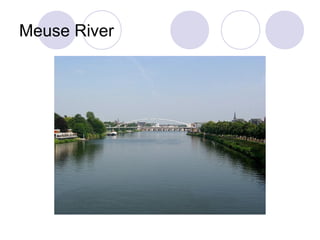
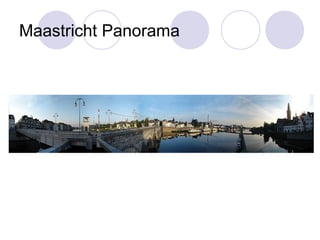
Meuse River
BinnenstadBinnenstad --
 inner city shopping district, including Grote andinner city shopping district, including Grote and
Kleine Staat, and high-end shopping street Stokstraat.Kleine Staat, and high-end shopping street Stokstraat.
Maastricht is also well-known for its cafés, pubs andMaastricht is also well-known for its cafés, pubs and
restaurants.restaurants.
 Entre DeuxEntre Deux - a recently rebuilt shopping centre which- a recently rebuilt shopping centre which
has won several international awards. It includes ahas won several international awards. It includes a
book store located inside a former 13th centurybook store located inside a former 13th century
Dominican church. In 2008, British newspaperDominican church. In 2008, British newspaper TheThe
GuardianGuardian proclaimed this the world's most beautifulproclaimed this the world's most beautiful
bookshop.bookshop.
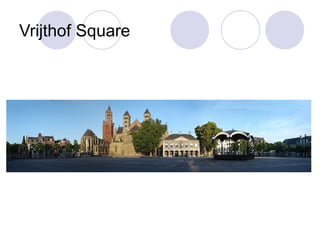
 Vrijthof - the best-known square in the city
 Basilica of Our Lady - 11th-century church.
 Mosae Forum - a brandnew shopping centre and civic
building- Citroën Miniature Cars
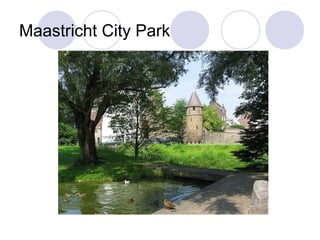
 Stadspark - the main public park on the West
bank of the river.
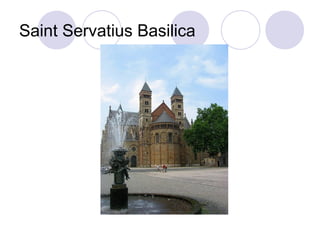
 Sint-Servaas Basiliek - Romanesque church of
Saint Servatius.
Saint Servatius Basilica
Maastricht City Park
Vrijthof Square
Maastricht Panorama
Weather
• Weather Netherlands is characterized by a
maritime climate and it enjoys pleasant
summers and cool winters.
• somewhat stable weather all the year round.
• The temperatures do not soar very high.
• The summers are mostly warm and they have
variable periods. A case of extremely hot
weather is a rarity.
• Winters can generally signify mild weather or
generally they are quite cold. Sometimes winters
can be accompanied by snowfall.
• Rainfall is common throughout the year.
 Almost each day clouds appear in the sky and the
winters also experience foggy weather.
 The average temperature of Netherlands is about
2°C in the month of January. In July it is 19°C.
 The annual average temperature is 10°C
approximately.
 The average rainfall in a year is 76.5cm which is
pretty heavy. -> rain wear is advised
 Maastricht:
http://www.weather.com/outlook/travel/businesstraveler/te
Events& Festivals
• The European Fine Art Fair -
TEFAF is the world's leading art
and antiques fair (March).
• Amstel Gold Race - international
cycling race which starts in
Maastricht (usually April).
• KunstTour - annual art festival
(May).
Bars & Cafes
• Over 300!
• Take five
• Café Zuid
• Ipanema
• The Highlander
• El phyton
• Edd’s
• http://www.world66.com/europe/neth
erlands/maastricht/bars_and_cafes
Internet Cafes
 Info-en-Surfshop
 Internetcafe Easylink
 http://www.world66.com/europe/netherlan
ds/maastricht/cybercafes
Nightlife
 Café Lord Nelson
 Kadans
 Shamrock
 Take one: specialized in beers- over 100
different!
 NightLive
 http://www.world66.com/europe/netherland
s/maastricht/nightlife
Things to do
 D’Artagnan Adventure Trip: The D'Artagnan
Adventure Trip is an adventure site in the
underground fortifications of Maastricht,
commonly known as the Casemates. The object
of the trip is to find your way through the
fortifications of the 16th century. Only adults over
the age of 20 are permitted to take part in this
adventure trip.
 Boat Trips on the Maas: A perfect way to enjoy
the afternoon is to take a relaxing boat trip on the
Maas. The boat trips are available during the
summer months, from Easter to the middle of
September.
 St. Pietersberg Caves: St. Pietersberg Caves
are located at St. Pieter’s Fort in Maastricht and are
easily accessible. A short boat ride to the Fort you will
drop you off at the town, from which the caves are a
short walk away. The boat ride costs only about $10
and includes the $4 fee for entering the caves. There
is a guide who will be present to guide you around.
Transportation
 Cycling
 buses
 trams
 subways
 Trains
 strippenkaart, or stripcard: the same ticket you use in all of the
buses, trams and subways throughout the country. You can buy
those with two or three strips from the bus or tram driver,
 but the cards with 15 or 45 strips that you buy in advance are
much cheaper. These more economical cards can be bought at
all railway stations and post offices, as well as in many
bookstores and cigarette shops.
 A stamp on a strip cancels that strip and all those above it. If you
buy a strippenkaart on the bus you pay in cash; note that on an
increasing number of buses you can also pay with your Chipknip.
Bicycle laws
 Note that the laws for cyclists in the Netherlands are
quite strict. Although there are many bicycle
facilities such as bicycle lanes on the streets and
bicycle parkings, you are advised to pay attention to
the road signs etc.
 One-way streets that are nevertheless accessible for
bicycles are clearly labelled as such; deciding to
drive into one-way streets in the wrong direction can
result in a heavy fine.
 Also, make sure that when buying a second hand
bicycle the brakes and more importantly the lights
actually WORK. The police do regular check-up
rounds on the inner city streets in particular and they
will pay no attention to the fact that you are a foreign
exchange student and therefore not familiar with
Dutch laws.
 There is a prohibition for bicycles and
scooters to be placed randomly within the
pedestrian area of the inner city. Bicycles
and scooters must be stored in the
respective bicycle racks. If you do not do
so, your bicycle will be removed and
brought to a bicycle parking on
Kesselskade; scooters are moved to Het
Bat. The owner can pick it up there.
Dutch PhrasesDutch Phrases
• http://www.tripadvisor.com/Travel-
g188553-s604/The-
Netherlands:Important.Phrases.html
• Ik wil graag een biertje = I would
like a beer
• Hoeveel kost het?= How much does
it cost?
• Mijn naam is= My name is
Dutch Music
• Traditional Dutch music however is a
genre known as "Levenslied", meaning
Song of/about life. These songs have
catchy, simple rhythms and melodies.
• Themes are often sentimental and include
love, death and loneliness.
• Traditional Dutch musical instruments
such as the accordion and the barrel
organ are essential to levenslied.
•THANK YOU

Holland presentation

  • 1.
  • 2.
  • 5.
    • HollandHolland isa name in common usage given to a region in theis a name in common usage given to a region in the western part of thewestern part of the NetherlandsNetherlands. The term. The term HollandHolland is alsois also frequently used to refer to the whole of the Netherlands.frequently used to refer to the whole of the Netherlands. • Capital: AmsterdamCapital: Amsterdam • Seat of Government: HagueSeat of Government: Hague • Rotterdam: Europe’s largest portRotterdam: Europe’s largest port • Population: around 6 million- one of thePopulation: around 6 million- one of the most denselymost densely populated countries in the worldpopulated countries in the world • Language: Dutch (mainly Hollandic dialects)Language: Dutch (mainly Hollandic dialects) • Currency: EuroCurrency: Euro • Timezone: GMT + 1Timezone: GMT + 1 • History:History: http://www.holland.com/global/aboutholland/generalinformahttp://www.holland.com/global/aboutholland/generalinforma • A quarter of The Netherlands is under sea level.A quarter of The Netherlands is under sea level.
  • 6.
    Dutch People  TheDutch are known for their professionalism and for being level-headed and down-to-earth. They frown upon boasting and bragging.  "Act normally and you will be conspicuous enough“  The Dutch are also very direct and they consider it a sign of honesty and openness.  The Dutch are also known as a tolerant people, particularly to those of different opinions and persuasions.  Freedom is a cherished virtue in the Netherlands. They are used to discussing differences of opinion and admire those who stand up for themselves, their ideas and ideals.
  • 7.
    Society  The Netherlandsis a multicultural society.  You will find more than two hundred different nationalities in the city of Amsterdam alone.  The largest minority groups in the Netherlands are Turkish, Surinamese, Moroccans and Antilleans from the Dutch Caribbean.
  • 8.
    Public Holidays  NewYear’s Day: 1 January  Good Friday: 22 April  Easter: 24 and 25 April  Queen Beatrix’s birthday: 30 April  Liberation Day: 2 June  Ascension Day: 13 May  Whitsun Weekend: 12 and 13 June  Christmas: 25 and 26 December
  • 9.
    Useful numbers andcodesUseful numbers and codes •• Emergency services (police, fire services andEmergency services (police, fire services and ambulance): 112ambulance): 112 • Police (non-emergencies): 0900 – 8844• Police (non-emergencies): 0900 – 8844  Important area codesImportant area codes  •• Amsterdam (0)20Amsterdam (0)20 • Rotterdam (0)10• Rotterdam (0)10 • Utrecht (0)30• Utrecht (0)30 • The Hague (0)70• The Hague (0)70 • Maastricht (0)43• Maastricht (0)43
  • 10.
    Is Holland safe?IsHolland safe?  Holland is a safe countryHolland is a safe country andand ranks high inranks high in Europe with respect to traffic safety.Europe with respect to traffic safety.  BUT:BUT: YYou must account for street crime,ou must account for street crime, and always be watchful of pickpockets.and always be watchful of pickpockets.
  • 11.
    TIPS to keepsafeTIPS to keep safe  • • Avoid isolated underground stations and poorlyAvoid isolated underground stations and poorly lit tram and bus stops, especially at night.lit tram and bus stops, especially at night. • Avoid isolated train carriages.• Avoid isolated train carriages. • Sit as closely as possible near the driver or• Sit as closely as possible near the driver or guard.guard. • Use licensed taxis only. You recognise these• Use licensed taxis only. You recognise these by the blue registration plate.by the blue registration plate. • Avoid confrontational situations.• Avoid confrontational situations. • Always cross the road at a zebra crossing, if• Always cross the road at a zebra crossing, if possible. Make sure you look both ways, aspossible. Make sure you look both ways, as traffic in Holland drives and rides on the right!traffic in Holland drives and rides on the right!
  • 12.
    Dutch Drug Policy The Netherlands is famous for its tolerant drugs policy. But a lot of people don’t realize that drugs are illegal in the Netherlands.  Coffeeshops may only sell soft drugs and not more than five grams of cannabis a person a day. Coffeeshops have strict laws that control the amount of admitted soft drugs, the conditions in which it is sold and the use.  the government designed a strict and controlled drug policy that enables and tolerates smoking cannabis.  The Dutch policy on drugs has been reasonably successful compared to the policies pursued in other countries, especially when it comes to prevention and care.
  • 13.
    Utilities & services Electricity: The voltage used in Holland is 220 volts, so you should take a power transformer and an adaptor for two-pin, round-pin plugs with side grounding contacts.  Water: The tap water in Holland is of excellent quality and you may drink from any tap.
  • 14.
    Business Hours  Mostshops are opened every day from around 9 a.m. till 5.30 p.m. Monday morning shops often open around noon. Thursday is usually a shopping night till 9 p.m. About Sunday ask at a local tourist information office.  Supermarkets: open every day till 10 p.m, except for Sunday’s when they close around 6 p.m.
  • 15.
     Most banksopen from Tuesday till Friday.  Post offices are open from Monday till Friday. Only a few major offices are also open on Saturday morning.
  • 16.
    Customs and etiquette At business after introducing themselves, the Dutch people call each other by their surnames or even by their first names!  Family, friends and acquaintances kiss each other three times on the cheek.  The Dutch like to receive items which they cannot buy in their own country.
  • 17.
    Communications  The Dutchmake a clear distinction between their private lives and their business lives. When negotiating they use a straightforward business strategy.  They do not spend days getting to know their business partners, in contrast to Asian cultures. The Dutch are used to getting to the point straightaway.  To the Dutch a contract means the end of the negotiations: agreed is agreed. Words, invitations and promises are often taken literally.
  • 18.
    Talking about andnot talking about….  Informal is not the same in Holland as emotional or very personal. At informal gatherings people do talk about more personal topics.  the Dutch are reserved about their private lives. Some Dutch people consider certain topics too personal, however, there are no specific topics that you cannot discuss.  It is not polite to ask a Dutch acquaintance how much he or she earns, something which is quite acceptable in some other cultures.
  • 19.
    Food  To theDutch the social aspect, the being together, is more important than the food itself.  Many Dutch skip breakfast on workdays. Lunch, in contrast, is an important meal. To the non-Dutch this is a somewhat simple meal, including bread and coffee, tea, dairy products (very popular) and some fruit.  Many people, mainly women, are on a never-ending diet.  Most Dutch people like meat dishes, especially beef and pork.
  • 20.
    Dutch Cousine  TheDutch don’t have a real specific cuisine. Potatoes, vegetables and a piece of meat are popular.  Dutch Dishes  Snert This pea soup with sausages, is a typical winter dish which is a great way to warm you and reenergize.  Stamppot Another winter dish with mashed potatoes, vegetables and meat. This dish comes in lots of varieties with kale, sauerkraut, onions, carrots, sausages and bacon. The final touch is a dimple with gravy in the middle of the ‘stamppot’.
  • 21.
     Poffertjes A realDutch treat are ‘poffertjes’: sort of mini pancakes, but thicker and sweeter. Often served with sugar and butter. Especially kids adore this dish.  Bitterballen The most favorite snack when sitting on a terrace with a drink are ‘bitterballen’. These are little fried balls with beef stew.  Hagelslag Ever had a sandwich with chocolate? Try ‘hagelslag’!  Haring Herring is the most popular fish in Holland. You can eat it on a bun with onions and pickles. Or choose to do it the original way and bite it while holding the fish by its tail in the air.
  • 22.
    TraditionsTraditions  Carnival:Carnival: DuringCarnival, costumed partygoersDuring Carnival, costumed partygoers take over the streets and pubstake over the streets and pubs-- a traditional 3-a traditional 3- day festival in the southern part of theday festival in the southern part of the Netherlands (February/March).Netherlands (February/March).  http://www.holland.com/global/aboutholland/culturalhhttp://www.holland.com/global/aboutholland/culturalh  Queen’s Day:Queen’s Day: 3030thth AprilApril,, the entire country isthe entire country is coloured in orange. Events and celebrations arecoloured in orange. Events and celebrations are held throughout the country, including theheld throughout the country, including the popular ‘Queen’s Night’ celebration in Thepopular ‘Queen’s Night’ celebration in The Hague on the eve before Queen’s Day and theHague on the eve before Queen’s Day and the public street market in Amsterdam on thepublic street market in Amsterdam on the holiday itself - regardless of the weather.holiday itself - regardless of the weather.
  • 23.
    Sports • The Dutchenjoy sports, besides their daily walks and cycling trips to work and friends. Sports are not only considered healthy, but also play a great social role. • Most popular Dutch sports: football, hockey, tennis, cycling, golf, volleyball, korfball, handball, swimming and ice- skating.
  • 24.
    Holland never losesHollandnever loses  No matter what you do, you just can’tNo matter what you do, you just can’t beat the Dutch.beat the Dutch.  If you win, the response will be: “WhatIf you win, the response will be: “What else did you expect from such a smallelse did you expect from such a small country?”.country?”.  If you lose, you’ll get remarks like: “LookIf you lose, you’ll get remarks like: “Look how great we are for such a smallhow great we are for such a small country”country”  or “If you ain’t Dutch, you ain’t much”.or “If you ain’t Dutch, you ain’t much”.
  • 25.
    Amsterdam[175km from Maastricht]  Thenational museum, the Rijksmuseum, has a great line-up of Dutch art and history.  Don’t forget to take a picture of the amazing Nightwatch by Rembrandt.  A stone’s throw away is the Van Gogh Museum with world famous self-portraits,  The Sunflowers and  The Potato Eaters by Van Gogh.
  • 26.
     the AnneFrank House,  the Hermitage Amsterdam,  a canal boat tour,  a concert at the Concertgebouw  and a walk through the Red Light District  The best way to discover and experience the great architecture and many cafes, terraces, parks, squares and shopping areas of Amsterdam is by bike.
  • 27.
    Sights of MaastrichtSightsof Maastricht  City FortificationsCity Fortifications, including:, including:  HelpoortHelpoort - a 13th century town gate, the oldest- a 13th century town gate, the oldest in the Netherlands.in the Netherlands.  Hoge FrontenHoge Fronten (or(or Linie van Du MoulinLinie van Du Moulin) -) - remnants of 17th and 18th centuryremnants of 17th and 18th century fortifications with a number of well-preservedfortifications with a number of well-preserved bastionsbastions and an early 19th centuryand an early 19th century fortressfortress Fort WillemFort Willem..
  • 28.
  • 29.
    BinnenstadBinnenstad --  innercity shopping district, including Grote andinner city shopping district, including Grote and Kleine Staat, and high-end shopping street Stokstraat.Kleine Staat, and high-end shopping street Stokstraat. Maastricht is also well-known for its cafés, pubs andMaastricht is also well-known for its cafés, pubs and restaurants.restaurants.  Entre DeuxEntre Deux - a recently rebuilt shopping centre which- a recently rebuilt shopping centre which has won several international awards. It includes ahas won several international awards. It includes a book store located inside a former 13th centurybook store located inside a former 13th century Dominican church. In 2008, British newspaperDominican church. In 2008, British newspaper TheThe GuardianGuardian proclaimed this the world's most beautifulproclaimed this the world's most beautiful bookshop.bookshop.
  • 30.
     Vrijthof -the best-known square in the city  Basilica of Our Lady - 11th-century church.  Mosae Forum - a brandnew shopping centre and civic building- Citroën Miniature Cars  Stadspark - the main public park on the West bank of the river.  Sint-Servaas Basiliek - Romanesque church of Saint Servatius.
  • 31.
  • 32.
  • 33.
  • 34.
  • 35.
    Weather • Weather Netherlandsis characterized by a maritime climate and it enjoys pleasant summers and cool winters. • somewhat stable weather all the year round. • The temperatures do not soar very high. • The summers are mostly warm and they have variable periods. A case of extremely hot weather is a rarity. • Winters can generally signify mild weather or generally they are quite cold. Sometimes winters can be accompanied by snowfall. • Rainfall is common throughout the year.
  • 36.
     Almost eachday clouds appear in the sky and the winters also experience foggy weather.  The average temperature of Netherlands is about 2°C in the month of January. In July it is 19°C.  The annual average temperature is 10°C approximately.  The average rainfall in a year is 76.5cm which is pretty heavy. -> rain wear is advised  Maastricht: http://www.weather.com/outlook/travel/businesstraveler/te
  • 37.
    Events& Festivals • TheEuropean Fine Art Fair - TEFAF is the world's leading art and antiques fair (March). • Amstel Gold Race - international cycling race which starts in Maastricht (usually April). • KunstTour - annual art festival (May).
  • 38.
    Bars & Cafes •Over 300! • Take five • Café Zuid • Ipanema • The Highlander • El phyton • Edd’s • http://www.world66.com/europe/neth erlands/maastricht/bars_and_cafes
  • 39.
    Internet Cafes  Info-en-Surfshop Internetcafe Easylink  http://www.world66.com/europe/netherlan ds/maastricht/cybercafes
  • 40.
    Nightlife  Café LordNelson  Kadans  Shamrock  Take one: specialized in beers- over 100 different!  NightLive  http://www.world66.com/europe/netherland s/maastricht/nightlife
  • 41.
    Things to do D’Artagnan Adventure Trip: The D'Artagnan Adventure Trip is an adventure site in the underground fortifications of Maastricht, commonly known as the Casemates. The object of the trip is to find your way through the fortifications of the 16th century. Only adults over the age of 20 are permitted to take part in this adventure trip.  Boat Trips on the Maas: A perfect way to enjoy the afternoon is to take a relaxing boat trip on the Maas. The boat trips are available during the summer months, from Easter to the middle of September.
  • 42.
     St. PietersbergCaves: St. Pietersberg Caves are located at St. Pieter’s Fort in Maastricht and are easily accessible. A short boat ride to the Fort you will drop you off at the town, from which the caves are a short walk away. The boat ride costs only about $10 and includes the $4 fee for entering the caves. There is a guide who will be present to guide you around.
  • 43.
    Transportation  Cycling  buses trams  subways  Trains  strippenkaart, or stripcard: the same ticket you use in all of the buses, trams and subways throughout the country. You can buy those with two or three strips from the bus or tram driver,  but the cards with 15 or 45 strips that you buy in advance are much cheaper. These more economical cards can be bought at all railway stations and post offices, as well as in many bookstores and cigarette shops.  A stamp on a strip cancels that strip and all those above it. If you buy a strippenkaart on the bus you pay in cash; note that on an increasing number of buses you can also pay with your Chipknip.
  • 44.
    Bicycle laws  Notethat the laws for cyclists in the Netherlands are quite strict. Although there are many bicycle facilities such as bicycle lanes on the streets and bicycle parkings, you are advised to pay attention to the road signs etc.  One-way streets that are nevertheless accessible for bicycles are clearly labelled as such; deciding to drive into one-way streets in the wrong direction can result in a heavy fine.  Also, make sure that when buying a second hand bicycle the brakes and more importantly the lights actually WORK. The police do regular check-up rounds on the inner city streets in particular and they will pay no attention to the fact that you are a foreign exchange student and therefore not familiar with Dutch laws.
  • 45.
     There isa prohibition for bicycles and scooters to be placed randomly within the pedestrian area of the inner city. Bicycles and scooters must be stored in the respective bicycle racks. If you do not do so, your bicycle will be removed and brought to a bicycle parking on Kesselskade; scooters are moved to Het Bat. The owner can pick it up there.
  • 46.
    Dutch PhrasesDutch Phrases •http://www.tripadvisor.com/Travel- g188553-s604/The- Netherlands:Important.Phrases.html • Ik wil graag een biertje = I would like a beer • Hoeveel kost het?= How much does it cost? • Mijn naam is= My name is
  • 47.
    Dutch Music • TraditionalDutch music however is a genre known as "Levenslied", meaning Song of/about life. These songs have catchy, simple rhythms and melodies. • Themes are often sentimental and include love, death and loneliness. • Traditional Dutch musical instruments such as the accordion and the barrel organ are essential to levenslied.
  • 48.