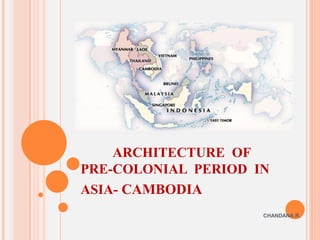
ARCHITECTURE OF
PRE-COLONIAL PERIOD IN
ASIA- CAMBODIA
CHANDANA R.
CAMBODIA
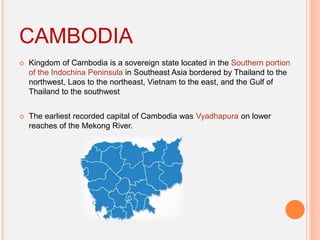
 Kingdom of Cambodia is a sovereign state located in the Southern portion
of the Indochina Peninsula in Southeast Asia bordered by Thailand to the
northwest, Laos to the northeast, Vietnam to the east, and the Gulf of
Thailand to the southwest
 The earliest recorded capital of Cambodia was Vyadhapura on lower
reaches of the Mekong River.
CAMBODIA (PERIODIZATION)
 Many temples had been built before Cambodia became a powerful Kingdom of
Khmer Empire (Golden Age) which dominated most of the Indochina region.
 At that time, Cambodia was known as Chenla kingdom, the predecessor state
of Khmer empire.
 There are three pre-Angkorean architectural styles :
1) Sambor Prei Kuk style (610-650 AD): Sambor Prei Kuk also known as
Isanapura where was the capital of Chenla Kingdom. Temples of Sambor Prei
Kuk were built in round shape, plain colonettes with capitals that include a
bulb.
2) Prei Khmeng style (635-700 AD): Structures reveal masterpieces of sculpture
but architecture scarce. Colonettes are larger than previous style. Buildings
were more heavily decorated but they had general decline of standards.
3) Kompong Preah style (700-800 AD): Temples with more decorative rings on
colonettes which remain cylindrical. Brick constructions were being continued.
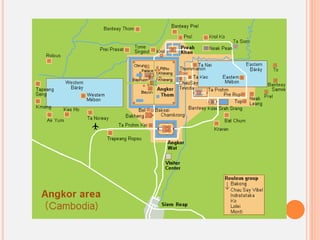
ANGKOR
 Angkor was the capital city of the Khmer Empire
(Yasodharapura) 9th to 15th centuries
 Angkor was a megacity supporting at least 0.1% of the
global population during 1010–1220.
 The Sanskrit word Angkor means "city”.
 The Angkorian period began in AD 802,
 when the Khmer Hindu monarch Jayavarman II declared and
lasted until the late 14th century
 first falling under Ayutthayan suzerainty in 1351. A Khmer
rebellion against Siamese authority resulted in the 1431
sacking of Angkor by Ayutthaya, causing its population to
migrate south to Longvek.
KHMER PERIOD
 At the beginning of early classical Khmer period three important
architectural events occurred
1) First was the creation of a city and temple mountain in the hill of
phnom kulen and the lake of tonle sap.
2) The second was the building of another capital on the hill and round
the temple mountain of phnom bakeng. It was a five leveled pyramid
with isolated towers on the topmost tier and smaller towers at the
lower levels.
3) The third event was the construction of archetypal urban irrigation
system at roluos. an immense artificial lake baray lolei about km
long and 800m wide was formed by earthern dykes to store water
from the stung roluos river. The lake provided for the needs of the
whole community. Its final purpose was to irrigate the paddy fields.
ARCHITECTURAL STYLES
 It was an assemblage of wooden
houses on piles, connected by little
canals linked to larger waterways
capable of taking sea going ships.
 Later funanese and early khmer
architectural development was
centered.
 Wooden buildings gave way to brick
and stone imitations of timber
prototypes which show a mixture of
Indian forms grafted on to indigenous
elements and rich decorative structure
derived from wood carving.
 Examples of temples and shrines still
exist
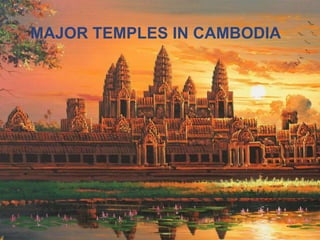
MAJOR TEMPLES IN CAMBODIA
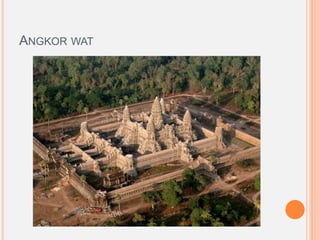
ANGKOR WAT
ANGKOR WAT
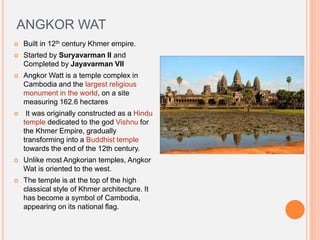
 Built in 12th century Khmer empire.
 Started by Suryavarman II and
Completed by Jayavarman VII
 Angkor Watt is a temple complex in
Cambodia and the largest religious
monument in the world, on a site
measuring 162.6 hectares
 It was originally constructed as a Hindu
temple dedicated to the god Vishnu for
the Khmer Empire, gradually
transforming into a Buddhist temple
towards the end of the 12th century.
 Unlike most Angkorian temples, Angkor
Wat is oriented to the west.
 The temple is at the top of the high
classical style of Khmer architecture. It
has become a symbol of Cambodia,
appearing on its national flag.
ANGKOR WAT
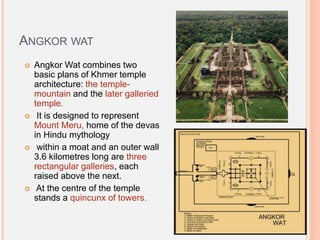
 Angkor Wat combines two
basic plans of Khmer temple
architecture: the temple-
mountain and the later galleried
temple.
 It is designed to represent
Mount Meru, home of the devas
in Hindu mythology
 within a moat and an outer wall
3.6 kilometres long are three
rectangular galleries, each
raised above the next.
 At the centre of the temple
stands a quincunx of towers.
BAYON
BAYON
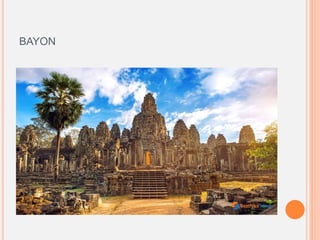
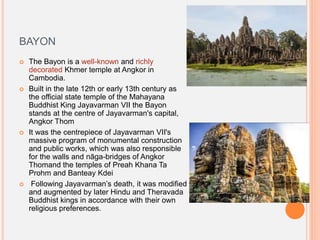
 The Bayon is a well-known and richly
decorated Khmer temple at Angkor in
Cambodia.
 Built in the late 12th or early 13th century as
the official state temple of the Mahayana
Buddhist King Jayavarman VII the Bayon
stands at the centre of Jayavarman's capital,
Angkor Thom
 It was the centrepiece of Jayavarman VII's
massive program of monumental construction
and public works, which was also responsible
for the walls and nāga-bridges of Angkor
Thomand the temples of Preah Khana Ta
Prohm and Banteay Kdei
 Following Jayavarman’s death, it was modified
and augmented by later Hindu and Theravada
Buddhist kings in accordance with their own
religious preferences.

Hoa ppt cambodia

  • 1.
    ARCHITECTURE OF PRE-COLONIAL PERIODIN ASIA- CAMBODIA CHANDANA R.
  • 2.
    CAMBODIA  Kingdom ofCambodia is a sovereign state located in the Southern portion of the Indochina Peninsula in Southeast Asia bordered by Thailand to the northwest, Laos to the northeast, Vietnam to the east, and the Gulf of Thailand to the southwest  The earliest recorded capital of Cambodia was Vyadhapura on lower reaches of the Mekong River.
  • 3.
    CAMBODIA (PERIODIZATION)  Manytemples had been built before Cambodia became a powerful Kingdom of Khmer Empire (Golden Age) which dominated most of the Indochina region.  At that time, Cambodia was known as Chenla kingdom, the predecessor state of Khmer empire.  There are three pre-Angkorean architectural styles : 1) Sambor Prei Kuk style (610-650 AD): Sambor Prei Kuk also known as Isanapura where was the capital of Chenla Kingdom. Temples of Sambor Prei Kuk were built in round shape, plain colonettes with capitals that include a bulb. 2) Prei Khmeng style (635-700 AD): Structures reveal masterpieces of sculpture but architecture scarce. Colonettes are larger than previous style. Buildings were more heavily decorated but they had general decline of standards. 3) Kompong Preah style (700-800 AD): Temples with more decorative rings on colonettes which remain cylindrical. Brick constructions were being continued.
  • 4.
    ANGKOR  Angkor wasthe capital city of the Khmer Empire (Yasodharapura) 9th to 15th centuries  Angkor was a megacity supporting at least 0.1% of the global population during 1010–1220.  The Sanskrit word Angkor means "city”.  The Angkorian period began in AD 802,  when the Khmer Hindu monarch Jayavarman II declared and lasted until the late 14th century  first falling under Ayutthayan suzerainty in 1351. A Khmer rebellion against Siamese authority resulted in the 1431 sacking of Angkor by Ayutthaya, causing its population to migrate south to Longvek.
  • 6.
    KHMER PERIOD  Atthe beginning of early classical Khmer period three important architectural events occurred 1) First was the creation of a city and temple mountain in the hill of phnom kulen and the lake of tonle sap. 2) The second was the building of another capital on the hill and round the temple mountain of phnom bakeng. It was a five leveled pyramid with isolated towers on the topmost tier and smaller towers at the lower levels. 3) The third event was the construction of archetypal urban irrigation system at roluos. an immense artificial lake baray lolei about km long and 800m wide was formed by earthern dykes to store water from the stung roluos river. The lake provided for the needs of the whole community. Its final purpose was to irrigate the paddy fields.
  • 7.
    ARCHITECTURAL STYLES  Itwas an assemblage of wooden houses on piles, connected by little canals linked to larger waterways capable of taking sea going ships.  Later funanese and early khmer architectural development was centered.  Wooden buildings gave way to brick and stone imitations of timber prototypes which show a mixture of Indian forms grafted on to indigenous elements and rich decorative structure derived from wood carving.  Examples of temples and shrines still exist
  • 8.
  • 9.
  • 10.
    ANGKOR WAT  Builtin 12th century Khmer empire.  Started by Suryavarman II and Completed by Jayavarman VII  Angkor Watt is a temple complex in Cambodia and the largest religious monument in the world, on a site measuring 162.6 hectares  It was originally constructed as a Hindu temple dedicated to the god Vishnu for the Khmer Empire, gradually transforming into a Buddhist temple towards the end of the 12th century.  Unlike most Angkorian temples, Angkor Wat is oriented to the west.  The temple is at the top of the high classical style of Khmer architecture. It has become a symbol of Cambodia, appearing on its national flag.
  • 11.
    ANGKOR WAT  AngkorWat combines two basic plans of Khmer temple architecture: the temple- mountain and the later galleried temple.  It is designed to represent Mount Meru, home of the devas in Hindu mythology  within a moat and an outer wall 3.6 kilometres long are three rectangular galleries, each raised above the next.  At the centre of the temple stands a quincunx of towers.
  • 12.
  • 13.
    BAYON  The Bayonis a well-known and richly decorated Khmer temple at Angkor in Cambodia.  Built in the late 12th or early 13th century as the official state temple of the Mahayana Buddhist King Jayavarman VII the Bayon stands at the centre of Jayavarman's capital, Angkor Thom  It was the centrepiece of Jayavarman VII's massive program of monumental construction and public works, which was also responsible for the walls and nāga-bridges of Angkor Thomand the temples of Preah Khana Ta Prohm and Banteay Kdei  Following Jayavarman’s death, it was modified and augmented by later Hindu and Theravada Buddhist kings in accordance with their own religious preferences.