Cambodia
Terms to Remember













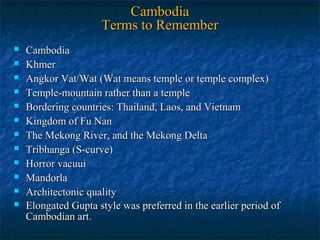
Cambodia
Khmer
Angkor Vat/Wat (Wat means temple or temple complex)
Temple-mountain rather than a temple
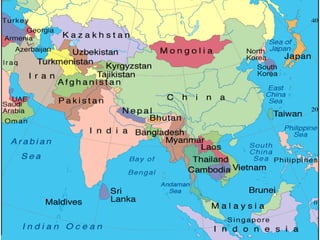
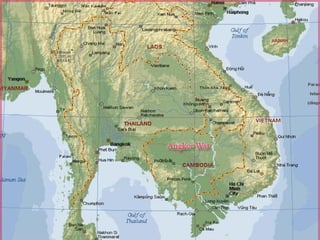
Bordering countries: Thailand, Laos, and Vietnam
Kingdom of Fu Nan
The Mekong River, and the Mekong Delta
Tribhanga (S-curve)
Horror vacuui
Mandorla
Architectonic quality
Elongated Gupta style was preferred in the earlier period of
Cambodian art.
















Hinduism
Devaraja=God-king (temporal & spiritual authority)
God Shiva
God Vishnu
Mt. Meru
Cham
Champa
Vietnam
Malay
Laos
The Bayon at Angkor Thom
The Mongols
Theravada
Mahayana
Gupta
Chronology of Khmer kings
1.
2.
3.
4.
5.
6.
7.
8.
9.
10.

Jayavarman I: 657-681
Jayavarman II: 802-850 (Devaraja, came from the court of
Shrivijaya in Java, identified himself w/Shiva)
Jayavarman III: 850-877
Indravarman I: 877-889
Jayavarman IV: 928-941
Jayavarman V: 968-1001
Suryavarman I: 1006-1050
Jayavarman VI: 1080-1107
Suryavarman II: 1113-1150 (Angkor Wat, identified
himself with Vishnu)
Jayavarman VII: 1181-1218 (Bayon at Angkor Tham, identified
himself with the universal Buddha)
Cambodia/Khmer


Sea contact with India in the 3rd. Century.



Primarily commercial in nature.



Interaction between a high culture and a low culture.



Cultural hegemony.



Its manifestation begins to appear in the art and
culture of Cambodia, Thailand and Indonesia.



This reflected not only in art but also in administration
and organization of society.



Indianization/Hinduization of Southeast Asia


Influence of Hinduism was mostly visible because of
sheer number of temples and its art.



Indianized kingdom of Fu Nan stretched from the
Mekong delta to Thailand and Burma.



The Cambodian rulers remained Hindus, taking
Hindu names, customs and manners.



Khmer Empire was re-established under the reign of
King Jayavarman II.
Cambodia/Khmer


Devaraja=God-king, instituted by Jayavarman II in 850



In 850 Jayavarman II identified himself with God Shiva.



Temple mountain or temple as mountain.



Indravarman (877-889)—devised irrigational system



Suryavarman identified himself with Vishnu and built
Angkor Wat (temple).



The temples were destroyed by the Chams by burning
the capital in 1177.






Jayavarman II (c. 770–850) is widely recognized
as the founder of the Khmer Empire.
Khmer, as an empire ruled much of Southeast
Asia, and it lasted for more than six hundred years.
Before Jayavarman II came to power, there was
much fighting among local overlords who ruled
different parts of Cambodia.


The country was not unified under one ruler.



An inscription from the Sdok Kak Thom temple
recounts that Jayavarman II instructed a Brahman
priest named Hiranhadama to conduct a religious
ritual known as the cult of the devaraja which placed
him as a chakravartin, universal monarch.
Jayavarman II


The cult established him as the supreme ruler of the
land, and therefore he succeeded in unifying the
country.



But Hindu civilization had already existed for
centuries in the region; the fact that Jayavarman was
the second monarch to carry that name was an
indication that there had been a powerful king in the
past.


Suryavarman II’s son Jayavarman VII drove the
Chams out of Angkor Vat in 1181 and annexed the
territories of Champa, Malaya, Thailand and Laos.



By now the Khamer rulers were predominantly
Mahayana Buddhists.


Jayavarman VII built the Bayon temple complex
at Angkor Thom



By the middle of the 13th century with the rise
of the Mongols, the Khmer empire began to
decline.



Theravada supplanted the Mahayana.


The golden age of Khmer civilization extended
from the 9th to the 13th centuries, when Khmer
Empire, which gave Kampuchea, or Cambodia,
its name, ruled large territories from its capital in
the region of Angkor in western Cambodia.


Legend has it that in 802 CE, Jayavarman II, king of
the Khmers, first came to the Kuhlen hills, the future
site of Angkor Wat.



Later, under Jayavarman VII (1181–ca. 1218),
Khmer reached its zenith of political power and
cultural creativity.



Jayavarman VII gained power and territory in a
series of successful wars.


Khmer conquests were unstoppable as they raided
home cities of powerful seafaring Chams.



Territorial expansion stopped only after a defeat by
Dai Viet. The battle also witnessed Suryavarman
II's death.



Following Jayavarman VII's death, Khmer
experienced a gradual decline.


Important factors were the aggressiveness of
neighboring peoples (especially the Thai), chronic
interdynastic strife, and the gradual deterioration of
complex irrigation system that had ensured rice
surpluses.



Angkor Dynasty survived until 1431, when the Thai
captured Angkor Thom and the Cambodian king fled
to the southern part of the country.
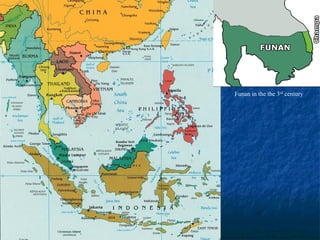
Funan in the the 3rd century
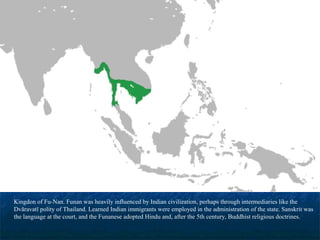
Kingdon of Fu-Nan. Funan was heavily influenced by Indian civilization, perhaps through intermediaries like the
Dvāravatī polity of Thailand. Learned Indian immigrants were employed in the administration of the state. Sanskrit was
the language at the court, and the Funanese adopted Hindu and, after the 5th century, Buddhist religious doctrines.
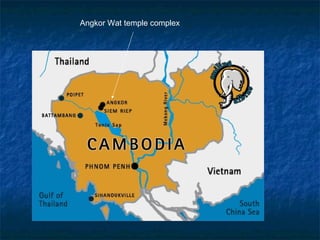
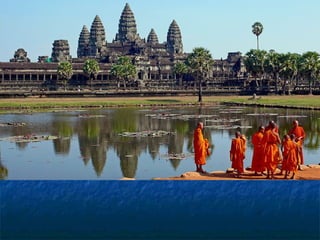
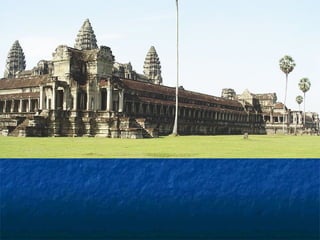
Angkor Wat temple complex
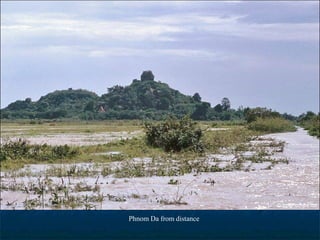
Phnom Da from distance
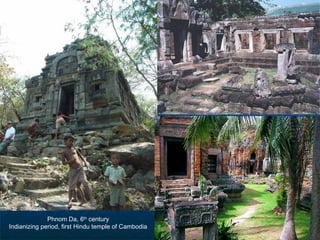
Phnom Da, 6th century
Indianizing period, first Hindu temple of Cambodia
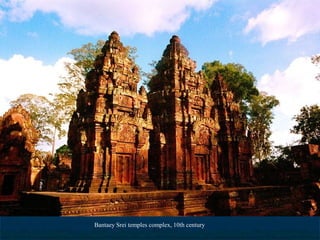
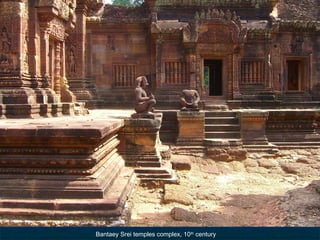
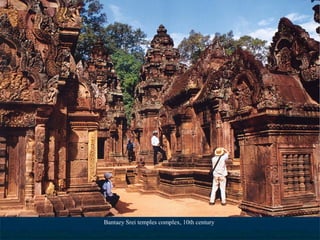
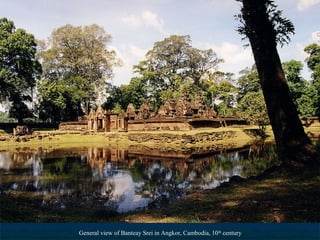
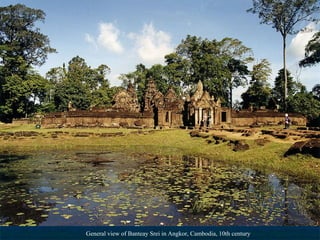
Bantaey Srei temples complex, 10th century
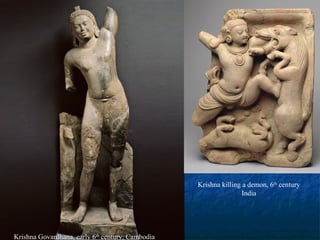
Krishna killing a demon, 6th century
India

Krishna Govardhana, early 6th century, Cambodia
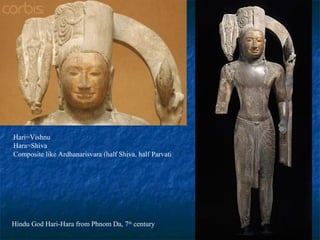
Hari=Vishnu
Hara=Shiva
Composite like Ardhanarisvara (half Shiva, half Parvati

Hindu God Hari-Hara from Phnom Da, 7th century
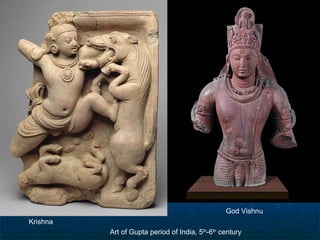
God Vishnu
Krishna
Art of Gupta period of India, 5th-6th century
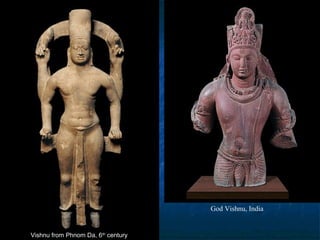
God Vishnu, India

Vishnu from Phnom Da, 6th century
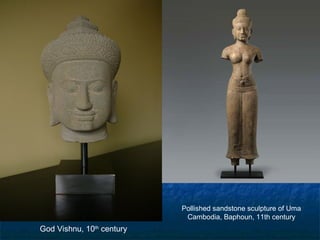
Pollished sandstone sculpture of Uma
Cambodia, Baphoun, 11th century

God Vishnu, 10th century
General view of Banteay Srei in Angkor, Cambodia, 10th century
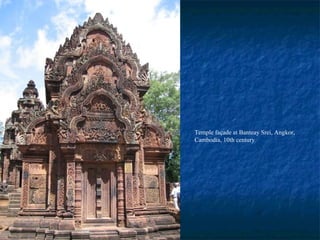
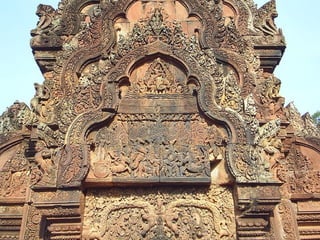
Temple façade at Banteay Srei, Angkor,
Cambodia, 10th century
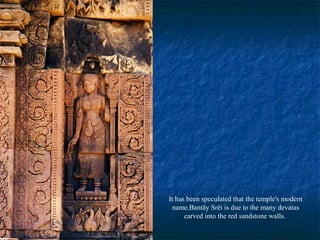
It has been speculated that the temple's modern
name,Bantãy Srĕi is due to the many devatas
carved into the red sandstone walls.
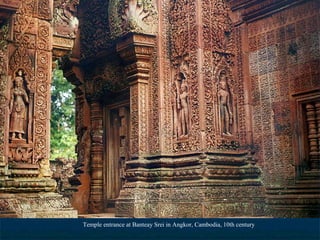
Temple entrance at Banteay Srei in Angkor, Cambodia, 10th century
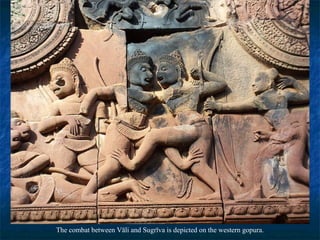
The combat between Vāli and Sugrīva is depicted on the western gopura.
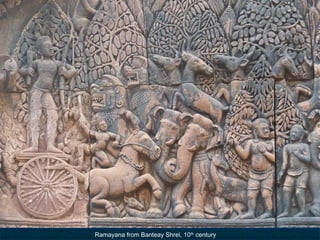
Ramayana from Banteay Shrei, 10 th century
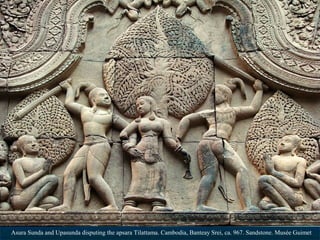
Asura Sunda and Upasunda disputing the apsara Tilattama. Cambodia, Banteay Srei, ca. 967. Sandstone. Musée Guimet
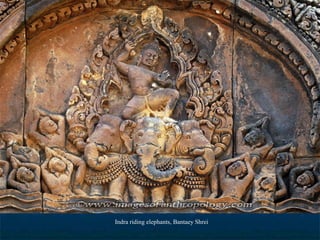
Indra riding elephants, Bantaey Shrei
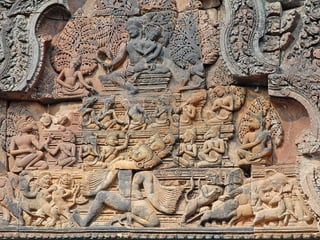
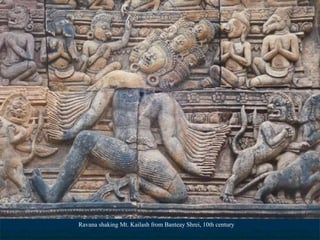
Ravana shaking Mt. Kailash from Banteay Shrei, 10th century
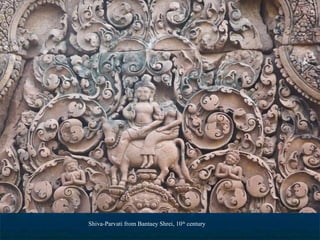
Shiva-Parvati from Bantaey Shrei, 10th century
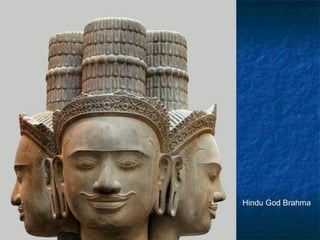
Hindu God Brahma
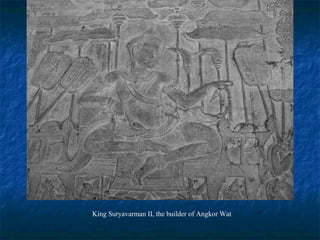
King Suryavarman II, the builder of Angkor Wat
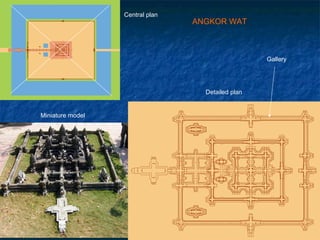
Central plan

ANGKOR WAT

Gallery

Detailed plan
Miniature model
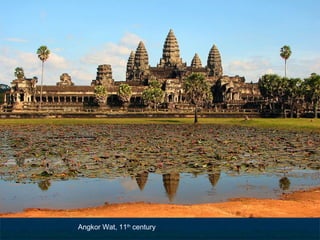
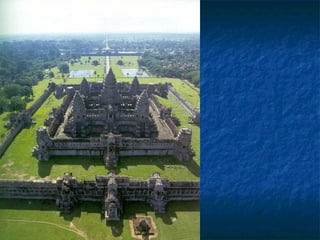
Angkor Wat, 11th century
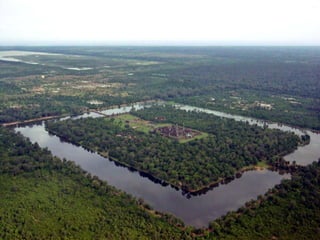
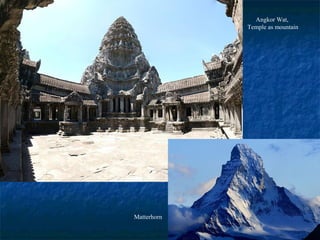
Angkor Wat,
Temple as mountain

Matterhorn
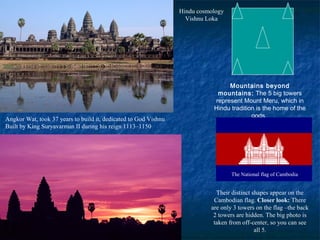
Hindu cosmology
Vishnu Loka

Angkor Wat, took 37 years to build it, dedicated to God Vishnu
Built by King Suryavarman II during his reign 1113–1150

Mountains beyond
mountains: The 5 big towers
represent Mount Meru, which in
Hindu tradition is the home of the
gods.

The National flag of Cambodia

Their distinct shapes appear on the
Cambodian flag. Closer look: There
are only 3 towers on the flag –the back
2 towers are hidden. The big photo is
taken from off-center, so you can see
all 5.
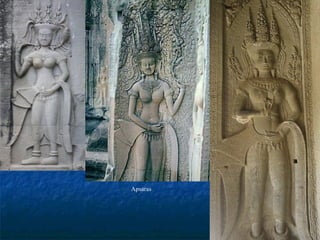
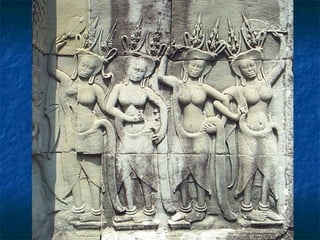
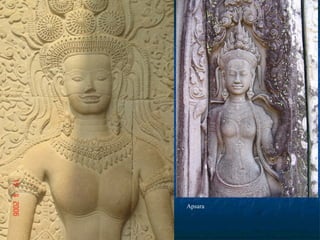
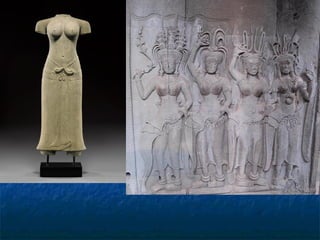
Apsaras
Apsara
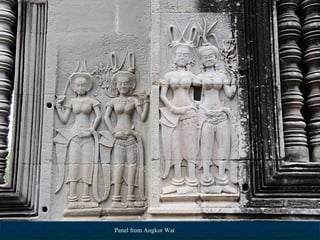
Panel from Angkor Wat
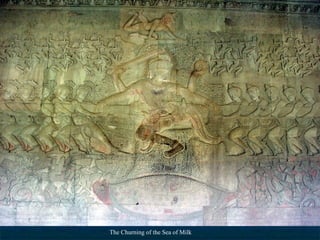
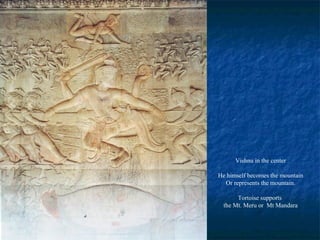
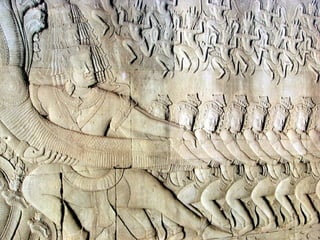
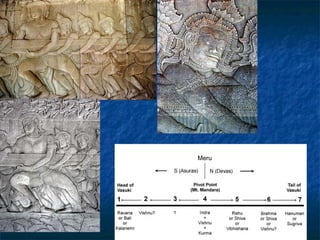
The Churning of the Sea of Milk
Vishnu in the center
He himself becomes the mountain
Or represents the mountain.
Tortoise supports
the Mt. Meru or Mt Mandara
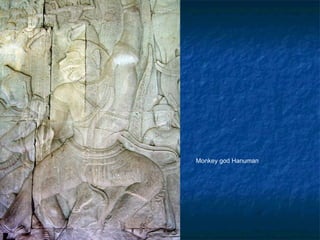
Monkey god Hanuman
Meru
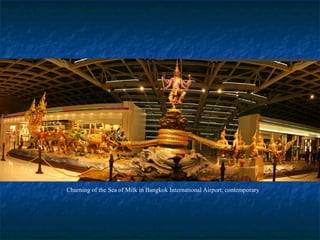
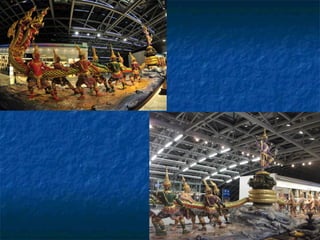
Churning of the Sea of Milk in Bangkok International Airport, contemporary
India Starts Angkor Wat Replica in Bihar
by Amarnath Tewary, BBC correspondent, 3/6/2012


A Hindu Trust in India’s eastern state of Bihar has begun building a replica of
Cambodia’s Angkor Wat temple.



On March 6, 2012 a foundation laying ceremony for the $20 million project was held 16 miles
from Bihar’s capital Patna, on the banks of the Ganges.



The temple will be constructed on a sprawling 40-acre site in Vaishali district in north Bihar.



The builders say the result will be the world’s largest Hindu temple.



The construction will take 10 years to complete.



"It will be the world’s largest Hindu temple….bigger in size, shape and height than the Angkor
Wat of Cambodia,” the Trust’s secretary told the BBC.



It will be called Virat Angkor Wat Ram Temple, but will aslo house other Hindu deities like
Radha-Krishna, Shiva-Parvati, Ganesha, Surya and 10 incarnations of Lord Vishnu.



Bamiyan in China
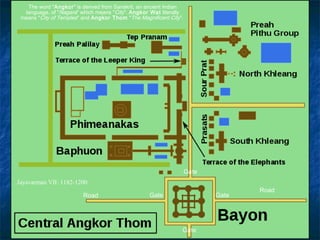
The word "Angkor" is derived from Sanskrit, an ancient Indian
language, of "Nagara" which means "City". Angkor Wat literally
means "City of Temples" and Angkor Thom "The Magnificent City".

Gate
Jayavarman VII: 1182-1200
Road

Gate

Gate

Gate

Road


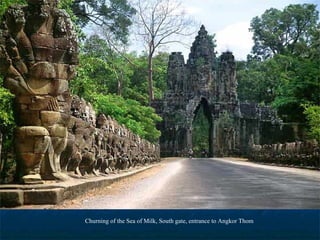
Gate at each of the cardinal point



It leads to the Bayon, located at the center of the city



A causeway goes over a moat in front of each tower



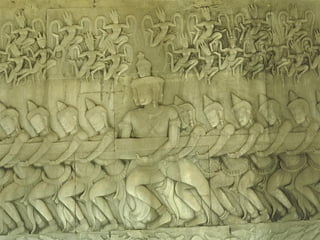
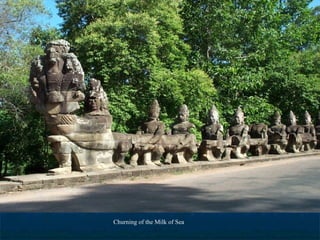
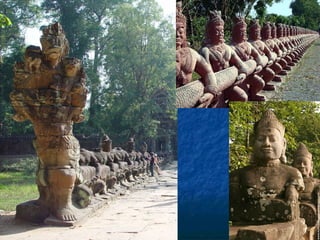
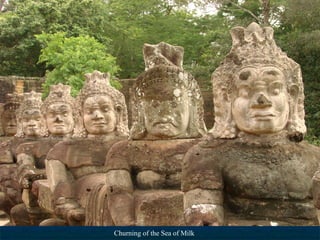
South causeway has a row of devas on the left and asuras on
the right, each row holding a naga in the attitude of a tug-ofwar



This appears to be a reference to the myth of the Churning of
the Sea of Milk



The temple-mountain of the Bayon would then be the pivot
around which the churning takes place
Churning of the Sea of Milk, South gate, entrance to Angkor Thom
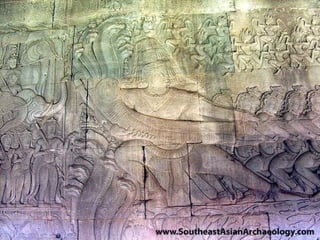
Churning of the Milk of Sea
Churning of the Sea of Milk
Ke jasto dekcha?
Mt. Meru

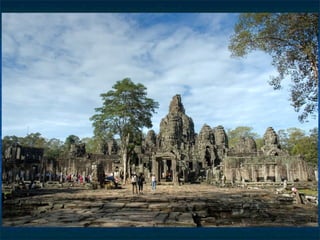
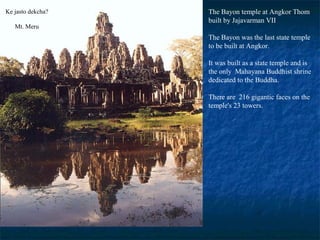
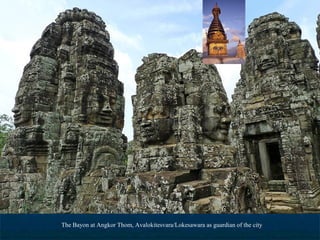
The Bayon temple at Angkor Thom
built by Jajavarman VII
The Bayon was the last state temple
to be built at Angkor.
It was built as a state temple and is
the only Mahayana Buddhist shrine
dedicated to the Buddha.
There are 216 gigantic faces on the
temple's 23 towers.
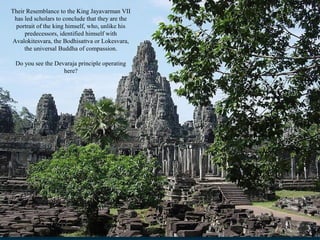
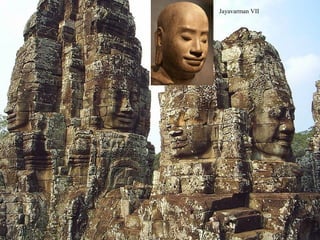
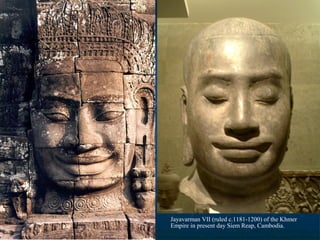
Their Resemblance to the King Jayavarman VII
has led scholars to conclude that they are the
portrait of the king himself, who, unlike his
predecessors, identified himself with
Avalokitesvara, the Bodhisattva or Lokesvara,
the universal Buddha of compassion.
Do you see the Devaraja principle operating
here?
The Bayon at Angkor Thom, Avalokitesvara/Lokesawara as guardian of the city
Jayavarman VII
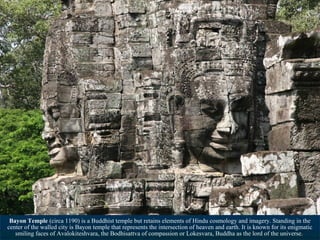
Bayon Temple (circa 1190) is a Buddhist temple but retains elements of Hindu cosmology and imagery. Standing in the
center of the walled city is Bayon temple that represents the intersection of heaven and earth. It is known for its enigmatic
smiling faces of Avalokiteshvara, the Bodhisattva of compassion or Lokesvara, Buddha as the lord of the universe.
Jayavarman VII (ruled c.1181-1200) of the Khmer
Empire in present day Siem Reap, Cambodia.
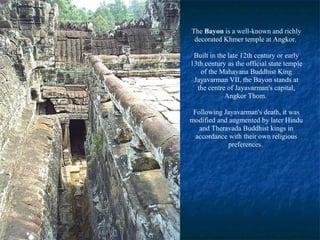
The Bayon is a well-known and richly
decorated Khmer temple at Angkor.
Built in the late 12th century or early
13th century as the official state temple
of the Mahayana Buddhist King
Jayavarman VII, the Bayon stands at
the centre of Jayavarman's capital,
Angkor Thom.
Following Jayavarman's death, it was
modified and augmented by later Hindu
and Theravada Buddhist kings in
accordance with their own religious
preferences.
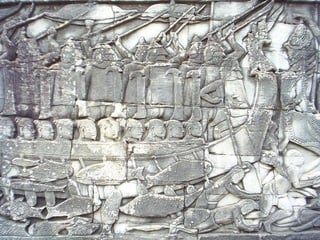
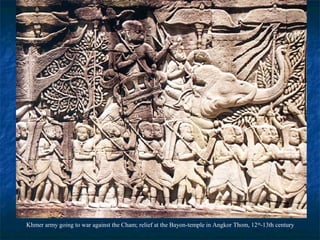
Khmer army going to war against the Cham; relief at the Bayon-temple in Angkor Thom, 12 th-13th century
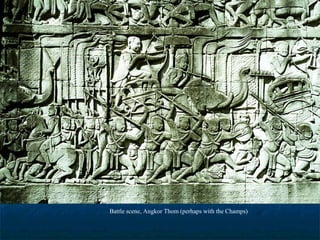
Battle scene, Angkor Thom (perhaps with the Champs)
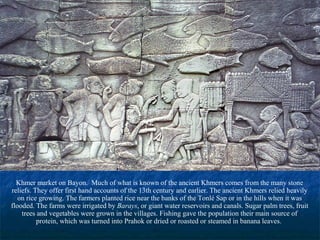
Khmer market on Bayon. Much of what is known of the ancient Khmers comes from the many stone
reliefs. They offer first hand accounts of the 13th century and earlier. The ancient Khmers relied heavily
on rice growing. The farmers planted rice near the banks of the Tonlé Sap or in the hills when it was
flooded. The farms were irrigated by Barays, or giant water reservoirs and canals. Sugar palm trees, fruit
trees and vegetables were grown in the villages. Fishing gave the population their main source of
protein, which was turned into Prahok or dried or roasted or steamed in banana leaves.
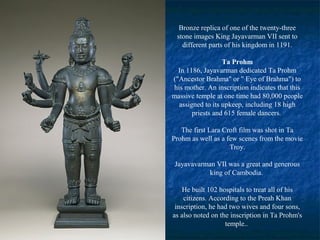
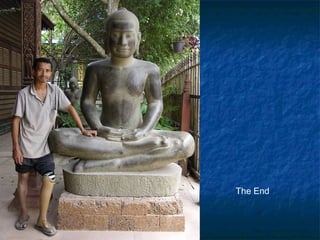
Bronze replica of one of the twenty-three
stone images King Jayavarman VII sent to
different parts of his kingdom in 1191.
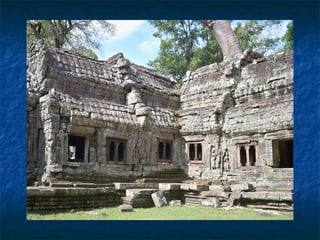
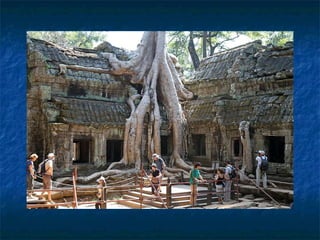
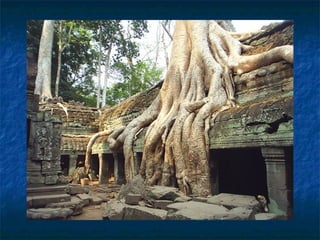
Ta Prohm
In 1186, Jayavarman dedicated Ta Prohm
("Ancestor Brahma" or " Eye of Brahma") to
his mother. An inscription indicates that this
massive temple at one time had 80,000 people
assigned to its upkeep, including 18 high
priests and 615 female dancers.
The first Lara Croft film was shot in Ta
Prohm as well as a few scenes from the movie
Troy.
Jayavavarman VII was a great and generous
king of Cambodia.
He built 102 hospitals to treat all of his
citizens. According to the Preah Khan
inscription, he had two wives and four sons,
as also noted on the inscription in Ta Prohm's
temple..


Jayavarman VII constructed Rajavihara in
honor of his family.



The temple's main image, representing
Prajnaparamita, the personification of wisdom,
was modelled on the king's mother.


The northern and southern satellite temples in the
third enclosure were dedicated to the king's guru
and his elder brother respectively.



As such, Ta Prohm formed a complementary pair
with the temple monastery of Preah Khan,
dedicated in 1191 A.D., the main image of which
represented the Bodhisattva of compassion
Lokesvara and was modelled on the king's father.


The temple's stele records that the site was home to
more than 12,500 people (including 18 high priests
and 615 dancers), with an additional 800,000 souls in
the surrounding villages working to provide services
and supplies.



The stele also notes that the temple amassed
considerable riches, including gold, pearls and silks.



Expansions and additions to Ta Prohm continued as
late as the rule of Srindravarman at the end of the 15th
century.
The End

Cambodia

  • 1.
    Cambodia Terms to Remember             Cambodia Khmer AngkorVat/Wat (Wat means temple or temple complex) Temple-mountain rather than a temple Bordering countries: Thailand, Laos, and Vietnam Kingdom of Fu Nan The Mekong River, and the Mekong Delta Tribhanga (S-curve) Horror vacuui Mandorla Architectonic quality Elongated Gupta style was preferred in the earlier period of Cambodian art.
  • 2.
                   Hinduism Devaraja=God-king (temporal &spiritual authority) God Shiva God Vishnu Mt. Meru Cham Champa Vietnam Malay Laos The Bayon at Angkor Thom The Mongols Theravada Mahayana Gupta
  • 3.
    Chronology of Khmerkings 1. 2. 3. 4. 5. 6. 7. 8. 9. 10. Jayavarman I: 657-681 Jayavarman II: 802-850 (Devaraja, came from the court of Shrivijaya in Java, identified himself w/Shiva) Jayavarman III: 850-877 Indravarman I: 877-889 Jayavarman IV: 928-941 Jayavarman V: 968-1001 Suryavarman I: 1006-1050 Jayavarman VI: 1080-1107 Suryavarman II: 1113-1150 (Angkor Wat, identified himself with Vishnu) Jayavarman VII: 1181-1218 (Bayon at Angkor Tham, identified himself with the universal Buddha)
  • 4.
    Cambodia/Khmer  Sea contact withIndia in the 3rd. Century.  Primarily commercial in nature.  Interaction between a high culture and a low culture.  Cultural hegemony.  Its manifestation begins to appear in the art and culture of Cambodia, Thailand and Indonesia.  This reflected not only in art but also in administration and organization of society.  Indianization/Hinduization of Southeast Asia
  • 5.
     Influence of Hinduismwas mostly visible because of sheer number of temples and its art.  Indianized kingdom of Fu Nan stretched from the Mekong delta to Thailand and Burma.  The Cambodian rulers remained Hindus, taking Hindu names, customs and manners.  Khmer Empire was re-established under the reign of King Jayavarman II.
  • 6.
    Cambodia/Khmer  Devaraja=God-king, instituted byJayavarman II in 850  In 850 Jayavarman II identified himself with God Shiva.  Temple mountain or temple as mountain.  Indravarman (877-889)—devised irrigational system  Suryavarman identified himself with Vishnu and built Angkor Wat (temple).  The temples were destroyed by the Chams by burning the capital in 1177.
  • 7.
       Jayavarman II (c.770–850) is widely recognized as the founder of the Khmer Empire. Khmer, as an empire ruled much of Southeast Asia, and it lasted for more than six hundred years. Before Jayavarman II came to power, there was much fighting among local overlords who ruled different parts of Cambodia.
  • 8.
     The country wasnot unified under one ruler.  An inscription from the Sdok Kak Thom temple recounts that Jayavarman II instructed a Brahman priest named Hiranhadama to conduct a religious ritual known as the cult of the devaraja which placed him as a chakravartin, universal monarch.
  • 9.
    Jayavarman II  The cultestablished him as the supreme ruler of the land, and therefore he succeeded in unifying the country.  But Hindu civilization had already existed for centuries in the region; the fact that Jayavarman was the second monarch to carry that name was an indication that there had been a powerful king in the past.
  • 10.
     Suryavarman II’s sonJayavarman VII drove the Chams out of Angkor Vat in 1181 and annexed the territories of Champa, Malaya, Thailand and Laos.  By now the Khamer rulers were predominantly Mahayana Buddhists.
  • 11.
     Jayavarman VII builtthe Bayon temple complex at Angkor Thom  By the middle of the 13th century with the rise of the Mongols, the Khmer empire began to decline.  Theravada supplanted the Mahayana.
  • 12.
     The golden ageof Khmer civilization extended from the 9th to the 13th centuries, when Khmer Empire, which gave Kampuchea, or Cambodia, its name, ruled large territories from its capital in the region of Angkor in western Cambodia.
  • 13.
     Legend has itthat in 802 CE, Jayavarman II, king of the Khmers, first came to the Kuhlen hills, the future site of Angkor Wat.  Later, under Jayavarman VII (1181–ca. 1218), Khmer reached its zenith of political power and cultural creativity.  Jayavarman VII gained power and territory in a series of successful wars.
  • 14.
     Khmer conquests wereunstoppable as they raided home cities of powerful seafaring Chams.  Territorial expansion stopped only after a defeat by Dai Viet. The battle also witnessed Suryavarman II's death.  Following Jayavarman VII's death, Khmer experienced a gradual decline.
  • 15.
     Important factors werethe aggressiveness of neighboring peoples (especially the Thai), chronic interdynastic strife, and the gradual deterioration of complex irrigation system that had ensured rice surpluses.  Angkor Dynasty survived until 1431, when the Thai captured Angkor Thom and the Cambodian king fled to the southern part of the country.
  • 17.
    Funan in thethe 3rd century
  • 18.
    Kingdon of Fu-Nan.Funan was heavily influenced by Indian civilization, perhaps through intermediaries like the Dvāravatī polity of Thailand. Learned Indian immigrants were employed in the administration of the state. Sanskrit was the language at the court, and the Funanese adopted Hindu and, after the 5th century, Buddhist religious doctrines.
  • 20.
  • 21.
    Phnom Da fromdistance
  • 22.
    Phnom Da, 6thcentury Indianizing period, first Hindu temple of Cambodia
  • 23.
    Bantaey Srei templescomplex, 10th century
  • 24.
    Bantaey Srei templescomplex, 10th century
  • 25.
    Bantaey Srei templescomplex, 10th century
  • 26.
    Krishna killing ademon, 6th century India Krishna Govardhana, early 6th century, Cambodia
  • 27.
    Hari=Vishnu Hara=Shiva Composite like Ardhanarisvara(half Shiva, half Parvati Hindu God Hari-Hara from Phnom Da, 7th century
  • 28.
    God Vishnu Krishna Art ofGupta period of India, 5th-6th century
  • 29.
    God Vishnu, India Vishnufrom Phnom Da, 6th century
  • 30.
    Pollished sandstone sculptureof Uma Cambodia, Baphoun, 11th century God Vishnu, 10th century
  • 31.
    General view ofBanteay Srei in Angkor, Cambodia, 10th century
  • 32.
    General view ofBanteay Srei in Angkor, Cambodia, 10th century
  • 33.
    Temple façade atBanteay Srei, Angkor, Cambodia, 10th century
  • 34.
    It has beenspeculated that the temple's modern name,Bantãy Srĕi is due to the many devatas carved into the red sandstone walls.
  • 35.
    Temple entrance atBanteay Srei in Angkor, Cambodia, 10th century
  • 36.
    The combat betweenVāli and Sugrīva is depicted on the western gopura.
  • 38.
    Ramayana from BanteayShrei, 10 th century
  • 39.
    Asura Sunda andUpasunda disputing the apsara Tilattama. Cambodia, Banteay Srei, ca. 967. Sandstone. Musée Guimet
  • 40.
  • 42.
    Ravana shaking Mt.Kailash from Banteay Shrei, 10th century
  • 43.
    Shiva-Parvati from BantaeyShrei, 10th century
  • 45.
  • 46.
    King Suryavarman II,the builder of Angkor Wat
  • 47.
  • 49.
  • 51.
    Angkor Wat, Temple asmountain Matterhorn
  • 55.
    Hindu cosmology Vishnu Loka AngkorWat, took 37 years to build it, dedicated to God Vishnu Built by King Suryavarman II during his reign 1113–1150 Mountains beyond mountains: The 5 big towers represent Mount Meru, which in Hindu tradition is the home of the gods. The National flag of Cambodia Their distinct shapes appear on the Cambodian flag. Closer look: There are only 3 towers on the flag –the back 2 towers are hidden. The big photo is taken from off-center, so you can see all 5.
  • 56.
  • 58.
  • 60.
  • 61.
    The Churning ofthe Sea of Milk
  • 62.
    Vishnu in thecenter He himself becomes the mountain Or represents the mountain. Tortoise supports the Mt. Meru or Mt Mandara
  • 64.
  • 67.
  • 68.
    Churning of theSea of Milk in Bangkok International Airport, contemporary
  • 70.
    India Starts AngkorWat Replica in Bihar by Amarnath Tewary, BBC correspondent, 3/6/2012  A Hindu Trust in India’s eastern state of Bihar has begun building a replica of Cambodia’s Angkor Wat temple.  On March 6, 2012 a foundation laying ceremony for the $20 million project was held 16 miles from Bihar’s capital Patna, on the banks of the Ganges.  The temple will be constructed on a sprawling 40-acre site in Vaishali district in north Bihar.  The builders say the result will be the world’s largest Hindu temple.  The construction will take 10 years to complete.  "It will be the world’s largest Hindu temple….bigger in size, shape and height than the Angkor Wat of Cambodia,” the Trust’s secretary told the BBC.  It will be called Virat Angkor Wat Ram Temple, but will aslo house other Hindu deities like Radha-Krishna, Shiva-Parvati, Ganesha, Surya and 10 incarnations of Lord Vishnu.  Bamiyan in China
  • 71.
    The word "Angkor"is derived from Sanskrit, an ancient Indian language, of "Nagara" which means "City". Angkor Wat literally means "City of Temples" and Angkor Thom "The Magnificent City". Gate Jayavarman VII: 1182-1200 Road Gate Gate Gate Road
  • 72.
     Gate at eachof the cardinal point  It leads to the Bayon, located at the center of the city  A causeway goes over a moat in front of each tower  South causeway has a row of devas on the left and asuras on the right, each row holding a naga in the attitude of a tug-ofwar  This appears to be a reference to the myth of the Churning of the Sea of Milk  The temple-mountain of the Bayon would then be the pivot around which the churning takes place
  • 75.
    Churning of theSea of Milk, South gate, entrance to Angkor Thom
  • 76.
    Churning of theMilk of Sea
  • 79.
    Churning of theSea of Milk
  • 80.
    Ke jasto dekcha? Mt.Meru The Bayon temple at Angkor Thom built by Jajavarman VII The Bayon was the last state temple to be built at Angkor. It was built as a state temple and is the only Mahayana Buddhist shrine dedicated to the Buddha. There are 216 gigantic faces on the temple's 23 towers.
  • 81.
    Their Resemblance tothe King Jayavarman VII has led scholars to conclude that they are the portrait of the king himself, who, unlike his predecessors, identified himself with Avalokitesvara, the Bodhisattva or Lokesvara, the universal Buddha of compassion. Do you see the Devaraja principle operating here?
  • 82.
    The Bayon atAngkor Thom, Avalokitesvara/Lokesawara as guardian of the city
  • 83.
  • 84.
    Bayon Temple (circa1190) is a Buddhist temple but retains elements of Hindu cosmology and imagery. Standing in the center of the walled city is Bayon temple that represents the intersection of heaven and earth. It is known for its enigmatic smiling faces of Avalokiteshvara, the Bodhisattva of compassion or Lokesvara, Buddha as the lord of the universe.
  • 85.
    Jayavarman VII (ruledc.1181-1200) of the Khmer Empire in present day Siem Reap, Cambodia.
  • 86.
    The Bayon isa well-known and richly decorated Khmer temple at Angkor. Built in the late 12th century or early 13th century as the official state temple of the Mahayana Buddhist King Jayavarman VII, the Bayon stands at the centre of Jayavarman's capital, Angkor Thom. Following Jayavarman's death, it was modified and augmented by later Hindu and Theravada Buddhist kings in accordance with their own religious preferences.
  • 87.
    Khmer army goingto war against the Cham; relief at the Bayon-temple in Angkor Thom, 12 th-13th century
  • 88.
    Battle scene, AngkorThom (perhaps with the Champs)
  • 89.
    Khmer market onBayon. Much of what is known of the ancient Khmers comes from the many stone reliefs. They offer first hand accounts of the 13th century and earlier. The ancient Khmers relied heavily on rice growing. The farmers planted rice near the banks of the Tonlé Sap or in the hills when it was flooded. The farms were irrigated by Barays, or giant water reservoirs and canals. Sugar palm trees, fruit trees and vegetables were grown in the villages. Fishing gave the population their main source of protein, which was turned into Prahok or dried or roasted or steamed in banana leaves.
  • 90.
    Bronze replica ofone of the twenty-three stone images King Jayavarman VII sent to different parts of his kingdom in 1191. Ta Prohm In 1186, Jayavarman dedicated Ta Prohm ("Ancestor Brahma" or " Eye of Brahma") to his mother. An inscription indicates that this massive temple at one time had 80,000 people assigned to its upkeep, including 18 high priests and 615 female dancers. The first Lara Croft film was shot in Ta Prohm as well as a few scenes from the movie Troy. Jayavavarman VII was a great and generous king of Cambodia. He built 102 hospitals to treat all of his citizens. According to the Preah Khan inscription, he had two wives and four sons, as also noted on the inscription in Ta Prohm's temple..
  • 94.
     Jayavarman VII constructedRajavihara in honor of his family.  The temple's main image, representing Prajnaparamita, the personification of wisdom, was modelled on the king's mother.
  • 95.
     The northern andsouthern satellite temples in the third enclosure were dedicated to the king's guru and his elder brother respectively.  As such, Ta Prohm formed a complementary pair with the temple monastery of Preah Khan, dedicated in 1191 A.D., the main image of which represented the Bodhisattva of compassion Lokesvara and was modelled on the king's father.
  • 96.
     The temple's stelerecords that the site was home to more than 12,500 people (including 18 high priests and 615 dancers), with an additional 800,000 souls in the surrounding villages working to provide services and supplies.  The stele also notes that the temple amassed considerable riches, including gold, pearls and silks.  Expansions and additions to Ta Prohm continued as late as the rule of Srindravarman at the end of the 15th century.
  • 97.