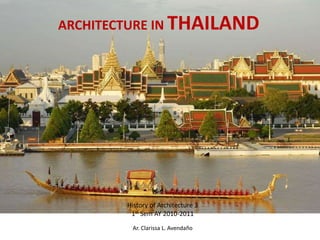
ARCHITECTURE IN THAILAND

History of Architecture 3
1st Sem AY 2010-2011
Ar. Clarissa L. Avendaño
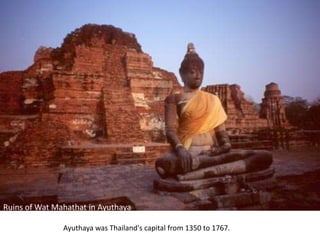
Ruins of Wat Mahathat in Ayuthaya
Ayuthaya was Thailand's capital from 1350 to 1767.
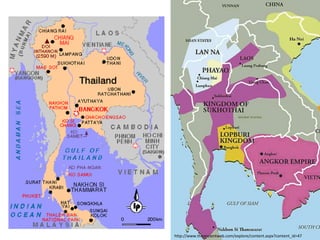
Thailand in the 13th c.

http://www.theancientweb.com/explore/content.aspx?content_id=47
http://www.manaliandterry.com/index.php/2009/11/13/chiang-mai-thailand-monk-chat/
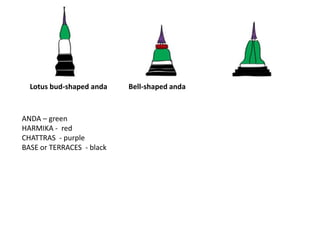
Lotus bud-shaped anda

ANDA – green
HARMIKA - red
CHATTRAS - purple
BASE or TERRACES - black

Bell-shaped anda
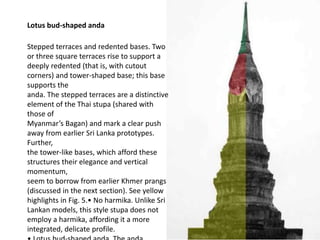
Lotus bud-shaped anda
Stepped terraces and redented bases. Two
or three square terraces rise to support a
deeply redented (that is, with cutout
corners) and tower-shaped base; this base
supports the
anda. The stepped terraces are a distinctive
element of the Thai stupa (shared with
those of
Myanmar’s Bagan) and mark a clear push
away from earlier Sri Lanka prototypes.
Further,
the tower-like bases, which afford these
structures their elegance and vertical
momentum,
seem to borrow from earlier Khmer prangs
(discussed in the next section). See yellow
highlights in Fig. 5.• No harmika. Unlike Sri
Lankan models, this style stupa does not
employ a harmika, affording it a more
integrated, delicate profile.
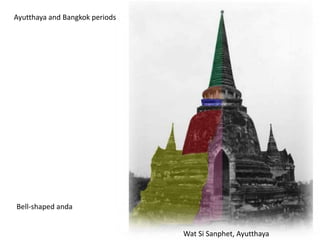
Ayutthaya and Bangkok periods

Bell-shaped anda
Wat Si Sanphet, Ayutthaya
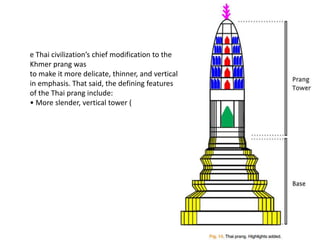
e Thai civilization’s chief modification to the
Khmer prang was
to make it more delicate, thinner, and vertical
in emphasis. That said, the defining features
of the Thai prang include:
• More slender, vertical tower (
irst prangs in Thailand were built in Phimai and Khao Phnom
Rung and Lopburi between the early 10th century and the late 12th century,
when the Khmer kingdom was dominant.
After the Khmer Empire collapsed, the Thai building masters of the Sukhothai
Kingdom adapted the Prang form. They extended and developed it. The
building material was no more separate small sandstone blocks, instead the
Thais built the Prang in brick or laterite covered with stucco. And the Cella could
be reached only by stairs. An example for this is the Prang of the Wat
Mahathat in Phitsanulok. Later developments of the Prang suggested the Cella
only. The entrance door became a niche, in which was placed
the Buddharupa(Buddha statue), which had originally taken the central position
inside. For reasons of symmetry the niche was repeated on all four sides. On its
pinnacle was a Trishul, the "weapon of Indra".
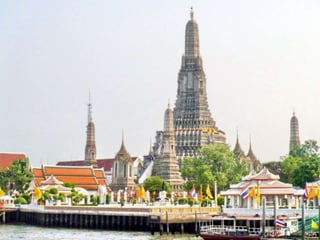
A "more modern" Prang is a slim construction, like an ear of corn, which lets its
Khmer origin be only suspected. The best example is Wat Arun, the landmark
of Bangkok. AlsoWat Phra Kaeo has six thin Prangs arranged in a row. Another
example is the four Prangs arranged in all four directions around Wat
Pho in Bangkok, and the five Prangs in Wat Pichayart in Thonburi.
ARCHITECTURAL STRUCTURES
1. Temples and Monasteries
2. Palaces
3. Houses/Dwelling Units
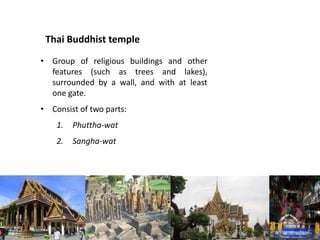
Thai Buddhist temple
• Group of religious buildings and other
features (such as trees and lakes),
surrounded by a wall, and with at least
one gate.
• Consist of two parts:

1.

Phuttha-wat

2.

Sangha-wat
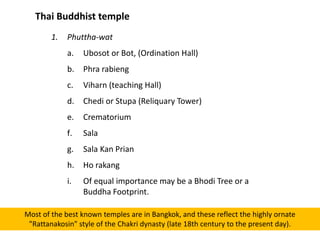
Thai Buddhist temple
1.

Phuttha-wat
a.

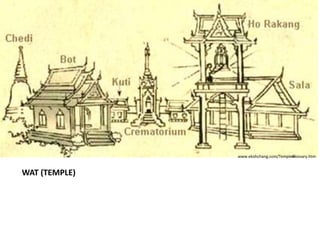
Ubosot or Bot, (Ordination Hall)

b.

Phra rabieng

c.

Viharn (teaching Hall)

d.

Chedi or Stupa (Reliquary Tower)

e.

Crematorium

f.

Sala

g.

Sala Kan Prian

h.

Ho rakang

i.

Of equal importance may be a Bhodi Tree or a
Buddha Footprint.

Most of the best known temples are in Bangkok, and these reflect the highly ornate
"Rattanakosin" style of the Chakri dynasty (late 18th century to the present day).
www.ekohchang.com/TempleGlossary.htm

WAT (TEMPLE)
VIHARN
CHEDI

CHEDI

1

BOT

VIHARN

CHEDI
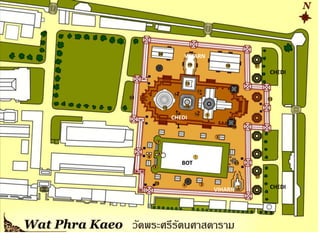
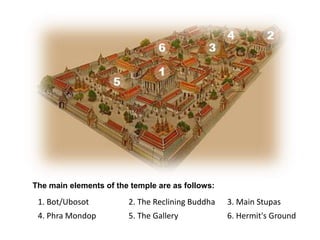
The main elements of the temple are as follows:

1. Bot/Ubosot

2. The Reclining Buddha

3. Main Stupas

4. Phra Mondop

5. The Gallery

6. Hermit's Ground
WAT
•

Thai Buddhist temple
or monastery.

•

In most cases it is not
just one building, but
a
collection
of
buildings, shrines, and
monuments within a
courtyard
that
is
enclosed by a wall.

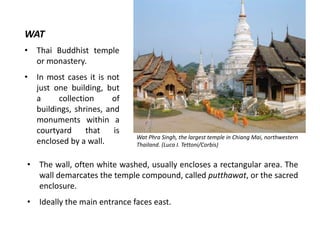
Wat Phra Singh, the largest temple in Chiang Mai, northwestern
Thailand. (Luca I. Tettoni/Corbis)

•

The wall, often white washed, usually encloses a rectangular area. The
wall demarcates the temple compound, called putthawat, or the sacred
enclosure.

•

Ideally the main entrance faces east.
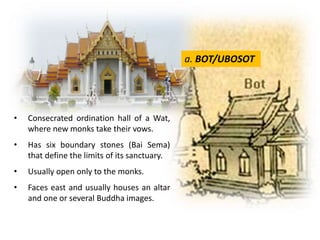
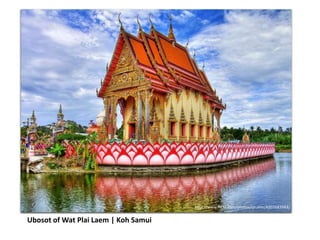
a. BOT/UBOSOT

•

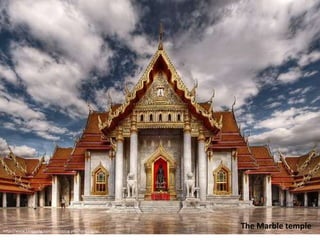
Consecrated ordination hall of a Wat,
where new monks take their vows.

•

Has six boundary stones (Bai Sema)
that define the limits of its sanctuary.

•

Usually open only to the monks.

•

Faces east and usually houses an altar
and one or several Buddha images.
http://www.slowtrav.com/blog/candi/Wat%20Phra%20Singh%20ubosot.jpg
http://www.flickr.com/photos/iprahin/4207683943/

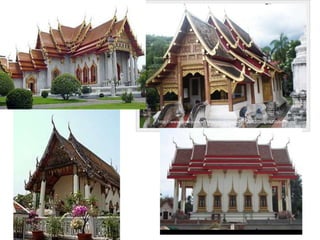
Ubosot of Wat Plai Laem | Koh Samui
http://www.bloggang.com/mainblog.php?id=lungpai

The Marble temple
http://www.chiangmai-traveltips.com/wat-doi-suthep.htm

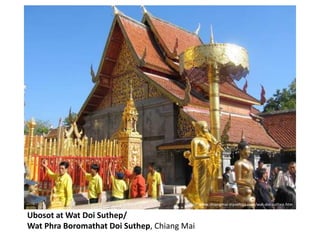
Ubosot at Wat Doi Suthep/
Wat Phra Boromathat Doi Suthep, Chiang Mai
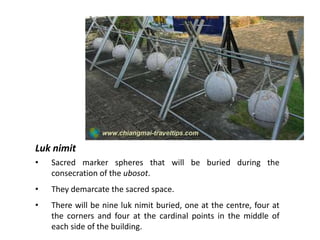
Luk nimit
•

Sacred marker spheres that will be buried during the
consecration of the ubosot.

•

They demarcate the sacred space.

•

There will be nine luk nimit buried, one at the centre, four at
the corners and four at the cardinal points in the middle of
each side of the building.
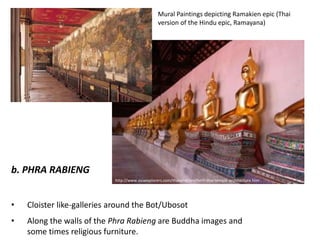
Mural Paintings depicting Ramakien epic (Thai
version of the Hindu epic, Ramayana)

b. PHRA RABIENG
http://www.asiaexplorers.com/thailand/northern-thai-temple-architecture.htm

•

Cloister like-galleries around the Bot/Ubosot

•

Along the walls of the Phra Rabieng are Buddha images and
some times religious furniture.
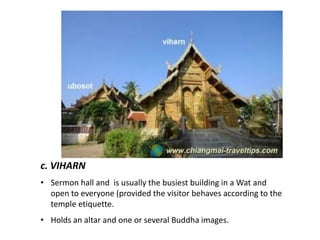
c. VIHARN
• Sermon hall and is usually the busiest building in a Wat and
open to everyone (provided the visitor behaves according to the
temple etiquette.
• Holds an altar and one or several Buddha images.
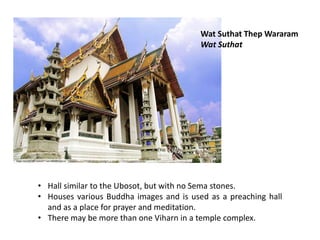
Wat Suthat Thep Wararam
Wat Suthat

• Hall similar to the Ubosot, but with no Sema stones.
• Houses various Buddha images and is used as a preaching hall
and as a place for prayer and meditation.
• There may be more than one Viharn in a temple complex.
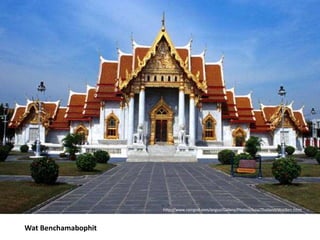
http://www.raingod.com/angus/Gallery/Photos/Asia/Thailand/WatBen.html

Wat Benchamabophit
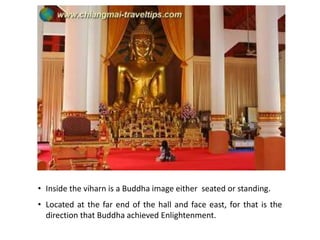
• Inside the viharn is a Buddha image either seated or standing.
• Located at the far end of the hall and face east, for that is the
direction that Buddha achieved Enlightenment.
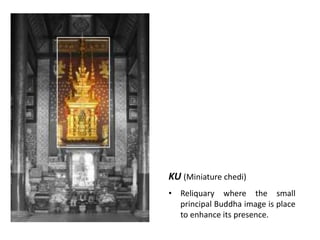
KU (Miniature chedi)
• Reliquary where the small
principal Buddha image is place
to enhance its presence.
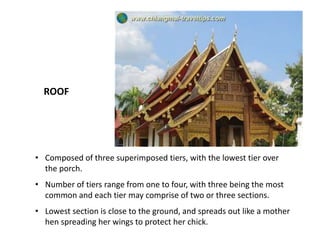
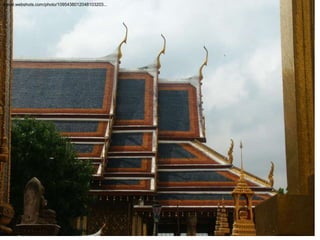
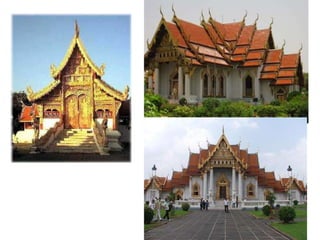
ROOF

• Composed of three superimposed tiers, with the lowest tier over
the porch.

• Number of tiers range from one to four, with three being the most
common and each tier may comprise of two or three sections.
• Lowest section is close to the ground, and spreads out like a mother
hen spreading her wings to protect her chick.
travel.webshots.com/photo/1095438012048103203...
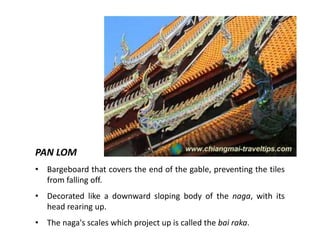
PAN LOM
• Bargeboard that covers the end of the gable, preventing the tiles
from falling off.
• Decorated like a downward sloping body of the naga, with its
head rearing up.
• The naga's scales which project up is called the bai raka.
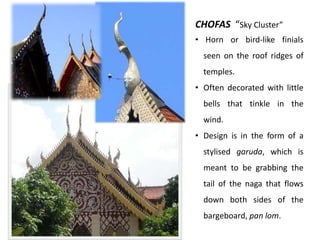
CHOFAS “Sky Cluster”
• Horn or bird-like finials
seen on the roof ridges of

temples.
• Often decorated with little
bells that tinkle in the
wind.
• Design is in the form of a
stylised garuda, which is
meant to be grabbing the

tail of the naga that flows
down both sides of the
bargeboard, pan lom.
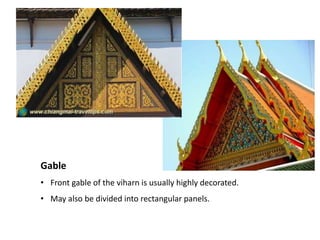
Gable
• Front gable of the viharn is usually highly decorated.
• May also be divided into rectangular panels.
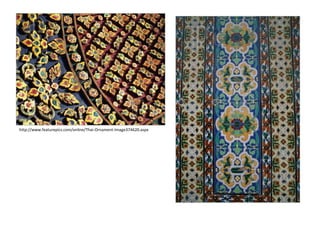
http://www.featurepics.com/online/Thai-Ornament-Image374620.aspx
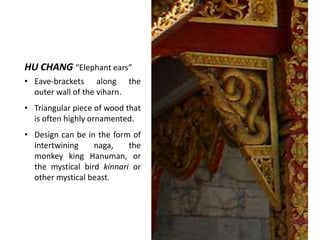
HU CHANG “Elephant ears”
• Eave-brackets along the
outer wall of the viharn.
• Triangular piece of wood that
is often highly ornamented.
• Design can be in the form of
intertwining
naga,
the
monkey king Hanuman, or
the mystical bird kinnari or
other mystical beast.
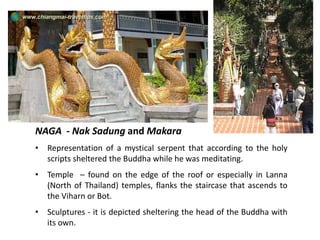
NAGA - Nak Sadung and Makara
•

Representation of a mystical serpent that according to the holy
scripts sheltered the Buddha while he was meditating.

•

Temple – found on the edge of the roof or especially in Lanna
(North of Thailand) temples, flanks the staircase that ascends to
the Viharn or Bot.

•

Sculptures - it is depicted sheltering the head of the Buddha with
its own.
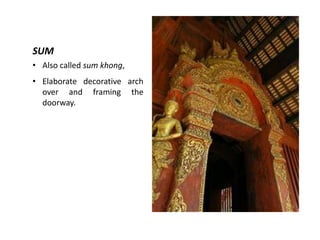
SUM
• Also called sum khong,
• Elaborate decorative arch
over and framing the
doorway.
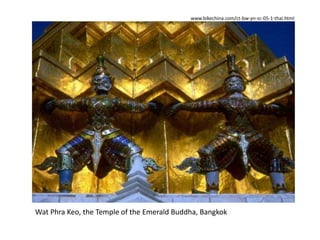
www.bikechina.com/ct-bw-yn-sc-05-1-thai.html

Wat Phra Keo, the Temple of the Emerald Buddha, Bangkok
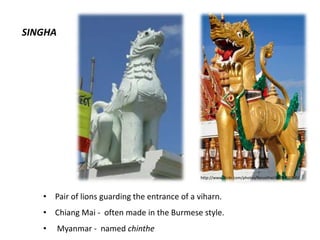
SINGHA

http://www.flickr.com/photos/focusthai/4820490300/

• Pair of lions guarding the entrance of a viharn.
• Chiang Mai - often made in the Burmese style.
•

Myanmar - named chinthe
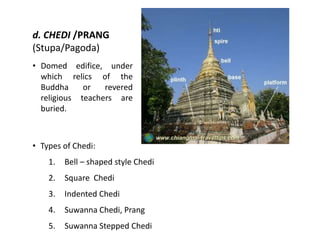
d. CHEDI /PRANG
(Stupa/Pagoda)
• Domed edifice, under
which relics of the
Buddha
or
revered
religious teachers are
buried.

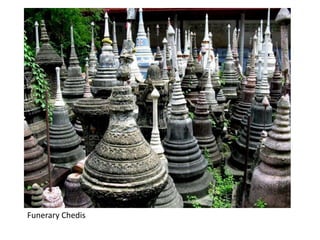
• Types of Chedi:
1.

Bell – shaped style Chedi

2.

Square Chedi

3.

Indented Chedi

4.

Suwanna Chedi, Prang

5.

Suwanna Stepped Chedi
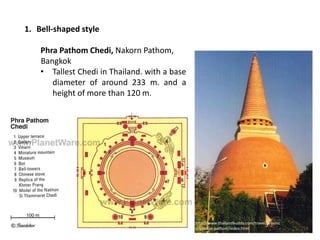
1. Bell-shaped style

Phra Pathom Chedi, Nakorn Pathom,
Bangkok
• Tallest Chedi in Thailand. with a base
diameter of around 233 m. and a
height of more than 120 m.

http://www.thailandbuddy.com/travel/provinc
e/nakhon-pathom/index.html
Funerary Chedis
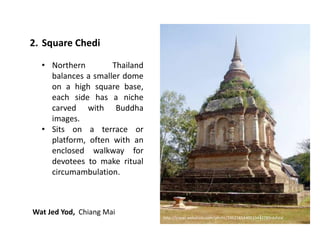
2. Square Chedi
• Northern
Thailand
balances a smaller dome
on a high square base,
each side has a niche
carved with Buddha
images.
• Sits on a terrace or
platform, often with an
enclosed walkway for
devotees to make ritual
circumambulation.

Wat Jed Yod, Chiang Mai

http://travel.webshots.com/photo/2462165440010442789nbAVaI
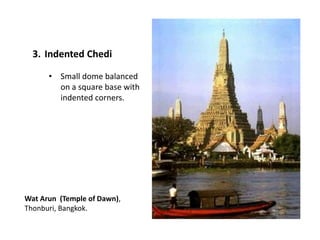
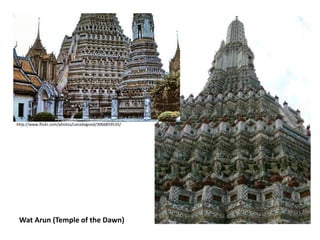
3. Indented Chedi
• Small dome balanced
on a square base with
indented corners.

Wat Arun (Temple of Dawn),
Thonburi, Bangkok.
http://www.flickr.com/photos/canadagood/3066859535/

Wat Arun (Temple of the Dawn)
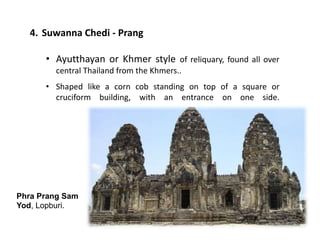
4. Suwanna Chedi - Prang

• Ayutthayan or Khmer style of reliquary, found all over
central Thailand from the Khmers..
• Shaped like a corn cob standing on top of a square or
cruciform building, with an entrance on one side.

Phra Prang Sam
Yod, Lopburi.
http://www.thailandbytrain.com/Lopburi.html
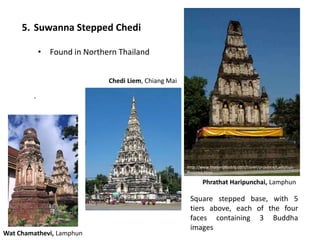
5. Suwanna Stepped Chedi
• Found in Northern Thailand
Chedi Liem, Chiang Mai

.

http://www.thailandbuddy.com/travel/province/LamphunProvince.html

Phrathat Haripunchai, Lamphun

•

Wat Chamathevi, Lamphun

Square stepped base, with 5
tiers above, each of the four
faces containing 3 Buddha
images
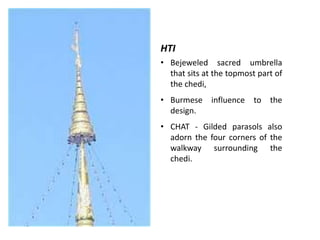
HTI
• Bejeweled sacred umbrella
that sits at the topmost part of
the chedi,
• Burmese influence to the
design.

• CHAT - Gilded parasols also
adorn the four corners of the
walkway surrounding the
chedi.
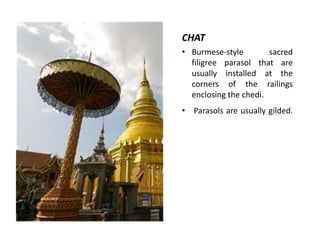
CHAT
• Burmese-style
sacred
filigree parasol that are
usually installed at the
corners of the railings
enclosing the chedi.
• Parasols are usually gilded.
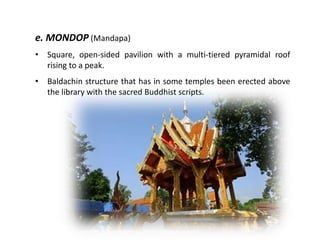
e. MONDOP (Mandapa)
•

Square, open-sided pavilion with a multi-tiered pyramidal roof
rising to a peak.

•

Baldachin structure that has in some temples been erected above
the library with the sacred Buddhist scripts.
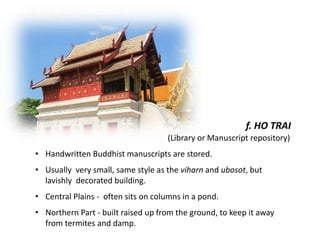
f. HO TRAI
(Library or Manuscript repository)
• Handwritten Buddhist manuscripts are stored.
• Usually very small, same style as the viharn and ubosot, but
lavishly decorated building.
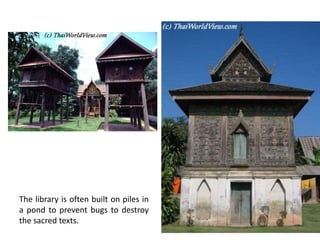
• Central Plains - often sits on columns in a pond.
• Northern Part - built raised up from the ground, to keep it away
from termites and damp.
The library is often built on piles in
a pond to prevent bugs to destroy
the sacred texts.
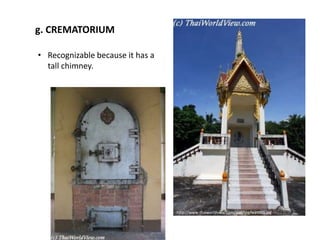
g. CREMATORIUM
• Recognizable because it has a
tall chimney.

http://www.thaiworldview.com/wat/jpg/wat050.jpg
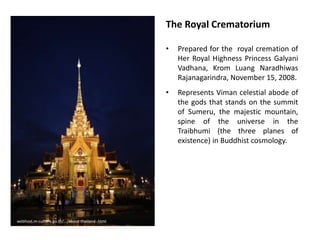
The Royal Crematorium
•

•

webhost.m-culture.go.th/.../about-thailand-.html

Prepared for the royal cremation of
Her Royal Highness Princess Galyani
Vadhana, Krom Luang Naradhiwas
Rajanagarindra, November 15, 2008.
Represents Viman celestial abode of
the gods that stands on the summit
of Sumeru, the majestic mountain,
spine of the universe in the
Traibhumi (the three planes of
existence) in Buddhist cosmology.
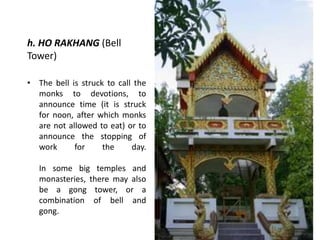
h. HO RAKHANG (Bell
Tower)
• The bell is struck to call the
monks to devotions, to
announce time (it is struck
for noon, after which monks
are not allowed to eat) or to
announce the stopping of
work
for
the
day.
In some big temples and
monasteries, there may also
be a gong tower, or a
combination of bell and
gong.
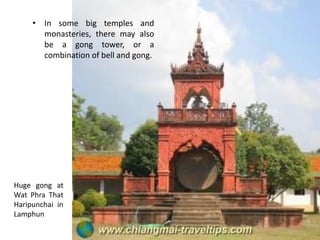
• In some big temples and
monasteries, there may also
be a gong tower, or a
combination of bell and gong.

Huge gong at
Wat Phra That
Haripunchai in
Lamphun
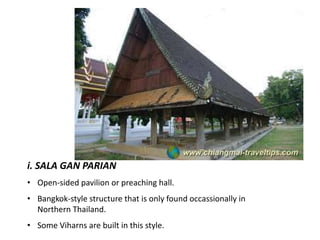
i. SALA GAN PARIAN
• Open-sided pavilion or preaching hall.
• Bangkok-style structure that is only found occassionally in
Northern Thailand.
• Some Viharns are built in this style.
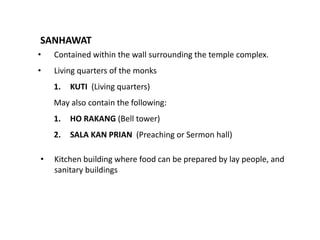
SANHAWAT
•

Contained within the wall surrounding the temple complex.

•

Living quarters of the monks
1.

KUTI (Living quarters)

May also contain the following:
1.
2.
•

HO RAKANG (Bell tower)
SALA KAN PRIAN (Preaching or Sermon hall)

Kitchen building where food can be prepared by lay people, and
sanitary buildings
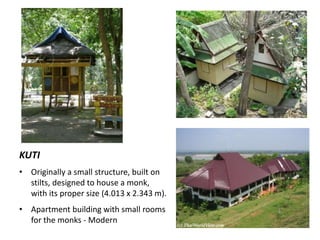
KUTI
• Originally a small structure, built on
stilts, designed to house a monk,
with its proper size (4.013 x 2.343 m).
• Apartment building with small rooms
for the monks - Modern
Buddhist temples
1. Sukhothai
2. Ayutthaya
Latter Period
1. Lanna
2. Rattanakosin Buddhist temples.
http://www.archicentral.com/tag/thailand/

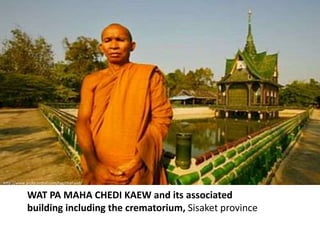
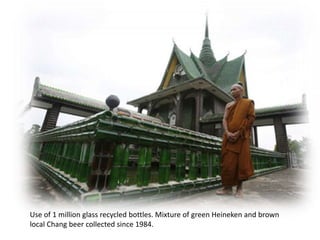
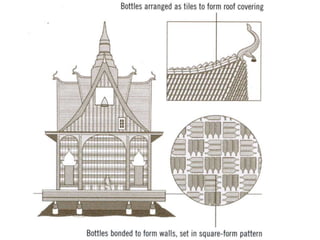
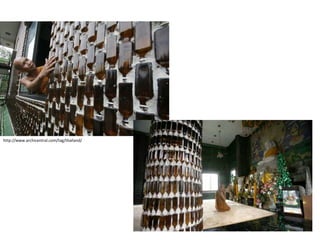
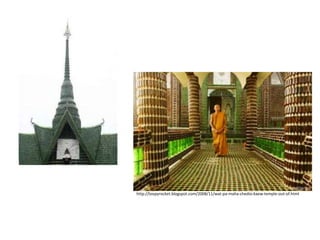
WAT PA MAHA CHEDI KAEW and its associated
building including the crematorium, Sisaket province
Use of 1 million glass recycled bottles. Mixture of green Heineken and brown
local Chang beer collected since 1984.
http://www.archicentral.com/tag/thailand/
http://loopyrocket.blogspot.com/2008/11/wat-pa-maha-chedio-kaew-temple-out-of.html
Samui, Thailand

http://www.bridgeandtunnelclub.com/bigmap/outofto
wn/thailand/kosamui/bigbuddha/index.htm

http://www.bloggersbase.com/travel/buddhas-majestic-bodh-gaya

/

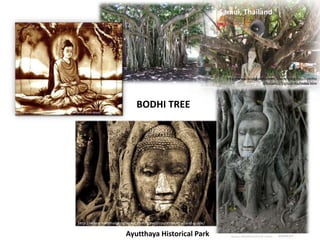
BODHI TREE

http://video.nationalgeographic.com/travel/countries/thailand-guide/

Ayutthaya Historical Park
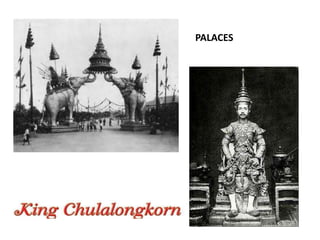
PALACES
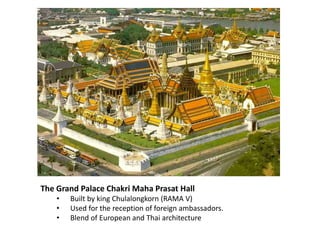
The Grand Palace Chakri Maha Prasat Hall
•
•
•

Built by king Chulalongkorn (RAMA V)
Used for the reception of foreign ambassadors.
Blend of European and Thai architecture
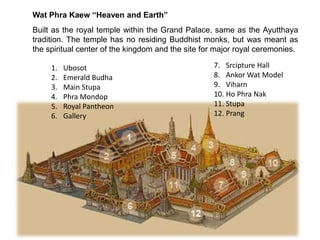
Wat Phra Kaew “Heaven and Earth”
Built as the royal temple within the Grand Palace, same as the Ayutthaya
tradition. The temple has no residing Buddhist monks, but was meant as
the spiritual center of the kingdom and the site for major royal ceremonies.
1.
2.
3.
4.
5.
6.

Ubosot
Emerald Budha
Main Stupa
Phra Mondop
Royal Pantheon
Gallery

7. Srcipture Hall
8. Ankor Wat Model
9. Viharn
10. Ho Phra Nak
11. Stupa
12. Prang
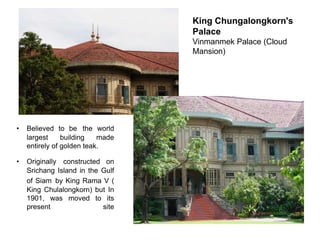
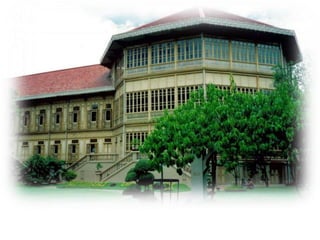
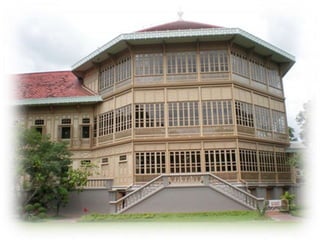
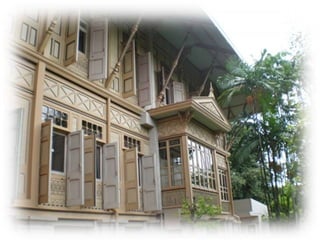
King Chungalongkorn's
Palace
Vinmanmek Palace (Cloud
Mansion)

•

Believed to be the world
largest
building
made
entirely of golden teak.

•

Originally constructed on
Srichang Island in the Gulf
of Siam by King Rama V (
King Chulalongkorn) but In
1901, was moved to its
present
site
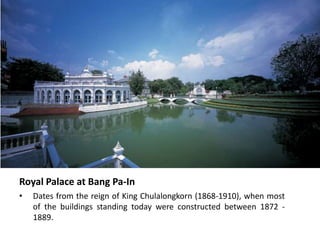
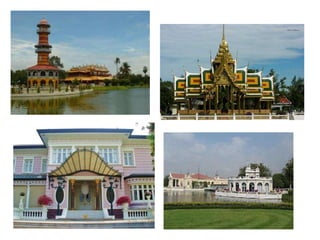
Royal Palace at Bang Pa-In
•

Dates from the reign of King Chulalongkorn (1868-1910), when most
of the buildings standing today were constructed between 1872 1889.
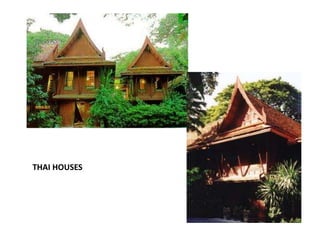
THAI HOUSES
www.koleksyon.com/.../thai_architecture.asp

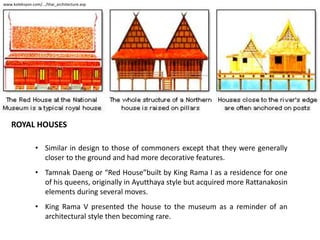
ROYAL HOUSES
• Similar in design to those of commoners except that they were generally
closer to the ground and had more decorative features.
• Tamnak Daeng or “Red House”built by King Rama I as a residence for one
of his queens, originally in Ayutthaya style but acquired more Rattanakosin
elements during several moves.
• King Rama V presented the house to the museum as a reminder of an
architectural style then becoming rare.
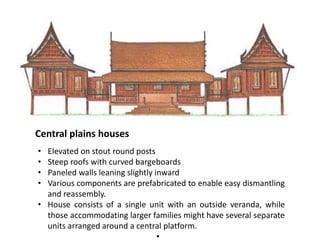
Central plains houses
•
•
•
•

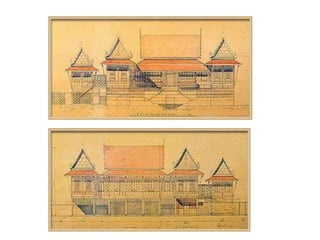
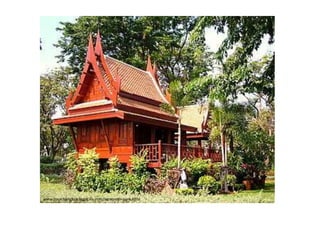
Elevated on stout round posts
Steep roofs with curved bargeboards
Paneled walls leaning slightly inward
Various components are prefabricated to enable easy dismantling
and reassembly.
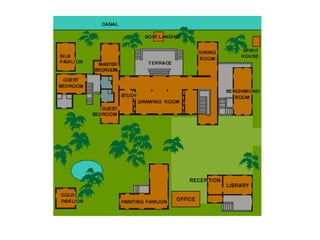
• House consists of a single unit with an outside veranda, while
those accommodating larger families might have several separate
units arranged around a central platform.
•
www.tour-bangkok-legacies.com/saranrom-park.html
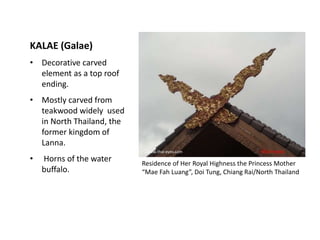
KALAE (Galae)
• Decorative carved
element as a top roof
ending.
• Mostly carved from
teakwood widely used
in North Thailand, the
former kingdom of
Lanna.
•

Horns of the water
buffalo.

:www.thai-eyes.com
Residence of Her Royal Highness the Princess Mother
“Mae Fah Luang”, Doi Tung, Chiang Rai/North Thailand
http://page2rss.com/277a2a2dcf2b23e11bdc4aef122a06b7 Thailand elements

Architecture in Thailand

  • 1.
    ARCHITECTURE IN THAILAND Historyof Architecture 3 1st Sem AY 2010-2011 Ar. Clarissa L. Avendaño
  • 2.
    Ruins of WatMahathat in Ayuthaya Ayuthaya was Thailand's capital from 1350 to 1767.
  • 3.
    Thailand in the13th c. http://www.theancientweb.com/explore/content.aspx?content_id=47
  • 5.
  • 6.
    Lotus bud-shaped anda ANDA– green HARMIKA - red CHATTRAS - purple BASE or TERRACES - black Bell-shaped anda
  • 7.
    Lotus bud-shaped anda Steppedterraces and redented bases. Two or three square terraces rise to support a deeply redented (that is, with cutout corners) and tower-shaped base; this base supports the anda. The stepped terraces are a distinctive element of the Thai stupa (shared with those of Myanmar’s Bagan) and mark a clear push away from earlier Sri Lanka prototypes. Further, the tower-like bases, which afford these structures their elegance and vertical momentum, seem to borrow from earlier Khmer prangs (discussed in the next section). See yellow highlights in Fig. 5.• No harmika. Unlike Sri Lankan models, this style stupa does not employ a harmika, affording it a more integrated, delicate profile.
  • 8.
    Ayutthaya and Bangkokperiods Bell-shaped anda Wat Si Sanphet, Ayutthaya
  • 9.
    e Thai civilization’schief modification to the Khmer prang was to make it more delicate, thinner, and vertical in emphasis. That said, the defining features of the Thai prang include: • More slender, vertical tower (
  • 11.
    irst prangs inThailand were built in Phimai and Khao Phnom Rung and Lopburi between the early 10th century and the late 12th century, when the Khmer kingdom was dominant. After the Khmer Empire collapsed, the Thai building masters of the Sukhothai Kingdom adapted the Prang form. They extended and developed it. The building material was no more separate small sandstone blocks, instead the Thais built the Prang in brick or laterite covered with stucco. And the Cella could be reached only by stairs. An example for this is the Prang of the Wat Mahathat in Phitsanulok. Later developments of the Prang suggested the Cella only. The entrance door became a niche, in which was placed the Buddharupa(Buddha statue), which had originally taken the central position inside. For reasons of symmetry the niche was repeated on all four sides. On its pinnacle was a Trishul, the "weapon of Indra". A "more modern" Prang is a slim construction, like an ear of corn, which lets its Khmer origin be only suspected. The best example is Wat Arun, the landmark of Bangkok. AlsoWat Phra Kaeo has six thin Prangs arranged in a row. Another example is the four Prangs arranged in all four directions around Wat Pho in Bangkok, and the five Prangs in Wat Pichayart in Thonburi.
  • 13.
    ARCHITECTURAL STRUCTURES 1. Templesand Monasteries 2. Palaces 3. Houses/Dwelling Units
  • 14.
    Thai Buddhist temple •Group of religious buildings and other features (such as trees and lakes), surrounded by a wall, and with at least one gate. • Consist of two parts: 1. Phuttha-wat 2. Sangha-wat
  • 15.
    Thai Buddhist temple 1. Phuttha-wat a. Ubosotor Bot, (Ordination Hall) b. Phra rabieng c. Viharn (teaching Hall) d. Chedi or Stupa (Reliquary Tower) e. Crematorium f. Sala g. Sala Kan Prian h. Ho rakang i. Of equal importance may be a Bhodi Tree or a Buddha Footprint. Most of the best known temples are in Bangkok, and these reflect the highly ornate "Rattanakosin" style of the Chakri dynasty (late 18th century to the present day).
  • 16.
  • 17.
  • 18.
    The main elementsof the temple are as follows: 1. Bot/Ubosot 2. The Reclining Buddha 3. Main Stupas 4. Phra Mondop 5. The Gallery 6. Hermit's Ground
  • 19.
    WAT • Thai Buddhist temple ormonastery. • In most cases it is not just one building, but a collection of buildings, shrines, and monuments within a courtyard that is enclosed by a wall. Wat Phra Singh, the largest temple in Chiang Mai, northwestern Thailand. (Luca I. Tettoni/Corbis) • The wall, often white washed, usually encloses a rectangular area. The wall demarcates the temple compound, called putthawat, or the sacred enclosure. • Ideally the main entrance faces east.
  • 20.
    a. BOT/UBOSOT • Consecrated ordinationhall of a Wat, where new monks take their vows. • Has six boundary stones (Bai Sema) that define the limits of its sanctuary. • Usually open only to the monks. • Faces east and usually houses an altar and one or several Buddha images.
  • 21.
  • 22.
  • 23.
  • 24.
    http://www.chiangmai-traveltips.com/wat-doi-suthep.htm Ubosot at WatDoi Suthep/ Wat Phra Boromathat Doi Suthep, Chiang Mai
  • 25.
    Luk nimit • Sacred markerspheres that will be buried during the consecration of the ubosot. • They demarcate the sacred space. • There will be nine luk nimit buried, one at the centre, four at the corners and four at the cardinal points in the middle of each side of the building.
  • 26.
    Mural Paintings depictingRamakien epic (Thai version of the Hindu epic, Ramayana) b. PHRA RABIENG http://www.asiaexplorers.com/thailand/northern-thai-temple-architecture.htm • Cloister like-galleries around the Bot/Ubosot • Along the walls of the Phra Rabieng are Buddha images and some times religious furniture.
  • 27.
    c. VIHARN • Sermonhall and is usually the busiest building in a Wat and open to everyone (provided the visitor behaves according to the temple etiquette. • Holds an altar and one or several Buddha images.
  • 28.
    Wat Suthat ThepWararam Wat Suthat • Hall similar to the Ubosot, but with no Sema stones. • Houses various Buddha images and is used as a preaching hall and as a place for prayer and meditation. • There may be more than one Viharn in a temple complex.
  • 29.
  • 30.
    • Inside theviharn is a Buddha image either seated or standing. • Located at the far end of the hall and face east, for that is the direction that Buddha achieved Enlightenment.
  • 31.
    KU (Miniature chedi) •Reliquary where the small principal Buddha image is place to enhance its presence.
  • 32.
    ROOF • Composed ofthree superimposed tiers, with the lowest tier over the porch. • Number of tiers range from one to four, with three being the most common and each tier may comprise of two or three sections. • Lowest section is close to the ground, and spreads out like a mother hen spreading her wings to protect her chick.
  • 33.
  • 35.
    PAN LOM • Bargeboardthat covers the end of the gable, preventing the tiles from falling off. • Decorated like a downward sloping body of the naga, with its head rearing up. • The naga's scales which project up is called the bai raka.
  • 36.
    CHOFAS “Sky Cluster” •Horn or bird-like finials seen on the roof ridges of temples. • Often decorated with little bells that tinkle in the wind. • Design is in the form of a stylised garuda, which is meant to be grabbing the tail of the naga that flows down both sides of the bargeboard, pan lom.
  • 37.
    Gable • Front gableof the viharn is usually highly decorated. • May also be divided into rectangular panels.
  • 38.
  • 39.
    HU CHANG “Elephantears” • Eave-brackets along the outer wall of the viharn. • Triangular piece of wood that is often highly ornamented. • Design can be in the form of intertwining naga, the monkey king Hanuman, or the mystical bird kinnari or other mystical beast.
  • 40.
    NAGA - NakSadung and Makara • Representation of a mystical serpent that according to the holy scripts sheltered the Buddha while he was meditating. • Temple – found on the edge of the roof or especially in Lanna (North of Thailand) temples, flanks the staircase that ascends to the Viharn or Bot. • Sculptures - it is depicted sheltering the head of the Buddha with its own.
  • 41.
    SUM • Also calledsum khong, • Elaborate decorative arch over and framing the doorway.
  • 42.
    www.bikechina.com/ct-bw-yn-sc-05-1-thai.html Wat Phra Keo,the Temple of the Emerald Buddha, Bangkok
  • 43.
    SINGHA http://www.flickr.com/photos/focusthai/4820490300/ • Pair oflions guarding the entrance of a viharn. • Chiang Mai - often made in the Burmese style. • Myanmar - named chinthe
  • 44.
    d. CHEDI /PRANG (Stupa/Pagoda) •Domed edifice, under which relics of the Buddha or revered religious teachers are buried. • Types of Chedi: 1. Bell – shaped style Chedi 2. Square Chedi 3. Indented Chedi 4. Suwanna Chedi, Prang 5. Suwanna Stepped Chedi
  • 45.
    1. Bell-shaped style PhraPathom Chedi, Nakorn Pathom, Bangkok • Tallest Chedi in Thailand. with a base diameter of around 233 m. and a height of more than 120 m. http://www.thailandbuddy.com/travel/provinc e/nakhon-pathom/index.html
  • 46.
  • 47.
    2. Square Chedi •Northern Thailand balances a smaller dome on a high square base, each side has a niche carved with Buddha images. • Sits on a terrace or platform, often with an enclosed walkway for devotees to make ritual circumambulation. Wat Jed Yod, Chiang Mai http://travel.webshots.com/photo/2462165440010442789nbAVaI
  • 48.
    3. Indented Chedi •Small dome balanced on a square base with indented corners. Wat Arun (Temple of Dawn), Thonburi, Bangkok.
  • 49.
  • 50.
    4. Suwanna Chedi- Prang • Ayutthayan or Khmer style of reliquary, found all over central Thailand from the Khmers.. • Shaped like a corn cob standing on top of a square or cruciform building, with an entrance on one side. Phra Prang Sam Yod, Lopburi. http://www.thailandbytrain.com/Lopburi.html
  • 51.
    5. Suwanna SteppedChedi • Found in Northern Thailand Chedi Liem, Chiang Mai . http://www.thailandbuddy.com/travel/province/LamphunProvince.html Phrathat Haripunchai, Lamphun • Wat Chamathevi, Lamphun Square stepped base, with 5 tiers above, each of the four faces containing 3 Buddha images
  • 52.
    HTI • Bejeweled sacredumbrella that sits at the topmost part of the chedi, • Burmese influence to the design. • CHAT - Gilded parasols also adorn the four corners of the walkway surrounding the chedi.
  • 53.
    CHAT • Burmese-style sacred filigree parasolthat are usually installed at the corners of the railings enclosing the chedi. • Parasols are usually gilded.
  • 54.
    e. MONDOP (Mandapa) • Square,open-sided pavilion with a multi-tiered pyramidal roof rising to a peak. • Baldachin structure that has in some temples been erected above the library with the sacred Buddhist scripts.
  • 55.
    f. HO TRAI (Libraryor Manuscript repository) • Handwritten Buddhist manuscripts are stored. • Usually very small, same style as the viharn and ubosot, but lavishly decorated building. • Central Plains - often sits on columns in a pond. • Northern Part - built raised up from the ground, to keep it away from termites and damp.
  • 56.
    The library isoften built on piles in a pond to prevent bugs to destroy the sacred texts.
  • 57.
    g. CREMATORIUM • Recognizablebecause it has a tall chimney. http://www.thaiworldview.com/wat/jpg/wat050.jpg
  • 58.
    The Royal Crematorium • • webhost.m-culture.go.th/.../about-thailand-.html Preparedfor the royal cremation of Her Royal Highness Princess Galyani Vadhana, Krom Luang Naradhiwas Rajanagarindra, November 15, 2008. Represents Viman celestial abode of the gods that stands on the summit of Sumeru, the majestic mountain, spine of the universe in the Traibhumi (the three planes of existence) in Buddhist cosmology.
  • 59.
    h. HO RAKHANG(Bell Tower) • The bell is struck to call the monks to devotions, to announce time (it is struck for noon, after which monks are not allowed to eat) or to announce the stopping of work for the day. In some big temples and monasteries, there may also be a gong tower, or a combination of bell and gong.
  • 60.
    • In somebig temples and monasteries, there may also be a gong tower, or a combination of bell and gong. Huge gong at Wat Phra That Haripunchai in Lamphun
  • 61.
    i. SALA GANPARIAN • Open-sided pavilion or preaching hall. • Bangkok-style structure that is only found occassionally in Northern Thailand. • Some Viharns are built in this style.
  • 62.
    SANHAWAT • Contained within thewall surrounding the temple complex. • Living quarters of the monks 1. KUTI (Living quarters) May also contain the following: 1. 2. • HO RAKANG (Bell tower) SALA KAN PRIAN (Preaching or Sermon hall) Kitchen building where food can be prepared by lay people, and sanitary buildings
  • 63.
    KUTI • Originally asmall structure, built on stilts, designed to house a monk, with its proper size (4.013 x 2.343 m). • Apartment building with small rooms for the monks - Modern
  • 64.
    Buddhist temples 1. Sukhothai 2.Ayutthaya Latter Period 1. Lanna 2. Rattanakosin Buddhist temples.
  • 65.
    http://www.archicentral.com/tag/thailand/ WAT PA MAHACHEDI KAEW and its associated building including the crematorium, Sisaket province
  • 66.
    Use of 1million glass recycled bottles. Mixture of green Heineken and brown local Chang beer collected since 1984.
  • 68.
  • 69.
  • 70.
  • 71.
  • 72.
    The Grand PalaceChakri Maha Prasat Hall • • • Built by king Chulalongkorn (RAMA V) Used for the reception of foreign ambassadors. Blend of European and Thai architecture
  • 73.
    Wat Phra Kaew“Heaven and Earth” Built as the royal temple within the Grand Palace, same as the Ayutthaya tradition. The temple has no residing Buddhist monks, but was meant as the spiritual center of the kingdom and the site for major royal ceremonies. 1. 2. 3. 4. 5. 6. Ubosot Emerald Budha Main Stupa Phra Mondop Royal Pantheon Gallery 7. Srcipture Hall 8. Ankor Wat Model 9. Viharn 10. Ho Phra Nak 11. Stupa 12. Prang
  • 74.
    King Chungalongkorn's Palace Vinmanmek Palace(Cloud Mansion) • Believed to be the world largest building made entirely of golden teak. • Originally constructed on Srichang Island in the Gulf of Siam by King Rama V ( King Chulalongkorn) but In 1901, was moved to its present site
  • 78.
    Royal Palace atBang Pa-In • Dates from the reign of King Chulalongkorn (1868-1910), when most of the buildings standing today were constructed between 1872 1889.
  • 80.
  • 81.
    www.koleksyon.com/.../thai_architecture.asp ROYAL HOUSES • Similarin design to those of commoners except that they were generally closer to the ground and had more decorative features. • Tamnak Daeng or “Red House”built by King Rama I as a residence for one of his queens, originally in Ayutthaya style but acquired more Rattanakosin elements during several moves. • King Rama V presented the house to the museum as a reminder of an architectural style then becoming rare.
  • 82.
    Central plains houses • • • • Elevatedon stout round posts Steep roofs with curved bargeboards Paneled walls leaning slightly inward Various components are prefabricated to enable easy dismantling and reassembly. • House consists of a single unit with an outside veranda, while those accommodating larger families might have several separate units arranged around a central platform. •
  • 85.
  • 86.
    KALAE (Galae) • Decorativecarved element as a top roof ending. • Mostly carved from teakwood widely used in North Thailand, the former kingdom of Lanna. • Horns of the water buffalo. :www.thai-eyes.com Residence of Her Royal Highness the Princess Mother “Mae Fah Luang”, Doi Tung, Chiang Rai/North Thailand
  • 87.