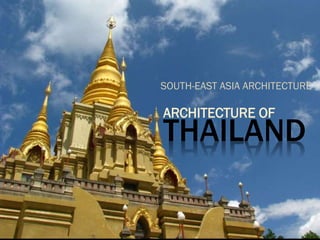
THAILAND
SOUTH-EAST ASIA ARCHITECTURE
ARCHITECTURE OF
THAI ARCHITECTURE ELEMENTS
 TRADITIONAL THAI HOUSE –STILT HOUSE
 BUDHIST TEMPLE - THAI WAT
 KUTI
INTRODUCTION
 Thai architecture can be grouped into three
categories, consisting of Buddhist temples and
their monasteries, known as Wat in Thai,
palaces, and houses
 Eight periods in the evolution of Thai
architecture, Dvaravati, Srivijaya, Lop Buri,
Chiang Saen, Sukhothai, U Thong,
Ayutthaya and Rattanakosin.
COMMON CHARACTERISTICS
 Most noticeable in Thai architecture are:
 the swooping (of a bird) multi-tiered rooflines,
 the distinctly (noticeable) ornamental decorations,
 the stunning interior murals,
 the vivid colour (bright, distinct, contrast)
 the lovingly crafted and gold- adorned Buddha
images
THAI STILT HOUSE
THAI STILT HOUSE
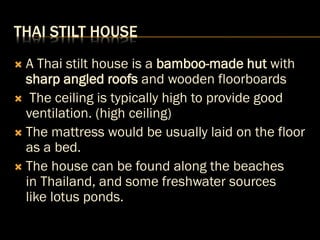
 A Thai stilt house is a bamboo-made hut with
sharp angled roofs and wooden floorboards
 The ceiling is typically high to provide good
ventilation. (high ceiling)
 The mattress would be usually laid on the floor
as a bed.
 The house can be found along the beaches
in Thailand, and some freshwater sources
like lotus ponds.
THAI STILT HOUSE
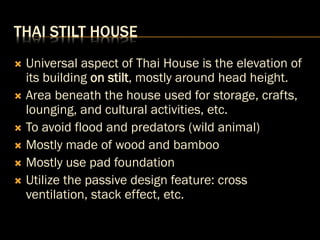
 Universal aspect of Thai House is the elevation of
its building on stilt, mostly around head height.
 Area beneath the house used for storage, crafts,
lounging, and cultural activities, etc.
 To avoid flood and predators (wild animal)
 Mostly made of wood and bamboo
 Mostly use pad foundation
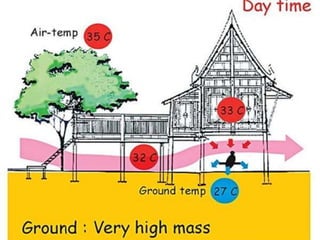
 Utilize the passive design feature: cross
ventilation, stack effect, etc.
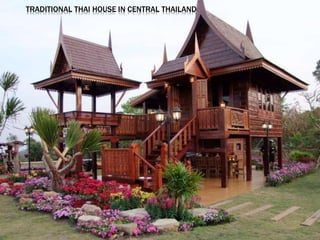
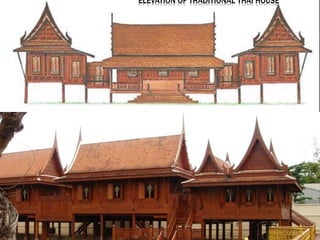
TRADITIONAL THAI HOUSE IN CENTRAL THAILAND
ELEVATION OF TRADITIONAL THAI HOUSE
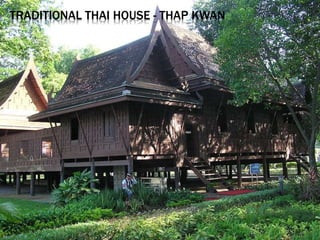
TRADITIONAL THAI HOUSE - THAP KWAN
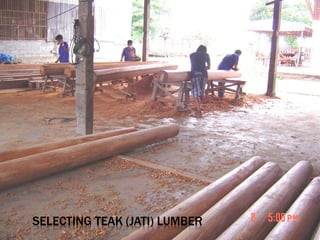
SELECTING TEAK (JATI) LUMBER
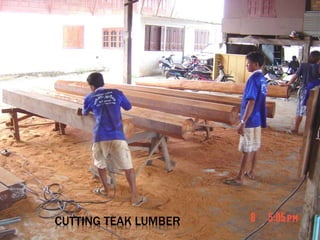
CUTTING TEAK LUMBER
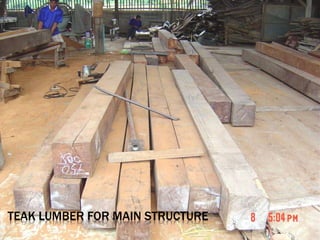
TEAK LUMBER FOR MAIN STRUCTURE
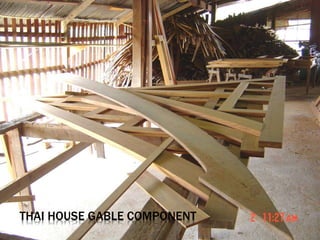
THAI HOUSE GABLE COMPONENT
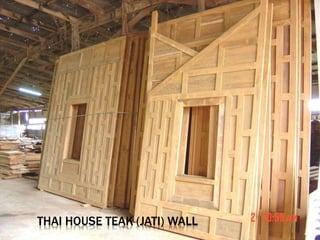
THAI HOUSE TEAK (JATI) WALL
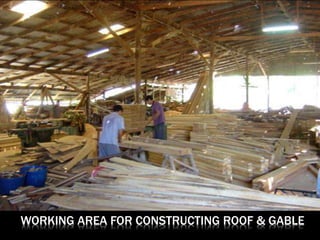
WORKING AREA FOR CONSTRUCTING ROOF & GABLE
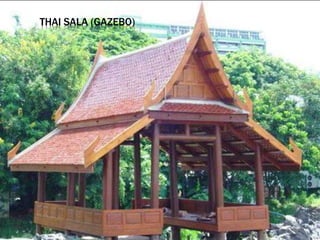
THAI SALA (GAZEBO)
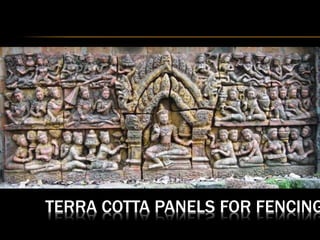
TERRA COTTA PANELS FOR FENCING
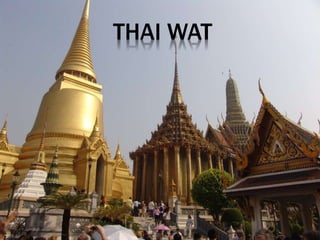
THAI WAT
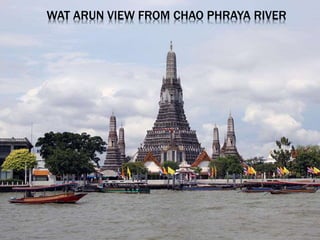
WAT ARUN VIEW FROM CHAO PHRAYA RIVER
THAI WAT
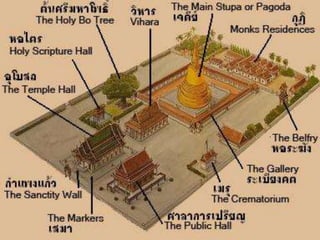
 Wat (enclosure) is a Thai Buddhist temple or
monastery.
 Consists of collection of buildings, shrines, and
monuments within a courtyard.
 A typical Wat has enclosing wall that divides it
from secular world.
 Different in lay-out and style, but still adhere to the
same principal.
THAI WAT
 Consists of two parts
1- Puttha Wat
– dedicated to Buddha.
2- Sangha Wat
– The living quarters of monks.
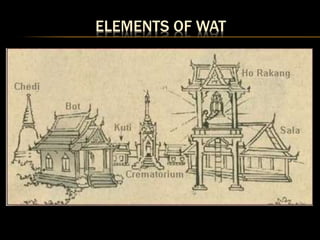
ELEMENTS OF WAT
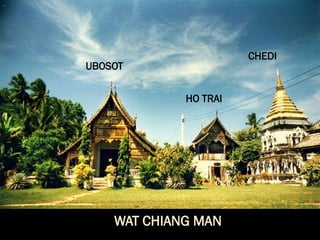
WAT CHIANG MAN
UBOSOT
HO TRAI
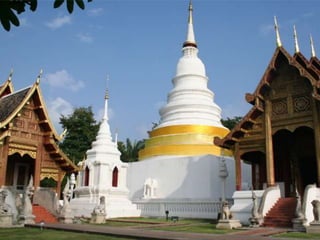
CHEDI
PUTTHA WAT
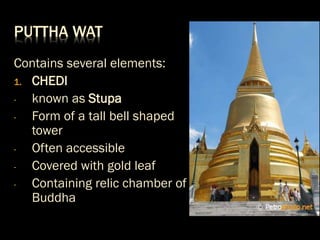
Contains several elements:
1. CHEDI
- known as Stupa
- Form of a tall bell shaped
tower
- Often accessible
- Covered with gold leaf
- Containing relic chamber of
Buddha
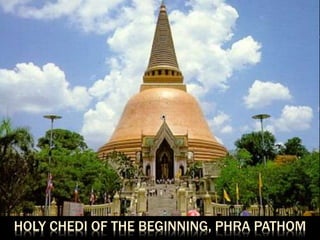
HOLY CHEDI OF THE BEGINNING, PHRA PATHOM
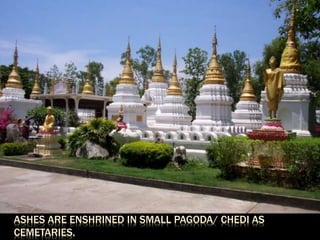
ASHES ARE ENSHRINED IN SMALL PAGODA/ CHEDI AS
CEMETARIES.
PUTTHA WAT
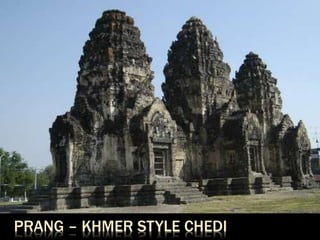
2. PRANG
- Ayutthayan or Khmer-style Chedi
- High and slim, looks like vertical ear corn
- the Thai version of Khmer temple tower.
- Mostly seen in temples from the Sukhstani and
Ayutthaya period.
PRANG – KHMER STYLE CHEDI
PUTTHA WAT
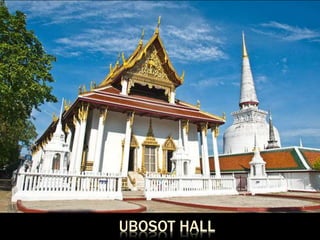
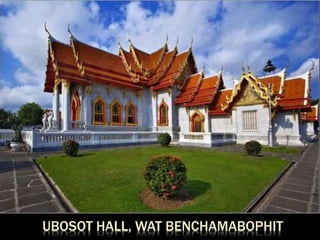
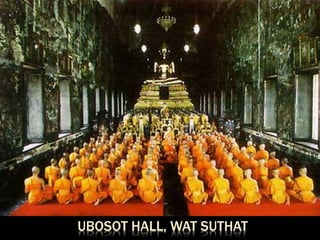
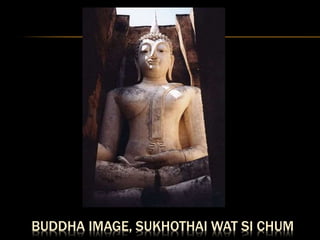
3. UBOSOT HALL / BOT
- The ordination Hall of a Wat
- Place where monks take their vows.
- Six boundary stones (Bai Sema) placed around
the perimeter - mark the limit of its sanctuary.
- Building facing East
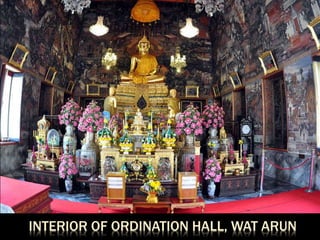
- Houses an altar and one or several Buddha
images.
- Chofah on top of roof finial
UBOSOT HALL
UBOSOT HALL, WAT BENCHAMABOPHIT
UBOSOT HALL, WAT SUTHAT
INTERIOR OF ORDINATION HALL, WAT ARUN
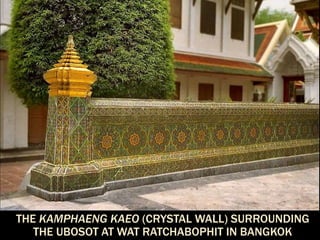
THE KAMPHAENG KAEO (CRYSTAL WALL) SURROUNDING
THE UBOSOT AT WAT RATCHABOPHIT IN BANGKOK
BUDDHA IMAGE, SUKHOTHAI WAT SI CHUM
PUTTHA WAT
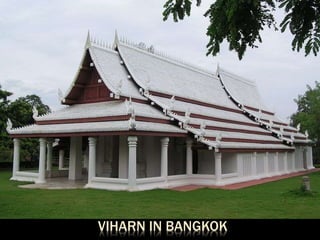
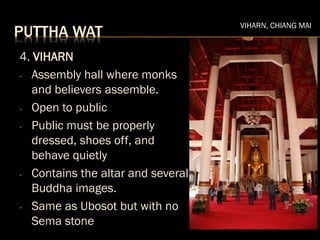
4. VIHARN
- Assembly hall where monks
and believers assemble.
- Open to public
- Public must be properly
dressed, shoes off, and
behave quietly
- Contains the altar and several
Buddha images.
- Same as Ubosot but with no
Sema stone
VIHARN, CHIANG MAI
VIHARN IN BANGKOK
PUTTHA WAT
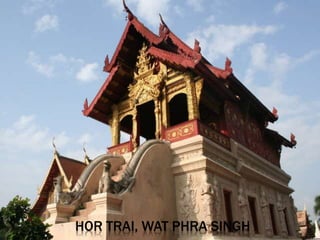
5. HOR TRAI
- The temple library or Scriptures Depository
houses of the sacred Tripitaka Scriptures.
- Very small highly decorated building
- Sometimes, built in the form of Mondop
HOR TRAI, WAT PHRA SINGH
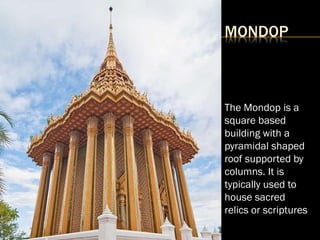
MONDOP
The Mondop is a
square based
building with a
pyramidal shaped
roof supported by
columns. It is
typically used to
house sacred
relics or scriptures
PUTTHA WAT
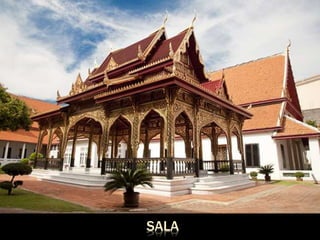
6. SALA
- An open-sided pavilion.
- Open on four sides.
- A place for meeting, rest, eat or listen
to sermon from the monks.
SALA
PUTTHA WAT
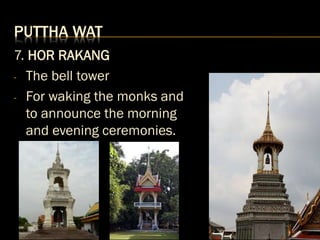
7. HOR RAKANG
- The bell tower
- For waking the monks and
to announce the morning
and evening ceremonies.
PUTTHA WAT
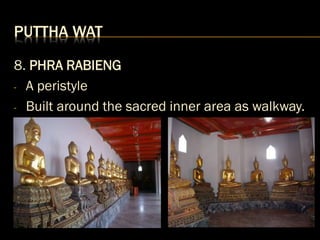
8. PHRA RABIENG
- A peristyle
- Built around the sacred inner area as walkway.
PUTTHA WAT
9. ADDITIONAL BUILDING
- Depends on local needs, such as Crematorium
or a school.
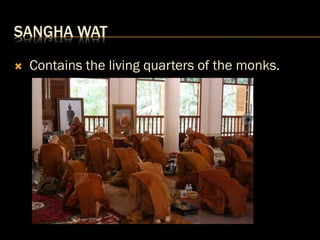
SANGHA WAT
 Contains the living quarters of the monks.
SANGHA WAT
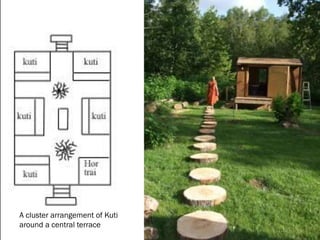
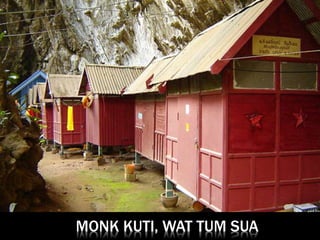
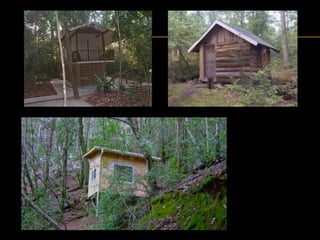
KUTI
- Originally a small structure built on stilt.
- Designed to house a monk.
- Proper size defined in Sanghathisep, Rule 6 to
be 12 by 7 keub( 4.013 by 2.343 m)
- Modern Kuti – shape of an apartment with
small rooms for the monks.
A cluster arrangement of Kuti
around a central terrace
MONK KUTI, WAT TUM SUA
SANGHA WAT
2. Also contains ‘Hor rakang’ (bell tower) and
even the ‘Sala Kan Prian’ (Sermon Hall)
3. Will house most of the functional buildings
such as kitchen building and sanitary building.
 Roof forms
Multiple roof tiers
Ornamented roof
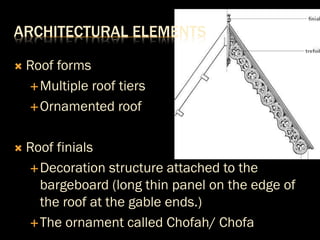
 Roof finials
Decoration structure attached to the
bargeboard (long thin panel on the edge of
the roof at the gable ends.)
The ornament called Chofah/ Chofa
ARCHITECTURAL ELEMENTS
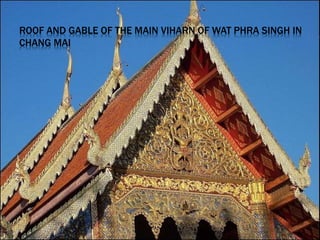
ROOF AND GABLE OF THE MAIN VIHARN OF WAT PHRA SINGH IN
CHANG MAI
CHOFAH
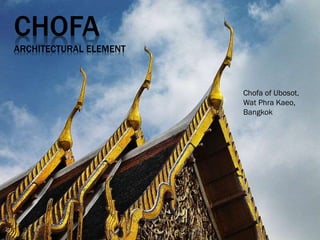
 Chofah is a decorative ornament that
decorates the top at the end of Wat and
palaces roof.
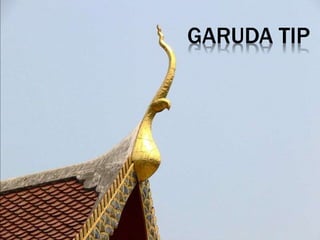
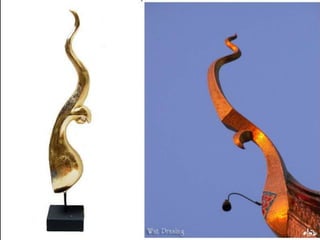
 It resembles a tall thin bird and hornlike looks.
 The Chofah is generally believed to represent
the mythical creature Garuda, half bird and half
man, act as vehicle of the Hindu god Vishnu.
CHOFAH/ CHOFA
 Same function as the ‘tunjuk langit’ of Malay
traditional house
 Usually designed based on the animal figure.
 Design as the holy symbol.
 Usually painted in golden color as a symbol of
dignity and richness.
CHOFA
ARCHITECTURAL ELEMENT
Chofa of Ubosot,
Wat Phra Kaeo,
Bangkok
GARUDA TIP
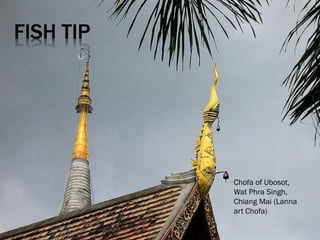
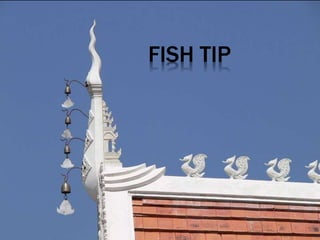
FISH TIP
Chofa of Ubosot,
Wat Phra Singh,
Chiang Mai (Lanna
art Chofa)
FISH TIP
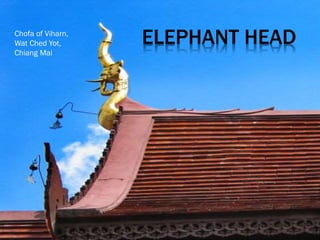
ELEPHANT HEAD
Chofa of Viharn,
Wat Ched Yot,
Chiang Mai
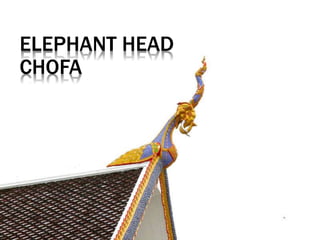
ELEPHANT HEAD
CHOFA
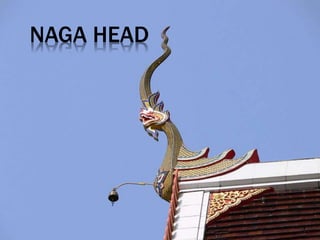
NAGA HEAD
REFERENCES
 Ruethai Chaichongrak. (2002). Thai House: History And
Evolution. Weatherhill. ISBN 0-8348-0520-0
 Karl Döhring, Buddhist Temples of Thailand: an Architectonic
Introduction, White Lotus, 2000. ISBN 974-7534-40-1
END

6-THAILAND ARCHITECTURE .pdf

  • 1.
  • 2.
    THAI ARCHITECTURE ELEMENTS TRADITIONAL THAI HOUSE –STILT HOUSE  BUDHIST TEMPLE - THAI WAT  KUTI
  • 3.
    INTRODUCTION  Thai architecturecan be grouped into three categories, consisting of Buddhist temples and their monasteries, known as Wat in Thai, palaces, and houses  Eight periods in the evolution of Thai architecture, Dvaravati, Srivijaya, Lop Buri, Chiang Saen, Sukhothai, U Thong, Ayutthaya and Rattanakosin.
  • 4.
    COMMON CHARACTERISTICS  Mostnoticeable in Thai architecture are:  the swooping (of a bird) multi-tiered rooflines,  the distinctly (noticeable) ornamental decorations,  the stunning interior murals,  the vivid colour (bright, distinct, contrast)  the lovingly crafted and gold- adorned Buddha images
  • 5.
  • 6.
    THAI STILT HOUSE A Thai stilt house is a bamboo-made hut with sharp angled roofs and wooden floorboards  The ceiling is typically high to provide good ventilation. (high ceiling)  The mattress would be usually laid on the floor as a bed.  The house can be found along the beaches in Thailand, and some freshwater sources like lotus ponds.
  • 7.
    THAI STILT HOUSE Universal aspect of Thai House is the elevation of its building on stilt, mostly around head height.  Area beneath the house used for storage, crafts, lounging, and cultural activities, etc.  To avoid flood and predators (wild animal)  Mostly made of wood and bamboo  Mostly use pad foundation  Utilize the passive design feature: cross ventilation, stack effect, etc.
  • 8.
    TRADITIONAL THAI HOUSEIN CENTRAL THAILAND
  • 10.
  • 11.
  • 12.
  • 13.
  • 14.
    TEAK LUMBER FORMAIN STRUCTURE
  • 15.
  • 16.
    THAI HOUSE TEAK(JATI) WALL
  • 17.
    WORKING AREA FORCONSTRUCTING ROOF & GABLE
  • 18.
  • 19.
    TERRA COTTA PANELSFOR FENCING
  • 20.
  • 21.
    WAT ARUN VIEWFROM CHAO PHRAYA RIVER
  • 22.
    THAI WAT  Wat(enclosure) is a Thai Buddhist temple or monastery.  Consists of collection of buildings, shrines, and monuments within a courtyard.  A typical Wat has enclosing wall that divides it from secular world.  Different in lay-out and style, but still adhere to the same principal.
  • 23.
    THAI WAT  Consistsof two parts 1- Puttha Wat – dedicated to Buddha. 2- Sangha Wat – The living quarters of monks.
  • 24.
  • 25.
  • 27.
    PUTTHA WAT Contains severalelements: 1. CHEDI - known as Stupa - Form of a tall bell shaped tower - Often accessible - Covered with gold leaf - Containing relic chamber of Buddha
  • 28.
    HOLY CHEDI OFTHE BEGINNING, PHRA PATHOM
  • 29.
    ASHES ARE ENSHRINEDIN SMALL PAGODA/ CHEDI AS CEMETARIES.
  • 30.
    PUTTHA WAT 2. PRANG -Ayutthayan or Khmer-style Chedi - High and slim, looks like vertical ear corn - the Thai version of Khmer temple tower. - Mostly seen in temples from the Sukhstani and Ayutthaya period.
  • 31.
    PRANG – KHMERSTYLE CHEDI
  • 32.
    PUTTHA WAT 3. UBOSOTHALL / BOT - The ordination Hall of a Wat - Place where monks take their vows. - Six boundary stones (Bai Sema) placed around the perimeter - mark the limit of its sanctuary. - Building facing East - Houses an altar and one or several Buddha images. - Chofah on top of roof finial
  • 33.
  • 34.
    UBOSOT HALL, WATBENCHAMABOPHIT
  • 35.
  • 36.
    INTERIOR OF ORDINATIONHALL, WAT ARUN
  • 37.
    THE KAMPHAENG KAEO(CRYSTAL WALL) SURROUNDING THE UBOSOT AT WAT RATCHABOPHIT IN BANGKOK
  • 38.
  • 39.
    PUTTHA WAT 4. VIHARN -Assembly hall where monks and believers assemble. - Open to public - Public must be properly dressed, shoes off, and behave quietly - Contains the altar and several Buddha images. - Same as Ubosot but with no Sema stone VIHARN, CHIANG MAI
  • 40.
  • 41.
    PUTTHA WAT 5. HORTRAI - The temple library or Scriptures Depository houses of the sacred Tripitaka Scriptures. - Very small highly decorated building - Sometimes, built in the form of Mondop
  • 42.
    HOR TRAI, WATPHRA SINGH
  • 43.
    MONDOP The Mondop isa square based building with a pyramidal shaped roof supported by columns. It is typically used to house sacred relics or scriptures
  • 44.
    PUTTHA WAT 6. SALA -An open-sided pavilion. - Open on four sides. - A place for meeting, rest, eat or listen to sermon from the monks.
  • 45.
  • 46.
    PUTTHA WAT 7. HORRAKANG - The bell tower - For waking the monks and to announce the morning and evening ceremonies.
  • 47.
    PUTTHA WAT 8. PHRARABIENG - A peristyle - Built around the sacred inner area as walkway.
  • 48.
    PUTTHA WAT 9. ADDITIONALBUILDING - Depends on local needs, such as Crematorium or a school.
  • 49.
    SANGHA WAT  Containsthe living quarters of the monks.
  • 50.
    SANGHA WAT KUTI - Originallya small structure built on stilt. - Designed to house a monk. - Proper size defined in Sanghathisep, Rule 6 to be 12 by 7 keub( 4.013 by 2.343 m) - Modern Kuti – shape of an apartment with small rooms for the monks.
  • 51.
    A cluster arrangementof Kuti around a central terrace
  • 52.
  • 54.
    SANGHA WAT 2. Alsocontains ‘Hor rakang’ (bell tower) and even the ‘Sala Kan Prian’ (Sermon Hall) 3. Will house most of the functional buildings such as kitchen building and sanitary building.
  • 55.
     Roof forms Multipleroof tiers Ornamented roof  Roof finials Decoration structure attached to the bargeboard (long thin panel on the edge of the roof at the gable ends.) The ornament called Chofah/ Chofa ARCHITECTURAL ELEMENTS
  • 56.
    ROOF AND GABLEOF THE MAIN VIHARN OF WAT PHRA SINGH IN CHANG MAI
  • 57.
    CHOFAH  Chofah isa decorative ornament that decorates the top at the end of Wat and palaces roof.  It resembles a tall thin bird and hornlike looks.  The Chofah is generally believed to represent the mythical creature Garuda, half bird and half man, act as vehicle of the Hindu god Vishnu.
  • 58.
    CHOFAH/ CHOFA  Samefunction as the ‘tunjuk langit’ of Malay traditional house  Usually designed based on the animal figure.  Design as the holy symbol.  Usually painted in golden color as a symbol of dignity and richness.
  • 59.
    CHOFA ARCHITECTURAL ELEMENT Chofa ofUbosot, Wat Phra Kaeo, Bangkok
  • 60.
  • 62.
    FISH TIP Chofa ofUbosot, Wat Phra Singh, Chiang Mai (Lanna art Chofa)
  • 63.
  • 64.
    ELEPHANT HEAD Chofa ofViharn, Wat Ched Yot, Chiang Mai
  • 65.
  • 66.
  • 69.
    REFERENCES  Ruethai Chaichongrak.(2002). Thai House: History And Evolution. Weatherhill. ISBN 0-8348-0520-0  Karl Döhring, Buddhist Temples of Thailand: an Architectonic Introduction, White Lotus, 2000. ISBN 974-7534-40-1
  • 70.