HNFE 2014:
ORIENTATION TO SCHOLARLY
RESEARCH & RESOURCES
Ginny Pannabecker
vpannabe@vt.edu
540-231-7980
February 2016
Content in this presentation is reused with permission
from a presentation by Rebecca Kate Miller, with some
modifications. This presentation is licensed for reuse
as CC BY-SA 4.0:
https://creativecommons.org/licenses/by-sa/4.0/
“RESEARCH”
 Involves identifying and locating sources that
provide factual information or personal/expert
opinion on a research question
 A necessary component of all research
projects/questions/methods at some point
 What IS the library, and why is it still relevant?
NEWMAN LIBRARY
 Physically, Newman Library houses most of the
research materials at VT
 Other branches include Vet Med and Art + Architecture
 Aside from books, journals, and reference help, you
will find:
 Comm Lab
 Electronic equipment (laptops, iPads, etc.)
 Language Resource Lab
 Writing Center
NEWMAN LIBRARY SERVICES
 Circulation
 Check out books, DVDs, journals, equipment and more!
 Use your Hokie Passport to do this
 Request It! service
 “Reserve” books are also found here
 Reference & research help
 Librarians. We’re here to help.
 Visit the 2nd floor reference desk
 Interlibrary Loan
 Desktop Delivery
 Order a book that the library does not own…it’s FREE to you!
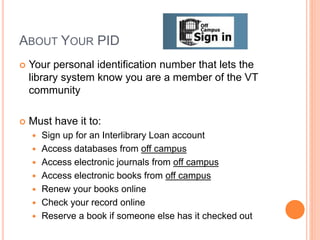
ABOUT YOUR PID
 Your personal identification number that lets the
library system know you are a member of the VT
community
 Must have it to:
 Sign up for an Interlibrary Loan account
 Access databases from off campus
 Access electronic journals from off campus
 Access electronic books from off campus
 Renew your books online
 Check your record online
 Reserve a book if someone else has it checked out
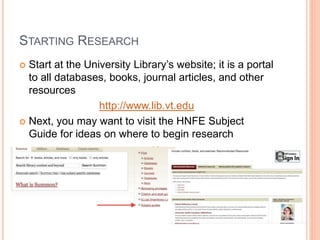
 Start at the University Library’s website; it is a portal
to all databases, books, journal articles, and other
resources
http://www.lib.vt.edu
 Next, you may want to visit the HNFE Subject
Guide for ideas on where to begin research
STARTING RESEARCH
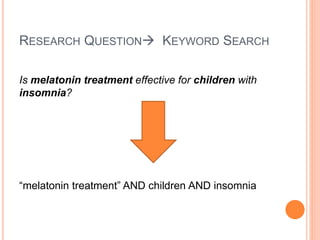
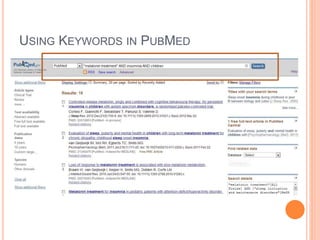
RESEARCH QUESTION KEYWORD SEARCH
Is melatonin treatment effective for children with
insomnia?
“melatonin treatment” AND children AND insomnia
BUILDING SEARCHES
Use our Search Strategy Builder:
http://www.lib.vt.edu/help/portal/search-strategy-
builder.html
Use PubMed’s Search Builder:
http://www.ncbi.nlm.nih.gov/pubmed/advanced/
Off campus? Use this for PubMed Search Builder:
https://login.ezproxy.lib.vt.edu/login?url=http://www.nc
bi.nlm.nih.gov/pubmed?otool=vauvpilib
INFORMATION FORMATS
 Books
 Addison
 Summon
 Journal articles
 Summon
 Databases
Where to
search?
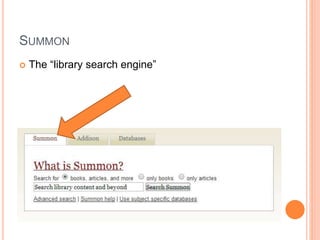
SUMMON
 The “library search engine”
PERIODICAL LITERATURE
 While books represent the best way to gain a basic
understanding (background) of your chosen topic,
periodical literature will let you gain an
understanding of the current conversation
revolving around your topic.
 What is a periodical? And how do you search for
related periodical articles?
 Think magazines, newspapers, journals…
DATABASES
 Definition:
Generally, a large, computer-based file of organized
information. In library terms, such a file, devoted to
a specific subject and organized for information
search and retrieval. For example, PubMed is a
database of sources, such as journal articles, for
the study of medical-related material. May also be
called an “index.”
DATABASES…
 Most likely, you will be using a database to look for
a periodical article much like you would use the
online catalog to look for a book
 The information is organized in the same way
 Databases will let you search for individual articles,
which the catalog will not let you do
 How do you decide which databases to use?
SELECTING A DATABASE
 Currently, at VT, we subscribe to nearly 1,000
databases
 Search for a specific database using the
“Databases” tab on the homepage
OR
 Use a related Subject Guide as your starting point,
and view recommended databases
 http://guides.lib.vt.edu/course-guides/hnfe2014
DATABASE DEMONSTRATION
 PubMed
 Visit through the library website
 Make sure you’re logged in to Off Campus Sign In to
view the Get VText icon
 The most comprehensive medical database
 Some full text articles, some bibliographic articles
 Limits: dates, publication types, subjects
 Web of Science
 Visit through the library website
 If off campus, must log in to view this database
 Completely bibliographic database
USING KEYWORDS IN PUBMED
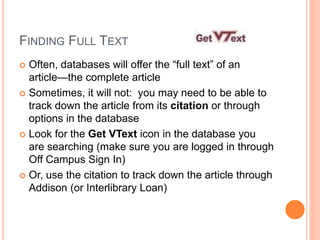
FINDING FULL TEXT
 Often, databases will offer the “full text” of an
article—the complete article
 Sometimes, it will not: you may need to be able to
track down the article from its citation or through
options in the database
 Look for the Get VText icon in the database you
are searching (make sure you are logged in through
Off Campus Sign In)
 Or, use the citation to track down the article through
Addison (or Interlibrary Loan)
TYPES OF JOURNAL ARTICLES
 We’ve discussed different types of sources, such as
books, journal articles, conference proceedings.
However, journal articles reporting on research
describe different study types.
 Let’s review each type of study article that you
might use
 Review article
 Clinical Trial/Intervention
 Observational (cross-sectional or longitudinal)
 Meta-Analysis
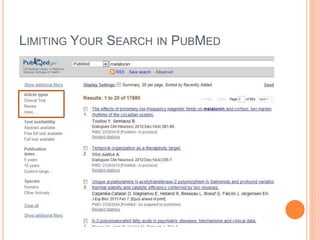
LIMITING YOUR SEARCH IN PUBMED
A WORD ON PEER REVIEW
 What is peer review?
 Also known as “scholarly” or “refereed” (as opposed to
“popular”)
 An editorial process in which experts from a particular
discipline scrutinize articles before they are published by a
journal
 Why is it helpful to us, as researchers?
 We can trust that the information presented in a peer-
reviewed article or journal is authoritative
 You WANT to use peer-reviewed journals in your research
So, how can you tell if an article is from a peer-reviewed
journal?
DETERMINING PEER REVIEW
 The journal’s website—they will tell you if it’s peer
reviewed
 Ulrich’s Periodical Directory
 Using “limiting” options in a database that allows
you to search specifically for peer-reviewed articles
 Understanding the principles behind scholarly work,
and recognizing them…
RESOURCE EVALUATION, IN GENERAL
 Consider:
 Currency—when was the book/article/website
published?
 Audience—who is this information intended for? Why?
 Authority—who is the author? What are his/her
credentials?
 Publisher/sponsoring body—is this an academic
press? A hate group? Do they have a bias/agenda?
 Organization—is the book/article organized well? Is
the grammar correct? Are there footnotes, endnotes,
and a bibliography?
 Coverage—is the topic treated with depth? Does the
book/article contribute to the existing body of
knowledge?
A WORD ON CITATIONS
 There are many different styles of citations, but
they all have the same components
 When conducting research, it will be necessary to
understand citations:
 You will need to create citations when you attribute your
sources in papers/projects you create
 You will need to understand how to find the original
resource from the citations given in databases or other
bibliographies
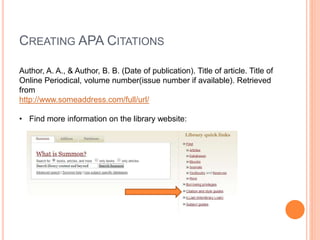
CREATING APA CITATIONS
Author, A. A., & Author, B. B. (Date of publication). Title of article. Title of
Online Periodical, volume number(issue number if available). Retrieved
from
http://www.someaddress.com/full/url/
• Find more information on the library website:
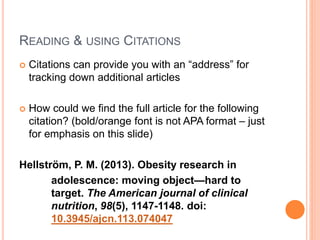
READING & USING CITATIONS
 Citations can provide you with an “address” for
tracking down additional articles
 How could we find the full article for the following
citation?
Hellström, P. M. (2013). Obesity research in
adolescence: moving object--hard to
target. American Journal of Clinical Nutrition,
98(5), 1147-1148.
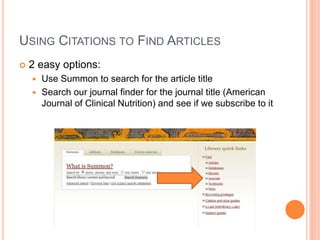
USING CITATIONS TO FIND ARTICLES
 2 easy options:
 Use Summon to search for the article title
 Search our journal finder for the journal title (American
Journal of Clinical Nutrition) and see if we subscribe to it
REVIEW
 Library services
 Starting research
 Locating research resources
 Determining study type
 Determining peer review
 Finding full text
 Good evaluation criteria
 APA citations
 Your questions…
Thank you!
Contact me if you have any lingering questions:
Ginny Pannabecker
vpannabe@vt.edu
4010 Newman Library / 3066A Derring
540-231-7980

HNFE 2014 library lecture Spring 2016

  • 1.
    HNFE 2014: ORIENTATION TOSCHOLARLY RESEARCH & RESOURCES Ginny Pannabecker vpannabe@vt.edu 540-231-7980 February 2016 Content in this presentation is reused with permission from a presentation by Rebecca Kate Miller, with some modifications. This presentation is licensed for reuse as CC BY-SA 4.0: https://creativecommons.org/licenses/by-sa/4.0/
  • 2.
    “RESEARCH”  Involves identifyingand locating sources that provide factual information or personal/expert opinion on a research question  A necessary component of all research projects/questions/methods at some point  What IS the library, and why is it still relevant?
  • 3.
    NEWMAN LIBRARY  Physically,Newman Library houses most of the research materials at VT  Other branches include Vet Med and Art + Architecture  Aside from books, journals, and reference help, you will find:  Comm Lab  Electronic equipment (laptops, iPads, etc.)  Language Resource Lab  Writing Center
  • 4.
    NEWMAN LIBRARY SERVICES Circulation  Check out books, DVDs, journals, equipment and more!  Use your Hokie Passport to do this  Request It! service  “Reserve” books are also found here  Reference & research help  Librarians. We’re here to help.  Visit the 2nd floor reference desk  Interlibrary Loan  Desktop Delivery  Order a book that the library does not own…it’s FREE to you!
  • 5.
    ABOUT YOUR PID Your personal identification number that lets the library system know you are a member of the VT community  Must have it to:  Sign up for an Interlibrary Loan account  Access databases from off campus  Access electronic journals from off campus  Access electronic books from off campus  Renew your books online  Check your record online  Reserve a book if someone else has it checked out
  • 6.
     Start atthe University Library’s website; it is a portal to all databases, books, journal articles, and other resources http://www.lib.vt.edu  Next, you may want to visit the HNFE Subject Guide for ideas on where to begin research STARTING RESEARCH
  • 7.
    RESEARCH QUESTION KEYWORDSEARCH Is melatonin treatment effective for children with insomnia? “melatonin treatment” AND children AND insomnia
  • 8.
    BUILDING SEARCHES Use ourSearch Strategy Builder: http://www.lib.vt.edu/help/portal/search-strategy- builder.html Use PubMed’s Search Builder: http://www.ncbi.nlm.nih.gov/pubmed/advanced/ Off campus? Use this for PubMed Search Builder: https://login.ezproxy.lib.vt.edu/login?url=http://www.nc bi.nlm.nih.gov/pubmed?otool=vauvpilib
  • 9.
    INFORMATION FORMATS  Books Addison  Summon  Journal articles  Summon  Databases Where to search?
  • 10.
    SUMMON  The “librarysearch engine”
  • 11.
    PERIODICAL LITERATURE  Whilebooks represent the best way to gain a basic understanding (background) of your chosen topic, periodical literature will let you gain an understanding of the current conversation revolving around your topic.  What is a periodical? And how do you search for related periodical articles?  Think magazines, newspapers, journals…
  • 12.
    DATABASES  Definition: Generally, alarge, computer-based file of organized information. In library terms, such a file, devoted to a specific subject and organized for information search and retrieval. For example, PubMed is a database of sources, such as journal articles, for the study of medical-related material. May also be called an “index.”
  • 13.
    DATABASES…  Most likely,you will be using a database to look for a periodical article much like you would use the online catalog to look for a book  The information is organized in the same way  Databases will let you search for individual articles, which the catalog will not let you do  How do you decide which databases to use?
  • 14.
    SELECTING A DATABASE Currently, at VT, we subscribe to nearly 1,000 databases  Search for a specific database using the “Databases” tab on the homepage OR  Use a related Subject Guide as your starting point, and view recommended databases  http://guides.lib.vt.edu/course-guides/hnfe2014
  • 15.
    DATABASE DEMONSTRATION  PubMed Visit through the library website  Make sure you’re logged in to Off Campus Sign In to view the Get VText icon  The most comprehensive medical database  Some full text articles, some bibliographic articles  Limits: dates, publication types, subjects  Web of Science  Visit through the library website  If off campus, must log in to view this database  Completely bibliographic database
  • 16.
  • 17.
    FINDING FULL TEXT Often, databases will offer the “full text” of an article—the complete article  Sometimes, it will not: you may need to be able to track down the article from its citation or through options in the database  Look for the Get VText icon in the database you are searching (make sure you are logged in through Off Campus Sign In)  Or, use the citation to track down the article through Addison (or Interlibrary Loan)
  • 18.
    TYPES OF JOURNALARTICLES  We’ve discussed different types of sources, such as books, journal articles, conference proceedings. However, journal articles reporting on research describe different study types.  Let’s review each type of study article that you might use  Review article  Clinical Trial/Intervention  Observational (cross-sectional or longitudinal)  Meta-Analysis
  • 19.
  • 20.
    A WORD ONPEER REVIEW  What is peer review?  Also known as “scholarly” or “refereed” (as opposed to “popular”)  An editorial process in which experts from a particular discipline scrutinize articles before they are published by a journal  Why is it helpful to us, as researchers?  We can trust that the information presented in a peer- reviewed article or journal is authoritative  You WANT to use peer-reviewed journals in your research So, how can you tell if an article is from a peer-reviewed journal?
  • 21.
    DETERMINING PEER REVIEW The journal’s website—they will tell you if it’s peer reviewed  Ulrich’s Periodical Directory  Using “limiting” options in a database that allows you to search specifically for peer-reviewed articles  Understanding the principles behind scholarly work, and recognizing them…
  • 22.
    RESOURCE EVALUATION, INGENERAL  Consider:  Currency—when was the book/article/website published?  Audience—who is this information intended for? Why?  Authority—who is the author? What are his/her credentials?  Publisher/sponsoring body—is this an academic press? A hate group? Do they have a bias/agenda?  Organization—is the book/article organized well? Is the grammar correct? Are there footnotes, endnotes, and a bibliography?  Coverage—is the topic treated with depth? Does the book/article contribute to the existing body of knowledge?
  • 23.
    A WORD ONCITATIONS  There are many different styles of citations, but they all have the same components  When conducting research, it will be necessary to understand citations:  You will need to create citations when you attribute your sources in papers/projects you create  You will need to understand how to find the original resource from the citations given in databases or other bibliographies
  • 24.
    CREATING APA CITATIONS Author,A. A., & Author, B. B. (Date of publication). Title of article. Title of Online Periodical, volume number(issue number if available). Retrieved from http://www.someaddress.com/full/url/ • Find more information on the library website:
  • 25.
    READING & USINGCITATIONS  Citations can provide you with an “address” for tracking down additional articles  How could we find the full article for the following citation? Hellström, P. M. (2013). Obesity research in adolescence: moving object--hard to target. American Journal of Clinical Nutrition, 98(5), 1147-1148.
  • 26.
    USING CITATIONS TOFIND ARTICLES  2 easy options:  Use Summon to search for the article title  Search our journal finder for the journal title (American Journal of Clinical Nutrition) and see if we subscribe to it
  • 27.
    REVIEW  Library services Starting research  Locating research resources  Determining study type  Determining peer review  Finding full text  Good evaluation criteria  APA citations  Your questions…
  • 28.
    Thank you! Contact meif you have any lingering questions: Ginny Pannabecker vpannabe@vt.edu 4010 Newman Library / 3066A Derring 540-231-7980

Editor's Notes