Information Literacy
for the Health Sciences
Student
Introduction
Why Is This Important?
As a professional in the health sciences you will need to relate
important health information to the people you serve.
You will help people make proper health decisions.
While in school, you are learning skills for life.
Think of your class assignments as practice for the future.
Learn proper information literacy habits now and they will be
natural in your professional life.
A Definition of Information
Literacy
“Information Literacy is the set
of skills needed to find, retrieve,
analyze, and use information.”
A Definition of Health Information
Literacy
The Medical Library Association
has devised a working definition
of health information literacy.
“Health Information Literacy is the set of
abilities needed to: recognize a health
information need; identify likely
information sources and use them to
retrieve relevant information; assess the
quality of the information and its
applicability to a specific situation; and
analyze, understand, and use the
information to make good health
decisions.”
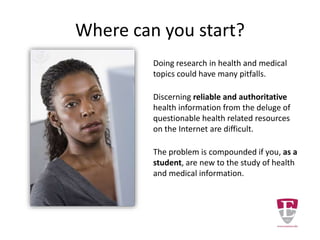
Where can you start?
Discerning reliable and authoritative health
and medical information from the deluge of
related resources on the Internet is difficult.
The problem is compounded if you, as a
student, are new to the study of health and
medical information.
Authoritative Resources
In this course, we will focus on
authoritative and reliable resources that
you can use for your academic research.
The resources will help you obtain the best
information available for your academic
and professional lives.
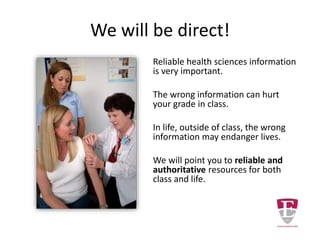
We will be direct!
Reliable health sciences information is very
important.
In school, the wrong type of information can
hurt your grade in a class.
In the work place, the wrong type information
may endanger lives.
We will point you to authoritative and reliable
resources for both class and life.
Health sciences students should be information
literate. More importantly, they should be
health information literate.
Two Literacy Types
Health Literacy Health Information Literacy
Focus on Communicating
Information.
Focus on Discovery Methods
and Search Techniques.
The two literacies have many commonalities their focus is different.
Jane Lawless, Coleen E. Toronto, Gail L. Grammatica, (2016) "Health literacy and information
literacy: a concept comparison", Reference Services Review, Vol. 44 Issue: 2, pp.144-162, doi:
10.1108/RSR-02-2016-0013
Permanent link to this document:
http://dx.doi.org/10.1108/RSR-02-2016-0013
Health Literacy
"Studies show as many as half of all adults in all
socio-economic levels struggle with health
literacy, defined as the ability to read,
understand and act on spoken and written
health information from medical professionals.”
Wall Street Journal July 3, 2003
The People
You Will Serve
In a September 2012 survey of adult
Internet users, 72% of the respondents
said that they looked online for health
information within the past year.
http://www.pewinternet.org/fact-sheets/health-fact-sheet/
What Are They Using?
Seventy-seven percent of online health
seekers say they began their information
seeking at a search engine such as Google,
Bing, or Yahoo.
http://www.pewinternet.org/fact-sheets/health-fact-sheet/
Seeking Advice
The facts are 35% of U.S. adults say that at one time or another they have
gone online specifically to try to figure out what medical condition they or
someone else might have.
One in five Internet users have consulted online reviews and rankings of health
care service providers and treatments.
Additionally, 18% of Internet users, or 13% of adults, have gone online to find
others who might have health concerns similar to theirs. People living with
chronic and rare conditions are significantly more likely to do this.
http://www.pewinternet.org/fact-sheets/health-fact-sheet/
Patients Trust the Web
Earlier surveys reveal that 75% of
health information-seeking adults
on the Internet rarely or never
checks the source or date of the
information they have found.
Among the health information-
seeking adults, 72% express trust in
most or all information they have
found online.
Source: Fox, S. Vital Decisions (2003). Online Health Search (2006). Washington, DC: Pew Internet & American Life Project.
Patients Trust Healthcare
Providers More
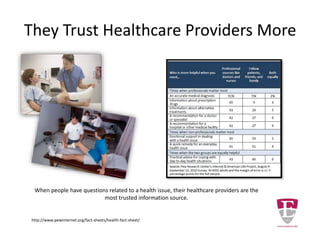
When people have questions related to a health issue, their
healthcare providers are the most trusted information source.
http://www.pewinternet.org/fact-sheets/health-fact-sheet/
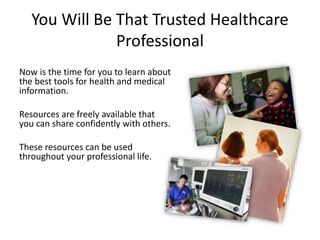
You Will Be A Trusted Health
Information Provider.
Now is the time for you to learn about the
best tools for finding health and medical
information.
There are resources freely available that
you can share with confidence throughout
your professional life.
Health Information Literacy
The information gathering and
processing skills you learn in class will
help you in your professional life.
Conduct research in an organized way.
This is important in the classroom and
the workplace.
Organizing your research saves time
and increases the quality of results.
Thinking It Through
If you have the option of
selecting to choose your own
research topic, choose a subject
that interests you.
Satisfying your curiosity makes
the work much more enjoyable.
You may find that you know a
great deal already.
When selecting your topic you should
ask if there are adequate resources
available to you in order to develop the
topic.
Check with a librarian to see if the
information you need is available
through the library.
The librarian can help you locate
materials whether in the library or from
other libraries using inter-library loan.
Adequate Resources
Adequate Time
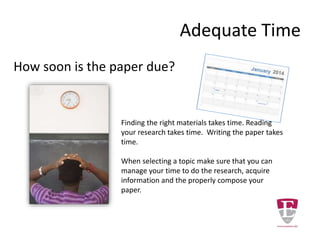
How soon is the paper due?
Finding the right materials takes time. Reading
your research takes time. Writing the paper takes
time.
When selecting a topic make sure that you can
manage your time to do the research, acquire
information and the properly compose your
paper.
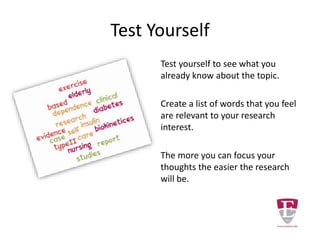
Test Yourself
Test yourself to see what you
already know about the topic.
Create a list of words that you
feel are relevant to your research
interest.
The more you can focus your
thoughts the easier the research
process will be.
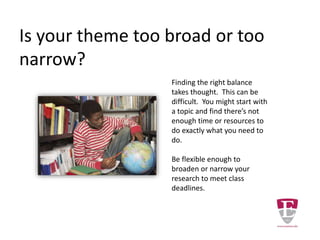
Is your theme too broad or too
narrow?
Finding the right balance takes thought.
This can be difficult. You might start with
a topic and find there’s not enough time
or resources to do exactly what you need
to do.
Be flexible enough to broaden or narrow
your research to meet class deadlines.
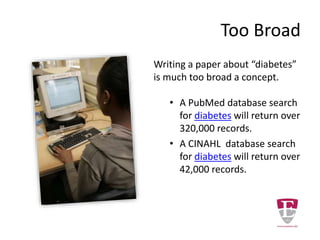
Too Broad A Topic
Writing a paper about “diabetes” seems like
an excellent topic for research. However
doing a few example searches will reveal a
very complex topic that needs narrowed
down.
• A PubMed database search for diabetes
alone returns over 300,000 records.
• A CINAHL database search for diabetes
alone will returns over 40,000 records.
Better to Narrow the Topic
Writing about “insulin-dependent diabetes
mellitus” is better choice for a topic but still too
broad.
Sample searches will return far too many items to
review in a semester.
• A PubMed search for diabetes mellitus
AND insulin-dependent will return over
24,000 records.
• A CINAHL search for diabetes mellitus
AND insulin-dependent will return over
16,000 records.
Even Better
Writing about "insulin-dependent diabetes mellitus and the
aged over 65” is focusing more. However, it is still too broad.
• A PubMed search for diabetes mellitus AND
insulin-dependent AND aged over 65 returns
over 4000 records.
• A CINAHL search for diabetes mellitus AND
insulin-dependent AND aged over 65 returns
over 400 records.
Try adding terms such as:
• nursing practice
• diet changes
• physical exercise
• medical treatment
Ask Yourself Some Serious
Questions
You must choose your topic with a definite goal.
At the end of the research process what specific
think will you have learned.
Focus your thoughts by determining just what you
want to learn.
Think of concrete examples that turns your research
into healthcare practice.
Question Examples
Here are a few example topic based on the searches above:
How can healthcare providers assist the elderly coping with
insulin-dependence on their own? ?
Can the healthcare provider promote a “sense of
empowerment” for insulin-dependent elderly through
“self-care”?
How can a healthcare provider help elderly patients cope
with the social implications of insulin-dependence?
Information Type?
Once you have formulated a topic question or proposition, determine the
type of information that you will need.
Case Report (or series) - "descriptive study of a group of people, usually receiving
the same treatment or with the same disease."
Clinical Practice Guideline - "systematically developed statements to assist
practitioner and patient making decisions about appropriate health care for
specific clinical circumstances."
Evidence-based Practice - articles that reflect "the conscientious, explicit and
judicious use of current best evidence in making decisions about the care of
individual patients"
Technical Report - documents that describe the process, progress, and or results of
technical or scientific research or the state of a technical or scientific research
problem or something else.
Tasks
Over the next few sessions, we will look at the resources you need to
consider when doing research for your classes.
Do the student activity for this lesson.
Then proceed to the next lesson.

Introduction

  • 1.
    Information Literacy for theHealth Sciences Student Introduction
  • 2.
    Why Is ThisImportant? As a professional in the health sciences you will need to relate important health information to the people you serve. You will help people make proper health decisions. While in school, you are learning skills for life. Think of your class assignments as practice for the future. Learn proper information literacy habits now and they will be natural in your professional life.
  • 3.
    A Definition ofInformation Literacy “Information Literacy is the set of skills needed to find, retrieve, analyze, and use information.”
  • 4.
    A Definition ofHealth Information Literacy The Medical Library Association has devised a working definition of health information literacy. “Health Information Literacy is the set of abilities needed to: recognize a health information need; identify likely information sources and use them to retrieve relevant information; assess the quality of the information and its applicability to a specific situation; and analyze, understand, and use the information to make good health decisions.”
  • 5.
    Where can youstart? Discerning reliable and authoritative health and medical information from the deluge of related resources on the Internet is difficult. The problem is compounded if you, as a student, are new to the study of health and medical information.
  • 6.
    Authoritative Resources In thiscourse, we will focus on authoritative and reliable resources that you can use for your academic research. The resources will help you obtain the best information available for your academic and professional lives.
  • 7.
    We will bedirect! Reliable health sciences information is very important. In school, the wrong type of information can hurt your grade in a class. In the work place, the wrong type information may endanger lives. We will point you to authoritative and reliable resources for both class and life. Health sciences students should be information literate. More importantly, they should be health information literate.
  • 8.
    Two Literacy Types HealthLiteracy Health Information Literacy Focus on Communicating Information. Focus on Discovery Methods and Search Techniques. The two literacies have many commonalities their focus is different. Jane Lawless, Coleen E. Toronto, Gail L. Grammatica, (2016) "Health literacy and information literacy: a concept comparison", Reference Services Review, Vol. 44 Issue: 2, pp.144-162, doi: 10.1108/RSR-02-2016-0013 Permanent link to this document: http://dx.doi.org/10.1108/RSR-02-2016-0013
  • 9.
    Health Literacy "Studies showas many as half of all adults in all socio-economic levels struggle with health literacy, defined as the ability to read, understand and act on spoken and written health information from medical professionals.” Wall Street Journal July 3, 2003
  • 10.
    The People You WillServe In a September 2012 survey of adult Internet users, 72% of the respondents said that they looked online for health information within the past year. http://www.pewinternet.org/fact-sheets/health-fact-sheet/
  • 11.
    What Are TheyUsing? Seventy-seven percent of online health seekers say they began their information seeking at a search engine such as Google, Bing, or Yahoo. http://www.pewinternet.org/fact-sheets/health-fact-sheet/
  • 12.
    Seeking Advice The factsare 35% of U.S. adults say that at one time or another they have gone online specifically to try to figure out what medical condition they or someone else might have. One in five Internet users have consulted online reviews and rankings of health care service providers and treatments. Additionally, 18% of Internet users, or 13% of adults, have gone online to find others who might have health concerns similar to theirs. People living with chronic and rare conditions are significantly more likely to do this. http://www.pewinternet.org/fact-sheets/health-fact-sheet/
  • 13.
    Patients Trust theWeb Earlier surveys reveal that 75% of health information-seeking adults on the Internet rarely or never checks the source or date of the information they have found. Among the health information- seeking adults, 72% express trust in most or all information they have found online. Source: Fox, S. Vital Decisions (2003). Online Health Search (2006). Washington, DC: Pew Internet & American Life Project.
  • 14.
    Patients Trust Healthcare ProvidersMore When people have questions related to a health issue, their healthcare providers are the most trusted information source. http://www.pewinternet.org/fact-sheets/health-fact-sheet/
  • 15.
    You Will BeA Trusted Health Information Provider. Now is the time for you to learn about the best tools for finding health and medical information. There are resources freely available that you can share with confidence throughout your professional life.
  • 16.
    Health Information Literacy Theinformation gathering and processing skills you learn in class will help you in your professional life. Conduct research in an organized way. This is important in the classroom and the workplace. Organizing your research saves time and increases the quality of results.
  • 17.
    Thinking It Through Ifyou have the option of selecting to choose your own research topic, choose a subject that interests you. Satisfying your curiosity makes the work much more enjoyable. You may find that you know a great deal already.
  • 18.
    When selecting yourtopic you should ask if there are adequate resources available to you in order to develop the topic. Check with a librarian to see if the information you need is available through the library. The librarian can help you locate materials whether in the library or from other libraries using inter-library loan. Adequate Resources
  • 19.
    Adequate Time How soonis the paper due? Finding the right materials takes time. Reading your research takes time. Writing the paper takes time. When selecting a topic make sure that you can manage your time to do the research, acquire information and the properly compose your paper.
  • 20.
    Test Yourself Test yourselfto see what you already know about the topic. Create a list of words that you feel are relevant to your research interest. The more you can focus your thoughts the easier the research process will be.
  • 21.
    Is your themetoo broad or too narrow? Finding the right balance takes thought. This can be difficult. You might start with a topic and find there’s not enough time or resources to do exactly what you need to do. Be flexible enough to broaden or narrow your research to meet class deadlines.
  • 22.
    Too Broad ATopic Writing a paper about “diabetes” seems like an excellent topic for research. However doing a few example searches will reveal a very complex topic that needs narrowed down. • A PubMed database search for diabetes alone returns over 300,000 records. • A CINAHL database search for diabetes alone will returns over 40,000 records.
  • 23.
    Better to Narrowthe Topic Writing about “insulin-dependent diabetes mellitus” is better choice for a topic but still too broad. Sample searches will return far too many items to review in a semester. • A PubMed search for diabetes mellitus AND insulin-dependent will return over 24,000 records. • A CINAHL search for diabetes mellitus AND insulin-dependent will return over 16,000 records.
  • 24.
    Even Better Writing about"insulin-dependent diabetes mellitus and the aged over 65” is focusing more. However, it is still too broad. • A PubMed search for diabetes mellitus AND insulin-dependent AND aged over 65 returns over 4000 records. • A CINAHL search for diabetes mellitus AND insulin-dependent AND aged over 65 returns over 400 records. Try adding terms such as: • nursing practice • diet changes • physical exercise • medical treatment
  • 25.
    Ask Yourself SomeSerious Questions You must choose your topic with a definite goal. At the end of the research process what specific think will you have learned. Focus your thoughts by determining just what you want to learn. Think of concrete examples that turns your research into healthcare practice.
  • 26.
    Question Examples Here area few example topic based on the searches above: How can healthcare providers assist the elderly coping with insulin-dependence on their own? ? Can the healthcare provider promote a “sense of empowerment” for insulin-dependent elderly through “self-care”? How can a healthcare provider help elderly patients cope with the social implications of insulin-dependence?
  • 27.
    Information Type? Once youhave formulated a topic question or proposition, determine the type of information that you will need. Case Report (or series) - "descriptive study of a group of people, usually receiving the same treatment or with the same disease." Clinical Practice Guideline - "systematically developed statements to assist practitioner and patient making decisions about appropriate health care for specific clinical circumstances." Evidence-based Practice - articles that reflect "the conscientious, explicit and judicious use of current best evidence in making decisions about the care of individual patients" Technical Report - documents that describe the process, progress, and or results of technical or scientific research or the state of a technical or scientific research problem or something else.
  • 28.
    Tasks Over the nextfew sessions, we will look at the resources you need to consider when doing research for your classes. Do the student activity for this lesson. Then proceed to the next lesson.