A Texas Curriculum
for
Livestock Educationhttp://qualitycounts.tamu.edu/
HOWDY!!!
• Introduction
Curriculum Focus
Quality AssuranceQuality Assurance
Character EducationCharacter Education
Objective 1
• Ensure all 4-H and FFA
livestock projects meet all
food quality standards
Objective 2
• Enhance character
education for Texas
4-H and FFA Youth
Objective 3
• Promote a Positive Image
of Youth Livestock
Programs
Eight Core Concepts
Eight Core Concepts
Character Education
• Six Pillars of Character
• Purpose of 4-H/FFA
• Purpose of Livestock Projects
• Making Decisions/Goal Setting
Eight Core Concepts
Quality Assurance
• Impact of Livestock Projects on Red Meat
Industry
• Responsibilities of Producing a Safe Product
• Medication use/Reading and Following Labels
• Animal Care and Well-Being
Eight Core Concepts
Character Education
• Six Pillars of
Character
• Purpose of 4-H/FFA
• Purpose of Livestock
Projects
• Making
Decisions/Goal
Setting
Quality Assurance
• Impact of Livestock
Projects on Red Meat
Industry
• Responsibilities of
Producing a Safe Product
• Medication use/Reading
and Following Labels
• Animal Care and Well-
Being
The Six Pillars of Character
The Six Pillars
• Trustworthiness
• Respect
• Responsibility
• Fairness
• Caring
• Citizenship
Trustworthiness
• Be honest
• Don’t deceive, cheat or steal
• Be reliable
• Do what you say you will do
• Have the courage to do the right thing
• Build a good reputation
• Be loyal
• Stand by your family, friends and country
Respect
• Treat others with respect
• Follow the Golden Rule
• Be tolerant to differences
• Use good manners, not bad language
• Be considerate of the feelings of others
• Don't threaten, hit or hurt anyone
• Deal peacefully with anger, insults and
disagreements
• Do what you are supposed to do
• Persevere: Keep trying!
• Always do your best
• Use self control: be disciplined
• Think before you act
• Consider the consequences
• Be accountable for your choices
Responsibility
• Play by the rules
• Take turns and share
• Be open minded
• Listen to others
• Don't take advantage of others
• Don't blame others carelessly
Fairness
• Be kind
• Be compassionate and show you care
• Express gratitude
• Forgive others
• Help people in need
Caring
• Do your share to make your school and
community better
• Cooperate
• Stay informed; vote
• Be a good neighbor
• Obey laws and rules
• Respect authority
• Protect the environment
Citizenship
The Food Supply Continuum
Our Role in Food Supply Continuum
Food Supply ContinuumFood Supply Continuum
ConsumerConsumer
FoodFood
ServiceService
Retail/Retail/
DistributionDistribution
ProcessingProcessing HarvestingHarvesting
MarketingMarketing
TransportationTransportation
ProducerProducer
AttitudeAttitude
From: NPPC,
Youth PQA;
2000
Responsibility
• ALL producers are affected by negative
publicity concerning our food supply
• Product safety can be compromised at
any time in the food supply continuum
Responsibility
Citizenship
Our Role in Food Supply Continuum
• Past failures in food safety process
– Recalls, scares, contamination
• Hazard Analysis and Critical Control
Points (HACCP) plans and monitoring
now required by every packing plant,
regardless of size - PREVENTION
Responsibility Citizenship Trustworthiness
Our Role in Food Supply Continuum
• Role of producer in providing packer with
safe product
– “On-farm HACCP”
– Certain hazards occur before product reaches
packer
– Notify packer of potential hazards
• Importance of record keeping
– Medication use and storage
Responsibility Citizenship Trustworthiness
ACTIVITY
The Impact of 4-H and FFA Projects
• Reveal impact of 76,000
market projects
ACTIVITY 4 –
What’s under that hide?
Orange and Tin Foil
How many pounds of carcass are there?
• Terms & Calculations:
(1) Live Weight, (2)
Dressing Percent, and
(3) Carcass Weight
Citizenship
Total Entry Numbers
Market Swine: 32,617
Meat Goats: 32,821
Market Lamb: 11,438
Market Steers: 8,438
TOTAL: 76,225
Responsibility
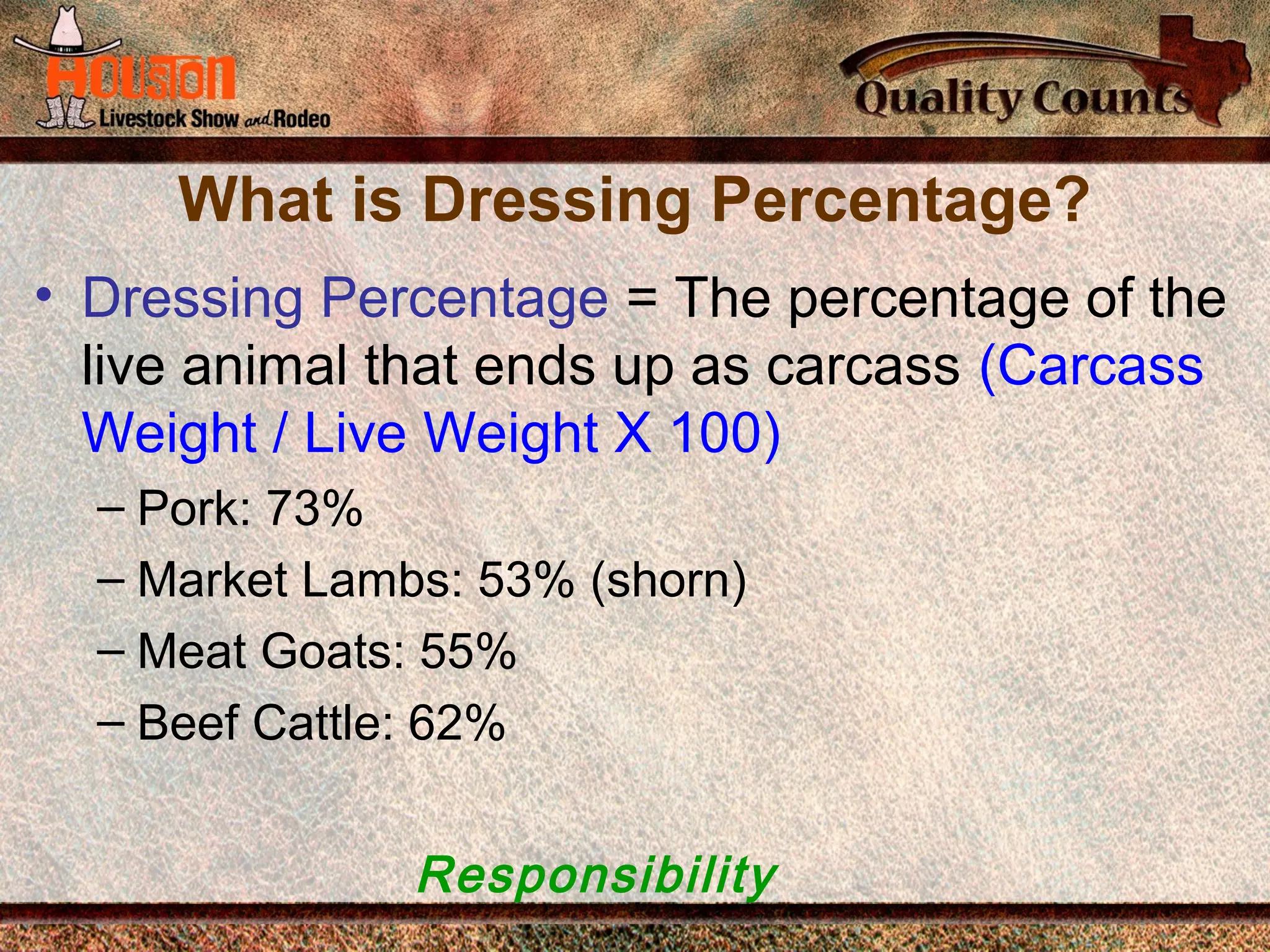
What is Dressing Percentage?
• Dressing Percentage = The percentage of the
live animal that ends up as carcass (Carcass
Weight / Live Weight X 100)
– Pork: 73%
– Market Lambs: 53% (shorn)
– Meat Goats: 55%
– Beef Cattle: 62%
Responsibility
Dressing Percentage is Affected by:
• Gut fill – The more gut fill at the time the live weight is
taken, the lower the dressing percentage will be.
• Muscling – A heavier muscled animal will have a higher
dressing percentage than a light muscled animal.
• Fatness – A fatter animal will have a higher dressing
percentage than a lean animal.
• Mud – Cattle with a lot of mud attached to their hide will
have a lower dressing percentage than clean cattle.
• Wool – Lambs with long wool will have a lower dressing
percentage than recently-shorn lambs
• Skin – In market swine, the skin is left on.
• Stomach Type – Market swine are monogastics, cattle,
sheep and goats are ruminants.
Citizenship
PORK
Ave Wt. – 240
D. P. - 73%
5,714,498.4 lb
Responsibility
SHEEP
Ave Wt. – 125
D. P. - 53%
751,871.25 lb
Responsibility
GOATS
Ave Wt. – 110
D. P. - 55%
1,441,170.5 lb
Responsibility
BEEF
Ave Wt. – 1200
D. P. - 62%
6,277,872.0 lb
Responsibility
Grand Total:
14,185,412.15
pounds of
carcass!!!!!!
What does this mean?
• Livestock projects can IMPACT
thousands of people!!!
• Think about the CONSUMER!!!!
• You never know who they might
be……..
Identify Potential Hazards in Meat Products
• Three types of hazards:
– Microbial
• E. coli, salmonella
– Chemical
• Antibiotic residue
– Physical
• Broken needle
Caring
Responsibility Citizenship
Trustworthiness
Prevent Potential Hazards in Meat Products
QUESTIONS:
• What could potentially happen if a person extremely
allergic to penicillin (or ibuprofen) ate meat with
such a residue?
• What would happen if a consumer bit into a portion
of a broken needle?
ACTIVITY
Prevent Potential Hazards in Meat Products
Subcutaneous Injection
Citizenship
Prevent Potential Hazards in Meat Products
Intramuscular injection
Citizenshi
p
Prevent Potential Hazards in Meat Products
Responsibility Citizenship
On-Line Program
It’s Game Time
Quality Counts Style
In closing………
The Future of the
Youth Livestock Show
Program Depends on
Us!
Thank You!

Quality Counts

  • 1.
    A Texas Curriculum for LivestockEducationhttp://qualitycounts.tamu.edu/
  • 2.
  • 3.
    Curriculum Focus Quality AssuranceQualityAssurance Character EducationCharacter Education
  • 4.
    Objective 1 • Ensureall 4-H and FFA livestock projects meet all food quality standards
  • 5.
    Objective 2 • Enhancecharacter education for Texas 4-H and FFA Youth
  • 6.
    Objective 3 • Promotea Positive Image of Youth Livestock Programs
  • 7.
  • 8.
    Eight Core Concepts CharacterEducation • Six Pillars of Character • Purpose of 4-H/FFA • Purpose of Livestock Projects • Making Decisions/Goal Setting
  • 9.
    Eight Core Concepts QualityAssurance • Impact of Livestock Projects on Red Meat Industry • Responsibilities of Producing a Safe Product • Medication use/Reading and Following Labels • Animal Care and Well-Being
  • 10.
    Eight Core Concepts CharacterEducation • Six Pillars of Character • Purpose of 4-H/FFA • Purpose of Livestock Projects • Making Decisions/Goal Setting Quality Assurance • Impact of Livestock Projects on Red Meat Industry • Responsibilities of Producing a Safe Product • Medication use/Reading and Following Labels • Animal Care and Well- Being
  • 11.
    The Six Pillarsof Character
  • 12.
    The Six Pillars •Trustworthiness • Respect • Responsibility • Fairness • Caring • Citizenship
  • 13.
    Trustworthiness • Be honest •Don’t deceive, cheat or steal • Be reliable • Do what you say you will do • Have the courage to do the right thing • Build a good reputation • Be loyal • Stand by your family, friends and country
  • 14.
    Respect • Treat otherswith respect • Follow the Golden Rule • Be tolerant to differences • Use good manners, not bad language • Be considerate of the feelings of others • Don't threaten, hit or hurt anyone • Deal peacefully with anger, insults and disagreements
  • 15.
    • Do whatyou are supposed to do • Persevere: Keep trying! • Always do your best • Use self control: be disciplined • Think before you act • Consider the consequences • Be accountable for your choices Responsibility
  • 16.
    • Play bythe rules • Take turns and share • Be open minded • Listen to others • Don't take advantage of others • Don't blame others carelessly Fairness
  • 17.
    • Be kind •Be compassionate and show you care • Express gratitude • Forgive others • Help people in need Caring
  • 18.
    • Do yourshare to make your school and community better • Cooperate • Stay informed; vote • Be a good neighbor • Obey laws and rules • Respect authority • Protect the environment Citizenship
  • 19.
    The Food SupplyContinuum
  • 20.
    Our Role inFood Supply Continuum Food Supply ContinuumFood Supply Continuum ConsumerConsumer FoodFood ServiceService Retail/Retail/ DistributionDistribution ProcessingProcessing HarvestingHarvesting MarketingMarketing TransportationTransportation ProducerProducer AttitudeAttitude From: NPPC, Youth PQA; 2000 Responsibility
  • 21.
    • ALL producersare affected by negative publicity concerning our food supply • Product safety can be compromised at any time in the food supply continuum Responsibility Citizenship Our Role in Food Supply Continuum
  • 22.
    Our Role inFood Supply Continuum • Past failures in food safety process – Recalls, scares, contamination • Hazard Analysis and Critical Control Points (HACCP) plans and monitoring now required by every packing plant, regardless of size - PREVENTION Responsibility Citizenship Trustworthiness
  • 23.
    Our Role inFood Supply Continuum • Role of producer in providing packer with safe product – “On-farm HACCP” – Certain hazards occur before product reaches packer – Notify packer of potential hazards • Importance of record keeping – Medication use and storage Responsibility Citizenship Trustworthiness
  • 24.
  • 25.
    The Impact of4-H and FFA Projects • Reveal impact of 76,000 market projects
  • 26.
    ACTIVITY 4 – What’sunder that hide? Orange and Tin Foil
  • 27.
    How many poundsof carcass are there? • Terms & Calculations: (1) Live Weight, (2) Dressing Percent, and (3) Carcass Weight Citizenship
  • 28.
    Total Entry Numbers MarketSwine: 32,617 Meat Goats: 32,821 Market Lamb: 11,438 Market Steers: 8,438 TOTAL: 76,225 Responsibility
  • 29.
    What is DressingPercentage? • Dressing Percentage = The percentage of the live animal that ends up as carcass (Carcass Weight / Live Weight X 100) – Pork: 73% – Market Lambs: 53% (shorn) – Meat Goats: 55% – Beef Cattle: 62% Responsibility
  • 30.
    Dressing Percentage isAffected by: • Gut fill – The more gut fill at the time the live weight is taken, the lower the dressing percentage will be. • Muscling – A heavier muscled animal will have a higher dressing percentage than a light muscled animal. • Fatness – A fatter animal will have a higher dressing percentage than a lean animal. • Mud – Cattle with a lot of mud attached to their hide will have a lower dressing percentage than clean cattle. • Wool – Lambs with long wool will have a lower dressing percentage than recently-shorn lambs • Skin – In market swine, the skin is left on. • Stomach Type – Market swine are monogastics, cattle, sheep and goats are ruminants. Citizenship
  • 31.
    PORK Ave Wt. –240 D. P. - 73% 5,714,498.4 lb Responsibility
  • 32.
    SHEEP Ave Wt. –125 D. P. - 53% 751,871.25 lb Responsibility
  • 33.
    GOATS Ave Wt. –110 D. P. - 55% 1,441,170.5 lb Responsibility
  • 34.
    BEEF Ave Wt. –1200 D. P. - 62% 6,277,872.0 lb Responsibility
  • 35.
  • 36.
    What does thismean? • Livestock projects can IMPACT thousands of people!!! • Think about the CONSUMER!!!! • You never know who they might be……..
  • 37.
    Identify Potential Hazardsin Meat Products • Three types of hazards: – Microbial • E. coli, salmonella – Chemical • Antibiotic residue – Physical • Broken needle Caring Responsibility Citizenship Trustworthiness
  • 38.
    Prevent Potential Hazardsin Meat Products QUESTIONS: • What could potentially happen if a person extremely allergic to penicillin (or ibuprofen) ate meat with such a residue? • What would happen if a consumer bit into a portion of a broken needle?
  • 39.
  • 40.
    Prevent Potential Hazardsin Meat Products Subcutaneous Injection Citizenship
  • 41.
    Prevent Potential Hazardsin Meat Products Intramuscular injection Citizenshi p
  • 42.
    Prevent Potential Hazardsin Meat Products Responsibility Citizenship
  • 43.
  • 45.
  • 46.
  • 47.
    The Future ofthe Youth Livestock Show Program Depends on Us!
  • 48.

Editor's Notes

  • #2 This is the introduction slide. Note that this is a cooperative effort between Extension and Ag Science Teachers.
  • #4 This slide has the two-fold mission of Quality Counts.
  • #5 The next 3 slides discuss the main objectives of Quality Counts.
  • #37 Read from slide
  • #41 Injection Scenarios Team A Inject one of these six pigs (bananas) with ABCD vitamin cocktail. Identify the banana/pig you injected with tape and note the date of administration on this sheet ________________________. The withdrawal time for ABCD vitamin cocktail is 30 days. Team B Inject one of these steers (bananas) with XYZ antibiotic. The injection should be administered IM. Note the date of administration on this sheet__________________. The withdrawal time is 30 days. Team C Inject one of these lambs (bananas) with “stimulant unknown” given to us by Lamb Trader “Kill’em Quick”. The injection should be made SubQ and the lamb should be identified with tape. Note the date of administration ____________________.
  • #42 Injection Scenarios Team A Inject one of these six pigs (bananas) with ABCD vitamin cocktail. Identify the banana/pig you injected with tape and note the date of administration on this sheet ________________________. The withdrawal time for ABCD vitamin cocktail is 30 days. Team B Inject one of these steers (bananas) with XYZ antibiotic. The injection should be administered IM. Note the date of administration on this sheet__________________. The withdrawal time is 30 days. Team C Inject one of these lambs (bananas) with “stimulant unknown” given to us by Lamb Trader “Kill’em Quick”. The injection should be made SubQ and the lamb should be identified with tape. Note the date of administration ____________________.
  • #47 -Close out the training session