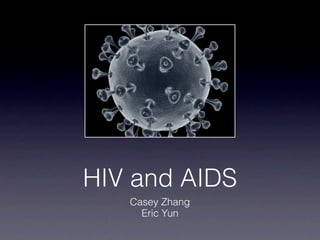
HIV and AIDS
   Casey Zhang
     Eric Yun
HIV versus AIDS
• HIV - Human Immunodeficiency Virus
 – Can be acquired from sexual intercourse
 – HIV is the stage before AIDS

• AIDS - Acquired Immunodeficiency Syndrome
 – HIV will develop into AIDS.
 – AIDS is a label given when a person's white blood cell
 count goes below a certain number
 – AIDS is one step closer to death.
What does HIV do?
• HIV kills helper T cells.

• Helper T cells signal the body to attack
  when the body is infected.

• Without the helper T cells, the body would
  not know it is being attacked in the first
  place.

• This weakens the immune system which
  leaves the body open to opportunistic
  infections. Infections that can be normally
  fought off.

• Many deaths are caused by these
  infections.
Modes of
              Transmission
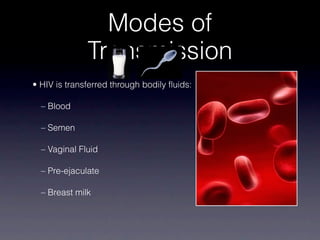
• HIV is transferred through bodily fluids:

  – Blood

  – Semen

  – Vaginal Fluid

  – Pre-ejaculate

  – Breast milk
Risky Behavior
• Four major routes of transmission:
  – Unsafe sex
  – Contaminated needles
  – Breast milk
  – Mother to child

• Unprotected sex or unsafe sex is not taking proper
  methods to prevent STIs, including not using a condom.
  Even if you only haven't used it once.

• Unsafe sex is the biggest cause of HIV. Therefore, it is very
  important to use a condom to lower the chances of
  acquiring HIV.
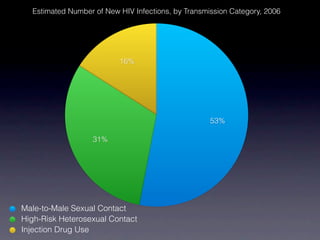
Estimated Number of New HIV Infections, by Transmission Category, 2006


                          16%


                                                    53%

                   31%


Male-to-Male Sexual Contact
High-Risk Heterosexual Contact
Injection Drug Use
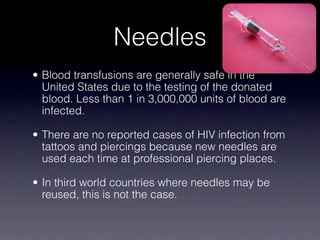
Needles
• Blood transfusions are generally safe in the
  United States due to the testing of the donated
  blood. Less than 1 in 3,000,000 units of blood are
  infected.

• There are no reported cases of HIV infection from
  tattoos and piercings because new needles are
  used each time at professional piercing places.

• In third world countries where needles may be
  reused, this is not the case.
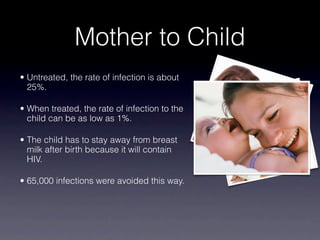
Mother to Child
• Untreated, the rate of infection is about
  25%.

• When treated, the rate of infection to the
  child can be as low as 1%.

• The child has to stay away from breast
  milk after birth because it will contain
  HIV.

• 65,000 infections were avoided this way.
Symptoms of HIV
• An HIV positive person may experience anywhere
  from no symptoms at all to strong symptoms.

• The symptoms that may show are fever, fatigue, and
  possibly rash.

• Because the symptoms are so similar to other
  illnesses (ex: flu) and even stress, basing a HIV
  diagnosis by looking at symptoms is unreliable.

• For this reason, it is not possible to tell whether or not
  someone has HIV by looking at them.
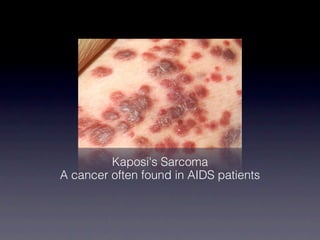
Kaposi's Sarcoma
A cancer often found in AIDS patients
Prevention
• Abstinence – without any sexual contact, bodily
  fluids that carry the virus will not be able to be
  exchanged.

• Consistent use of condoms – use a condom every
  time you have intercourse. If it is not used, the HIV
  virus can be transmitted.

• Be faithful – if you and your partner don't cheat,
  then there is no way HIV could be passed on to you
  or your partner. HIV is only transferred, not created.
Should You Get Tested?
• If you ever had sex without a condom.

• If you've ever used needles for:
 – Drugs
 – Steroids
 – Piercings/Tattoos
 – Blood transfusions in third world countries.

• If you're planning to get pregnant – don't pass it onto
  your baby.
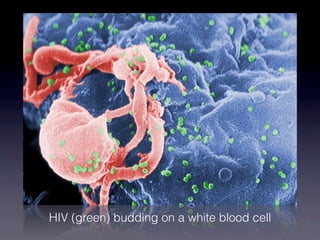
HIV (green) budding on a white blood cell
Types of HIV Testing
• Confidential – You tell your testing center your
  name. Your name is attached to your results
  and will be put into your medical record. It
  may be shared with your healthcare provider.
  Results may not be shared with anyone else
  without your consent.

• Anonymous – You are only given an unique
  testing number that identifies you. You use
  this number to get your test results. Not all
  HIV test sites offer anonymous testing.
New York State HIV
         Laws
• Started in June 2000

• Requires doctors and laboratories to report
  new cases of HIV. Doctors also have to talk to
  the HIV positive patient.

• Information will be used without names to
  track the HIV epidemic.
Partner Notification
                     Laws not required to
• If you are HIV positive, you are
  report people who you did risky acts with. It is
  advised that you do, however.

• The best way to tell the person that they may have
  given you HIV is directly talking to them but you
  can find a doctor or counselor to do it for you.

• When informing sexual partners about their risk of
  having HIV through a doctor, they will not be told
  that you are HIV positive.

• It's illegal to discriminate because of HIV.
Children's Rights to
                 Testing to testing
• Oarents have the legal right to consent
 for infants and young children since they are not
 capable of making that decision.

• If you want to be tested, you may consent
  yourself no matter how old you are.

• Your results will not be shared, even with your
  parents. They will not even know you were even
  tested. The confidentiality laws will apply.

• Exception – if an adolescent was abused, raped,
  or needs urgent care.
Bibliography
• http://www.who.int/publications/cra/chapters/
  volume2/1177-1254.pdf

• http://en.wikipedia.org/wiki/HIV

• http://en.wikipedia.org/wiki/Helper_T_cell

• http://en.wikipedia.org/wiki/AIDS

• http://www.nyc.gov/html/doh/html/ah/ahn1.shtml

• http://hivinsite.ucsf.edu/hiv?page=basics-00-02

• http://www.health.ny.gov/diseases/aids/facts/questions/
  child_adolescents.htm

HIV and AIDS

  • 1.
    HIV and AIDS Casey Zhang Eric Yun
  • 2.
    HIV versus AIDS •HIV - Human Immunodeficiency Virus – Can be acquired from sexual intercourse – HIV is the stage before AIDS • AIDS - Acquired Immunodeficiency Syndrome – HIV will develop into AIDS. – AIDS is a label given when a person's white blood cell count goes below a certain number – AIDS is one step closer to death.
  • 4.
    What does HIVdo? • HIV kills helper T cells. • Helper T cells signal the body to attack when the body is infected. • Without the helper T cells, the body would not know it is being attacked in the first place. • This weakens the immune system which leaves the body open to opportunistic infections. Infections that can be normally fought off. • Many deaths are caused by these infections.
  • 5.
    Modes of Transmission • HIV is transferred through bodily fluids: – Blood – Semen – Vaginal Fluid – Pre-ejaculate – Breast milk
  • 6.
    Risky Behavior • Fourmajor routes of transmission: – Unsafe sex – Contaminated needles – Breast milk – Mother to child • Unprotected sex or unsafe sex is not taking proper methods to prevent STIs, including not using a condom. Even if you only haven't used it once. • Unsafe sex is the biggest cause of HIV. Therefore, it is very important to use a condom to lower the chances of acquiring HIV.
  • 7.
    Estimated Number ofNew HIV Infections, by Transmission Category, 2006 16% 53% 31% Male-to-Male Sexual Contact High-Risk Heterosexual Contact Injection Drug Use
  • 8.
    Needles • Blood transfusionsare generally safe in the United States due to the testing of the donated blood. Less than 1 in 3,000,000 units of blood are infected. • There are no reported cases of HIV infection from tattoos and piercings because new needles are used each time at professional piercing places. • In third world countries where needles may be reused, this is not the case.
  • 10.
    Mother to Child •Untreated, the rate of infection is about 25%. • When treated, the rate of infection to the child can be as low as 1%. • The child has to stay away from breast milk after birth because it will contain HIV. • 65,000 infections were avoided this way.
  • 11.
    Symptoms of HIV •An HIV positive person may experience anywhere from no symptoms at all to strong symptoms. • The symptoms that may show are fever, fatigue, and possibly rash. • Because the symptoms are so similar to other illnesses (ex: flu) and even stress, basing a HIV diagnosis by looking at symptoms is unreliable. • For this reason, it is not possible to tell whether or not someone has HIV by looking at them.
  • 12.
    Kaposi's Sarcoma A canceroften found in AIDS patients
  • 13.
    Prevention • Abstinence –without any sexual contact, bodily fluids that carry the virus will not be able to be exchanged. • Consistent use of condoms – use a condom every time you have intercourse. If it is not used, the HIV virus can be transmitted. • Be faithful – if you and your partner don't cheat, then there is no way HIV could be passed on to you or your partner. HIV is only transferred, not created.
  • 14.
    Should You GetTested? • If you ever had sex without a condom. • If you've ever used needles for: – Drugs – Steroids – Piercings/Tattoos – Blood transfusions in third world countries. • If you're planning to get pregnant – don't pass it onto your baby.
  • 15.
    HIV (green) buddingon a white blood cell
  • 16.
    Types of HIVTesting • Confidential – You tell your testing center your name. Your name is attached to your results and will be put into your medical record. It may be shared with your healthcare provider. Results may not be shared with anyone else without your consent. • Anonymous – You are only given an unique testing number that identifies you. You use this number to get your test results. Not all HIV test sites offer anonymous testing.
  • 17.
    New York StateHIV Laws • Started in June 2000 • Requires doctors and laboratories to report new cases of HIV. Doctors also have to talk to the HIV positive patient. • Information will be used without names to track the HIV epidemic.
  • 18.
    Partner Notification Laws not required to • If you are HIV positive, you are report people who you did risky acts with. It is advised that you do, however. • The best way to tell the person that they may have given you HIV is directly talking to them but you can find a doctor or counselor to do it for you. • When informing sexual partners about their risk of having HIV through a doctor, they will not be told that you are HIV positive. • It's illegal to discriminate because of HIV.
  • 19.
    Children's Rights to Testing to testing • Oarents have the legal right to consent for infants and young children since they are not capable of making that decision. • If you want to be tested, you may consent yourself no matter how old you are. • Your results will not be shared, even with your parents. They will not even know you were even tested. The confidentiality laws will apply. • Exception – if an adolescent was abused, raped, or needs urgent care.
  • 20.
    Bibliography • http://www.who.int/publications/cra/chapters/ volume2/1177-1254.pdf • http://en.wikipedia.org/wiki/HIV • http://en.wikipedia.org/wiki/Helper_T_cell • http://en.wikipedia.org/wiki/AIDS • http://www.nyc.gov/html/doh/html/ah/ahn1.shtml • http://hivinsite.ucsf.edu/hiv?page=basics-00-02 • http://www.health.ny.gov/diseases/aids/facts/questions/ child_adolescents.htm

Editor's Notes