St. Robert’s
International Academy
St. Robert’s
International Academy
St. Robert’s
International Academy
St. Robert’s
International Academy
St. Robert’s
International Academy
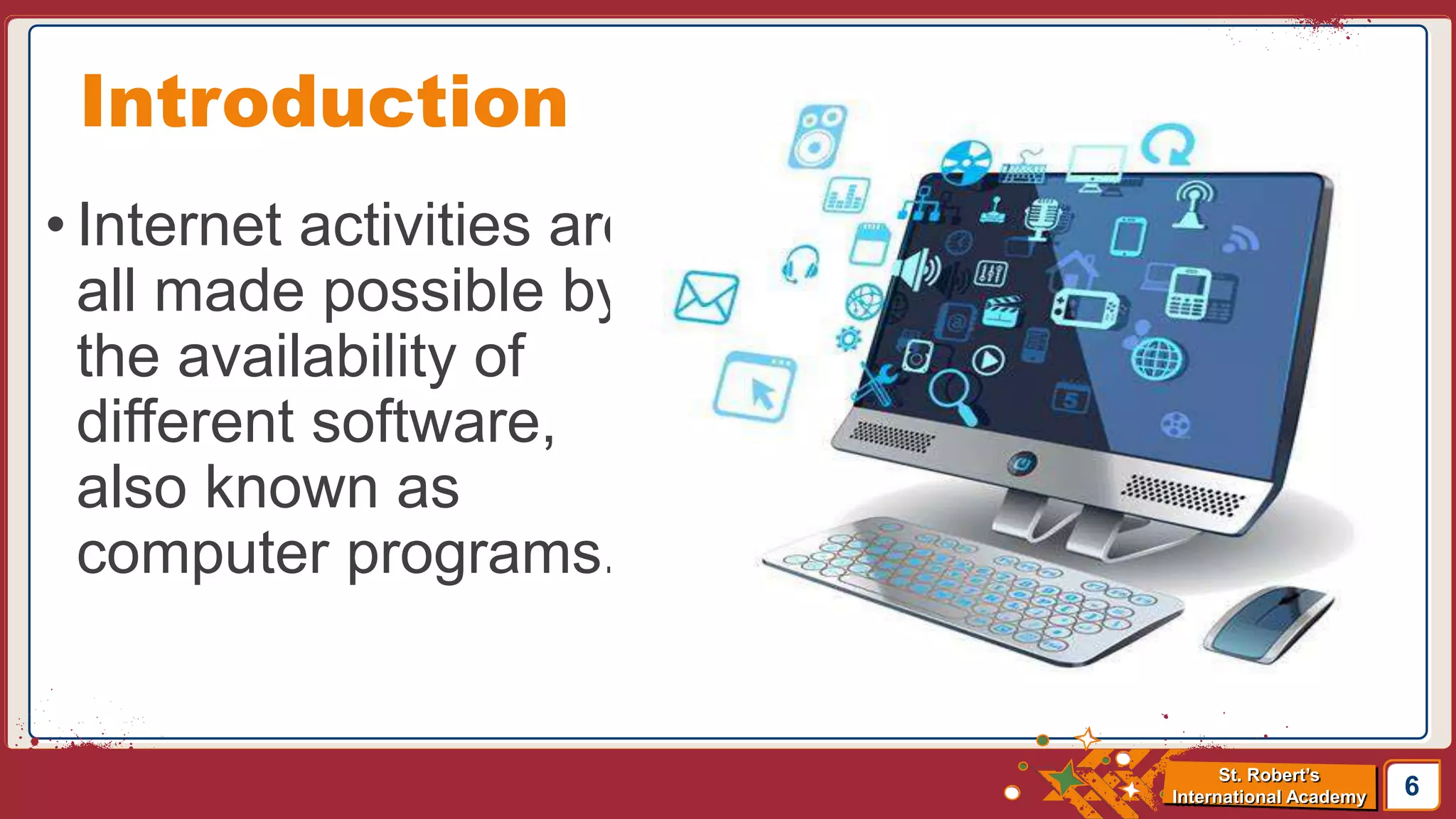
• Internet activities are
all made possible by
the availability of
different software,
also known as
computer programs.
6
Introduction
St. Robert’s
International Academy
A Review on Computer History
7
A computer is an electronic device
capable of performing commands.
The basic commands that a
computer performs are input (get
data), output (display results),
storage, and performance of
arithmetic and logical operations.
St. Robert’s
International Academy
• The term "computer" was
originally given to humans
(human computers) who
performed numerical
calculations using
mechanical calculators,
such as the abacus and
slide rule. The term was
later given to a mechanical
device as they began
replacing the human
computers.
9
“Human Computers”
St. Robert’s
International Academy
Types of Computers
10
Computers are generally classified
by size and power as follows,
although there is considerable
overlap. The differences between
computer classifications generally get
smaller as technology advances,
creating smaller and more powerful
and cost-friendly components.
St. Robert’s
International Academy
Types of Computers
11
Personal computer: a small, single-
user computer based on a
microprocessor. In addition to the
microprocessor, a personal computer
has a keyboard for entering data, a
monitor for displaying information, and
a storage device for saving data.
St. Robert’s
International Academy
Types of Computers
12
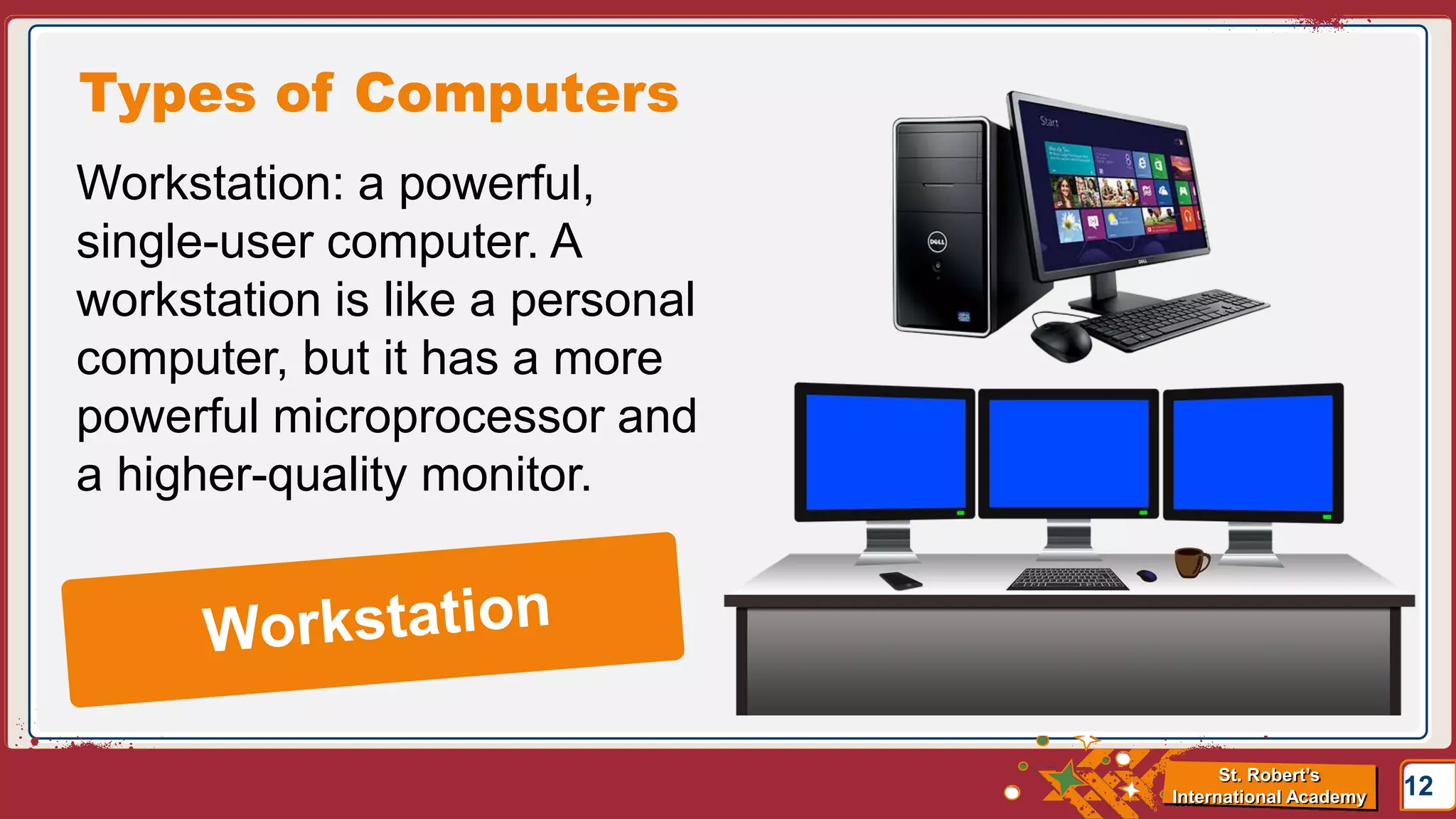
Workstation: a powerful,
single-user computer. A
workstation is like a personal
computer, but it has a more
powerful microprocessor and
a higher-quality monitor.
St. Robert’s
International Academy
Types of Computers
13
Microcomputer: Term used to
describe a standard personal
computer. Technically, a
microcomputer has a CPU, RAM,
sound card, modem, and video
card. It is slower than other high
performing computers, such as a
server or a mainframe.
St. Robert’s
International Academy
Types of Computers
14
Minicomputer: is a computer which has
all the features of a large size computer,
but its size is smaller than those. In
1996, Nokia introduced a phone that
had internet capabilities. This started a
revolution of devices that were small
portable computers.
St. Robert’s
International Academy
Types of Computers
15
Mainframe: a powerful multi-user computer
capable of supporting many hundreds or
thousands of users simultaneously. A
mainframe is used by governments, schools,
and corporations for added security and
processing large amounts of data, such as
consumer statistics, census data, or
electronic transactions.
St. Robert’s
International Academy
Types of Computers
16
Supercomputer: an extremely
fast computer that can perform
hundreds of millions of
instructions per second.
A computer or array of computers
that act as one collective
machine capable of processing
enormous amounts of data.

History of Computers

  • 2.
  • 3.
  • 4.
  • 5.
  • 6.
    St. Robert’s International Academy •Internet activities are all made possible by the availability of different software, also known as computer programs. 6 Introduction
  • 7.
    St. Robert’s International Academy AReview on Computer History 7 A computer is an electronic device capable of performing commands. The basic commands that a computer performs are input (get data), output (display results), storage, and performance of arithmetic and logical operations.
  • 9.
    St. Robert’s International Academy •The term "computer" was originally given to humans (human computers) who performed numerical calculations using mechanical calculators, such as the abacus and slide rule. The term was later given to a mechanical device as they began replacing the human computers. 9 “Human Computers”
  • 10.
    St. Robert’s International Academy Typesof Computers 10 Computers are generally classified by size and power as follows, although there is considerable overlap. The differences between computer classifications generally get smaller as technology advances, creating smaller and more powerful and cost-friendly components.
  • 11.
    St. Robert’s International Academy Typesof Computers 11 Personal computer: a small, single- user computer based on a microprocessor. In addition to the microprocessor, a personal computer has a keyboard for entering data, a monitor for displaying information, and a storage device for saving data.
  • 12.
    St. Robert’s International Academy Typesof Computers 12 Workstation: a powerful, single-user computer. A workstation is like a personal computer, but it has a more powerful microprocessor and a higher-quality monitor.
  • 13.
    St. Robert’s International Academy Typesof Computers 13 Microcomputer: Term used to describe a standard personal computer. Technically, a microcomputer has a CPU, RAM, sound card, modem, and video card. It is slower than other high performing computers, such as a server or a mainframe.
  • 14.
    St. Robert’s International Academy Typesof Computers 14 Minicomputer: is a computer which has all the features of a large size computer, but its size is smaller than those. In 1996, Nokia introduced a phone that had internet capabilities. This started a revolution of devices that were small portable computers.
  • 15.
    St. Robert’s International Academy Typesof Computers 15 Mainframe: a powerful multi-user computer capable of supporting many hundreds or thousands of users simultaneously. A mainframe is used by governments, schools, and corporations for added security and processing large amounts of data, such as consumer statistics, census data, or electronic transactions.
  • 16.
    St. Robert’s International Academy Typesof Computers 16 Supercomputer: an extremely fast computer that can perform hundreds of millions of instructions per second. A computer or array of computers that act as one collective machine capable of processing enormous amounts of data.