Introduction to ICT Systems
CICRA Pathway to Deakin Degree
Professional Diploma in Network and Systems Administration
Tharindu Weerasinghe
www.tharinduweerasinghe.com
Overview of the First Lecture
•Course Overview
•What is ICT?
•Past, Present and Future of ICT
•Choosing a Career in ICT
Course Overview
• Introduction to ICT [4 hours] – This lecture
• ICT Infrastructure [8 hours]
• Maths Behind IT [2 hours]
• Internet and Web [4 hours]
• Software Engineering [4 hours]
• Data and Databases [4 hours]
• Graphics and Video Games [2 hours]
• Social Media [ 2 hours]
• Mobile Computing [2 hours]
• Security and Forensics [2 hours]
• Digital and Information Literacy [2 hours]
• ICT Policies and Governance [1 hour]
• Ethics in IT [1 hour]
What is ICT?
• Information – Data
• Communication – Transmitting and Receiving
• Technology – Mechanisms and Techniques
• So, ICT - The phenomenon of Data Transmitting
and Receiving with the help of specified
Mechanisms and Techniques. (This is my
explanation)
What is ICT? (contd.)
• What does the WIKI says ?
[https://en.wikipedia.org/wiki/Information_and_commun
ications_technology]
Information and communication technology (ICT) is an extended term for
information technology (IT) which stresses the role of unified communications
and the integration of telecommunications (telephone lines and wireless
signals), computers as well as necessary enterprise software, middleware,
storage, and audio-visual systems, which enable users to access, store,
transmit, and manipulate information
• Further the website says,
“However, ICT has no universal definition, as "the concepts, methods and
applications involved in ICT are constantly evolving on an almost daily basis"
What is ICT?(contd.)
Main aspects of ICT…
Again this is my point of view after evaluating
the ICT world.
1.People
2.Data
3.Data processing
4.Transmitting and Receiving
What is ICT? (contd.)
• This course is designed in a way that you will
get an overall idea what ICT is…
• There are many components and you need to
study and those components are well set in
order to start your journey with ICT
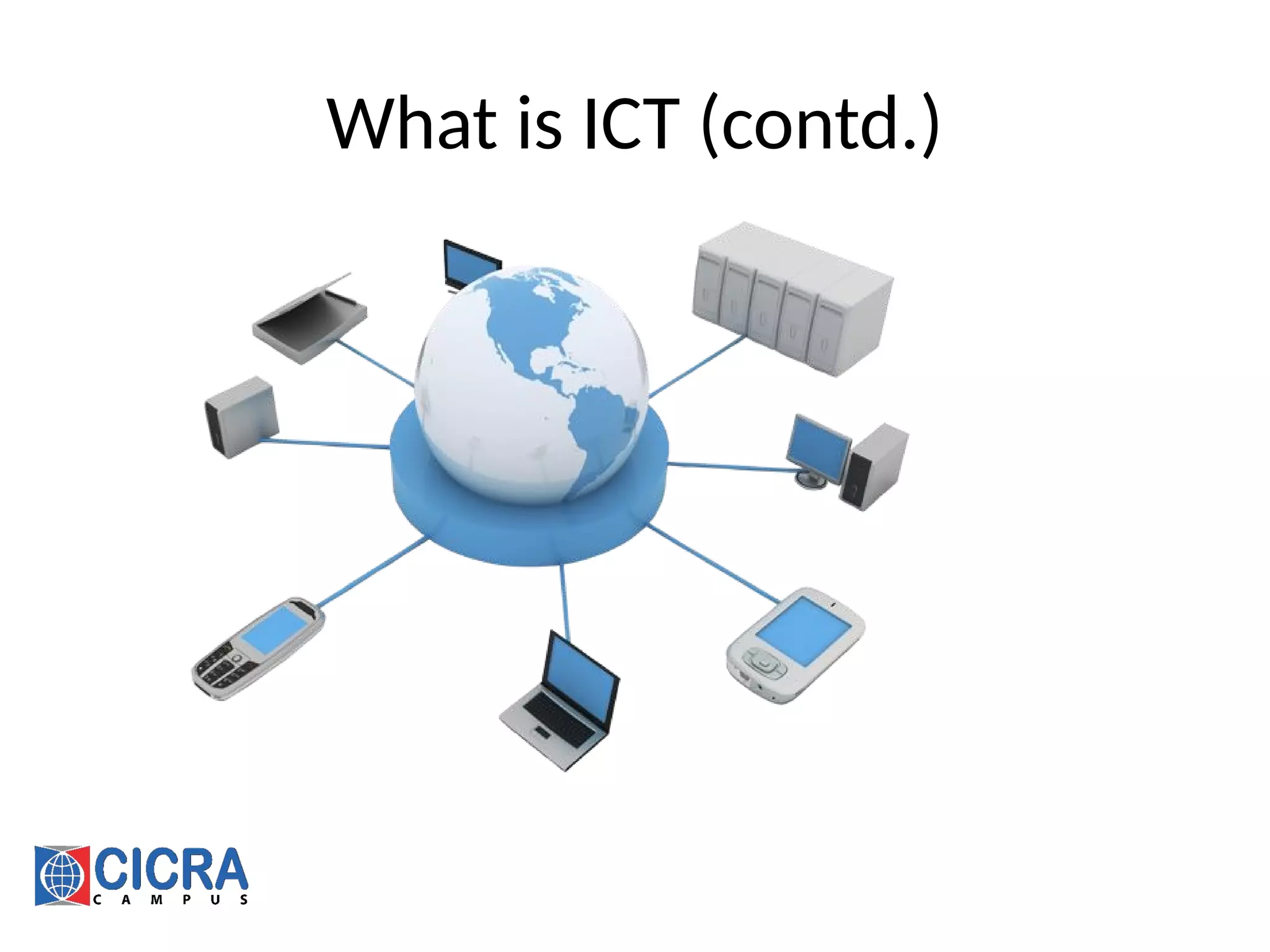
In order to achieve, Communication of Information, we need the
help of Hardware, Software and Human Interaction.
• Hardware – All physical items, equipment and
apparatus related to information processing
• Software – All programmed systems using
programming languages
• Human Interaction – People who are engaged
in Communication of Information.
What is ICT (contd.)
History of Computers
Simple Animation
History of ICT (Past)

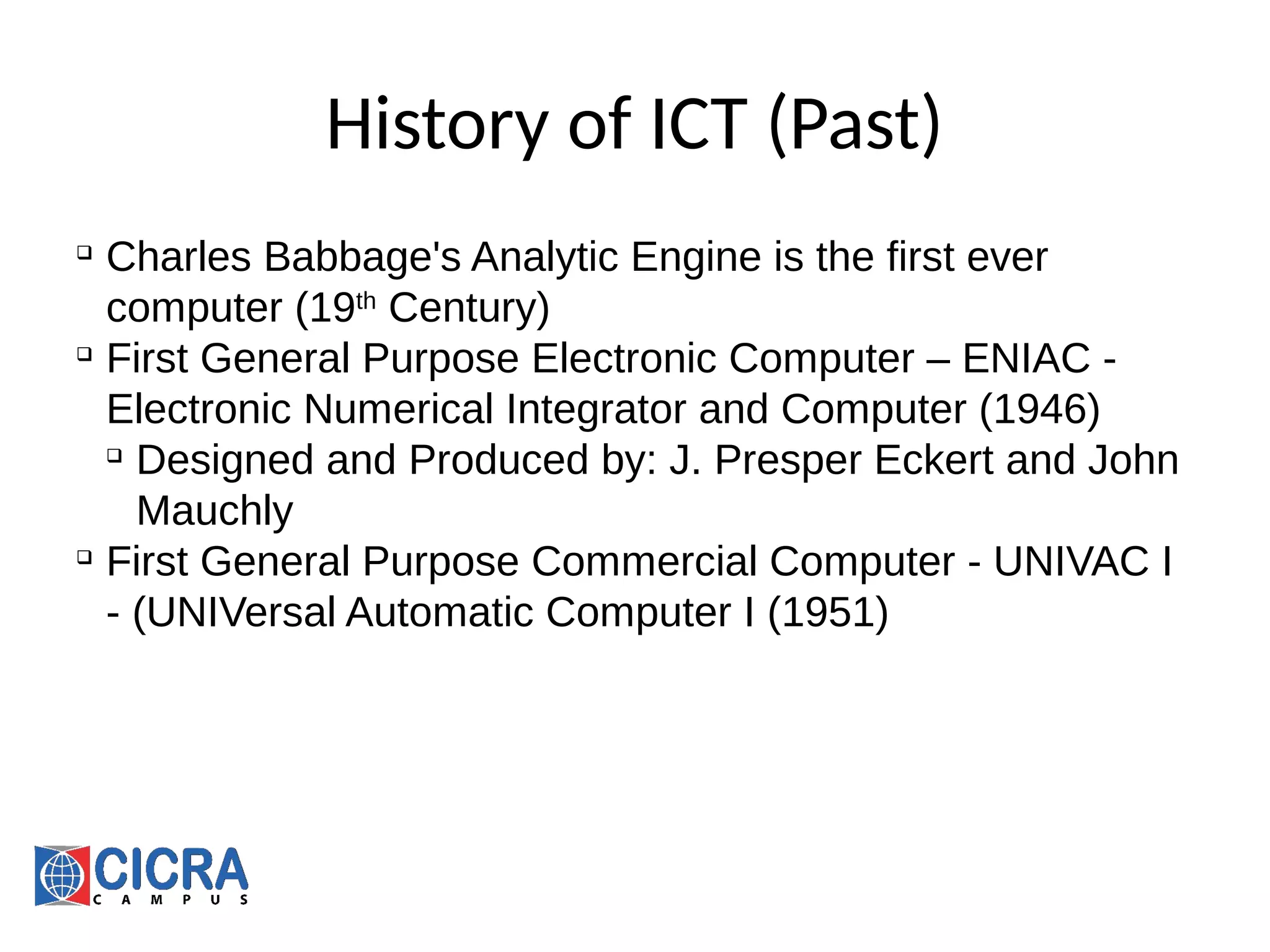
Charles Babbage's Analytic Engine is the first ever
computer (19th
Century)

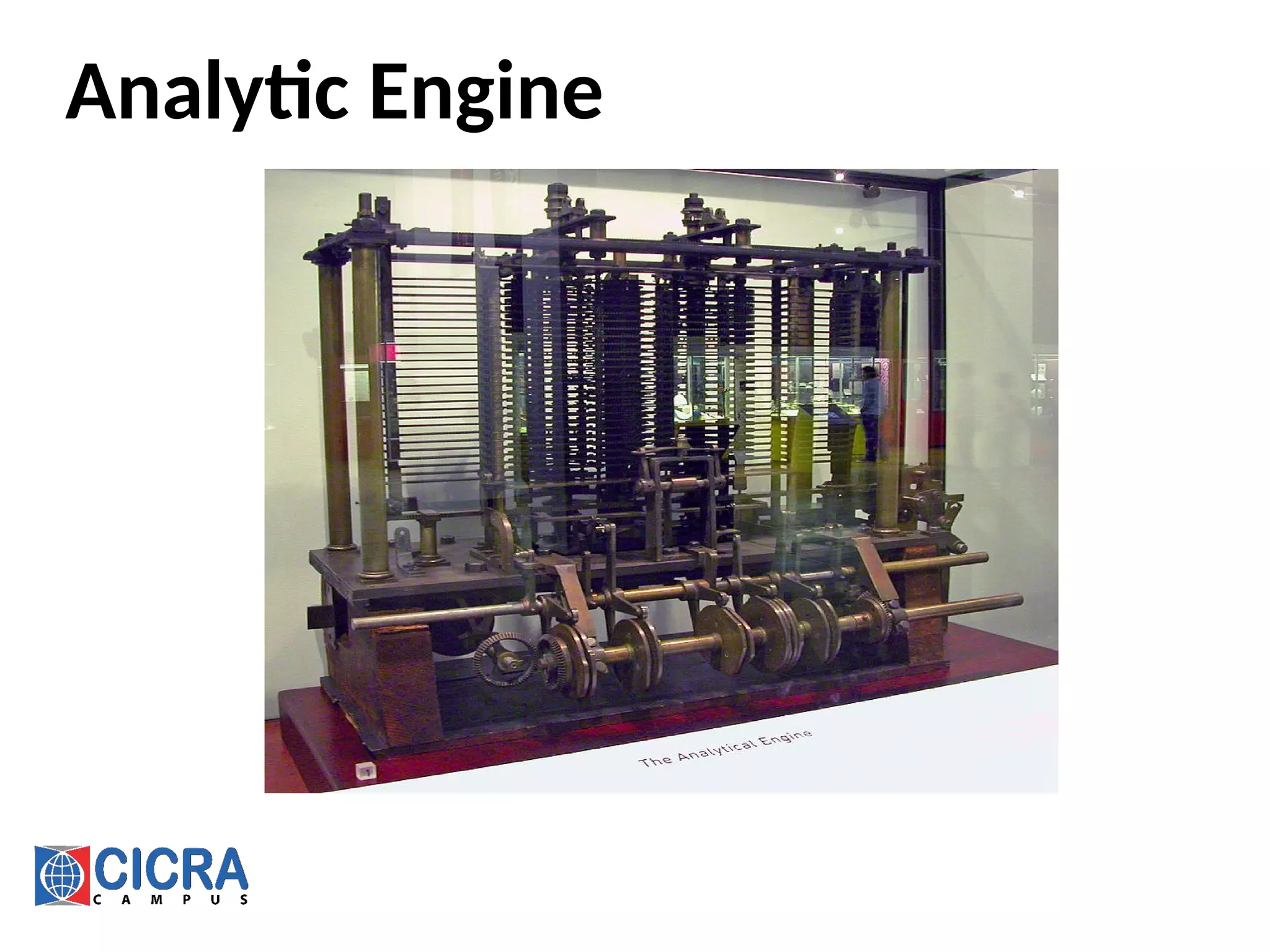
First General Purpose Electronic Computer – ENIAC -
Electronic Numerical Integrator and Computer (1946)

Designed and Produced by: J. Presper Eckert and John
Mauchly

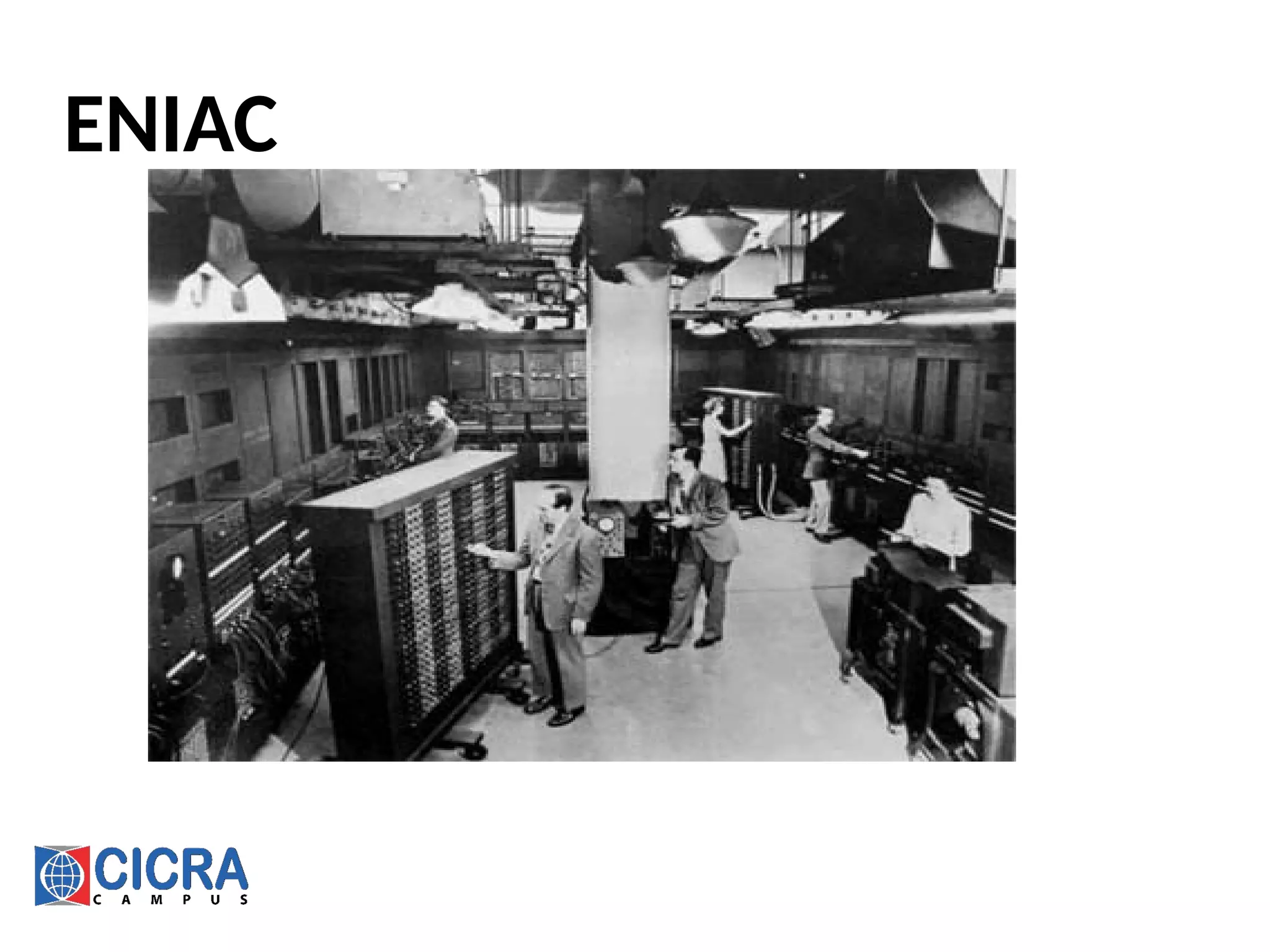
First General Purpose Commercial Computer - UNIVAC I
- (UNIVersal Automatic Computer I (1951)
Analytic Engine
ENIAC
UNIVAC
History of ICT (Past) – contd.
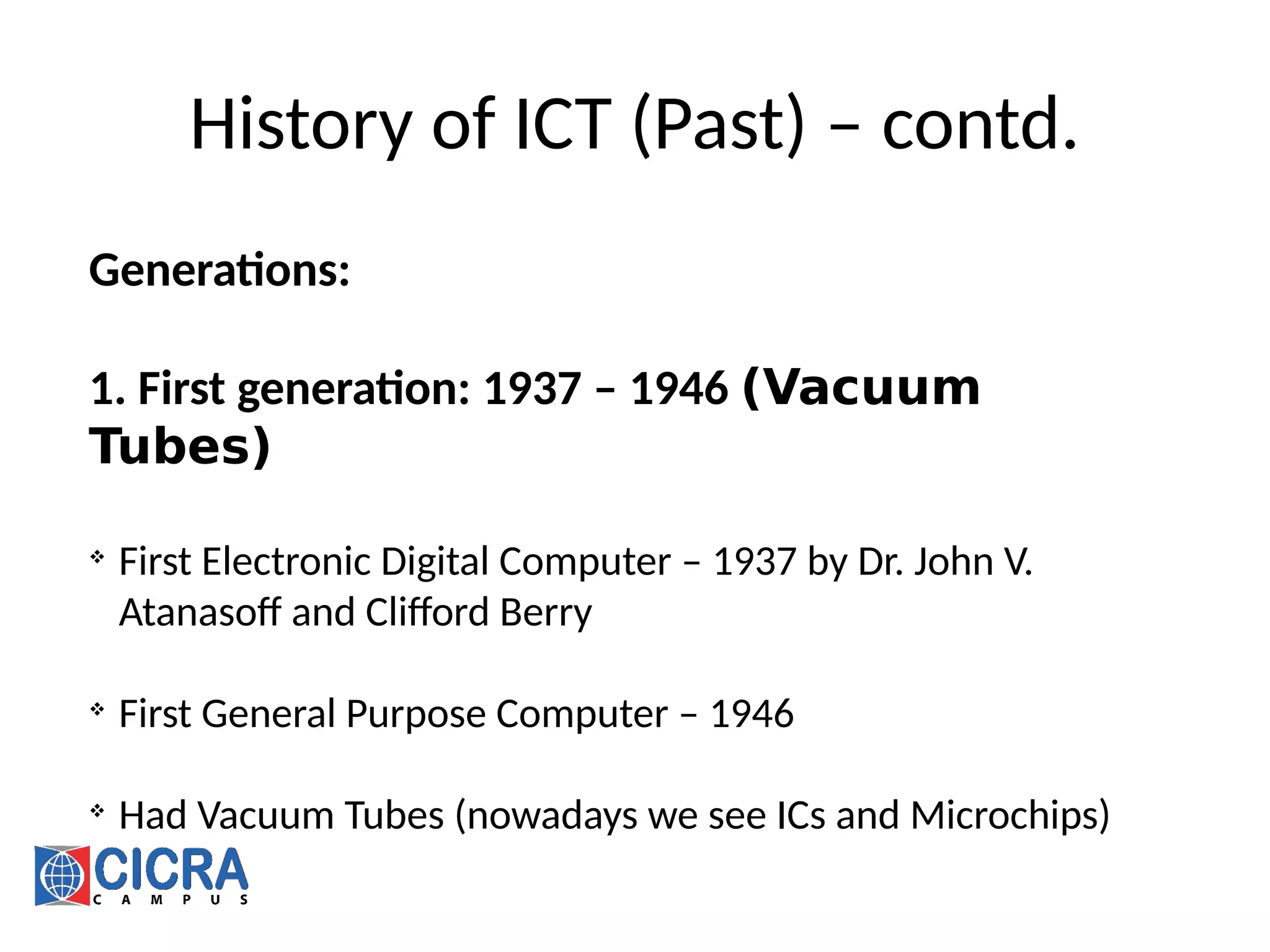
Generations:
1. First generation: 1937 – 1946 (Vacuum
Tubes)

First Electronic Digital Computer – 1937 by Dr. John V.
Atanasoff and Clifford Berry

First General Purpose Computer – 1946

Had Vacuum Tubes (nowadays we see ICs and Microchips)
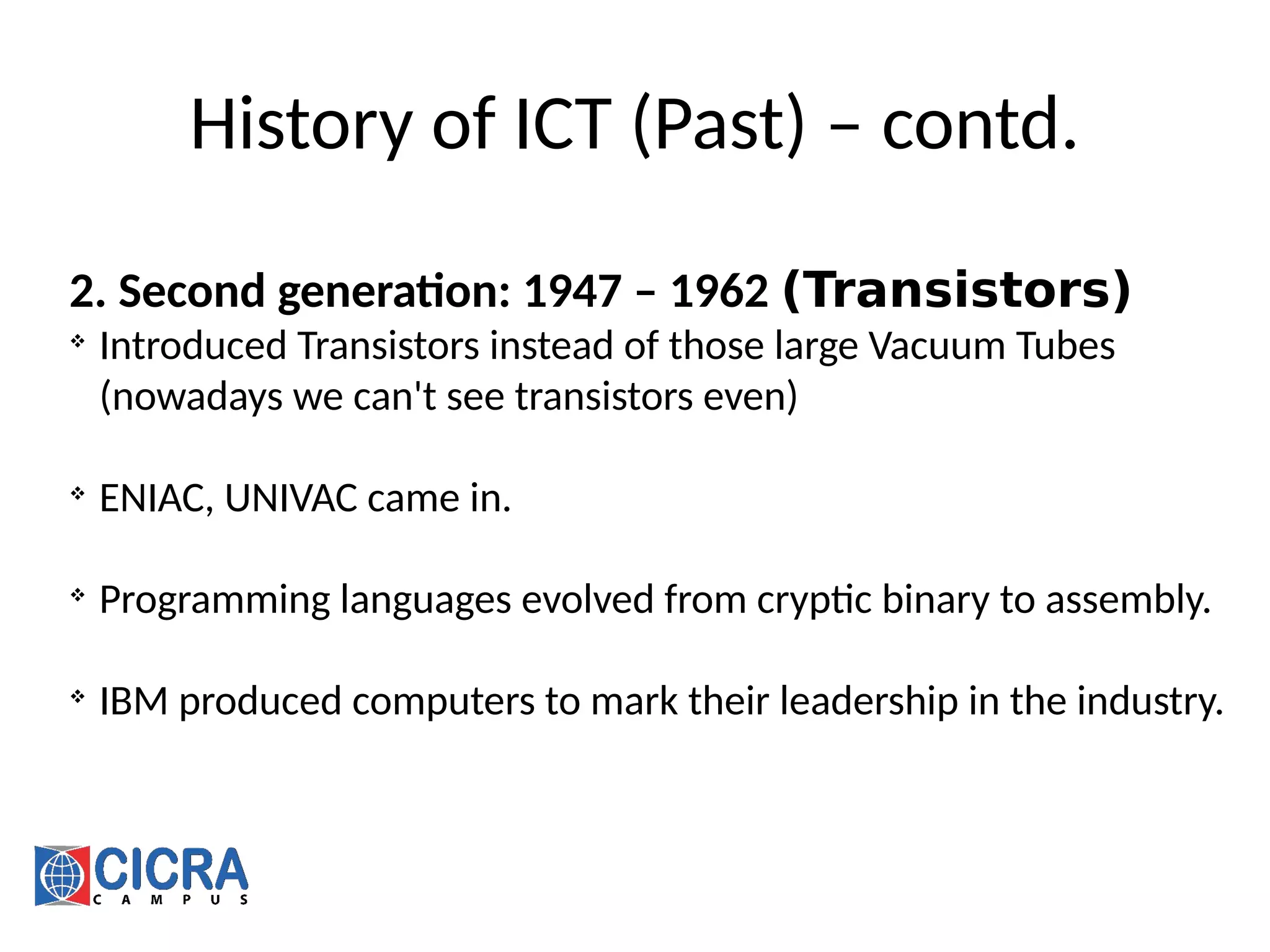
2. Second generation: 1947 – 1962 (Transistors)

Introduced Transistors instead of those large Vacuum Tubes
(nowadays we can't see transistors even)

ENIAC, UNIVAC came in.

Programming languages evolved from cryptic binary to assembly.

IBM produced computers to mark their leadership in the industry.
History of ICT (Past) – contd.
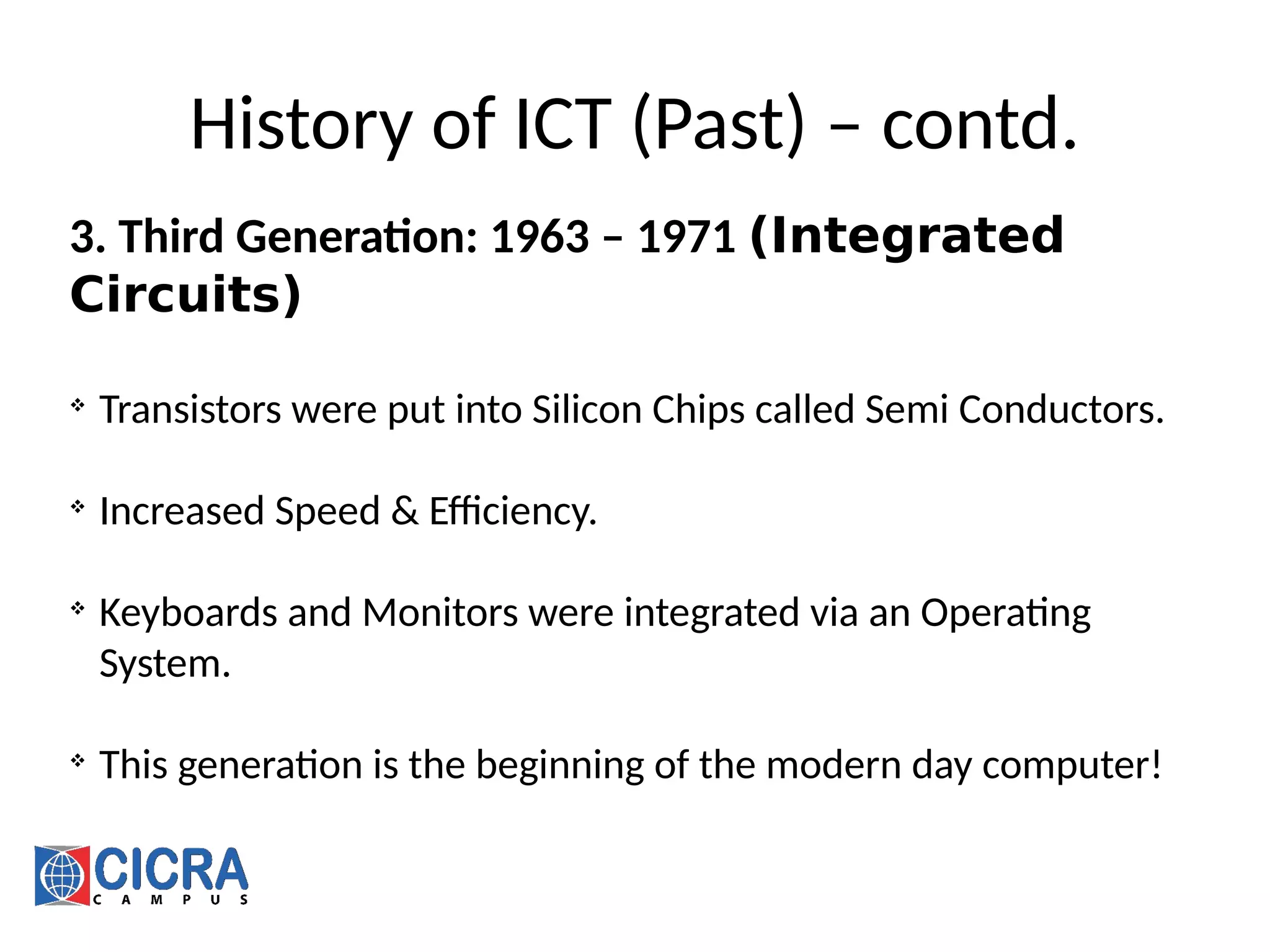
3. Third Generation: 1963 – 1971 (Integrated
Circuits)

Transistors were put into Silicon Chips called Semi Conductors.

Increased Speed & Efficiency.

Keyboards and Monitors were integrated via an Operating
System.

This generation is the beginning of the modern day computer!
History of ICT (Past) – contd.
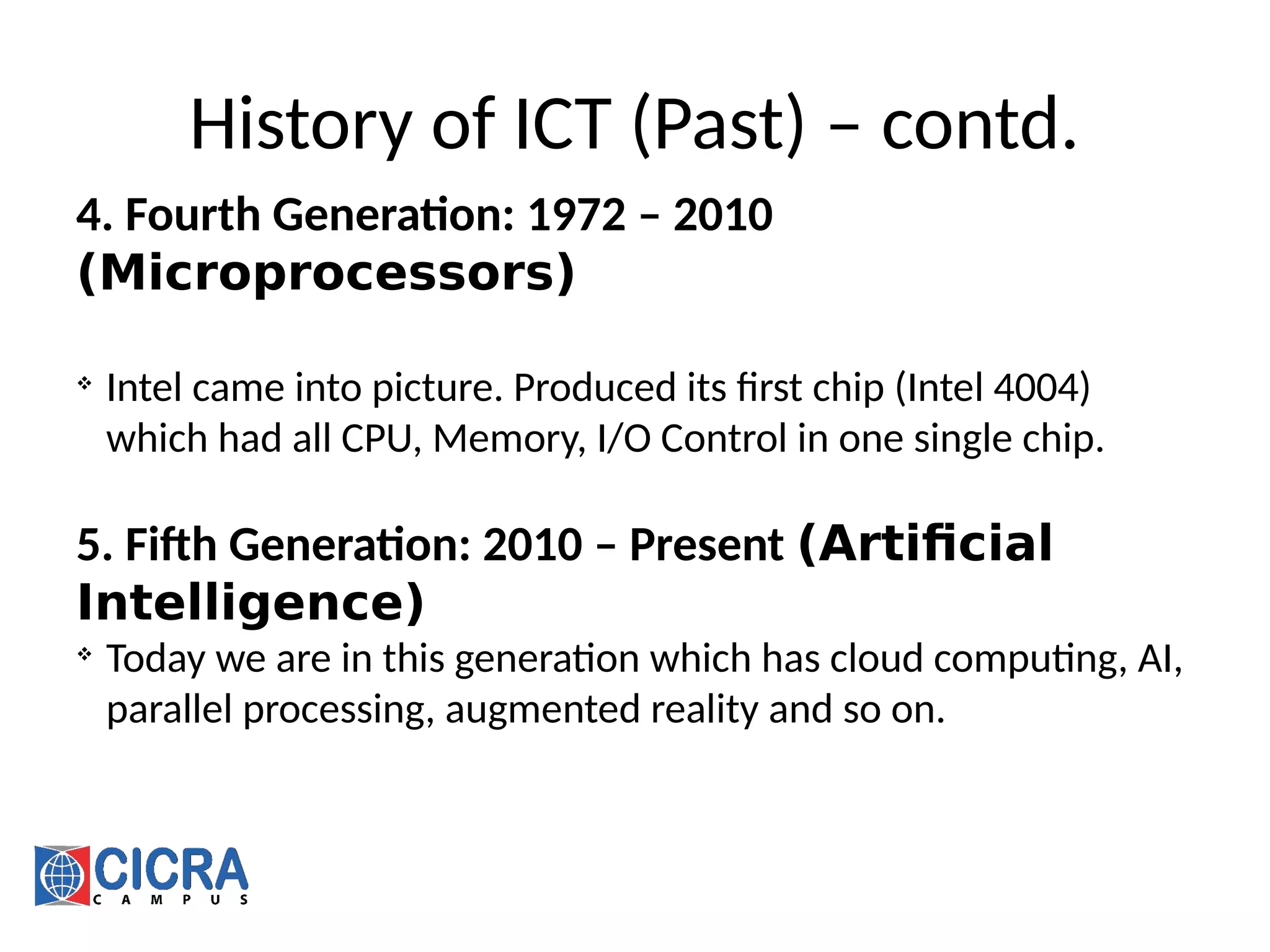
4. Fourth Generation: 1972 – 2010
(Microprocessors)

Intel came into picture. Produced its first chip (Intel 4004)
which had all CPU, Memory, I/O Control in one single chip.
5. Fifth Generation: 2010 – Present (Artificial
Intelligence)

Today we are in this generation which has cloud computing, AI,
parallel processing, augmented reality and so on.

As you already know and as you are a part of the present state,
no need to mention the backbone of the contemporary state is
the WWW (or what we call as the Internet)

Everyone who involves with ICT (the ICT community) is
part and parcel of the Internet.

Cloud computing has become a huge boost. (According
to IBM, Cloud Computing means Computing as a Service
over the Internet (SaaS, PaaS, IaaS)
Present state of ICT
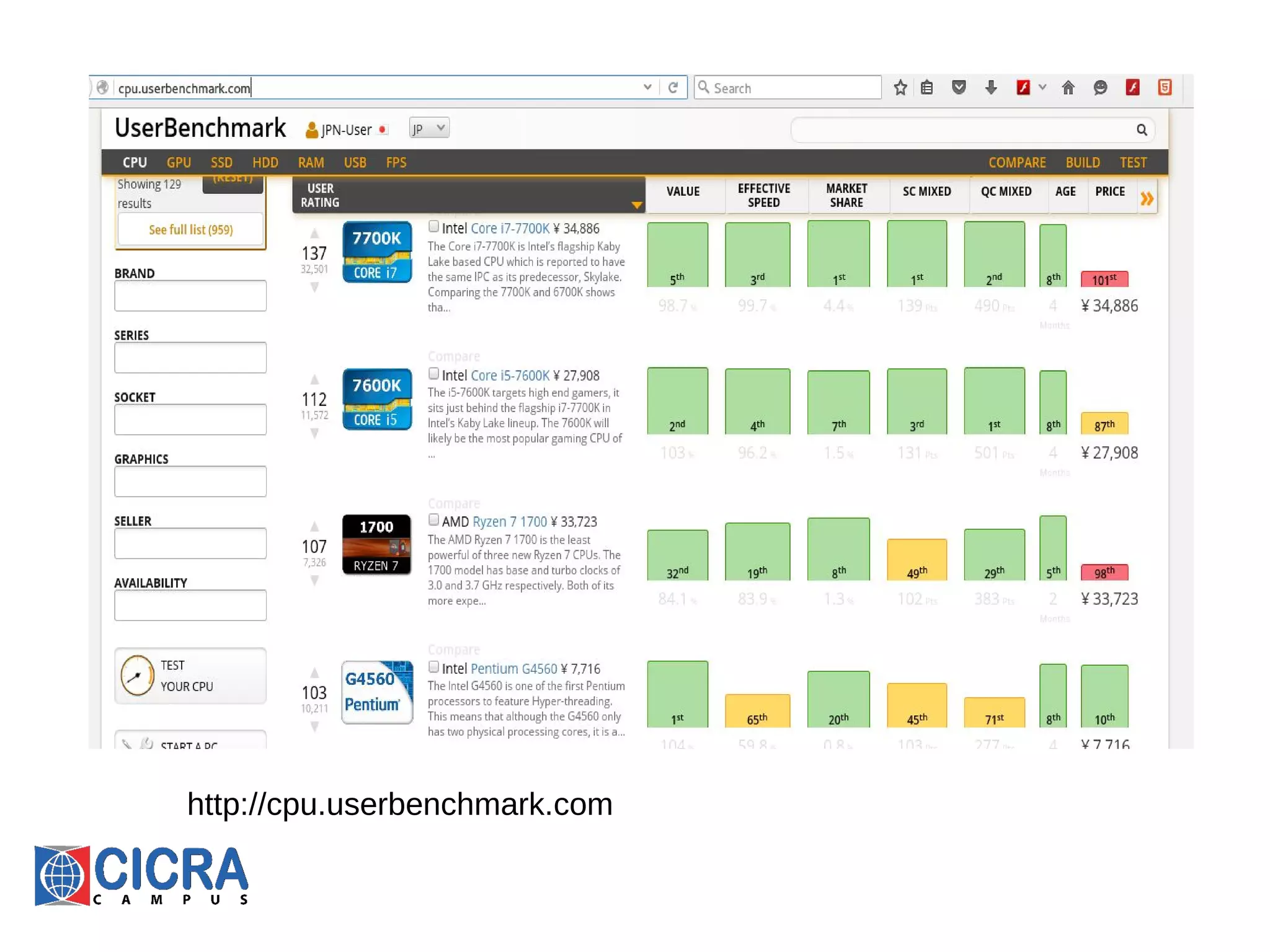
http://cpu.userbenchmark.com
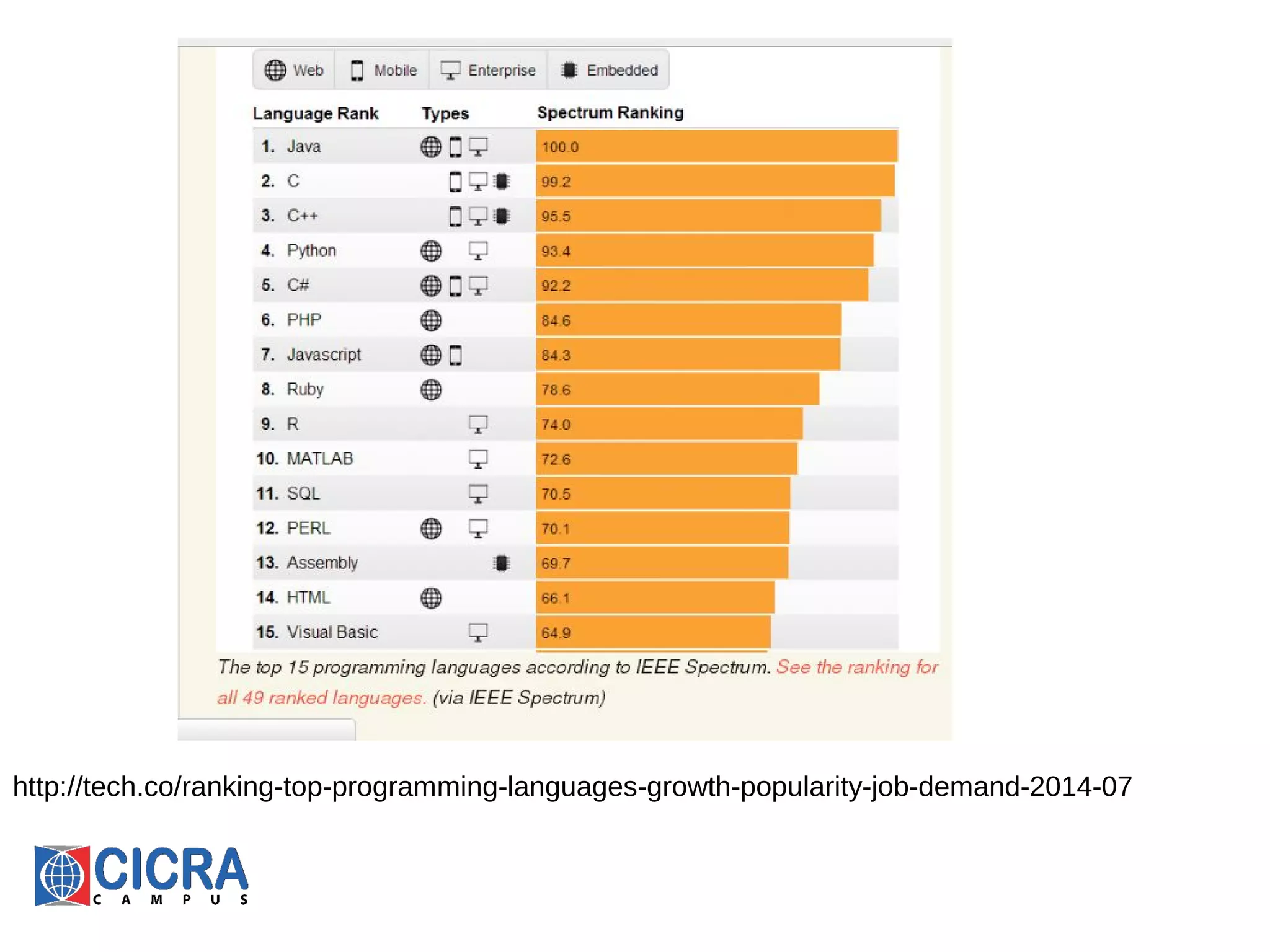
http://tech.co/ranking-top-programming-languages-growth-popularity-job-demand-2014-07
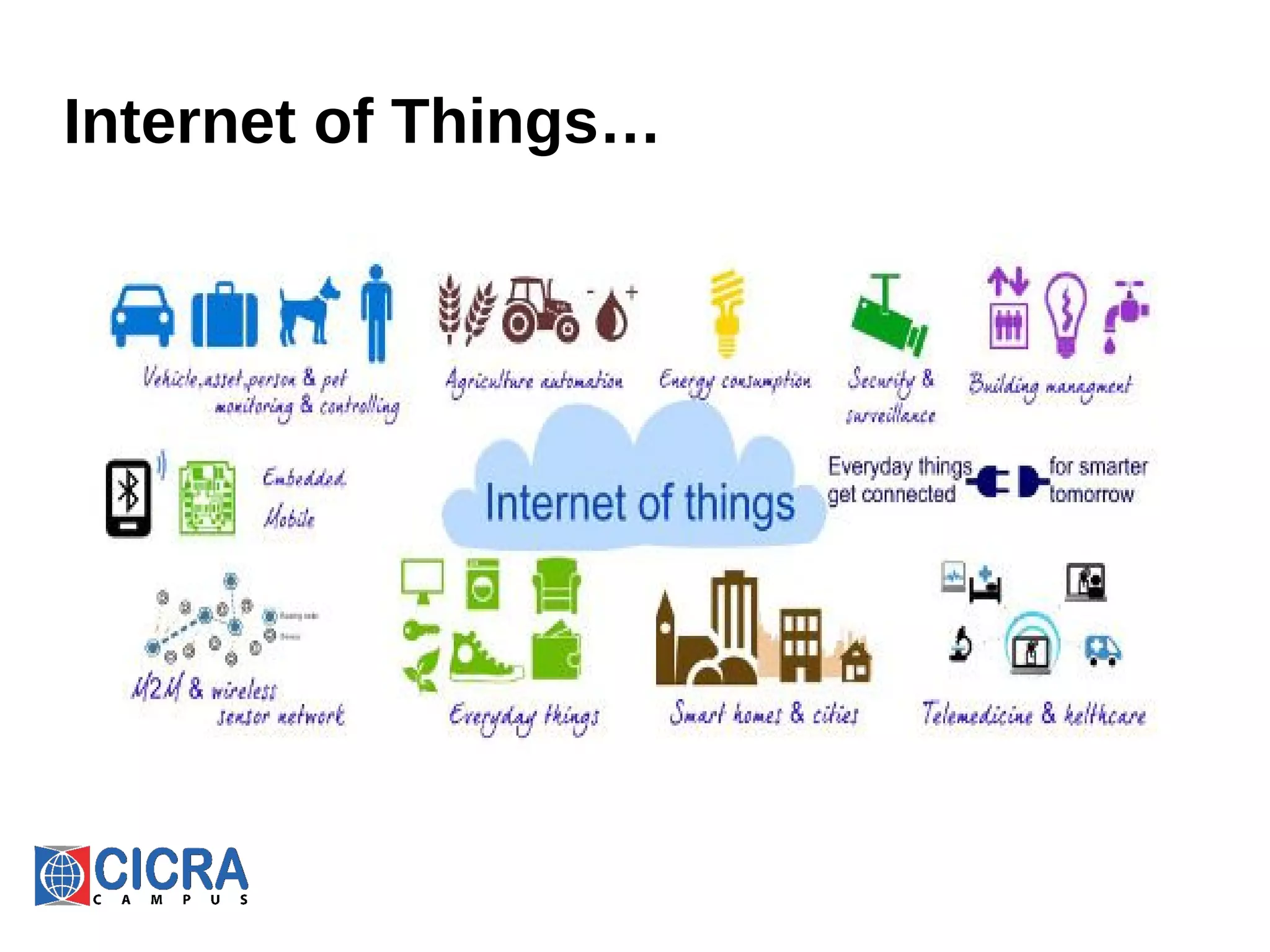
Internet of Things…
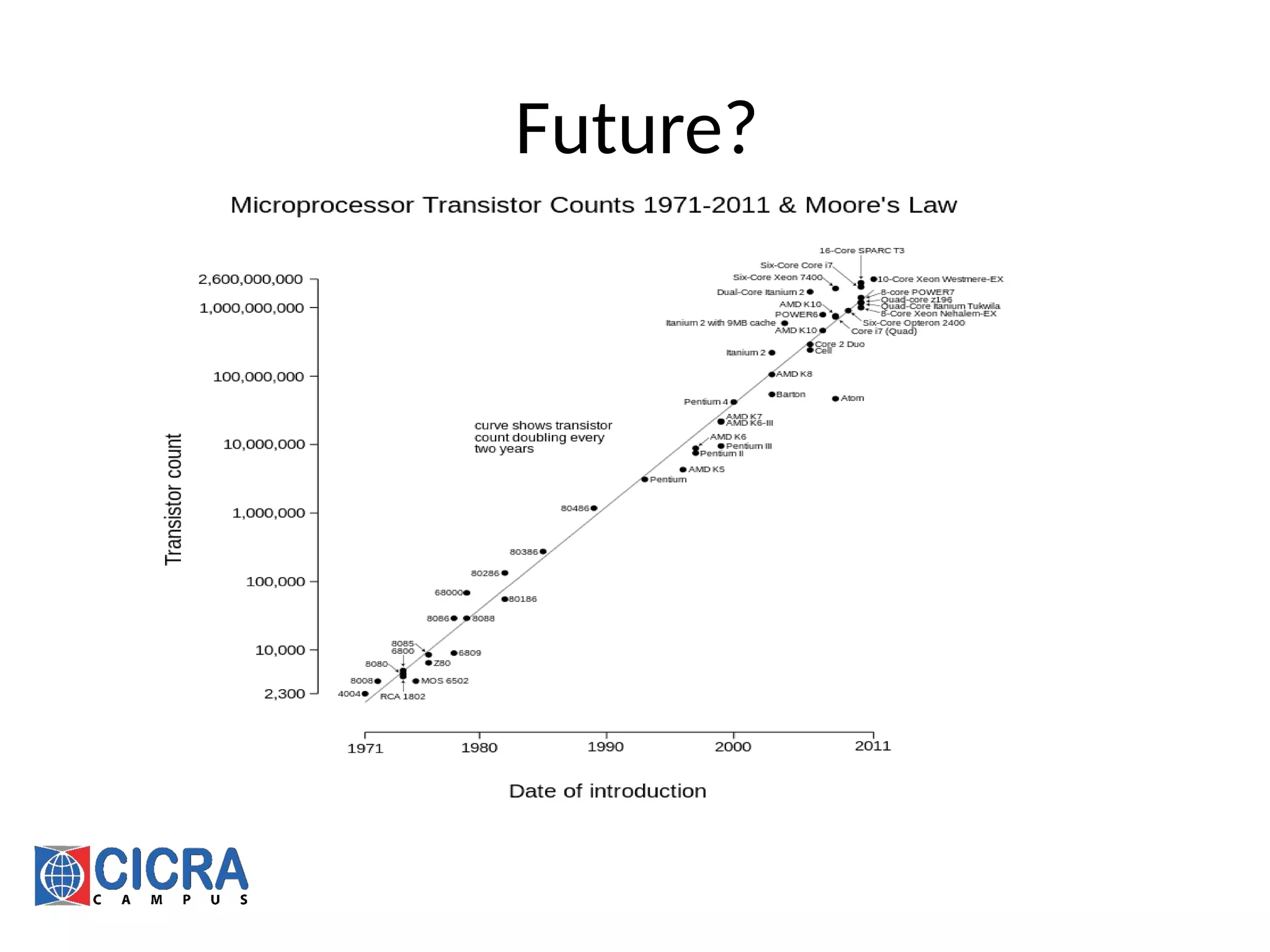
Future?
Virtual Reality
Augmented Reality
Intel’s Wireless
Future Perceptual
Computing
Wall Computing
Smartphones as PCs
WHAT YOU SHOULD DO?
• You have selected a highly competitive but
highly demanding career path(s).
• You need to be focus and vocal.
• Learn the basics and theories well.
• All must learn one programming language very
well.
Software Engineering (System Designing, Programming,
QA Testing, Business Analysis, Project Managing)
Network Engineering (Design, Implement, Troubleshoot)
Embedded System Designing and Implementing
UI/UX/Graphic Designing
Computer Security and Forensics
Careers in ICT
Career Paths in IT
Sample Video
References – Mentioned with Thanks
[1] https://en.wikipedia.org/wiki/Information_and_communications_technology
[2] http://people.bu.edu/baws/brief%20computer%20history.html
[3] https://en.wikipedia.org/wiki/Analytical_Engine
[4] http://www.pimall.com/nais/pivintage/enic.html
[5] https://en.wikipedia.org/wiki/ENIAC
[6] https://en.wikipedia.org/wiki/UNIVAC_I
[7] https://www.ibm.com/cloud-computing/learn-more/what-is-cloud-computing/
[8]http://cpu.userbenchmark.com/
[9] http://spectrum.ieee.org/computing/software/the-2016-top-programming-languages
[10] http://btob.co.nz/business-news/five-generations-computers/
[11] http://computer.howstuffworks.com/augmented-reality.htm
[12] http://www.pcworld.com/article/2988179/computers/10-enthralling-visions-for-the-future-of-
computing.html

Introduction to ICT

  • 1.
    Introduction to ICTSystems CICRA Pathway to Deakin Degree Professional Diploma in Network and Systems Administration Tharindu Weerasinghe www.tharinduweerasinghe.com
  • 2.
    Overview of theFirst Lecture •Course Overview •What is ICT? •Past, Present and Future of ICT •Choosing a Career in ICT
  • 3.
    Course Overview • Introductionto ICT [4 hours] – This lecture • ICT Infrastructure [8 hours] • Maths Behind IT [2 hours] • Internet and Web [4 hours] • Software Engineering [4 hours] • Data and Databases [4 hours] • Graphics and Video Games [2 hours] • Social Media [ 2 hours] • Mobile Computing [2 hours] • Security and Forensics [2 hours] • Digital and Information Literacy [2 hours] • ICT Policies and Governance [1 hour] • Ethics in IT [1 hour]
  • 4.
    What is ICT? •Information – Data • Communication – Transmitting and Receiving • Technology – Mechanisms and Techniques • So, ICT - The phenomenon of Data Transmitting and Receiving with the help of specified Mechanisms and Techniques. (This is my explanation)
  • 5.
    What is ICT?(contd.) • What does the WIKI says ? [https://en.wikipedia.org/wiki/Information_and_commun ications_technology] Information and communication technology (ICT) is an extended term for information technology (IT) which stresses the role of unified communications and the integration of telecommunications (telephone lines and wireless signals), computers as well as necessary enterprise software, middleware, storage, and audio-visual systems, which enable users to access, store, transmit, and manipulate information • Further the website says, “However, ICT has no universal definition, as "the concepts, methods and applications involved in ICT are constantly evolving on an almost daily basis"
  • 6.
    What is ICT?(contd.) Mainaspects of ICT… Again this is my point of view after evaluating the ICT world. 1.People 2.Data 3.Data processing 4.Transmitting and Receiving
  • 7.
    What is ICT?(contd.) • This course is designed in a way that you will get an overall idea what ICT is… • There are many components and you need to study and those components are well set in order to start your journey with ICT
  • 8.
    In order toachieve, Communication of Information, we need the help of Hardware, Software and Human Interaction. • Hardware – All physical items, equipment and apparatus related to information processing • Software – All programmed systems using programming languages • Human Interaction – People who are engaged in Communication of Information. What is ICT (contd.)
  • 9.
    What is ICT(contd.)
  • 10.
  • 11.
    History of ICT(Past)  Charles Babbage's Analytic Engine is the first ever computer (19th Century)  First General Purpose Electronic Computer – ENIAC - Electronic Numerical Integrator and Computer (1946)  Designed and Produced by: J. Presper Eckert and John Mauchly  First General Purpose Commercial Computer - UNIVAC I - (UNIVersal Automatic Computer I (1951)
  • 12.
  • 13.
  • 14.
  • 15.
    History of ICT(Past) – contd. Generations: 1. First generation: 1937 – 1946 (Vacuum Tubes)  First Electronic Digital Computer – 1937 by Dr. John V. Atanasoff and Clifford Berry  First General Purpose Computer – 1946  Had Vacuum Tubes (nowadays we see ICs and Microchips)
  • 16.
    2. Second generation:1947 – 1962 (Transistors)  Introduced Transistors instead of those large Vacuum Tubes (nowadays we can't see transistors even)  ENIAC, UNIVAC came in.  Programming languages evolved from cryptic binary to assembly.  IBM produced computers to mark their leadership in the industry. History of ICT (Past) – contd.
  • 17.
    History of ICT(Past) – contd. 3. Third Generation: 1963 – 1971 (Integrated Circuits)  Transistors were put into Silicon Chips called Semi Conductors.  Increased Speed & Efficiency.  Keyboards and Monitors were integrated via an Operating System.  This generation is the beginning of the modern day computer!
  • 18.
    History of ICT(Past) – contd. 4. Fourth Generation: 1972 – 2010 (Microprocessors)  Intel came into picture. Produced its first chip (Intel 4004) which had all CPU, Memory, I/O Control in one single chip. 5. Fifth Generation: 2010 – Present (Artificial Intelligence)  Today we are in this generation which has cloud computing, AI, parallel processing, augmented reality and so on.
  • 20.
     As you alreadyknow and as you are a part of the present state, no need to mention the backbone of the contemporary state is the WWW (or what we call as the Internet)  Everyone who involves with ICT (the ICT community) is part and parcel of the Internet.  Cloud computing has become a huge boost. (According to IBM, Cloud Computing means Computing as a Service over the Internet (SaaS, PaaS, IaaS) Present state of ICT
  • 21.
  • 22.
  • 23.
  • 24.
  • 25.
    Virtual Reality Augmented Reality Intel’sWireless Future Perceptual Computing Wall Computing Smartphones as PCs
  • 26.
    WHAT YOU SHOULDDO? • You have selected a highly competitive but highly demanding career path(s). • You need to be focus and vocal. • Learn the basics and theories well. • All must learn one programming language very well.
  • 27.
    Software Engineering (SystemDesigning, Programming, QA Testing, Business Analysis, Project Managing) Network Engineering (Design, Implement, Troubleshoot) Embedded System Designing and Implementing UI/UX/Graphic Designing Computer Security and Forensics Careers in ICT
  • 28.
    Career Paths inIT Sample Video
  • 29.
    References – Mentionedwith Thanks [1] https://en.wikipedia.org/wiki/Information_and_communications_technology [2] http://people.bu.edu/baws/brief%20computer%20history.html [3] https://en.wikipedia.org/wiki/Analytical_Engine [4] http://www.pimall.com/nais/pivintage/enic.html [5] https://en.wikipedia.org/wiki/ENIAC [6] https://en.wikipedia.org/wiki/UNIVAC_I [7] https://www.ibm.com/cloud-computing/learn-more/what-is-cloud-computing/ [8]http://cpu.userbenchmark.com/ [9] http://spectrum.ieee.org/computing/software/the-2016-top-programming-languages [10] http://btob.co.nz/business-news/five-generations-computers/ [11] http://computer.howstuffworks.com/augmented-reality.htm [12] http://www.pcworld.com/article/2988179/computers/10-enthralling-visions-for-the-future-of- computing.html