Snap . Post . Get Answer .
“ Your 24/7 HomeWork Assistant ”
The Singapore Math Model Method
Prepared by:
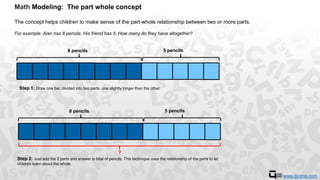
Math Modeling: The part whole concept
The concept helps children to make sense of the part-whole relationship between two or more parts.
For example: Alan has 8 pencils. His friend has 5. How many do they have altogether?
Step 1: Draw one bar, divided into two parts, one slightly longer than the other.
8 pencils 5 pencils
?
Step 2: Just add the 2 parts and answer is total of pencils. This technique uses the relationship of the parts to let
children learn about the whole.
8 pencils 5 pencils
www.goqna.com
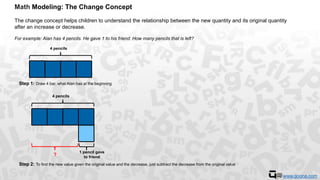
Math Modeling: The Change Concept
Step 1: Draw 4 bar, what Alan has at the beginning
4 pencils
?
Step 2: To find the new value given the original value and the decrease, just subtract the decrease from the original value
The change concept helps children to understand the relationship between the new quantity and its original quantity
after an increase or decrease.
For example: Alan has 4 pencils. He gave 1 to his friend. How many pencils that is left?
4 pencils
1 pencil gave
to friend
www.goqna.com
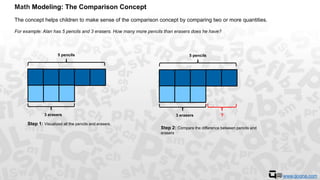
Math Modeling: The Comparison Concept
The concept helps children to make sense of the comparison concept by comparing two or more quantities.
For example: Alan has 5 pencils and 3 erasers. How many more pencils than erasers does he have?
Step 1: Visualized all the pencils and erasers
?3 erasers
5 pencils
3 erasers
5 pencils
Step 2: Compare the difference between pencils and
erasers
www.goqna.com
Applying math models: Learning Fractions
Fractions can be represented using the part whole concept. For the purpose of illustration, let’s solve the following
problem sum on fractions.
For example: “Alan is selling pencils. He sold 3/5 of them in the morning and 1/4 of the remainder in the afternoon. If Alan sold 200
more pencils in the morning than in the afternoon, how many pencils did Alan have in the beginning?”
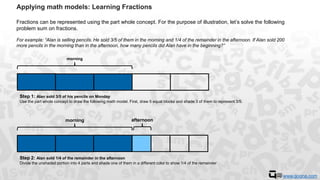
Step 1: Alan sold 3/5 of his pencils on Monday
Use the part whole concept to draw the following math model. First, draw 5 equal blocks and shade 3 of them to represent 3/5.
morning
Step 2: Alan sold 1/4 of the remainder in the afternoon
Divide the unshaded portion into 4 parts and shade one of them in a different color to show 1/4 of the remainder
morning afternoon
www.goqna.com
morning
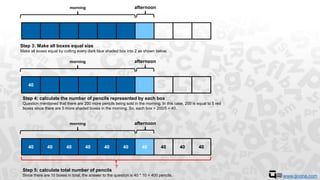
Step 4: calculate the number of pencils represented by each box
Question mentioned that there are 200 more pencils being sold in the morning. In this case, 200 is equal to 5 red
boxes since there are 5 more shaded boxes in the morning. So, each box = 200/5 = 40.
Step 3: Make all boxes equal size
Make all boxes equal by cutting every dark blue shaded box into 2 as shown below.
afternoon
morning
40
afternoon
Step 5: calculate total number of pencils
Since there are 10 boxes in total, the answer to the question is 40 * 10 = 400 pencils.
morning
40 40 40 4040 40 40 40 40 40
afternoon
?
www.goqna.com
Applying math models: Learning Ratios
For learning ratios, either the part whole concept or the change concept can be use. In the example here, let’s try
change concept
For example: “The ratio of Alan and Sandy’s money is 5:3. After Alan spent half of his money, he had $10 less than Sandy. What was
the total amount of money that both of them had in the beginning?”
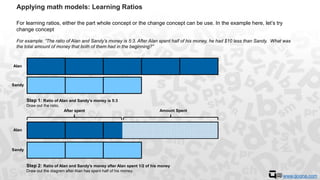
Step 1: Ratio of Alan and Sandy’s money is 5:3
Draw out the ratio.
Alan
Sandy
Step 2: Ratio of Alan and Sandy’s money after Alan spent 1/2 of his money
Draw out the diagram after Alan has spent half of his money.
Alan
Sandy
After spent Amount Spent
www.goqna.com
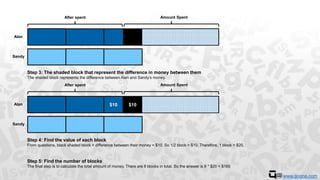
Step 3: The shaded block that represent the difference in money between them
The shaded block represents the difference between Alan and Sandy’s money.
Alan
Sandy
After spent Amount Spent
Step 4: Find the value of each block
From questions, black shaded block = difference between their money = $10. So 1/2 block = $10. Therefore, 1 block = $20.
Alan $10
Sandy
After spent Amount Spent
$10
Step 5: Find the number of blocks
The final step is to calculate the total amount of money. There are 8 blocks in total. So the answer is 8 * $20 = $160
www.goqna.com

Singapore Math Model Method

  • 1.
    Snap . Post. Get Answer . “ Your 24/7 HomeWork Assistant ” The Singapore Math Model Method Prepared by:
  • 2.
    Math Modeling: Thepart whole concept The concept helps children to make sense of the part-whole relationship between two or more parts. For example: Alan has 8 pencils. His friend has 5. How many do they have altogether? Step 1: Draw one bar, divided into two parts, one slightly longer than the other. 8 pencils 5 pencils ? Step 2: Just add the 2 parts and answer is total of pencils. This technique uses the relationship of the parts to let children learn about the whole. 8 pencils 5 pencils www.goqna.com
  • 3.
    Math Modeling: TheChange Concept Step 1: Draw 4 bar, what Alan has at the beginning 4 pencils ? Step 2: To find the new value given the original value and the decrease, just subtract the decrease from the original value The change concept helps children to understand the relationship between the new quantity and its original quantity after an increase or decrease. For example: Alan has 4 pencils. He gave 1 to his friend. How many pencils that is left? 4 pencils 1 pencil gave to friend www.goqna.com
  • 4.
    Math Modeling: TheComparison Concept The concept helps children to make sense of the comparison concept by comparing two or more quantities. For example: Alan has 5 pencils and 3 erasers. How many more pencils than erasers does he have? Step 1: Visualized all the pencils and erasers ?3 erasers 5 pencils 3 erasers 5 pencils Step 2: Compare the difference between pencils and erasers www.goqna.com
  • 5.
    Applying math models:Learning Fractions Fractions can be represented using the part whole concept. For the purpose of illustration, let’s solve the following problem sum on fractions. For example: “Alan is selling pencils. He sold 3/5 of them in the morning and 1/4 of the remainder in the afternoon. If Alan sold 200 more pencils in the morning than in the afternoon, how many pencils did Alan have in the beginning?” Step 1: Alan sold 3/5 of his pencils on Monday Use the part whole concept to draw the following math model. First, draw 5 equal blocks and shade 3 of them to represent 3/5. morning Step 2: Alan sold 1/4 of the remainder in the afternoon Divide the unshaded portion into 4 parts and shade one of them in a different color to show 1/4 of the remainder morning afternoon www.goqna.com
  • 6.
    morning Step 4: calculatethe number of pencils represented by each box Question mentioned that there are 200 more pencils being sold in the morning. In this case, 200 is equal to 5 red boxes since there are 5 more shaded boxes in the morning. So, each box = 200/5 = 40. Step 3: Make all boxes equal size Make all boxes equal by cutting every dark blue shaded box into 2 as shown below. afternoon morning 40 afternoon Step 5: calculate total number of pencils Since there are 10 boxes in total, the answer to the question is 40 * 10 = 400 pencils. morning 40 40 40 4040 40 40 40 40 40 afternoon ? www.goqna.com
  • 7.
    Applying math models:Learning Ratios For learning ratios, either the part whole concept or the change concept can be use. In the example here, let’s try change concept For example: “The ratio of Alan and Sandy’s money is 5:3. After Alan spent half of his money, he had $10 less than Sandy. What was the total amount of money that both of them had in the beginning?” Step 1: Ratio of Alan and Sandy’s money is 5:3 Draw out the ratio. Alan Sandy Step 2: Ratio of Alan and Sandy’s money after Alan spent 1/2 of his money Draw out the diagram after Alan has spent half of his money. Alan Sandy After spent Amount Spent www.goqna.com
  • 8.
    Step 3: Theshaded block that represent the difference in money between them The shaded block represents the difference between Alan and Sandy’s money. Alan Sandy After spent Amount Spent Step 4: Find the value of each block From questions, black shaded block = difference between their money = $10. So 1/2 block = $10. Therefore, 1 block = $20. Alan $10 Sandy After spent Amount Spent $10 Step 5: Find the number of blocks The final step is to calculate the total amount of money. There are 8 blocks in total. So the answer is 8 * $20 = $160 www.goqna.com