Unit- I
FSC 1801
Introduction to Forensic Science
Forensic science: Development
and growth
What is Forensic Science?
• Many people, Many Definitions..
“forensic science is science used for the purpose of the law”
“relating to or dealing with the application of scientific
knowledge to legal problems” by Webster
• Various fields in Forensic Science
• Forensic Medicine
• Fingerprinting
• DNA Analysis
• Physical Evidence
• Documents
• Ballistics
• Drug Analysis
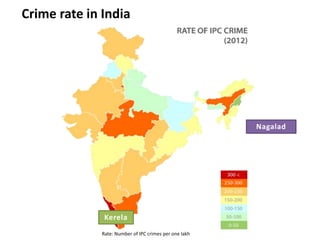
Crime rate in India
Rate: Number of IPC crimes per one lakh
Nagalad
Kerela
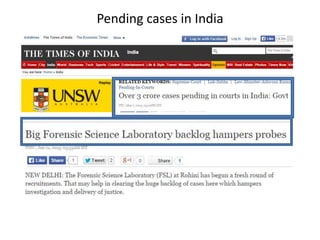
Pending cases in India
• Interpretation of Evidence
– How evidence can be interpreted
– Extent to which it can be relied upon
Scientist vs Forensic Scientist
• Scientist:
– Scientific paper
– Presentation in Conferences
• Forensic Scientist:
– Report to the court
– Convince the judge
– Withstand the cross examination
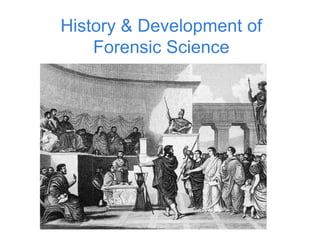
History & Development of
Forensic Science
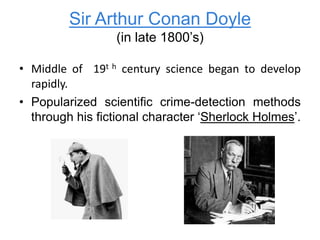
Sir Arthur Conan Doyle
(in late 1800’s)
• Middle of 19t h century science began to develop
rapidly.
• Popularized scientific crime-detection methods
through his fictional character ‘Sherlock Holmes’.
Mathieu Orfila
(1787-1853)
• “Father of Toxicology”
• Wrote about the detection
of poisons & their effects
on animals.
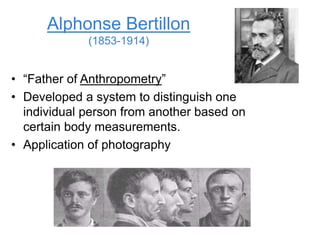
Alphonse Bertillon
(1853-1914)
• “Father of Anthropometry”
• Developed a system to distinguish one
individual person from another based on
certain body measurements.
• Application of photography
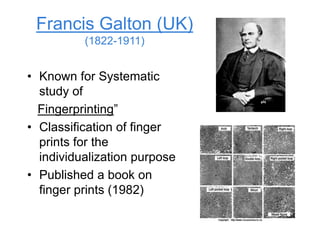
Francis Galton (UK)
(1822-1911)
• Known for Systematic
study of
Fingerprinting”
• Classification of finger
prints for the
individualization purpose
• Published a book on
finger prints (1982)
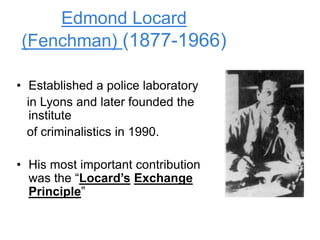
Edmond Locard
(Fenchman) (1877-1966)
• Established a police laboratory
in Lyons and later founded the
institute
of criminalistics in 1990.
• His most important contribution
was the “Locard’s Exchange
Principle”
Locard’s Exchange Principle
• “Every Contact Leaves a Trace.”
• He believed that every criminal can be connected to a
crime by particles carried from the crime scene.
• When a criminal comes in contact with an object or
person, a cross-transfer of evidence occurs.
Leone Lattes
(1887-1954)
• Bloodstain Identification”
• He developed a procedure for determining the
blood type.
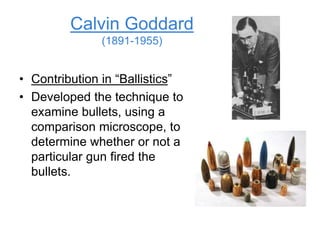
Calvin Goddard
(1891-1955)
• Contribution in “Ballistics”
• Developed the technique to
examine bullets, using a
comparison microscope, to
determine whether or not a
particular gun fired the
bullets.
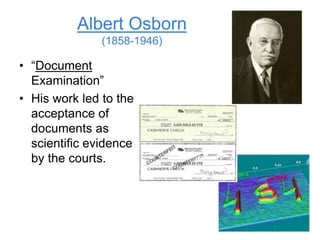
Albert Osborn
(1858-1946)
• “Document
Examination”
• His work led to the
acceptance of
documents as
scientific evidence
by the courts.
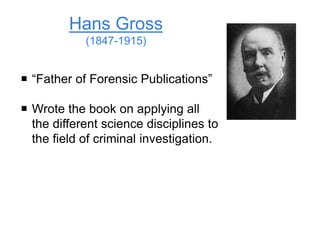
Hans Gross
(1847-1915)
 “Father of Forensic Publications”
 Wrote the book on applying all
the different science disciplines to
the field of criminal investigation.
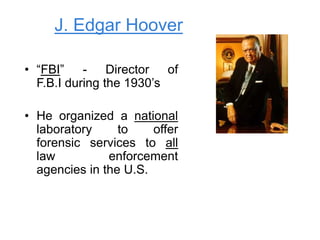
J. Edgar Hoover
• “FBI” - Director of
F.B.I during the 1930’s
• He organized a national
laboratory to offer
forensic services to all
law enforcement
agencies in the U.S.
History of Forensic Science
• The oldest forensic lab in united state is that of Los
Angles Police Department created in 1923.
• In 1932, FBI organized a national lab in country.
• Now FBI lab is now the world’s largest lab performing
over 1 million examination every years.
History and development in India
• Chemical examiner’s laboratories:
– The first Chemical Examiner’s Laboratory was set up in
Madras Presidency, 1849.
– Later, similar laboratories were set up at
Calcutta (1853), followed by one each at Agra (1864) and Bombay (1870
).
• Anthropometric bureau: It was established in 1892 at
Kolkatta.
o With the introduction of photography, the Criminal Investigation
o Department (CID) maintained records of every known criminal
including a detailed description of his appearance.
o With the invention of Bertillon’s anthropometric system in
1878, India, along with the other countries of the world
• Finger print bureau: The first fingerprint bureau in the
world was officially declared open at Calcutta in July 1897
• Department of explosives:
The foundation of the Department of Explosives was laid
when the first chief inspector of explosives was appointed in the
year 1898, with his headquarters at Nagpur.
Later, five regional offices at Calcutta, Bombay, Agra, Madras and
Gwalior, and three sub​offices at Shivkashi.
Gomia and Asallsol were opened
• Government examiner of questioned document, Shimla:
First it was opened in Bengal in 1904, later it was
shifted to Shimla in the year 1906.
 Serologist to the government of India:
FirstSerology Department’ was established in Calcutta in
1910 for the analysis of biological materials
 Footprint section:
During the year 1915, a Footprint Section was established unde
r the CID, Government of Bengal.
• Note forgery section:
During 1917, a Note Forgery Section was set up under the CID,
Government of Bengal to undertake the examination of
forged currency notes
 Ballistics laboratory:
In 1930, an Arms Expert was appointed and a small ballistic lab
oratory was set up under the Calcutta Police to
deal with the examination of firearms.
 Scientific sections:
During 1936, a Scientific Section was set up under the CID in B
engal and facilities were created for examination of bullets,
cartridge cases, firearms, etc., used in committing crime.
Few other states also started
scientific sections in their CID, where investigations
in fingerprints, footprints, firearms and questioned
documents were were also carried out.
Evolution of State FSL’s
First FSL---Calcutta (1952)
Medico-legal section of Chemical Examiner’s Laboratory, physics
Section, Foot print ans note forgery sections of CID was
transferred here, Chemistry Section of CEL was also transferred
here
Second FSL---Bombay (1958)
It has 5 regional labs at Nagpur, Aurangabad, Pune, Nasik, &
Amravati
CFSL and other Central Institutes
1. Central Finger Print Bureau: Established in 1905 in Shimla but
abolished in 1922. The CFPB restarted from 1955 in Delhi
under the purview of IB. In August 1956, it was shifted to
Calcutta. In Sept 1973 it was transferred to the CBI from IB. In
July 1986, it came under the purview of NCRB and was shifted
to ND.
2. Central Detective training School at Calcutta:
Was established in 1956 in Calcutta
3. CFSLs: First CFSL- Calcutta(1957)
Second CFSL-Hyderabad (1965)
Need of Forensic Science
• Factors for need of forensic science:
1. Social changes
2. Better facilities
3. Technical knowledge
4. Wide field
5. Better evidences
• Forensic science provides answer to the following three questions:
• 1. Has a crime been committed?
Consider the case of recovery of a dead body. Death could be
natural, accidental or homicidal. By ascertaining the nature of
death, it can be establish the existence or absence of corpus delicti.
• 2. How and when was the crime committed?
The examination of the corpus delicti reveals the way of the crime
was committed and possibly the time when it was committed.
• 3. Who has committed the crime?
Forensic science establishes the identity of the culprit through
personal clues like fingerprints, footprints, blood drops or hair. It
links the criminal with the crime through the objects that have been
left by him at the scene with the victim or which have been carried
from the scene by the victim.
Forensic science: Functions
The application of Forensic Science in the investigation of crime can
be effective only if the investigating officer (IO) knows:
1. Where it may be found.
2. How it is collected and packed.
3. What type of standard samples for comparison purposes
are necessary.
4. How much sample is required.
5. How the sampling is done.
6. How the packaging is done.
7. How the evidence will link with the crime and with the criminal.
8. This is possible only if IO is trained.
The application of Forensic Science at the crime
scene
• This is possible if the investigating officer is given a thorough
grounding in the above aspects.
• He needs both theoretical and practical training.
• Ignorance about the value of evidence sometimes causes a
lot of disappointment to an investigating officer.

FSC1801 Unit-1.pptx

  • 1.
    Unit- I FSC 1801 Introductionto Forensic Science Forensic science: Development and growth
  • 2.
    What is ForensicScience? • Many people, Many Definitions.. “forensic science is science used for the purpose of the law” “relating to or dealing with the application of scientific knowledge to legal problems” by Webster • Various fields in Forensic Science • Forensic Medicine • Fingerprinting • DNA Analysis • Physical Evidence • Documents • Ballistics • Drug Analysis
  • 3.
    Crime rate inIndia Rate: Number of IPC crimes per one lakh Nagalad Kerela
  • 4.
  • 5.
    • Interpretation ofEvidence – How evidence can be interpreted – Extent to which it can be relied upon Scientist vs Forensic Scientist • Scientist: – Scientific paper – Presentation in Conferences • Forensic Scientist: – Report to the court – Convince the judge – Withstand the cross examination
  • 6.
    History & Developmentof Forensic Science
  • 7.
    Sir Arthur ConanDoyle (in late 1800’s) • Middle of 19t h century science began to develop rapidly. • Popularized scientific crime-detection methods through his fictional character ‘Sherlock Holmes’.
  • 8.
    Mathieu Orfila (1787-1853) • “Fatherof Toxicology” • Wrote about the detection of poisons & their effects on animals.
  • 9.
    Alphonse Bertillon (1853-1914) • “Fatherof Anthropometry” • Developed a system to distinguish one individual person from another based on certain body measurements. • Application of photography
  • 10.
    Francis Galton (UK) (1822-1911) •Known for Systematic study of Fingerprinting” • Classification of finger prints for the individualization purpose • Published a book on finger prints (1982)
  • 11.
    Edmond Locard (Fenchman) (1877-1966) •Established a police laboratory in Lyons and later founded the institute of criminalistics in 1990. • His most important contribution was the “Locard’s Exchange Principle”
  • 12.
    Locard’s Exchange Principle •“Every Contact Leaves a Trace.” • He believed that every criminal can be connected to a crime by particles carried from the crime scene. • When a criminal comes in contact with an object or person, a cross-transfer of evidence occurs.
  • 13.
    Leone Lattes (1887-1954) • BloodstainIdentification” • He developed a procedure for determining the blood type.
  • 14.
    Calvin Goddard (1891-1955) • Contributionin “Ballistics” • Developed the technique to examine bullets, using a comparison microscope, to determine whether or not a particular gun fired the bullets.
  • 15.
    Albert Osborn (1858-1946) • “Document Examination” •His work led to the acceptance of documents as scientific evidence by the courts.
  • 16.
    Hans Gross (1847-1915)  “Fatherof Forensic Publications”  Wrote the book on applying all the different science disciplines to the field of criminal investigation.
  • 17.
    J. Edgar Hoover •“FBI” - Director of F.B.I during the 1930’s • He organized a national laboratory to offer forensic services to all law enforcement agencies in the U.S.
  • 18.
    History of ForensicScience • The oldest forensic lab in united state is that of Los Angles Police Department created in 1923. • In 1932, FBI organized a national lab in country. • Now FBI lab is now the world’s largest lab performing over 1 million examination every years.
  • 19.
    History and developmentin India • Chemical examiner’s laboratories: – The first Chemical Examiner’s Laboratory was set up in Madras Presidency, 1849. – Later, similar laboratories were set up at Calcutta (1853), followed by one each at Agra (1864) and Bombay (1870 ). • Anthropometric bureau: It was established in 1892 at Kolkatta. o With the introduction of photography, the Criminal Investigation o Department (CID) maintained records of every known criminal including a detailed description of his appearance. o With the invention of Bertillon’s anthropometric system in 1878, India, along with the other countries of the world
  • 20.
    • Finger printbureau: The first fingerprint bureau in the world was officially declared open at Calcutta in July 1897 • Department of explosives: The foundation of the Department of Explosives was laid when the first chief inspector of explosives was appointed in the year 1898, with his headquarters at Nagpur. Later, five regional offices at Calcutta, Bombay, Agra, Madras and Gwalior, and three sub​offices at Shivkashi. Gomia and Asallsol were opened • Government examiner of questioned document, Shimla: First it was opened in Bengal in 1904, later it was shifted to Shimla in the year 1906.
  • 21.
     Serologist tothe government of India: FirstSerology Department’ was established in Calcutta in 1910 for the analysis of biological materials  Footprint section: During the year 1915, a Footprint Section was established unde r the CID, Government of Bengal. • Note forgery section: During 1917, a Note Forgery Section was set up under the CID, Government of Bengal to undertake the examination of forged currency notes  Ballistics laboratory: In 1930, an Arms Expert was appointed and a small ballistic lab oratory was set up under the Calcutta Police to deal with the examination of firearms.
  • 22.
     Scientific sections: During1936, a Scientific Section was set up under the CID in B engal and facilities were created for examination of bullets, cartridge cases, firearms, etc., used in committing crime. Few other states also started scientific sections in their CID, where investigations in fingerprints, footprints, firearms and questioned documents were were also carried out.
  • 23.
    Evolution of StateFSL’s First FSL---Calcutta (1952) Medico-legal section of Chemical Examiner’s Laboratory, physics Section, Foot print ans note forgery sections of CID was transferred here, Chemistry Section of CEL was also transferred here Second FSL---Bombay (1958) It has 5 regional labs at Nagpur, Aurangabad, Pune, Nasik, & Amravati
  • 24.
    CFSL and otherCentral Institutes 1. Central Finger Print Bureau: Established in 1905 in Shimla but abolished in 1922. The CFPB restarted from 1955 in Delhi under the purview of IB. In August 1956, it was shifted to Calcutta. In Sept 1973 it was transferred to the CBI from IB. In July 1986, it came under the purview of NCRB and was shifted to ND. 2. Central Detective training School at Calcutta: Was established in 1956 in Calcutta 3. CFSLs: First CFSL- Calcutta(1957) Second CFSL-Hyderabad (1965)
  • 25.
    Need of ForensicScience • Factors for need of forensic science: 1. Social changes 2. Better facilities 3. Technical knowledge 4. Wide field 5. Better evidences
  • 26.
    • Forensic scienceprovides answer to the following three questions: • 1. Has a crime been committed? Consider the case of recovery of a dead body. Death could be natural, accidental or homicidal. By ascertaining the nature of death, it can be establish the existence or absence of corpus delicti. • 2. How and when was the crime committed? The examination of the corpus delicti reveals the way of the crime was committed and possibly the time when it was committed. • 3. Who has committed the crime? Forensic science establishes the identity of the culprit through personal clues like fingerprints, footprints, blood drops or hair. It links the criminal with the crime through the objects that have been left by him at the scene with the victim or which have been carried from the scene by the victim. Forensic science: Functions
  • 27.
    The application ofForensic Science in the investigation of crime can be effective only if the investigating officer (IO) knows: 1. Where it may be found. 2. How it is collected and packed. 3. What type of standard samples for comparison purposes are necessary. 4. How much sample is required. 5. How the sampling is done. 6. How the packaging is done. 7. How the evidence will link with the crime and with the criminal. 8. This is possible only if IO is trained. The application of Forensic Science at the crime scene
  • 28.
    • This ispossible if the investigating officer is given a thorough grounding in the above aspects. • He needs both theoretical and practical training. • Ignorance about the value of evidence sometimes causes a lot of disappointment to an investigating officer.