HISTORY
ANCIENT INDIA
ANCIENT
INDIA
• Pre History
• Proto History
• Proper History
• Vedic Age
MEDIEVAL
INDIA
• Early Medieval India
• Proper Medieval India
MODERN
INDIA
• Death Of Aurangzeb
• Rebellion of 1857
• Gandhian Era
• Partition Of India
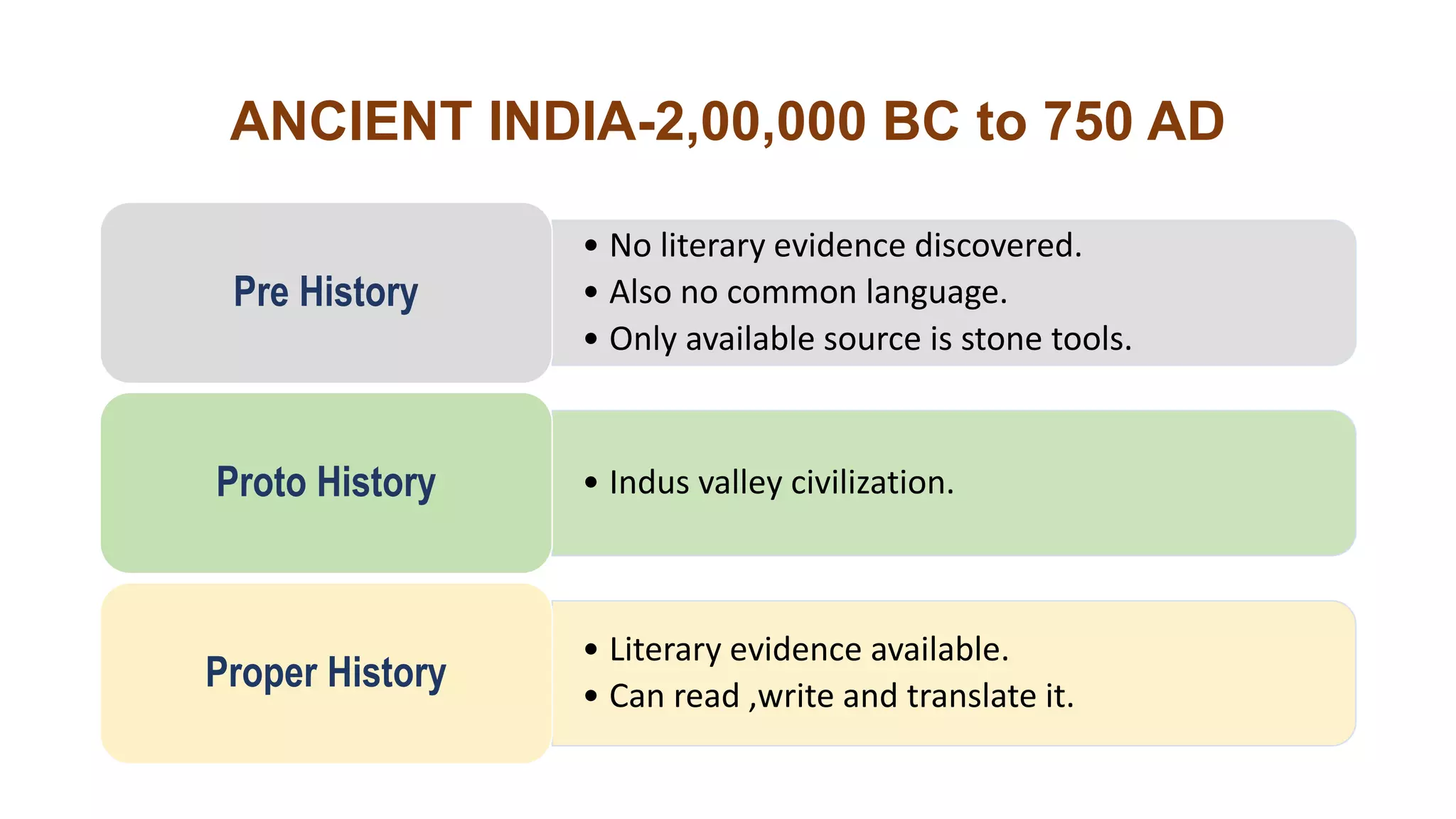
• No literary evidence discovered.
• Also no common language.
• Only available source is stone tools.
Pre History
• Indus valley civilization.Proto History
• Literary evidence available.
• Can read ,write and translate it.
Proper History
ANCIENT INDIA-2,00,000 BC to 750 AD
Vedic Age-1500 BC to 600 BC
Early Vedic age:
 1500 BC to 1000 BC .
 Tribal kingship.
 No standing /permanent army.
 No taxation, only voluntary offerings.
 Varna system based on social condition.
Later Vedic age:
 1000 BC to 600 BC.
 Discovery of iron /iron implements ,led to surplus agriculture.
 Kings become very powerful.
 Taxation was introduced.
 Evolution of jathi /caste.
RELIGIOUS CONDITION
Religion become costly as well as complicated.
Rituals become more rigid, meaning less practices, numerous ceremonies.
More domination of priests.
Even Kshatriyas and Vaishya's too suffered from dominated Brahmins.
Dominated Brahmins made monopoly of both religious thinking and sacrifice
performance.
As religious lost its former vitality ,the society also lost its earlier strength.
This led to form 62 religious sects in and around Gangetic plains.
Among 62 sects important is
 Buddhism
 Jainism
BUDDHISM
Gautama Buddha was born at Lumbini garden in 563BC as Siddhartha.
Father – king suddhodana of sakyan kingdom.
Mother – Mahamaya.
He was married to princess Yashodhara.
Son – Rahula.
At the age of 29 ,he went for street visit. He saw 4 men
1. Old man
2. Sick /diseased man As per Buddhism they call it as 4 sins
3. Dead body
4. Beggar/saint
He wandered as an ascetic for next 6 years.
At the age of 35 he attained enlightenment (nirvana) under pipal tree.
He gave 1st sermon at deer park in sarnath.
At the age of 80 he attained Mahaparinirvana (died )at kushinagar in 483 BC.
Doctrine of Buddha:
Life is full of sorrow.
Sorrow because of desire.
Yes there is a way.
Astangi/marga 8 fold path.
COUNCIL YEAR KING PLACE PRESIDENT
1 483 BC AJATASHATRU RAJGIR MAHAKASAPPA
2 383BC KALASHOKA VAISHALI SABBAGAMI
3 250BC ASHOKA PATALIPUTRA MOKALIPUTTA TISSA
4 1St AD KANISHKA KUNDALWANA (KASHMIR) VASUMITRA
BUDDHIST COUNCILS
Buddhism/Buddha followed the Middle Path (Madhya Marg).
Buddhism rejects Vedas.
Also rejects the concept of existence of soul (atman) unless Jainism.
To preach his ideas Buddha started an institution called sangha (monastery) an
residential place for Monks (male ) and Nuns (female).
His teachings compiled into three major Pitakas,namely
 Vinaya pitakas
 Sutta pitakas combined together called Tripitakas
 Abhidhamma pitakas
Most Buddhist literary work is in Pali language.
Hinayana Buddhism (lesser vehicle):
They do not believe in idol worship.
Used pali language to preach Buddhism.
Emperor Ashoka patronised Hinayana sect of Buddhism.
Worshiped only symbol of Buddha (bull).
Mahayana Buddhism (greater vehicle):
They believe in idol worship.
They used Sanskrit to preach others.
Emperor Kanishka is said to be founder of Mahayana sect of Buddhism.
During 7th century AD another form of Buddhism formed ,called as Vajrayana
Buddhism.
Here the main deity is Tara (a lady).
It involves combination of Vedas with Buddhist philosophies.
Vajrayana is based on Mahayana Buddhism.
It is patroned by Pala dynasty.
Followed in Bihar and Bengal region.
Buddhist art and culture
Three school of art and culture:
Gandhara (Pakistan)
Madura (Agra)
Amaravati (Andhra Pradesh)
JAINISM
The word Jain is derived from jina or jaina means conqueror.
Founder – Rishabhanatha or Adinatha.
Vardhamana Mahavira was the 24th Tirthankara born at Kundalgram around 540 BC.
Father – King Siddhartha of Vaishali.
Mother – Queen Trishala.
Wife – Yashoda.
Daughter – Anojja Priyadarshini.
At the age of 30 he left his home to live ascetic life.
For next 12 years he roamed around UP and Bihar.
He died at the age of 72 (468 BC) at Pava (Pavapuri).
Jain Philosophy:
They believe in three jewel path, namely
1. Right belief.
2. Right knowledge.
3. Right conduct.
They need to follow five principles in life
1. Ahimsa.
2. Satya. By Parshvanatha
3. Do not steal.
4. Not to acquire property.
5. Brahmachary. By Mahavira
They believe in existence of soul (atman).
They rejected the existence of god ,accept only in the form of Jina.
Most of the literary work is in Prakrit language.
Digambara sects:
Complete nudity, they do not wear dress.
Female monks wear plain white cloths.
Bhadrabahu was an exponent of Digambara sects.
Digambaras believe that women cant be Tirthankara's.
Also called as space clans.
Svetambara sects:
Followed preaching's of Prasvanath.
Sthulabhadra (Sthulabagu ) was great exponent of Svetambara sect.
Here the Tirthankara's can be either men or women.
They also called as white clans.
Council year Place Monk
1 3rd BC Pataliputra Sthulabahu
2 5th AD Valabhi (Gujarat) Devarandhi Sramanas
THANK YOU
BALAJI S
BE,MBA,

History

  • 1.
  • 2.
    ANCIENT INDIA • Pre History •Proto History • Proper History • Vedic Age MEDIEVAL INDIA • Early Medieval India • Proper Medieval India MODERN INDIA • Death Of Aurangzeb • Rebellion of 1857 • Gandhian Era • Partition Of India
  • 3.
    • No literaryevidence discovered. • Also no common language. • Only available source is stone tools. Pre History • Indus valley civilization.Proto History • Literary evidence available. • Can read ,write and translate it. Proper History ANCIENT INDIA-2,00,000 BC to 750 AD
  • 4.
    Vedic Age-1500 BCto 600 BC Early Vedic age:  1500 BC to 1000 BC .  Tribal kingship.  No standing /permanent army.  No taxation, only voluntary offerings.  Varna system based on social condition. Later Vedic age:  1000 BC to 600 BC.  Discovery of iron /iron implements ,led to surplus agriculture.  Kings become very powerful.  Taxation was introduced.  Evolution of jathi /caste.
  • 5.
    RELIGIOUS CONDITION Religion becomecostly as well as complicated. Rituals become more rigid, meaning less practices, numerous ceremonies. More domination of priests. Even Kshatriyas and Vaishya's too suffered from dominated Brahmins. Dominated Brahmins made monopoly of both religious thinking and sacrifice performance. As religious lost its former vitality ,the society also lost its earlier strength.
  • 6.
    This led toform 62 religious sects in and around Gangetic plains. Among 62 sects important is  Buddhism  Jainism
  • 7.
    BUDDHISM Gautama Buddha wasborn at Lumbini garden in 563BC as Siddhartha. Father – king suddhodana of sakyan kingdom. Mother – Mahamaya. He was married to princess Yashodhara. Son – Rahula. At the age of 29 ,he went for street visit. He saw 4 men 1. Old man 2. Sick /diseased man As per Buddhism they call it as 4 sins 3. Dead body 4. Beggar/saint
  • 8.
    He wandered asan ascetic for next 6 years. At the age of 35 he attained enlightenment (nirvana) under pipal tree. He gave 1st sermon at deer park in sarnath. At the age of 80 he attained Mahaparinirvana (died )at kushinagar in 483 BC. Doctrine of Buddha: Life is full of sorrow. Sorrow because of desire. Yes there is a way. Astangi/marga 8 fold path.
  • 9.
    COUNCIL YEAR KINGPLACE PRESIDENT 1 483 BC AJATASHATRU RAJGIR MAHAKASAPPA 2 383BC KALASHOKA VAISHALI SABBAGAMI 3 250BC ASHOKA PATALIPUTRA MOKALIPUTTA TISSA 4 1St AD KANISHKA KUNDALWANA (KASHMIR) VASUMITRA BUDDHIST COUNCILS
  • 10.
    Buddhism/Buddha followed theMiddle Path (Madhya Marg). Buddhism rejects Vedas. Also rejects the concept of existence of soul (atman) unless Jainism. To preach his ideas Buddha started an institution called sangha (monastery) an residential place for Monks (male ) and Nuns (female). His teachings compiled into three major Pitakas,namely  Vinaya pitakas  Sutta pitakas combined together called Tripitakas  Abhidhamma pitakas Most Buddhist literary work is in Pali language.
  • 11.
    Hinayana Buddhism (lesservehicle): They do not believe in idol worship. Used pali language to preach Buddhism. Emperor Ashoka patronised Hinayana sect of Buddhism. Worshiped only symbol of Buddha (bull). Mahayana Buddhism (greater vehicle): They believe in idol worship. They used Sanskrit to preach others. Emperor Kanishka is said to be founder of Mahayana sect of Buddhism.
  • 12.
    During 7th centuryAD another form of Buddhism formed ,called as Vajrayana Buddhism. Here the main deity is Tara (a lady). It involves combination of Vedas with Buddhist philosophies. Vajrayana is based on Mahayana Buddhism. It is patroned by Pala dynasty. Followed in Bihar and Bengal region.
  • 13.
    Buddhist art andculture Three school of art and culture: Gandhara (Pakistan) Madura (Agra) Amaravati (Andhra Pradesh)
  • 14.
    JAINISM The word Jainis derived from jina or jaina means conqueror. Founder – Rishabhanatha or Adinatha. Vardhamana Mahavira was the 24th Tirthankara born at Kundalgram around 540 BC. Father – King Siddhartha of Vaishali. Mother – Queen Trishala. Wife – Yashoda. Daughter – Anojja Priyadarshini. At the age of 30 he left his home to live ascetic life. For next 12 years he roamed around UP and Bihar. He died at the age of 72 (468 BC) at Pava (Pavapuri).
  • 15.
    Jain Philosophy: They believein three jewel path, namely 1. Right belief. 2. Right knowledge. 3. Right conduct. They need to follow five principles in life 1. Ahimsa. 2. Satya. By Parshvanatha 3. Do not steal. 4. Not to acquire property. 5. Brahmachary. By Mahavira
  • 16.
    They believe inexistence of soul (atman). They rejected the existence of god ,accept only in the form of Jina. Most of the literary work is in Prakrit language. Digambara sects: Complete nudity, they do not wear dress. Female monks wear plain white cloths. Bhadrabahu was an exponent of Digambara sects. Digambaras believe that women cant be Tirthankara's. Also called as space clans.
  • 17.
    Svetambara sects: Followed preaching'sof Prasvanath. Sthulabhadra (Sthulabagu ) was great exponent of Svetambara sect. Here the Tirthankara's can be either men or women. They also called as white clans. Council year Place Monk 1 3rd BC Pataliputra Sthulabahu 2 5th AD Valabhi (Gujarat) Devarandhi Sramanas
  • 18.