The emergence of Buddhism,
Jainism and other heterodox sects
in the 6th century BCE
World Civilizations and Cultures
HS 201
Lecture 020
Module C – India and the World: Ancient and Medieval Periods
IIT Gandhinagar
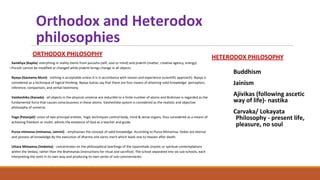
Orthodox and Heterodox
philosophies
ORTHODOX PHILOSOPHY
Samkhya (Kapila) everything in reality stems from purusha (self, soul or mind) and prakriti (matter, creative agency, energy).
○Purush cannot be modified or changed while prakriti brings change in all objects.
Nyaya (Gautama Muni)- nothing is acceptable unless it is in accordance with reason and experience (scientific approach). Nyaya is
considered as a technique of logical thinking. Nyaya Sutras say that there are four means of attaining valid knowledge: perception,
inference, comparison, and verbal testimony.
Vaisheshika (Kanada) - all objects in the physical universe are reducible to a finite number of atoms and Brahman is regarded as the
fundamental force that causes consciousness in these atoms. Vaisheshika system is considered as the realistic and objective
philosophy of universe.
Yoga (Patanjali) union of two principal entities. Yogic techniques control body, mind & sense organs, thus considered as a means of
achieving freedom or mukti. admits the existence of God as a teacher and guide.
Purva mimansa (mimansa, Jaimini) - emphasises the concept of valid knowledge. According to Purva Mimamsa, Vedas are eternal
and possess all knowledge.By the execution of dharma one earns merit which leads one to heaven after death.
Uttara Mimamsa (Vedanta) - concentrates on the philosophical teachings of the Upanishads (mystic or spiritual contemplations
within the Vedas), rather than the Brahmanas (instructions for ritual and sacrifice). The school separated into six sub-schools, each
interpreting the texts in its own way and producing its own series of sub-commentaries:
HETERODOX PHILOSOPHY
Buddhism
Jainism
Ajivikas (following ascetic
way of life)- nastika
Carvaka/ Lokayata
Philosophy - present life,
pleasure, no soul
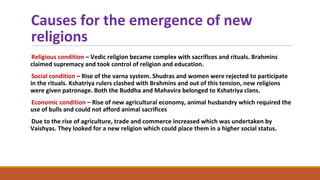
Causes for the emergence of new
religions
Religious condition – Vedic religion became complex with sacrifices and rituals. Brahmins
claimed supremacy and took control of religion and education.
Social condition – Rise of the varna system. Shudras and women were rejected to participate
in the rituals. Kshatriya rulers clashed with Brahmins and out of this tension, new religions
were given patronage. Both the Buddha and Mahavira belonged to Kshatriya clans.
Economic condition – Rise of new agricultural economy, animal husbandry which required the
use of bulls and could not afford animal sacrifices
Due to the rise of agriculture, trade and commerce increased which was undertaken by
Vaishyas. They looked for a new religion which could place them in a higher social status.
BUDDHISM
Sources
Literary:
•Pali texts -
Jatakas
Tripitakas - Sutta Pitaka, Vinaya Pitaka, Abhidhamma Pitaka
Milindpanho
•Sanskrit texts -
Ashwagosha - Buddha Charita, Saundarananda, Sutralankar, Sariputra Prakaran and Vijra Suchi
Vasumitra - Mahavibhash Shastra
Buddhagosha - Visudhamagga. Atthakathayen and Sumangalvasini
Nagarjuna - Madhyamika Karika and Prajnaparimita Karika
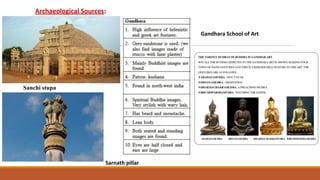
Archaeological Sources:
Sanchi stupa
Sarnath pillar
Gandhara School of Art
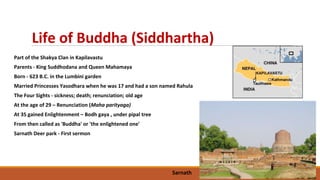
Life of Buddha (Siddhartha)
Part of the Shakya Clan in Kapilavastu
Parents - King Suddhodana and Queen Mahamaya
Born - 623 B.C. in the Lumbini garden
Married Princesses Yasodhara when he was 17 and had a son named Rahula
The Four Sights - sickness; death; renunciation; old age
At the age of 29 – Renunciation (Maha parityaga)
At 35 gained Enlightenment – Bodh gaya , under pipal tree
From then called as 'Buddha' or 'the enlightened one'
Sarnath Deer park - First sermon
Sarnath
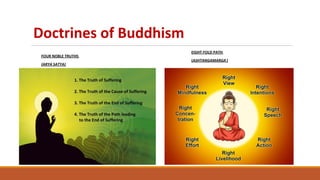
Doctrines of Buddhism
FOUR NOBLE TRUTHS
(ARYA SATYA)
EIGHT-FOLD PATH
(ASHTANGAMARGA )
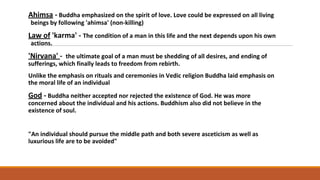
Ahimsa - Buddha emphasized on the spirit of love. Love could be expressed on all living
beings by following 'ahimsa' (non-killing)
Law of 'karma' - The condition of a man in this life and the next depends upon his own
actions.
'Nirvana' - the ultimate goal of a man must be shedding of all desires, and ending of
sufferings, which finally leads to freedom from rebirth.
Unlike the emphasis on rituals and ceremonies in Vedic religion Buddha laid emphasis on
the moral life of an individual
God - Buddha neither accepted nor rejected the existence of God. He was more
concerned about the individual and his actions. Buddhism also did not believe in the
existence of soul.
"An individual should pursue the middle path and both severe asceticism as well as
luxurious life are to be avoided"
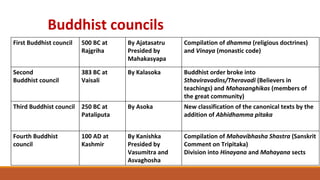
Buddhist councils
First Buddhist council 500 BC at
Rajgriha
By Ajatasatru
Presided by
Mahakasyapa
Compilation of dhamma (religious doctrines)
and Vinaya (monastic code)
Second
Buddhist council
383 BC at
Vaisali
By Kalasoka Buddhist order broke into
Sthaviravadins/Theravadi (Believers in
teachings) and Mahasanghikas (members of
the great community)
Third Buddhist council 250 BC at
Pataliputa
By Asoka New classification of the canonical texts by the
addition of Abhidhamma pitaka
Fourth Buddhist
council
100 AD at
Kashmir
By Kanishka
Presided by
Vasumitra and
Asvaghosha
Compilation of Mahavibhasha Shastra (Sanskrit
Comment on Tripitaka)
Division into Hinayana and Mahayana sects
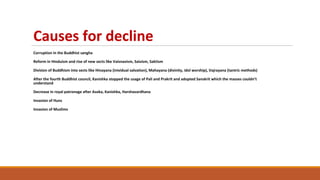
Causes for decline
Corruption in the Buddhist sangha
Reform in Hinduism and rise of new sects like Vaisnavism, Saivism, Saktism
Division of Buddhism into sects like Hinayana (inividual salvation), Mahayana (divinity, idol worship), Vajrayana (tantric methods)
After the fourth Buddhist council, Kanishka stopped the usage of Pali and Prakrit and adopted Sanskrit which the masses couldn’t
understand
Decrease in royal patronage after Asoka, Kanishka, Harshavardhana
Invasion of Huns
Invasion of Muslims
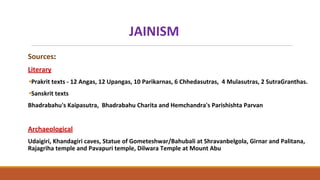
JAINISM
Sources:
Literary
•Prakrit texts - 12 Angas, 12 Upangas, 10 Parikarnas, 6 Chhedasutras, 4 Mulasutras, 2 SutraGranthas.
•Sanskrit texts
Bhadrabahu's Kaipasutra, Bhadrabahu Charita and Hemchandra's Parishishta Parvan
Archaeological
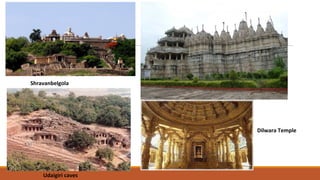
Udaigiri, Khandagiri caves, Statue of Gometeshwar/Bahubali at Shravanbelgola, Girnar and Palitana,
Rajagriha temple and Pavapuri temple, Dilwara Temple at Mount Abu
Shravanbelgola
Udaigiri caves
Dilwara Temple
Life of Mahavira (Vardhaman)
Vardhaman Mahavira - 24th Thirthankara
Parents - King Siddhartha and Queen Trishala of Ikshvaku dynasty
Born - 599 B.C. in Kundagrama
Married Princesses Yasodha
At the age of 30 – Renunciation
Spent the next twelve and a half years pursuing a life of hard penance and attained 'true
knowledge' or 'Kevala jnana'
From then called as 'Jina' or 'the conqueror of the self'
His followers are called 'Jains'
At the age of 72 attained nirvana at Pava
Doctrines
THE THREE PRINCIPLES OR TRIRATNAS (THREE GEMS)
Right Faith - belief in the teachings and wisdom of Mahavira
Right Knowledge - acceptance of the theory that there is
no God, and that the world has been existing without a
creator and that all objects possess a soul
Right Conduct - observance of the five great vows
FIVE GREAT VOWS
not to injure life
not to lie
not to steal
not to acquire property
not to lead immoral life
Jain councils
First Jain
council
300 BC At
Pataliputra
By Sthulabhadra Compilation of 12 Angas
Second jain
council
512 AD At Vallabhi By Devardhi
Kshmasramana
Final compilation of 12 Angas and 12
Upangas
Doctrine of ahimsa: He advocated a very holy and ethical code of life. Even the practice of
agriculture was considered sinful as it causes injury to the earth, worms and animals.
Doctrine of asceticism and renunciation: carried to extreme lengths by the practice of
starvation, nudity and other forms of self-torture.
Causes for decline
• Decrease in royal patronage after Bimbisara, Ajatasatru, Udayin and Kharavela
• Decrease in missionary activity
• Unlike the middle path of Buddhism, Jainism propagated severe penance and
fasting which failed to attract common people
• Jainism weakened due to schism into 2 two sects – Digambara and Svetambara
Digambara was led by Bhadrabahu and they followed nudity and severe penance.
Svetambara was led by Sitalabahu who wore white dress
• Buddhism spread rapidly due to the patronage of Asoka, Kanishka and Harsha
and attracted the masses.
• Rise of sects like Vaisnavism, Saivism, Saktism also led to its decline
AJIVIKAS
Founder Makkhali Goshala - contemporary of both the Buddha and Mahavira
Original texts of Ajivikas are lost – information from secondary sources like Buddhist and Jain texts
Doctrines:
•Everything is predetermined by absolute determinism or 'niyati'
•Hence human action has no consequence and no free will
•Doctrine of Karma – rejected. Since human action cannot change niyati
•Believed that there are no absolute moral laws
•Rejected existence of God
•All matter is made up of invisible atoms
•7 elemental categories (Kaya) -
4 matter – Fire, earth, water, air
3 non-matter – sukha or joy, dukka or sorrow, jiva or life
•Asceticism - Ajivikas wore no clothes and lived as ascetic monks in organised groups and
practiced severe austerities like lying on nails, going through fire, exposing themselves to
extreme weather and spending time in large earthen pots for penance
•no caste discrimination
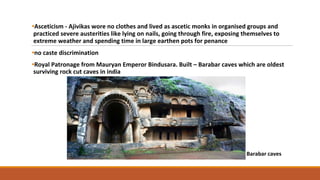
•Royal Patronage from Mauryan Emperor Bindusara. Built – Barabar caves which are oldest
surviving rock cut caves in india
Barabar caves
LOKAYATA OR CHARVAKA
Materialistic Philosophy – one of the oldest philosophy in Indian Materialism
Founder Charvaka aka Brihaspati – Author of Brihaspatya sutras
Secondary sources of information – Buddhist, Jain, Brahminical
Doctrines:
• Matter is the only reality and world is made of 4 basic elements – fire, water, earth and air
• Perception (Pratyaksha) is the only means of knowledge and anything that cannot be understood
through Perception is just 'imagination'
• Rejects the existence of good or bad in the world
• Rejects the existence of God
• Rejects the existence of separate soul. The living body is itself considered as soul. It is formed when
earth, fire, water, air are combined and contains life, breath and consciousness.
• Rejects the existence of Karma, reincarnation and afterlife
• Does not believe in Dharma and Moksha
• Believes that man should only strive for Kama (sensual pleasure) and Artha (wealth) to get
pleasure.

hss.pdf

  • 1.
    The emergence ofBuddhism, Jainism and other heterodox sects in the 6th century BCE World Civilizations and Cultures HS 201 Lecture 020 Module C – India and the World: Ancient and Medieval Periods IIT Gandhinagar
  • 2.
    Orthodox and Heterodox philosophies ORTHODOXPHILOSOPHY Samkhya (Kapila) everything in reality stems from purusha (self, soul or mind) and prakriti (matter, creative agency, energy). ○Purush cannot be modified or changed while prakriti brings change in all objects. Nyaya (Gautama Muni)- nothing is acceptable unless it is in accordance with reason and experience (scientific approach). Nyaya is considered as a technique of logical thinking. Nyaya Sutras say that there are four means of attaining valid knowledge: perception, inference, comparison, and verbal testimony. Vaisheshika (Kanada) - all objects in the physical universe are reducible to a finite number of atoms and Brahman is regarded as the fundamental force that causes consciousness in these atoms. Vaisheshika system is considered as the realistic and objective philosophy of universe. Yoga (Patanjali) union of two principal entities. Yogic techniques control body, mind & sense organs, thus considered as a means of achieving freedom or mukti. admits the existence of God as a teacher and guide. Purva mimansa (mimansa, Jaimini) - emphasises the concept of valid knowledge. According to Purva Mimamsa, Vedas are eternal and possess all knowledge.By the execution of dharma one earns merit which leads one to heaven after death. Uttara Mimamsa (Vedanta) - concentrates on the philosophical teachings of the Upanishads (mystic or spiritual contemplations within the Vedas), rather than the Brahmanas (instructions for ritual and sacrifice). The school separated into six sub-schools, each interpreting the texts in its own way and producing its own series of sub-commentaries: HETERODOX PHILOSOPHY Buddhism Jainism Ajivikas (following ascetic way of life)- nastika Carvaka/ Lokayata Philosophy - present life, pleasure, no soul
  • 3.
    Causes for theemergence of new religions Religious condition – Vedic religion became complex with sacrifices and rituals. Brahmins claimed supremacy and took control of religion and education. Social condition – Rise of the varna system. Shudras and women were rejected to participate in the rituals. Kshatriya rulers clashed with Brahmins and out of this tension, new religions were given patronage. Both the Buddha and Mahavira belonged to Kshatriya clans. Economic condition – Rise of new agricultural economy, animal husbandry which required the use of bulls and could not afford animal sacrifices Due to the rise of agriculture, trade and commerce increased which was undertaken by Vaishyas. They looked for a new religion which could place them in a higher social status.
  • 4.
    BUDDHISM Sources Literary: •Pali texts - Jatakas Tripitakas- Sutta Pitaka, Vinaya Pitaka, Abhidhamma Pitaka Milindpanho •Sanskrit texts - Ashwagosha - Buddha Charita, Saundarananda, Sutralankar, Sariputra Prakaran and Vijra Suchi Vasumitra - Mahavibhash Shastra Buddhagosha - Visudhamagga. Atthakathayen and Sumangalvasini Nagarjuna - Madhyamika Karika and Prajnaparimita Karika
  • 5.
    Archaeological Sources: Sanchi stupa Sarnathpillar Gandhara School of Art
  • 6.
    Life of Buddha(Siddhartha) Part of the Shakya Clan in Kapilavastu Parents - King Suddhodana and Queen Mahamaya Born - 623 B.C. in the Lumbini garden Married Princesses Yasodhara when he was 17 and had a son named Rahula The Four Sights - sickness; death; renunciation; old age At the age of 29 – Renunciation (Maha parityaga) At 35 gained Enlightenment – Bodh gaya , under pipal tree From then called as 'Buddha' or 'the enlightened one' Sarnath Deer park - First sermon Sarnath
  • 7.
    Doctrines of Buddhism FOURNOBLE TRUTHS (ARYA SATYA) EIGHT-FOLD PATH (ASHTANGAMARGA )
  • 8.
    Ahimsa - Buddhaemphasized on the spirit of love. Love could be expressed on all living beings by following 'ahimsa' (non-killing) Law of 'karma' - The condition of a man in this life and the next depends upon his own actions. 'Nirvana' - the ultimate goal of a man must be shedding of all desires, and ending of sufferings, which finally leads to freedom from rebirth. Unlike the emphasis on rituals and ceremonies in Vedic religion Buddha laid emphasis on the moral life of an individual God - Buddha neither accepted nor rejected the existence of God. He was more concerned about the individual and his actions. Buddhism also did not believe in the existence of soul. "An individual should pursue the middle path and both severe asceticism as well as luxurious life are to be avoided"
  • 9.
    Buddhist councils First Buddhistcouncil 500 BC at Rajgriha By Ajatasatru Presided by Mahakasyapa Compilation of dhamma (religious doctrines) and Vinaya (monastic code) Second Buddhist council 383 BC at Vaisali By Kalasoka Buddhist order broke into Sthaviravadins/Theravadi (Believers in teachings) and Mahasanghikas (members of the great community) Third Buddhist council 250 BC at Pataliputa By Asoka New classification of the canonical texts by the addition of Abhidhamma pitaka Fourth Buddhist council 100 AD at Kashmir By Kanishka Presided by Vasumitra and Asvaghosha Compilation of Mahavibhasha Shastra (Sanskrit Comment on Tripitaka) Division into Hinayana and Mahayana sects
  • 10.
    Causes for decline Corruptionin the Buddhist sangha Reform in Hinduism and rise of new sects like Vaisnavism, Saivism, Saktism Division of Buddhism into sects like Hinayana (inividual salvation), Mahayana (divinity, idol worship), Vajrayana (tantric methods) After the fourth Buddhist council, Kanishka stopped the usage of Pali and Prakrit and adopted Sanskrit which the masses couldn’t understand Decrease in royal patronage after Asoka, Kanishka, Harshavardhana Invasion of Huns Invasion of Muslims
  • 11.
    JAINISM Sources: Literary •Prakrit texts -12 Angas, 12 Upangas, 10 Parikarnas, 6 Chhedasutras, 4 Mulasutras, 2 SutraGranthas. •Sanskrit texts Bhadrabahu's Kaipasutra, Bhadrabahu Charita and Hemchandra's Parishishta Parvan Archaeological Udaigiri, Khandagiri caves, Statue of Gometeshwar/Bahubali at Shravanbelgola, Girnar and Palitana, Rajagriha temple and Pavapuri temple, Dilwara Temple at Mount Abu
  • 12.
  • 13.
    Life of Mahavira(Vardhaman) Vardhaman Mahavira - 24th Thirthankara Parents - King Siddhartha and Queen Trishala of Ikshvaku dynasty Born - 599 B.C. in Kundagrama Married Princesses Yasodha At the age of 30 – Renunciation Spent the next twelve and a half years pursuing a life of hard penance and attained 'true knowledge' or 'Kevala jnana' From then called as 'Jina' or 'the conqueror of the self' His followers are called 'Jains' At the age of 72 attained nirvana at Pava
  • 14.
    Doctrines THE THREE PRINCIPLESOR TRIRATNAS (THREE GEMS) Right Faith - belief in the teachings and wisdom of Mahavira Right Knowledge - acceptance of the theory that there is no God, and that the world has been existing without a creator and that all objects possess a soul Right Conduct - observance of the five great vows FIVE GREAT VOWS not to injure life not to lie not to steal not to acquire property not to lead immoral life
  • 15.
    Jain councils First Jain council 300BC At Pataliputra By Sthulabhadra Compilation of 12 Angas Second jain council 512 AD At Vallabhi By Devardhi Kshmasramana Final compilation of 12 Angas and 12 Upangas Doctrine of ahimsa: He advocated a very holy and ethical code of life. Even the practice of agriculture was considered sinful as it causes injury to the earth, worms and animals. Doctrine of asceticism and renunciation: carried to extreme lengths by the practice of starvation, nudity and other forms of self-torture.
  • 16.
    Causes for decline •Decrease in royal patronage after Bimbisara, Ajatasatru, Udayin and Kharavela • Decrease in missionary activity • Unlike the middle path of Buddhism, Jainism propagated severe penance and fasting which failed to attract common people • Jainism weakened due to schism into 2 two sects – Digambara and Svetambara Digambara was led by Bhadrabahu and they followed nudity and severe penance. Svetambara was led by Sitalabahu who wore white dress • Buddhism spread rapidly due to the patronage of Asoka, Kanishka and Harsha and attracted the masses. • Rise of sects like Vaisnavism, Saivism, Saktism also led to its decline
  • 17.
    AJIVIKAS Founder Makkhali Goshala- contemporary of both the Buddha and Mahavira Original texts of Ajivikas are lost – information from secondary sources like Buddhist and Jain texts Doctrines: •Everything is predetermined by absolute determinism or 'niyati' •Hence human action has no consequence and no free will •Doctrine of Karma – rejected. Since human action cannot change niyati •Believed that there are no absolute moral laws •Rejected existence of God •All matter is made up of invisible atoms •7 elemental categories (Kaya) - 4 matter – Fire, earth, water, air 3 non-matter – sukha or joy, dukka or sorrow, jiva or life
  • 18.
    •Asceticism - Ajivikaswore no clothes and lived as ascetic monks in organised groups and practiced severe austerities like lying on nails, going through fire, exposing themselves to extreme weather and spending time in large earthen pots for penance •no caste discrimination •Royal Patronage from Mauryan Emperor Bindusara. Built – Barabar caves which are oldest surviving rock cut caves in india Barabar caves
  • 19.
    LOKAYATA OR CHARVAKA MaterialisticPhilosophy – one of the oldest philosophy in Indian Materialism Founder Charvaka aka Brihaspati – Author of Brihaspatya sutras Secondary sources of information – Buddhist, Jain, Brahminical Doctrines: • Matter is the only reality and world is made of 4 basic elements – fire, water, earth and air • Perception (Pratyaksha) is the only means of knowledge and anything that cannot be understood through Perception is just 'imagination' • Rejects the existence of good or bad in the world • Rejects the existence of God
  • 20.
    • Rejects theexistence of separate soul. The living body is itself considered as soul. It is formed when earth, fire, water, air are combined and contains life, breath and consciousness. • Rejects the existence of Karma, reincarnation and afterlife • Does not believe in Dharma and Moksha • Believes that man should only strive for Kama (sensual pleasure) and Artha (wealth) to get pleasure.