Historical TEI:
DEVELOPING A PORTFOLIO OF COMMON PRACTICE
M. H. Beals
Loughborough University
@MHBEALS
m.h.beals@lboro.ac.uk
ORCID 0000-0002-2907-3313
Primary Source Analysis
Understand the context of source
Disentangle ‘facts’ from ‘argument’
Place it within a historiographical context
@mhbeals www.scissorsandpaste.net
The Thorny Problem of Bias
 Sourcing (Wineburg, 1991)
The source is examined, making use of contextual knowledge of its creator and a close reading
of the language used, to determine the 'truth' of any claims or arguments made
 Bias (Mabbett, 2007)
“A bias is a built-in tendency to lean to one side, a preference that inclines one to favour one side
in an argument. […] It is important to avoid confusing prejudice or bias with the mere possession
of an opinion. We all have opinions; what matters is the extent to which we are ready to let our
opinions be changed by examination of the evidence”
@mhbeals www.scissorsandpaste.net
A Pedagogical Experiment
 120 First-Year Students Transcribing a Single Text
 XML Encoding in Simplified TEI Standards
 Critically Analysing People, Places, and Claims
 XSL Output as Interactive HTML Website with Index
@mhbeals www.scissorsandpaste.net
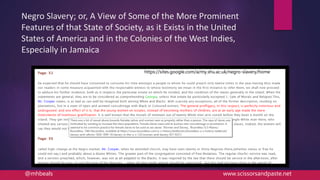
Negro Slavery; or, A View of Some of the More Prominent
Features of that State of Society, as it Exists in the United
States of America and in the Colonies of the West Indies,
Especially in Jamaica
https://sites.google.com/a/my.shu.ac.uk/negro-slavery/home
@mhbeals www.scissorsandpaste.net
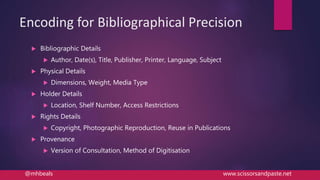
Encoding for Bibliographical Precision
 Bibliographic Details
 Author, Date(s), Title, Publisher, Printer, Language, Subject
 Physical Details
 Dimensions, Weight, Media Type
 Holder Details
 Location, Shelf Number, Access Restrictions
 Rights Details
 Copyright, Photographic Reproduction, Reuse in Publications
 Provenance
 Version of Consultation, Method of Digitisation
@mhbeals www.scissorsandpaste.net
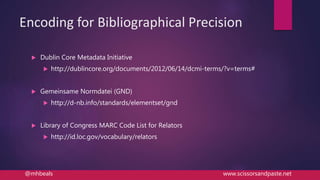
Encoding for Bibliographical Precision
 Dublin Core Metadata Initiative
 http://dublincore.org/documents/2012/06/14/dcmi-terms/?v=terms#
 Gemeinsame Normdatei (GND)
 http://d-nb.info/standards/elementset/gnd
 Library of Congress MARC Code List for Relators
 http://id.loc.gov/vocabulary/relators
@mhbeals www.scissorsandpaste.net
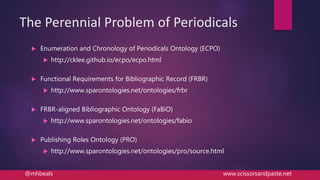
The Perennial Problem of Periodicals
 Enumeration and Chronology of Periodicals Ontology (ECPO)
 http://cklee.github.io/ecpo/ecpo.html
 Functional Requirements for Bibliographic Record (FRBR)
 http://www.sparontologies.net/ontologies/frbr
 FRBR-aligned Bibliographic Ontology (FaBiO)
 http://www.sparontologies.net/ontologies/fabio
 Publishing Roles Ontology (PRO)
 http://www.sparontologies.net/ontologies/pro/source.html
@mhbeals www.scissorsandpaste.net
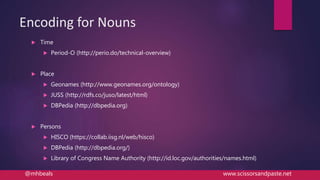
Encoding for Nouns
 Time
 Period-O (http://perio.do/technical-overview)
 Place
 Geonames (http://www.geonames.org/ontology)
 JUSS (http://rdfs.co/juso/latest/html)
 DBPedia (http://dbpedia.org)
 Persons
 HISCO (https://collab.iisg.nl/web/hisco)
 DBPedia (http://dbpedia.org/)
 Library of Congress Name Authority (http://id.loc.gov/authorities/names.html)
@mhbeals www.scissorsandpaste.net
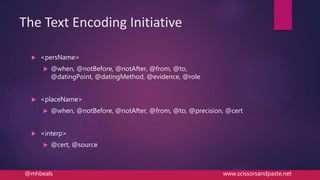
The Text Encoding Initiative
 <persName>
 @when, @notBefore, @notAfter, @from, @to,
@datingPoint, @datingMethod, @evidence, @role
 <placeName>
 @when, @notBefore, @notAfter, @from, @to, @precision, @cert
 <interp>
 @cert, @source
@mhbeals www.scissorsandpaste.net
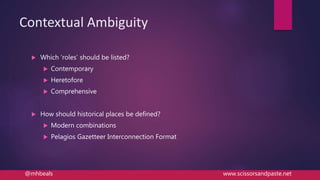
Contextual Ambiguity
 Which ‘roles’ should be listed?
 Contemporary
 Heretofore
 Comprehensive
 How should historical places be defined?
 Modern combinations
 Pelagios Gazetteer Interconnection Format
@mhbeals www.scissorsandpaste.net
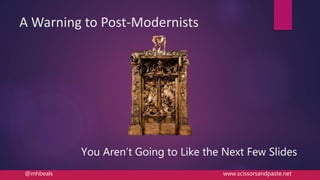
A Warning to Post-Modernists
You Aren’t Going to Like the Next Few Slides
@mhbeals www.scissorsandpaste.net
Encoding for Historiographical Meaning
“Historians (and students studying history) are interested instead in ‘why’ types of questions.
A typical historical question would be: ‘How and why did the cultural image of the Jews
change in medieval Europe?’ However, as the goal of the ontology was to support the
contextualization process, and not to provide an ontology which is interesting for historians
(or for students) per se, we did not try to encode the answers to why questions into the
ontology.
Even if we tried to do it, it would be impossible, as there are not clear
answers to those questions which can be captured using logical formalisms.
[…] Therefore this aspect will be ignored in this paper from now on.”
– Gábor Nagypál “History Ontology Building: The Technical View”, 2007
@mhbeals www.scissorsandpaste.net
Encoding for Historiographical Meaning
 Annotation
A footnote describing additional contextual information and
interpretation about a text
 Truth Values
A flag indicating the likelihood that statement is true or false,
a lie or mistake
@mhbeals www.scissorsandpaste.net
Variants on a Common Theme
 Structure
A common means of framing an argument in terms of actors,
relationships, actions, causality and correlation
 Vocabulary
A common set of terms to describe actors, relations and
actions
@mhbeals www.scissorsandpaste.net
Variants on a Common Theme
 Actor A was in relationship A with Actor B
 Actor A murdered Actor B
 Actor A lied about Murder A
 Lie A appears in Affidavit A
 Lie A is countered in Letter R
 Murder A took place in Location D
 Murder A contributed to Riot C
Translatable into Linked Data Triplets!
@mhbeals www.scissorsandpaste.net
Concluding Thoughts
Rather than simply building a library of interpretations, a digital
library of critical analyses on historical texts, we can create a
network of historiographical arguments that are
 Linked to specific primary and secondary texts
 Well defined
 Open to computational analysis
@mhbeals www.scissorsandpaste.net
Historical TEI:
DEVELOPING A PORTFOLIO OF COMMON PRACTICE
M. H. Beals
Loughborough University
@MHBEALS
m.h.beals@lboro.ac.uk
ORCID 0000-0002-2907-3313

Historical TEI: Developing a Portfolio of Common Practice

  • 1.
    Historical TEI: DEVELOPING APORTFOLIO OF COMMON PRACTICE M. H. Beals Loughborough University @MHBEALS m.h.beals@lboro.ac.uk ORCID 0000-0002-2907-3313
  • 2.
    Primary Source Analysis Understandthe context of source Disentangle ‘facts’ from ‘argument’ Place it within a historiographical context @mhbeals www.scissorsandpaste.net
  • 3.
    The Thorny Problemof Bias  Sourcing (Wineburg, 1991) The source is examined, making use of contextual knowledge of its creator and a close reading of the language used, to determine the 'truth' of any claims or arguments made  Bias (Mabbett, 2007) “A bias is a built-in tendency to lean to one side, a preference that inclines one to favour one side in an argument. […] It is important to avoid confusing prejudice or bias with the mere possession of an opinion. We all have opinions; what matters is the extent to which we are ready to let our opinions be changed by examination of the evidence” @mhbeals www.scissorsandpaste.net
  • 4.
    A Pedagogical Experiment 120 First-Year Students Transcribing a Single Text  XML Encoding in Simplified TEI Standards  Critically Analysing People, Places, and Claims  XSL Output as Interactive HTML Website with Index @mhbeals www.scissorsandpaste.net
  • 5.
    Negro Slavery; or,A View of Some of the More Prominent Features of that State of Society, as it Exists in the United States of America and in the Colonies of the West Indies, Especially in Jamaica https://sites.google.com/a/my.shu.ac.uk/negro-slavery/home @mhbeals www.scissorsandpaste.net
  • 6.
    Encoding for BibliographicalPrecision  Bibliographic Details  Author, Date(s), Title, Publisher, Printer, Language, Subject  Physical Details  Dimensions, Weight, Media Type  Holder Details  Location, Shelf Number, Access Restrictions  Rights Details  Copyright, Photographic Reproduction, Reuse in Publications  Provenance  Version of Consultation, Method of Digitisation @mhbeals www.scissorsandpaste.net
  • 7.
    Encoding for BibliographicalPrecision  Dublin Core Metadata Initiative  http://dublincore.org/documents/2012/06/14/dcmi-terms/?v=terms#  Gemeinsame Normdatei (GND)  http://d-nb.info/standards/elementset/gnd  Library of Congress MARC Code List for Relators  http://id.loc.gov/vocabulary/relators @mhbeals www.scissorsandpaste.net
  • 8.
    The Perennial Problemof Periodicals  Enumeration and Chronology of Periodicals Ontology (ECPO)  http://cklee.github.io/ecpo/ecpo.html  Functional Requirements for Bibliographic Record (FRBR)  http://www.sparontologies.net/ontologies/frbr  FRBR-aligned Bibliographic Ontology (FaBiO)  http://www.sparontologies.net/ontologies/fabio  Publishing Roles Ontology (PRO)  http://www.sparontologies.net/ontologies/pro/source.html @mhbeals www.scissorsandpaste.net
  • 9.
    Encoding for Nouns Time  Period-O (http://perio.do/technical-overview)  Place  Geonames (http://www.geonames.org/ontology)  JUSS (http://rdfs.co/juso/latest/html)  DBPedia (http://dbpedia.org)  Persons  HISCO (https://collab.iisg.nl/web/hisco)  DBPedia (http://dbpedia.org/)  Library of Congress Name Authority (http://id.loc.gov/authorities/names.html) @mhbeals www.scissorsandpaste.net
  • 10.
    The Text EncodingInitiative  <persName>  @when, @notBefore, @notAfter, @from, @to, @datingPoint, @datingMethod, @evidence, @role  <placeName>  @when, @notBefore, @notAfter, @from, @to, @precision, @cert  <interp>  @cert, @source @mhbeals www.scissorsandpaste.net
  • 11.
    Contextual Ambiguity  Which‘roles’ should be listed?  Contemporary  Heretofore  Comprehensive  How should historical places be defined?  Modern combinations  Pelagios Gazetteer Interconnection Format @mhbeals www.scissorsandpaste.net
  • 12.
    A Warning toPost-Modernists You Aren’t Going to Like the Next Few Slides @mhbeals www.scissorsandpaste.net
  • 13.
    Encoding for HistoriographicalMeaning “Historians (and students studying history) are interested instead in ‘why’ types of questions. A typical historical question would be: ‘How and why did the cultural image of the Jews change in medieval Europe?’ However, as the goal of the ontology was to support the contextualization process, and not to provide an ontology which is interesting for historians (or for students) per se, we did not try to encode the answers to why questions into the ontology. Even if we tried to do it, it would be impossible, as there are not clear answers to those questions which can be captured using logical formalisms. […] Therefore this aspect will be ignored in this paper from now on.” – Gábor Nagypál “History Ontology Building: The Technical View”, 2007 @mhbeals www.scissorsandpaste.net
  • 14.
    Encoding for HistoriographicalMeaning  Annotation A footnote describing additional contextual information and interpretation about a text  Truth Values A flag indicating the likelihood that statement is true or false, a lie or mistake @mhbeals www.scissorsandpaste.net
  • 15.
    Variants on aCommon Theme  Structure A common means of framing an argument in terms of actors, relationships, actions, causality and correlation  Vocabulary A common set of terms to describe actors, relations and actions @mhbeals www.scissorsandpaste.net
  • 16.
    Variants on aCommon Theme  Actor A was in relationship A with Actor B  Actor A murdered Actor B  Actor A lied about Murder A  Lie A appears in Affidavit A  Lie A is countered in Letter R  Murder A took place in Location D  Murder A contributed to Riot C Translatable into Linked Data Triplets! @mhbeals www.scissorsandpaste.net
  • 17.
    Concluding Thoughts Rather thansimply building a library of interpretations, a digital library of critical analyses on historical texts, we can create a network of historiographical arguments that are  Linked to specific primary and secondary texts  Well defined  Open to computational analysis @mhbeals www.scissorsandpaste.net
  • 18.
    Historical TEI: DEVELOPING APORTFOLIO OF COMMON PRACTICE M. H. Beals Loughborough University @MHBEALS m.h.beals@lboro.ac.uk ORCID 0000-0002-2907-3313