Historiography
Dr. John Lomax

Professor Traci Welch Moritz
Public Services Librarian
Purpose for today
• Current state of research for
historians
• Developing a research strategy for
this course
• Using scholarly resources
• Using popular resources in scholarly
research
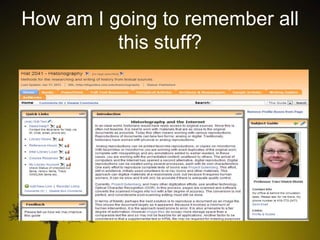
How am I going to remember all
this stuff?
Period of Transition
• Information explosion
• Problems with locating materials
• Problems with storage and
accessibility of materials
• Unreliability of burgeoning body of
literature
Period of transition
• Legibility/Stability of media
• Availability of equipment to read
and reproduce
• Availability of retrieval for
software
• Stability of content
Legibility/ Stability of Media
• Availability of equipment to read and
reproduce
• Availability of retrieval software
• Stability of content
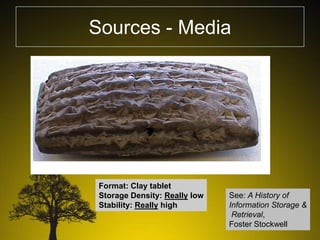
Sources - Media

Format: Clay tablet
Storage Density: Really low
Stability: Really high

See: A History of
Information Storage &
Retrieval,
Foster Stockwell
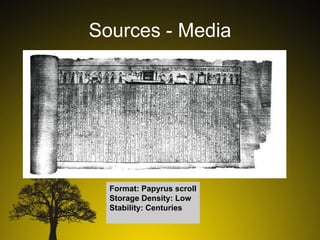
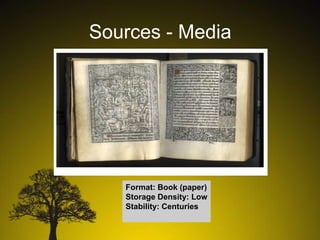
Sources - Media

Format: Papyrus scroll
Storage Density: Low
Stability: Centuries
Sources - Media

Format: Book (paper)
Storage Density: Low
Stability: Centuries
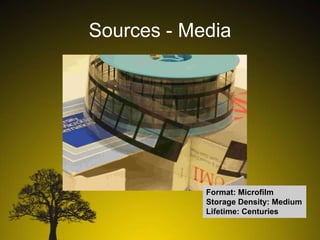
Sources - Media

Format: Microfilm
Storage Density: Medium
Lifetime: Centuries
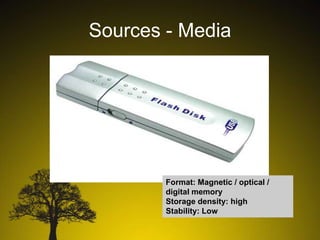
Sources - Media

Format: Magnetic / optical /
digital memory
Storage density: high
Stability: Low
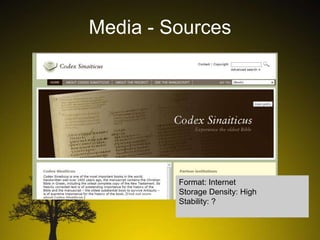
Media - Sources

Format: Internet
Storage Density: High
Stability: ?
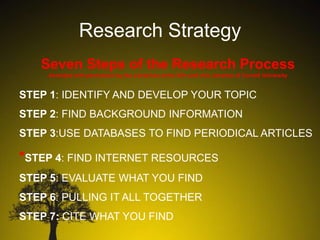
Research Strategy
Seven Steps of the Research Process
Amended with permission by the Librarians at the Olin and Uris Libraries of Cornell University

STEP 1: IDENTIFY AND DEVELOP YOUR TOPIC
STEP 2: FIND BACKGROUND INFORMATION
STEP 3:USE DATABASES TO FIND PERIODICAL ARTICLES

*STEP 4: FIND INTERNET RESOURCES
STEP 5: EVALUATE WHAT YOU FIND
STEP 6: PULLING IT ALL TOGETHER
STEP 7: CITE WHAT YOU FIND
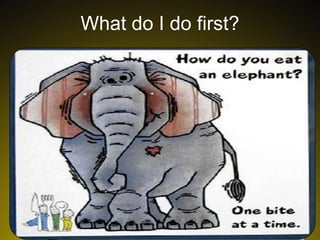
What do I do first?
 Take a look at your topic and identify key
search terms, Ask a question.
 Most databases now use an implied Boolean
logic search scheme so a keyword search
will get you started.
 Boolean logic is the use of AND, NOT, OR to
narrow or expand your search
 See Research Guide

WHO
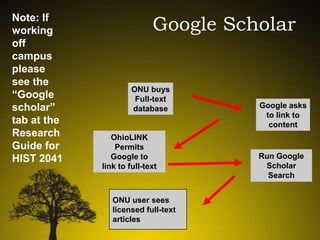
Note: If
working
off
campus
please
see the
“Google
scholar”
tab at the
Research
Guide for
HIST 2041

Google Scholar

ONU buys
Full-text
database

OhioLINK
Permits
Google to
link to full-text

ONU user sees
licensed full-text
articles

Google asks
to link to
content

Run Google
Scholar
Search
Annotated Bibliography
• Allows you to see what is out
there
• Helps you narrow your topic
and discard any irrelevant
materials
• Aids in developing the thesis
• Makes you a better scholar
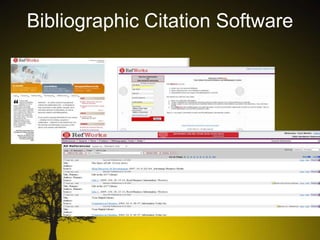
Bibliographic Citation Software
REFWORKS
Managing Information - RefWorks
• Licensed state-wide, access free to Ohio
students for the rest of your life!
• See: http://0-www.refworks.com.polar.onu.edu/

•
•
•
•

Write n’ Cite interfaces with MS Word
Excellent Tutorials
Help available at Heterick
Research Guide for instructions on how to
get your free-for-a-life-time account
Tools for locating resources
• EDS
• Catalogs
– POLAR
– OhioLINK
– SearchOhio
– WorldCat.org

• Databases
• Websites
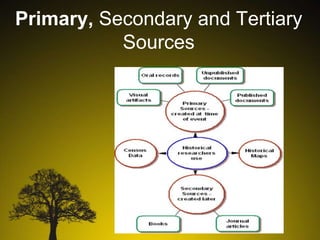
Primary, Secondary and Tertiary
Sources
Primary, Secondary and Tertiary
Sources
•Definitions depend on the department and
subject matter being studied
“In the humanities, a primary resource could be
defined as something that was created either
during the time period being studied or afterward
by individuals reflecting on their involvement in the
events of the time.”
http://www.ala.org/rusa/sections/history/
resources/pubs/usingprimarysources
Primary Sources: Definitions. Lafayette College Libraries & Academic Information Resources.
<http://ww2.lafayette.edu/~library/guides/primarysources/definitions.html> Accessed August 8, 2013
Primary, Secondary and Tertiary
Sources
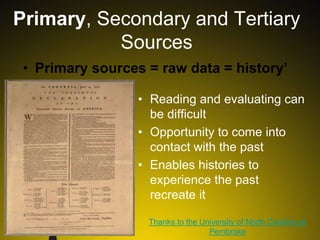
• Primary sources = raw data = history’
• Reading and evaluating can
be difficult
• Opportunity to come into
contact with the past
• Enables histories to
experience the past
recreate it
Thanks to the University of North Carolina at
Pembroke
Primary, Secondary and Tertiary
Sources
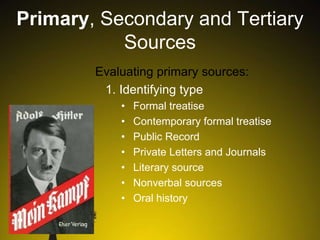
Evaluating primary sources:
1. Identifying type
•
•
•
•
•
•
•

Formal treatise
Contemporary formal treatise
Public Record
Private Letters and Journals
Literary source
Nonverbal sources
Oral history
Primary, Secondary and Tertiary
Sources
Questions to ask yourself when reviewing a
document
1. Is the source genuine?
2. What is the date of origin?
3. Who is the author?
4. Who is the audience?
Primary, Secondary and Tertiary
Sources
•Suggestions for reading a primary source
• Read through the entire document quickly
to set a sense of the whole source. Does it
show bias? Is the bias yours or the
source?
• Read the document a second time
carefully noting authorship, time period,
intended purpose and probably impact on
the intended audience.
Primary, Secondary and Tertiary
Sources

•Identify the following:
• Time and place
• Author
• Audience
• Personalities and roles of all people
mentioned
• Meaning and purpose
• Content (colloquial terminology, language
of the day, phrases and phrasing)
• Allusions
• Assumptions and/or bias
Primary, Secondary and Tertiary
Sources
Additional questions to ask yourself
1. Do the contents seem reasonable?
2. Are there other primary documents
for collaboration or are there
contradictions?
3. Place the document in the larger
historical context. Do secondary
resources fit with your
interpretation?
Primary, Secondary and Tertiary
Sources
•As you are following the steps above, be
sure to note anything you need to come
back to and look these up in reliable
reference works.
.
Primary, Secondary and Tertiary
Sources
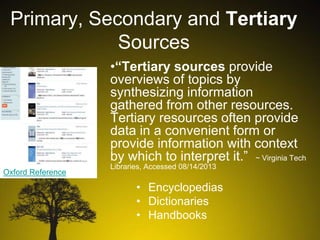
•“Tertiary sources provide
overviews of topics by
synthesizing information
gathered from other resources.
Tertiary resources often provide
data in a convenient form or
provide information with context
by which to interpret it.” ~ Virginia Tech
Oxford Reference

Libraries, Accessed 08/14/2013

• Encyclopedias
• Dictionaries
• Handbooks
Primary, Secondary and Tertiary
Sources
•Secondary Sources analyze or
interpret an historical event or artistic
work.
•Secondary sources often base their
theories and arguments on the direct
evidence found in primary sources.
• A secondary work for a subject is
one that discusses the subject but is
written after the time contemporary
with it.
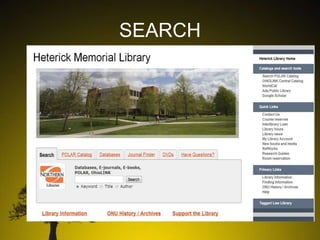
SEARCH
What is included?
•POLAR
•Article-level searching for all EBSCO
databases
•Article-level searching for a variety of
other databases: JSTOR, Hoover’s,
AccessPharmacy, etc.
•Title-level searching for most other
databases: IEEE, CIAO, Proquest Nursing
& Allied Health
•OhioLink central catalog
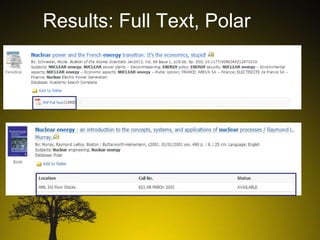
Results: Full Text, Polar
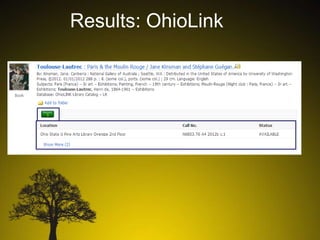
Results: OhioLink
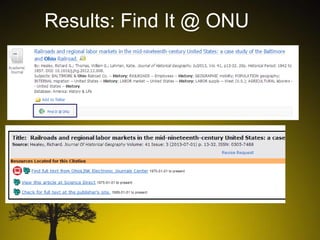
Results: Find It @ ONU
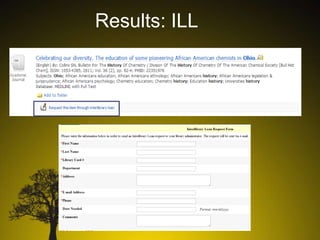
Results: ILL
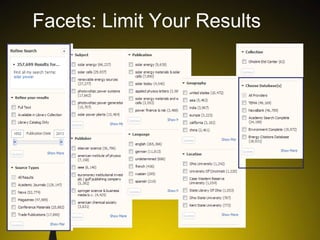
Facets: Limit Your Results
Things to Remember
•Facets are your Friend: After you
search, limit your results to what you
really want
•A tool not a solution: This is not the
solution to everything
•Ask the librarians for help
•There will still be some small
changes coming
Catalog -- POLAR
• Public Online Library Access & Retrieval
• Covers holdings of both Heterick & the law
library
• Access from library home page
• Includes items in all formats – including
online material
Catalogs -- OhioLINK +
SearchOhio
• Includes holdings of all Ohio colleges &
universities (SearchOhio links to the
catalogs of 23 of the largest public library
systems in Ohio
• Connected to POLAR
• Students can request materials from other
libraries – IF they are not available from
ONU
• Most items requested arrive 5 working days
CATALOGS - WorldCAT
• Includes holdings of libraries world wide
• Covers all types of libraries &
increasingly non-library organizations
• Materials can be in all formats
• Unlike OhioLINK - Does not allow
students to request materials directly
• Available via www.worldcat.org
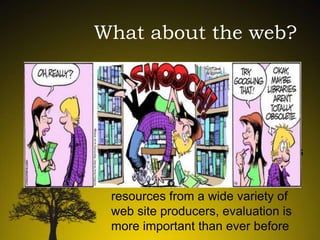
What about the web?
• Greater access to primary source
materials than ever before
• Documents, letters, maps,
photographs of ancient artifacts
and other primary material are
available online in different formats
from free websites
• With the proliferation of electronic
resources from a wide variety of
web site producers, evaluation is
more important than ever before
Critically analyzing
web sources
•
•
•
•

What? is the page/site about
Who? created and maintains this site
Where? Is the information coming from
Why? Is the information presented on
the web
• When? Was the page created or last
updated
• How? Accurate or credible is the page
From the University of Wisconsin Library,
worksheet for evaluating web sites
Databases
•
•
•
•
•
•

America History and Life
American Periodical Series
Historical Abstracts
JSTOR
Digital; Dissertations
History of Science and
Medicine
• HarpWeek
• ITER
• Sanborn Maps
Content
•

Full-text Resource – War of the Rebellion (TIF files)
http://cdl.library.cornell.edu/moa/moa_browse.html

•

Full-text Resource – New York Times (PDF file)

•

Full-text Resource – Gentle Measures in the Training
of the Young… (ASCII file, text)
Locating Tools - Metasites
• OAIster (Open Archives Initiative
(now a part of Worldcat)

• Repository of Primary Sources
• Text Encoding Initiative consortium
Websites -- Types
•
•
•
•

Professional Organizations
Topical/ Thematic Sites
Text/ Graphic Collections
Museums and Other Learned Bodies
Websites -- Professional
Am. Assoc. for State and Local History
http://www.aaslh.org

American Historical Association
http://www.historians.org

Ohio Historical Society
http://www.ohiohistory.org

Organization of American Historians
http://www.oah.org

Scholarly Societies Project
http://www.lib.uwaterloo.ca/society/overview.html
Websites -- Text
• Railroad Maps
http://memory.loc.gov/ammem/gmdhtml/rrhtml/rrhome.html

• Duke Papyrus Archive
http://scriptorium.lib.duke.edu/papyrus

• Documenting the American South
http://docsouth.unc.edu

• Internet Library of Early Journals
http://www.bodley.ox.ac.uk/ilej/

• Eurodocs
http://library.byu.edu/~rdh/eurodocs
Websites -- Topical
• Aquae Urbis Romae
http://jefferson.village.virginia.edu/waters/

• Ctr. For the Hist. Of Information
Technol.
http://www.cbi.umn.edu

• Ancient Metallurgy Research
Group
http://www.brad.ac.uk/acad/archsci/depart/resgrp/amrg/amrginfo.htm

• Bill Douglas Ctr. For the Hist. Of
Cinema
http://www.ex.ac.uk/bill.douglas/menu.html
Websites -- Museums, Libraries,
Archives
• U. Of Memphis Inst. Of Egyptian
Art
http://www.memphis.edu/egypt/main.html

• J. Paul Getty Museum
http://www.getty.edu/museum

• Sistine Chapel
http://www.christusrex.org/www1/sistine/0-Tour.html

• National Palace Museum –
Taipei
http://www.npm.gov.tw/english/index-e.htm
FURTHER HELP
• Reference Desk (see
library hours)
• Phone to Ref. Desk –
2185
• E-mail help on
database help pages

• Professor Traci
Welch Moritz
• T-moritz@onu.edu
• Ext. 2473
Hist 2041

Hist 2041

  • 1.
    Historiography Dr. John Lomax ProfessorTraci Welch Moritz Public Services Librarian
  • 2.
    Purpose for today •Current state of research for historians • Developing a research strategy for this course • Using scholarly resources • Using popular resources in scholarly research
  • 3.
    How am Igoing to remember all this stuff?
  • 4.
    Period of Transition •Information explosion • Problems with locating materials • Problems with storage and accessibility of materials • Unreliability of burgeoning body of literature
  • 5.
    Period of transition •Legibility/Stability of media • Availability of equipment to read and reproduce • Availability of retrieval for software • Stability of content
  • 6.
    Legibility/ Stability ofMedia • Availability of equipment to read and reproduce • Availability of retrieval software • Stability of content
  • 7.
    Sources - Media Format:Clay tablet Storage Density: Really low Stability: Really high See: A History of Information Storage & Retrieval, Foster Stockwell
  • 8.
    Sources - Media Format:Papyrus scroll Storage Density: Low Stability: Centuries
  • 9.
    Sources - Media Format:Book (paper) Storage Density: Low Stability: Centuries
  • 10.
    Sources - Media Format:Microfilm Storage Density: Medium Lifetime: Centuries
  • 11.
    Sources - Media Format:Magnetic / optical / digital memory Storage density: high Stability: Low
  • 12.
    Media - Sources Format:Internet Storage Density: High Stability: ?
  • 13.
    Research Strategy Seven Stepsof the Research Process Amended with permission by the Librarians at the Olin and Uris Libraries of Cornell University STEP 1: IDENTIFY AND DEVELOP YOUR TOPIC STEP 2: FIND BACKGROUND INFORMATION STEP 3:USE DATABASES TO FIND PERIODICAL ARTICLES *STEP 4: FIND INTERNET RESOURCES STEP 5: EVALUATE WHAT YOU FIND STEP 6: PULLING IT ALL TOGETHER STEP 7: CITE WHAT YOU FIND
  • 14.
    What do Ido first?  Take a look at your topic and identify key search terms, Ask a question.  Most databases now use an implied Boolean logic search scheme so a keyword search will get you started.  Boolean logic is the use of AND, NOT, OR to narrow or expand your search  See Research Guide WHO
  • 15.
    Note: If working off campus please see the “Google scholar” tabat the Research Guide for HIST 2041 Google Scholar ONU buys Full-text database OhioLINK Permits Google to link to full-text ONU user sees licensed full-text articles Google asks to link to content Run Google Scholar Search
  • 16.
    Annotated Bibliography • Allowsyou to see what is out there • Helps you narrow your topic and discard any irrelevant materials • Aids in developing the thesis • Makes you a better scholar
  • 17.
  • 18.
    Managing Information -RefWorks • Licensed state-wide, access free to Ohio students for the rest of your life! • See: http://0-www.refworks.com.polar.onu.edu/ • • • • Write n’ Cite interfaces with MS Word Excellent Tutorials Help available at Heterick Research Guide for instructions on how to get your free-for-a-life-time account
  • 19.
    Tools for locatingresources • EDS • Catalogs – POLAR – OhioLINK – SearchOhio – WorldCat.org • Databases • Websites
  • 20.
    Primary, Secondary andTertiary Sources
  • 21.
    Primary, Secondary andTertiary Sources •Definitions depend on the department and subject matter being studied “In the humanities, a primary resource could be defined as something that was created either during the time period being studied or afterward by individuals reflecting on their involvement in the events of the time.” http://www.ala.org/rusa/sections/history/ resources/pubs/usingprimarysources Primary Sources: Definitions. Lafayette College Libraries & Academic Information Resources. <http://ww2.lafayette.edu/~library/guides/primarysources/definitions.html> Accessed August 8, 2013
  • 22.
    Primary, Secondary andTertiary Sources • Primary sources = raw data = history’ • Reading and evaluating can be difficult • Opportunity to come into contact with the past • Enables histories to experience the past recreate it Thanks to the University of North Carolina at Pembroke
  • 23.
    Primary, Secondary andTertiary Sources Evaluating primary sources: 1. Identifying type • • • • • • • Formal treatise Contemporary formal treatise Public Record Private Letters and Journals Literary source Nonverbal sources Oral history
  • 24.
    Primary, Secondary andTertiary Sources Questions to ask yourself when reviewing a document 1. Is the source genuine? 2. What is the date of origin? 3. Who is the author? 4. Who is the audience?
  • 25.
    Primary, Secondary andTertiary Sources •Suggestions for reading a primary source • Read through the entire document quickly to set a sense of the whole source. Does it show bias? Is the bias yours or the source? • Read the document a second time carefully noting authorship, time period, intended purpose and probably impact on the intended audience.
  • 26.
    Primary, Secondary andTertiary Sources •Identify the following: • Time and place • Author • Audience • Personalities and roles of all people mentioned • Meaning and purpose • Content (colloquial terminology, language of the day, phrases and phrasing) • Allusions • Assumptions and/or bias
  • 27.
    Primary, Secondary andTertiary Sources Additional questions to ask yourself 1. Do the contents seem reasonable? 2. Are there other primary documents for collaboration or are there contradictions? 3. Place the document in the larger historical context. Do secondary resources fit with your interpretation?
  • 28.
    Primary, Secondary andTertiary Sources •As you are following the steps above, be sure to note anything you need to come back to and look these up in reliable reference works. .
  • 29.
    Primary, Secondary andTertiary Sources •“Tertiary sources provide overviews of topics by synthesizing information gathered from other resources. Tertiary resources often provide data in a convenient form or provide information with context by which to interpret it.” ~ Virginia Tech Oxford Reference Libraries, Accessed 08/14/2013 • Encyclopedias • Dictionaries • Handbooks
  • 30.
    Primary, Secondary andTertiary Sources •Secondary Sources analyze or interpret an historical event or artistic work. •Secondary sources often base their theories and arguments on the direct evidence found in primary sources. • A secondary work for a subject is one that discusses the subject but is written after the time contemporary with it.
  • 31.
  • 32.
    What is included? •POLAR •Article-levelsearching for all EBSCO databases •Article-level searching for a variety of other databases: JSTOR, Hoover’s, AccessPharmacy, etc. •Title-level searching for most other databases: IEEE, CIAO, Proquest Nursing & Allied Health •OhioLink central catalog
  • 33.
  • 34.
  • 35.
  • 36.
  • 37.
  • 38.
    Things to Remember •Facetsare your Friend: After you search, limit your results to what you really want •A tool not a solution: This is not the solution to everything •Ask the librarians for help •There will still be some small changes coming
  • 39.
    Catalog -- POLAR •Public Online Library Access & Retrieval • Covers holdings of both Heterick & the law library • Access from library home page • Includes items in all formats – including online material
  • 40.
    Catalogs -- OhioLINK+ SearchOhio • Includes holdings of all Ohio colleges & universities (SearchOhio links to the catalogs of 23 of the largest public library systems in Ohio • Connected to POLAR • Students can request materials from other libraries – IF they are not available from ONU • Most items requested arrive 5 working days
  • 41.
    CATALOGS - WorldCAT •Includes holdings of libraries world wide • Covers all types of libraries & increasingly non-library organizations • Materials can be in all formats • Unlike OhioLINK - Does not allow students to request materials directly • Available via www.worldcat.org
  • 42.
    What about theweb? • Greater access to primary source materials than ever before • Documents, letters, maps, photographs of ancient artifacts and other primary material are available online in different formats from free websites • With the proliferation of electronic resources from a wide variety of web site producers, evaluation is more important than ever before
  • 43.
    Critically analyzing web sources • • • • What?is the page/site about Who? created and maintains this site Where? Is the information coming from Why? Is the information presented on the web • When? Was the page created or last updated • How? Accurate or credible is the page From the University of Wisconsin Library, worksheet for evaluating web sites
  • 44.
    Databases • • • • • • America History andLife American Periodical Series Historical Abstracts JSTOR Digital; Dissertations History of Science and Medicine • HarpWeek • ITER • Sanborn Maps
  • 45.
    Content • Full-text Resource –War of the Rebellion (TIF files) http://cdl.library.cornell.edu/moa/moa_browse.html • Full-text Resource – New York Times (PDF file) • Full-text Resource – Gentle Measures in the Training of the Young… (ASCII file, text)
  • 46.
    Locating Tools -Metasites • OAIster (Open Archives Initiative (now a part of Worldcat) • Repository of Primary Sources • Text Encoding Initiative consortium
  • 47.
    Websites -- Types • • • • ProfessionalOrganizations Topical/ Thematic Sites Text/ Graphic Collections Museums and Other Learned Bodies
  • 48.
    Websites -- Professional Am.Assoc. for State and Local History http://www.aaslh.org American Historical Association http://www.historians.org Ohio Historical Society http://www.ohiohistory.org Organization of American Historians http://www.oah.org Scholarly Societies Project http://www.lib.uwaterloo.ca/society/overview.html
  • 49.
    Websites -- Text •Railroad Maps http://memory.loc.gov/ammem/gmdhtml/rrhtml/rrhome.html • Duke Papyrus Archive http://scriptorium.lib.duke.edu/papyrus • Documenting the American South http://docsouth.unc.edu • Internet Library of Early Journals http://www.bodley.ox.ac.uk/ilej/ • Eurodocs http://library.byu.edu/~rdh/eurodocs
  • 50.
    Websites -- Topical •Aquae Urbis Romae http://jefferson.village.virginia.edu/waters/ • Ctr. For the Hist. Of Information Technol. http://www.cbi.umn.edu • Ancient Metallurgy Research Group http://www.brad.ac.uk/acad/archsci/depart/resgrp/amrg/amrginfo.htm • Bill Douglas Ctr. For the Hist. Of Cinema http://www.ex.ac.uk/bill.douglas/menu.html
  • 51.
    Websites -- Museums,Libraries, Archives • U. Of Memphis Inst. Of Egyptian Art http://www.memphis.edu/egypt/main.html • J. Paul Getty Museum http://www.getty.edu/museum • Sistine Chapel http://www.christusrex.org/www1/sistine/0-Tour.html • National Palace Museum – Taipei http://www.npm.gov.tw/english/index-e.htm
  • 52.
    FURTHER HELP • ReferenceDesk (see library hours) • Phone to Ref. Desk – 2185 • E-mail help on database help pages • Professor Traci Welch Moritz • T-moritz@onu.edu • Ext. 2473