Making Collections Come to LifePromoting 21st Century Skills in Social Studies Classrooms
21st Century Skills for Social StudiesCritical Thinking and Problem SolvingContextual Learning SkillsCommunicationInformation and Media LiteracyCreativity and Innovation SkillsCollaboration Skills
historyAn interpretative narrative concerning aspects of what happened in the past and the relationships between events and humanity; the end product of historiography as either the process of writing history or the study of that process…A distinguishing feature of history…is its methodology, which relies heavily on the critical use of documentary sources created by or about the society under scrutiny. Primary sources are those produced near the event under investigation; secondary sources are works of other, later writers.The Concise Oxford Dictionary of Archaeology. Timothy Darvill. Oxford University Press, 2008.
historyAn interpretative narrative concerning aspects of what happened in the past and the relationships between events and humanity; the end product of historiography as either theprocess of writing historyor the study of that process…A distinguishing feature of history…is its methodology, which relies heavily on the critical use of documentary sources created by or about the society under scrutiny. Primary sources are those produced near the event under investigation; secondary sources are works of other, later writers.The Concise Oxford Dictionary of Archaeology. Timothy Darvill. Oxford University Press, 2008.
A Primary Source is…An artifact of its time
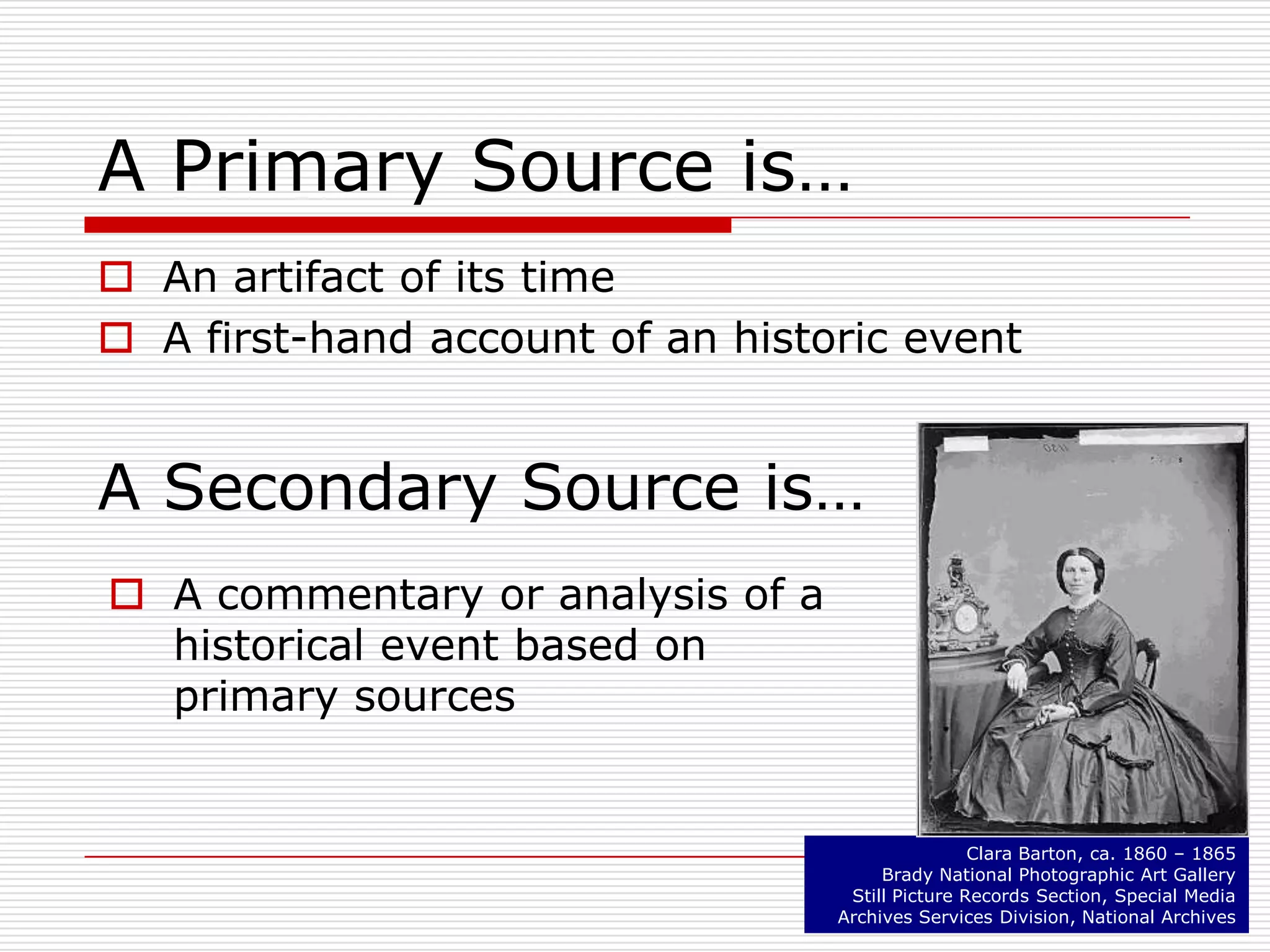
A first-hand account of an historic eventA Secondary Source is…A commentary or analysis of a historical event based on primary sourcesClara Barton, ca. 1860 – 1865Brady National Photographic Art GalleryStill Picture Records Section, Special Media Archives Services Division, National Archives
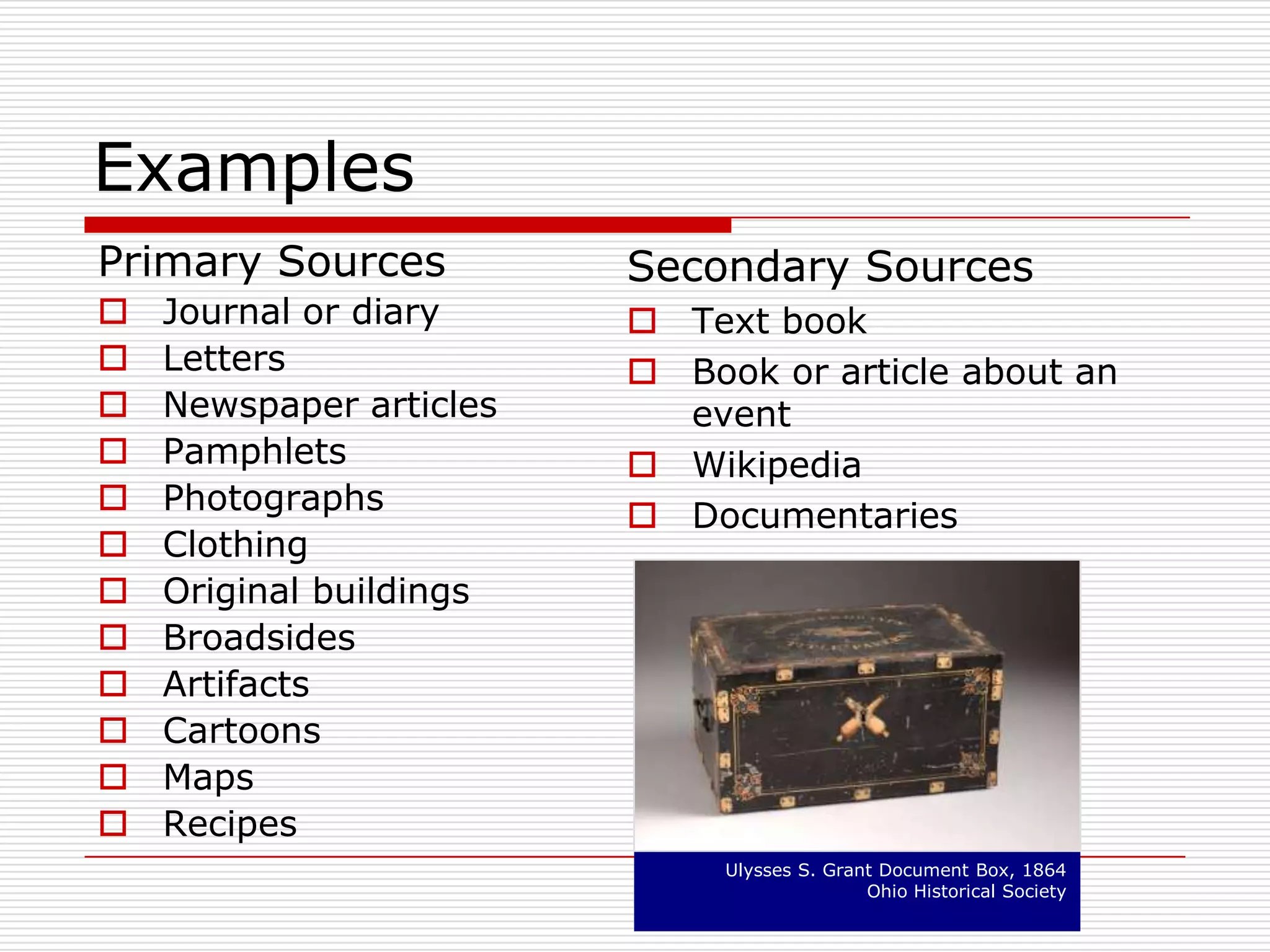
ExamplesPrimary SourcesJournal or diaryLettersNewspaper articlesPamphletsPhotographsClothingOriginal buildingsBroadsides ArtifactsCartoonsMapsRecipesSecondary SourcesText bookBook or article about an eventWikipediaDocumentariesUlysses S. Grant Document Box, 1864Ohio Historical Society
Wait a minute...What’s Wrong with Secondary Sources?Historians use both primary and secondary sourcesSecondary sources tell us: Who is that?
 What’s going on here?
 Context
 Clues to find out morePortrait of an Unidentified Woman Ohio Historical Society
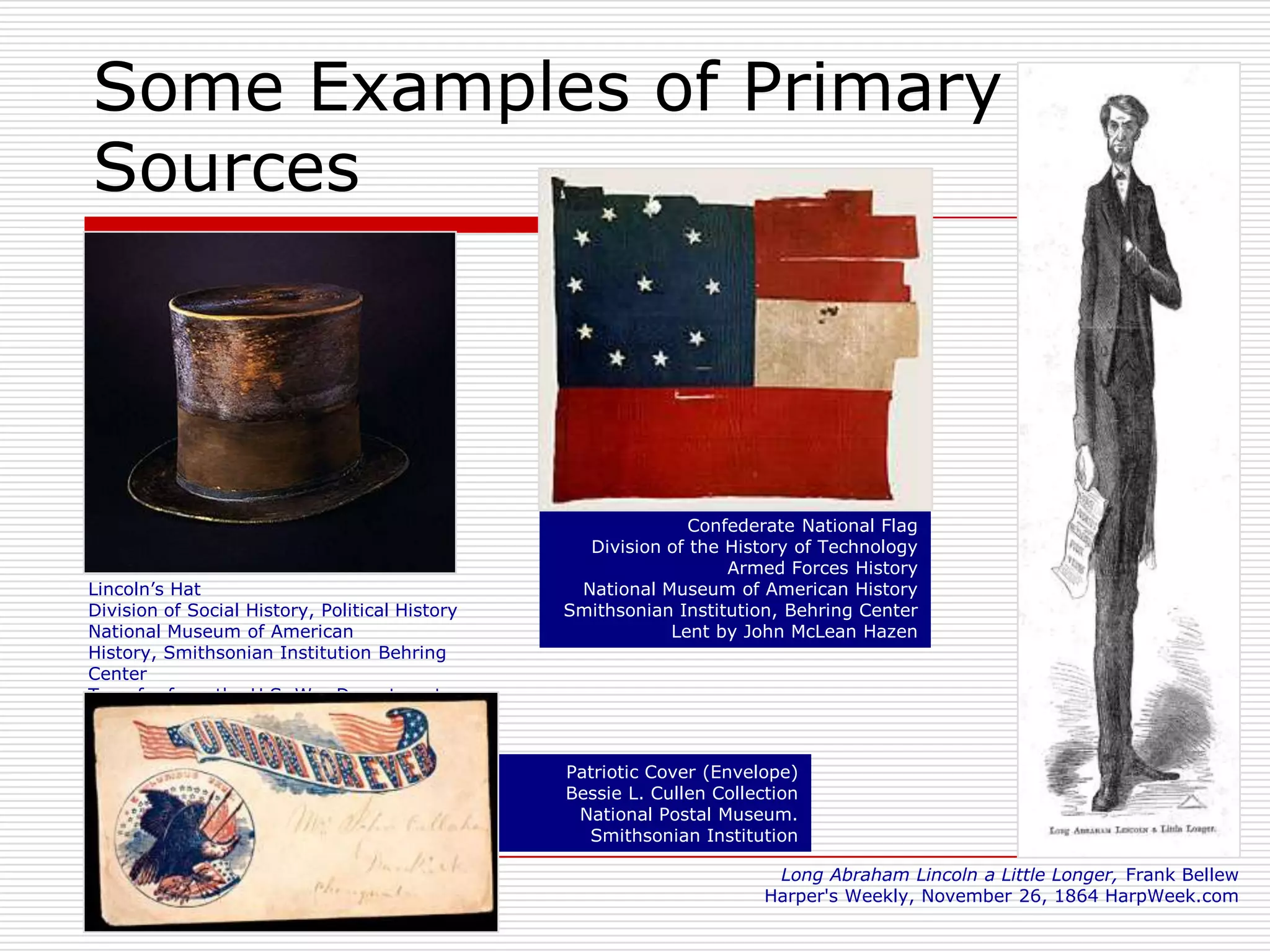
Confederate National FlagDivision of the History of Technology Armed Forces HistoryNational Museum of American HistorySmithsonian Institution, Behring CenterLent by John McLean Hazen Lincoln’s HatDivision of Social History, Political HistoryNational Museum of American History, Smithsonian Institution Behring CenterTransfer from the U.S. War DepartmentPatriotic Cover (Envelope) Bessie L. Cullen Collection National Postal Museum.Smithsonian InstitutionLong Abraham Lincoln a Little Longer, Frank Bellew Harper's Weekly, November 26, 1864 HarpWeek.comSome Examples of Primary Sources
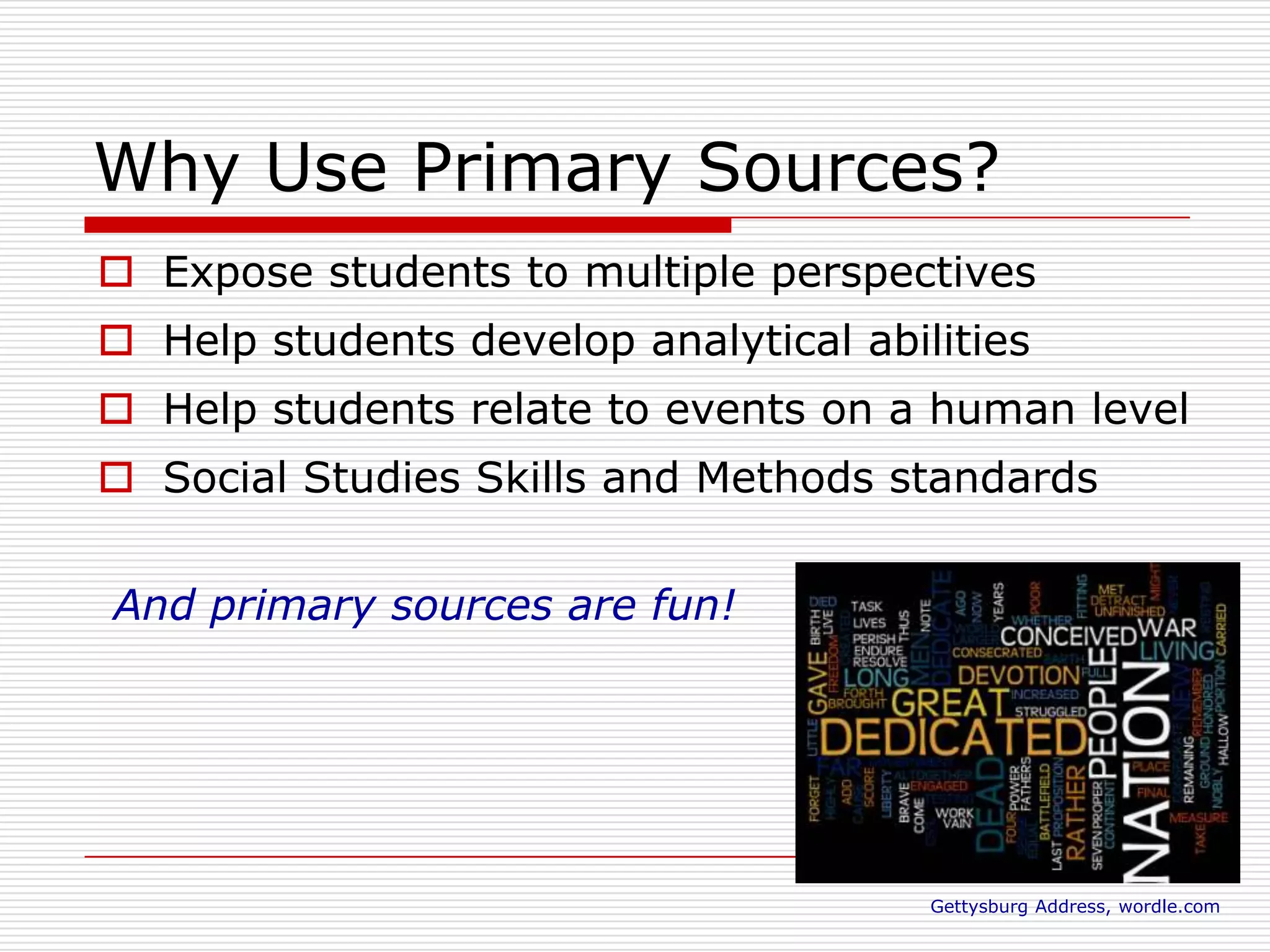
Why Use Primary Sources?Expose students to multiple perspectivesHelp students develop analytical abilitiesHelp students relate to events on a human levelSocial Studies Skills and Methods standardsAnd primary sources are fun!Gettysburg Address, wordle.com
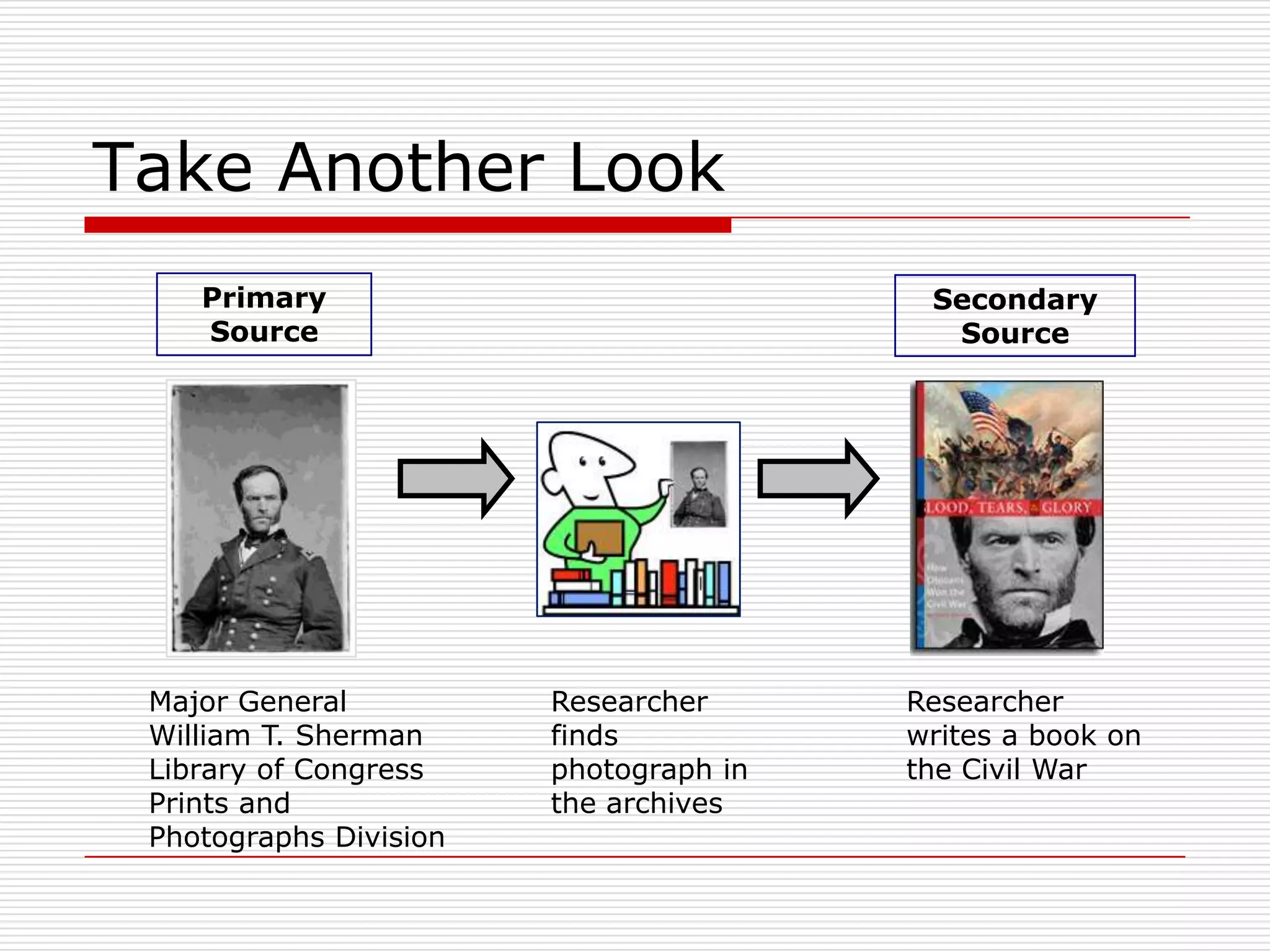
Take Another LookPrimary SourceSecondary SourceMajor GeneralWilliam T. Sherman Library of Congress Prints and Photographs DivisionResearcher finds photograph in the archivesResearcher writes a book on the Civil War
Selecting Primary SourcesThings to ConsiderInterestReading LevelLengthPoints of ViewVarietyDorothea Dix Letter to Dr. Flowers Regarding Appointment of Nurse, 1862Ohio Historical SocietyUnidentified African American Soldier in Union Uniform with Wife and Two Daughters, ca. 1863-1862Library of Congress Prints and Photographs Division
Where to Locate Primary SourcesOhio Historical Society www.ohiohistory.orgOhioPixwww.ohiohistory.org/ohiopixOhio Memory www.ohiomemory.orgAmerican Memory http://memory.loc.gov/ammem/National Archives www.archives.govLocal Historical Societies and Public LibrariesNational Colors of the Black Brigade of Cincinnati 1862Ohio Battleflag Collection Ohio Historical Society
Primary Source ActivityDevelop the Skills of HistoriansAnalyzeSynthesizeSupport an argumentProject-based learning
Primary Source ActivityDevelop the Skills of HistoriansAnalyzeSynthesizeSupport an argumentProject-based learning21st Century Learning Skills- Critical ThinkingExercise sound reasoning		Make complex choices		Understand interconnections		Frame, analyze and solve problems
Who’s That Lady?Description:Doing the Work of HistoriansBreak into groupsConsider the phrase “The First Lady”Quick, toss out 5 descriptive words and write each word on your activity sheetMake a sentence using                those words
Activity – Who’s that Lady?Now we’ll look at some sourcesCome up with 5 new descriptive words based on your evidence and write each word on a cardMake a sentence using those wordsShare your sentences with the class
CONGRATUATIONS!You’ve just made history!What differences did you see between your two sentences?Why?
Curating in the ClassroomBecause of your demonstrated knowledge of Ohio history and your considerable skill in the analysis and interpretation of primary source materials, you and your colleagues have been selected to be guest curators of the Ohio Historical Society and to develop a museum exhibit panel which will tell the story of immigration in Ohio
Curating in the ClassroomEach group has a packet of primary sourcesPick 5Name your exhibit (What is the unifying theme of your five sources?)Create your exhibitShare with the class
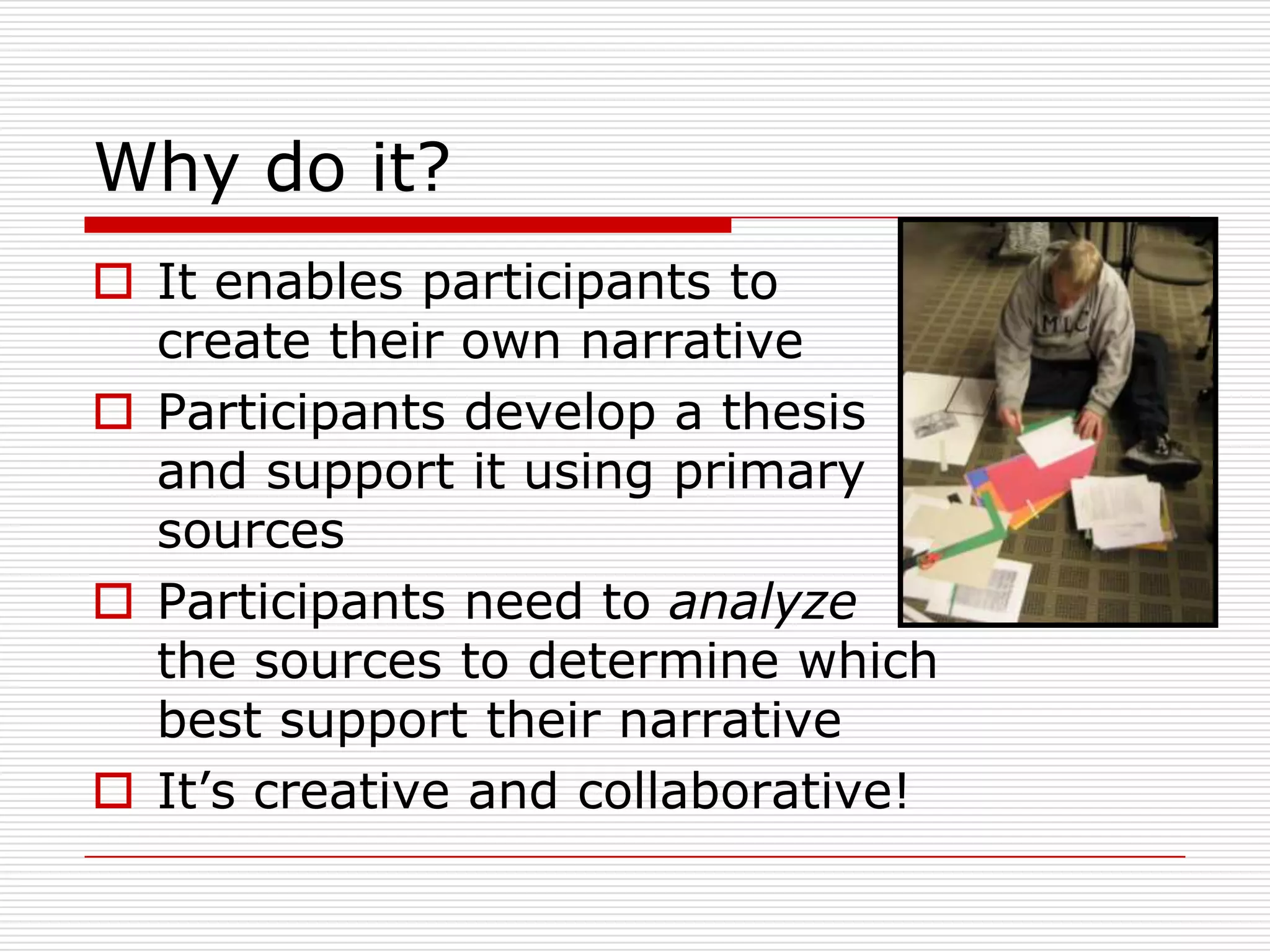
Why do it?It enables participants to create their own narrativeParticipants develop a thesis and support it using primary sourcesParticipants need to analyze the sources to determine which best support their narrativeIt’s creative and collaborative!
Works for almost any subjectParticipants form a historical narrative based on primary sources in a packet that is topic-specificAfrican Americans and the lawMigration to OhioWomen’s RightsThe possibilities are endless!
21st Century SkillsTechnology and Social Studieshttp://coolmaterial.com/roundup/if-historical-events-had-facebook-statuses/
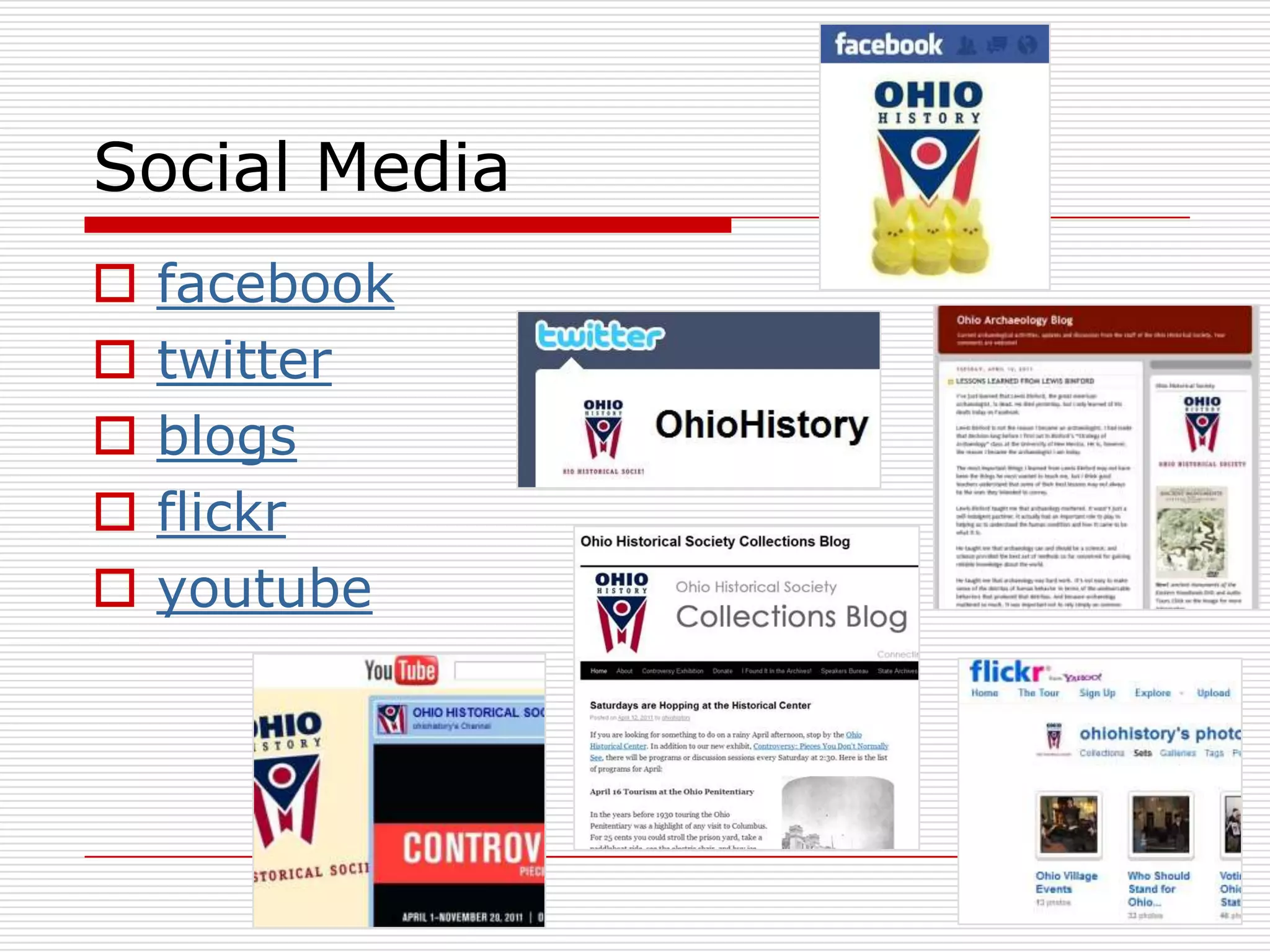
Social Studies 2.0	PostCommentTagUploadembedShareFriendFANLikeretweetCREATEMashup
Instead of an exhibit, how about a video?Created using Microsoft Photo Story 3 for Windows - Free Download
PowerPointFREE AlternativesOpenOffice IMPRESSOpen Source SoftwareGoogle docs Presentations	Advantage: Easy to share!slideshare

21st Century Skills in Social Studies Classrooms

  • 1.
    Making Collections Cometo LifePromoting 21st Century Skills in Social Studies Classrooms
  • 2.
    21st Century Skillsfor Social StudiesCritical Thinking and Problem SolvingContextual Learning SkillsCommunicationInformation and Media LiteracyCreativity and Innovation SkillsCollaboration Skills
  • 3.
    historyAn interpretative narrativeconcerning aspects of what happened in the past and the relationships between events and humanity; the end product of historiography as either the process of writing history or the study of that process…A distinguishing feature of history…is its methodology, which relies heavily on the critical use of documentary sources created by or about the society under scrutiny. Primary sources are those produced near the event under investigation; secondary sources are works of other, later writers.The Concise Oxford Dictionary of Archaeology. Timothy Darvill. Oxford University Press, 2008.
  • 4.
    historyAn interpretative narrativeconcerning aspects of what happened in the past and the relationships between events and humanity; the end product of historiography as either theprocess of writing historyor the study of that process…A distinguishing feature of history…is its methodology, which relies heavily on the critical use of documentary sources created by or about the society under scrutiny. Primary sources are those produced near the event under investigation; secondary sources are works of other, later writers.The Concise Oxford Dictionary of Archaeology. Timothy Darvill. Oxford University Press, 2008.
  • 5.
    A Primary Sourceis…An artifact of its time
  • 6.
    A first-hand accountof an historic eventA Secondary Source is…A commentary or analysis of a historical event based on primary sourcesClara Barton, ca. 1860 – 1865Brady National Photographic Art GalleryStill Picture Records Section, Special Media Archives Services Division, National Archives
  • 7.
    ExamplesPrimary SourcesJournal ordiaryLettersNewspaper articlesPamphletsPhotographsClothingOriginal buildingsBroadsides ArtifactsCartoonsMapsRecipesSecondary SourcesText bookBook or article about an eventWikipediaDocumentariesUlysses S. Grant Document Box, 1864Ohio Historical Society
  • 8.
    Wait a minute...What’sWrong with Secondary Sources?Historians use both primary and secondary sourcesSecondary sources tell us: Who is that?
  • 9.
  • 10.
  • 11.
    Clues tofind out morePortrait of an Unidentified Woman Ohio Historical Society
  • 12.
    Confederate National FlagDivisionof the History of Technology Armed Forces HistoryNational Museum of American HistorySmithsonian Institution, Behring CenterLent by John McLean Hazen Lincoln’s HatDivision of Social History, Political HistoryNational Museum of American History, Smithsonian Institution Behring CenterTransfer from the U.S. War DepartmentPatriotic Cover (Envelope) Bessie L. Cullen Collection National Postal Museum.Smithsonian InstitutionLong Abraham Lincoln a Little Longer, Frank Bellew Harper's Weekly, November 26, 1864 HarpWeek.comSome Examples of Primary Sources
  • 13.
    Why Use PrimarySources?Expose students to multiple perspectivesHelp students develop analytical abilitiesHelp students relate to events on a human levelSocial Studies Skills and Methods standardsAnd primary sources are fun!Gettysburg Address, wordle.com
  • 14.
    Take Another LookPrimarySourceSecondary SourceMajor GeneralWilliam T. Sherman Library of Congress Prints and Photographs DivisionResearcher finds photograph in the archivesResearcher writes a book on the Civil War
  • 15.
    Selecting Primary SourcesThingsto ConsiderInterestReading LevelLengthPoints of ViewVarietyDorothea Dix Letter to Dr. Flowers Regarding Appointment of Nurse, 1862Ohio Historical SocietyUnidentified African American Soldier in Union Uniform with Wife and Two Daughters, ca. 1863-1862Library of Congress Prints and Photographs Division
  • 16.
    Where to LocatePrimary SourcesOhio Historical Society www.ohiohistory.orgOhioPixwww.ohiohistory.org/ohiopixOhio Memory www.ohiomemory.orgAmerican Memory http://memory.loc.gov/ammem/National Archives www.archives.govLocal Historical Societies and Public LibrariesNational Colors of the Black Brigade of Cincinnati 1862Ohio Battleflag Collection Ohio Historical Society
  • 17.
    Primary Source ActivityDevelopthe Skills of HistoriansAnalyzeSynthesizeSupport an argumentProject-based learning
  • 18.
    Primary Source ActivityDevelopthe Skills of HistoriansAnalyzeSynthesizeSupport an argumentProject-based learning21st Century Learning Skills- Critical ThinkingExercise sound reasoning Make complex choices Understand interconnections Frame, analyze and solve problems
  • 19.
    Who’s That Lady?Description:Doingthe Work of HistoriansBreak into groupsConsider the phrase “The First Lady”Quick, toss out 5 descriptive words and write each word on your activity sheetMake a sentence using those words
  • 20.
    Activity – Who’sthat Lady?Now we’ll look at some sourcesCome up with 5 new descriptive words based on your evidence and write each word on a cardMake a sentence using those wordsShare your sentences with the class
  • 21.
    CONGRATUATIONS!You’ve just madehistory!What differences did you see between your two sentences?Why?
  • 22.
    Curating in theClassroomBecause of your demonstrated knowledge of Ohio history and your considerable skill in the analysis and interpretation of primary source materials, you and your colleagues have been selected to be guest curators of the Ohio Historical Society and to develop a museum exhibit panel which will tell the story of immigration in Ohio
  • 23.
    Curating in theClassroomEach group has a packet of primary sourcesPick 5Name your exhibit (What is the unifying theme of your five sources?)Create your exhibitShare with the class
  • 24.
    Why do it?Itenables participants to create their own narrativeParticipants develop a thesis and support it using primary sourcesParticipants need to analyze the sources to determine which best support their narrativeIt’s creative and collaborative!
  • 25.
    Works for almostany subjectParticipants form a historical narrative based on primary sources in a packet that is topic-specificAfrican Americans and the lawMigration to OhioWomen’s RightsThe possibilities are endless!
  • 26.
    21st Century SkillsTechnologyand Social Studieshttp://coolmaterial.com/roundup/if-historical-events-had-facebook-statuses/
  • 27.
  • 28.
    Instead of anexhibit, how about a video?Created using Microsoft Photo Story 3 for Windows - Free Download
  • 29.
    PowerPointFREE AlternativesOpenOffice IMPRESSOpenSource SoftwareGoogle docs Presentations Advantage: Easy to share!slideshare
  • 30.
    History as ConversationInJanuary 2008, the Library of Congress launched a pilot program on FlickrNot only did people look; but they tag, favorite, share, comment,and enhance the Prints and Photographs catalog records with new information!http://www.flickr.com/photos/library_of_congress
  • 31.
  • 32.
  • 33.