TEACHER: marina_hurt
History 4
HOW TO ANALYSE A
HISTORICAL MAP?
These steps can guide you:
When analysing a map we need to observe it and pay close attention to
certain details: What is the title? Is there a scale and compass?
What is in the legend?
You need to observe its parts: What place or places are shown? What is
labeled? If there are symbols or colors, what do they stand for? When is it
from?
And then try to make sense of it: What was happening at the time in history
this map was made? Why was it created? List evidence from the map or your
knowledge about the mapmaker that led you to your conclusion.
Write one sentence summarizing this map. How does it compare to a current
map of the same place?
You can now use it as a historical evidence: What did you find out from this
map that you might not learn anywhere else?
What other documents or historical evidence are you going to use to help you
understand this event or topic?
HISTORICAL MAPS ANALYSIS
Some tips
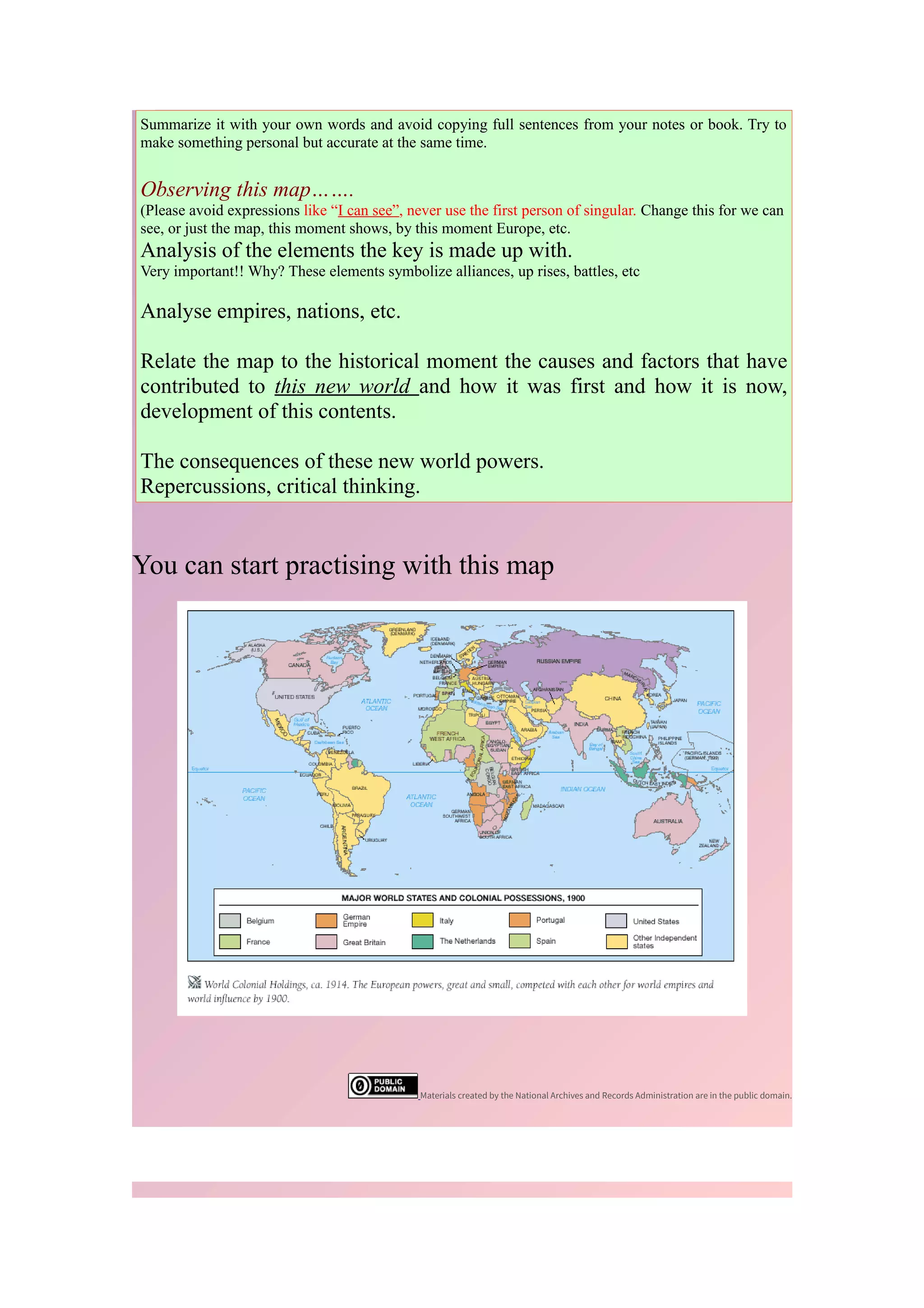
This map represents the world in……….
Add information of the historical event that modified the political borders, what happened and why?
Summarize it with your own words and avoid copying full sentences from your notes or book. Try to
make something personal but accurate at the same time.
Observing this map…….
(Please avoid expressions like “I can see”, never use the first person of singular. Change this for we can
see, or just the map, this moment shows, by this moment Europe, etc.
Analysis of the elements the key is made up with.
Very important!! Why? These elements symbolize alliances, up rises, battles, etc
Analyse empires, nations, etc.
Relate the map to the historical moment the causes and factors that have
contributed to this new world and how it was first and how it is now,
development of this contents.
The consequences of these new world powers.
Repercussions, critical thinking.
You can start practising with this map
Materials created by the National Archives and Records Administration are in the public domain.
Historical maps analysis

Historical maps analysis

  • 1.
    TEACHER: marina_hurt History 4 HOWTO ANALYSE A HISTORICAL MAP? These steps can guide you: When analysing a map we need to observe it and pay close attention to certain details: What is the title? Is there a scale and compass? What is in the legend? You need to observe its parts: What place or places are shown? What is labeled? If there are symbols or colors, what do they stand for? When is it from? And then try to make sense of it: What was happening at the time in history this map was made? Why was it created? List evidence from the map or your knowledge about the mapmaker that led you to your conclusion. Write one sentence summarizing this map. How does it compare to a current map of the same place? You can now use it as a historical evidence: What did you find out from this map that you might not learn anywhere else? What other documents or historical evidence are you going to use to help you understand this event or topic? HISTORICAL MAPS ANALYSIS Some tips This map represents the world in………. Add information of the historical event that modified the political borders, what happened and why?
  • 2.
    Summarize it withyour own words and avoid copying full sentences from your notes or book. Try to make something personal but accurate at the same time. Observing this map……. (Please avoid expressions like “I can see”, never use the first person of singular. Change this for we can see, or just the map, this moment shows, by this moment Europe, etc. Analysis of the elements the key is made up with. Very important!! Why? These elements symbolize alliances, up rises, battles, etc Analyse empires, nations, etc. Relate the map to the historical moment the causes and factors that have contributed to this new world and how it was first and how it is now, development of this contents. The consequences of these new world powers. Repercussions, critical thinking. You can start practising with this map Materials created by the National Archives and Records Administration are in the public domain.