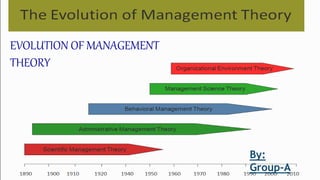
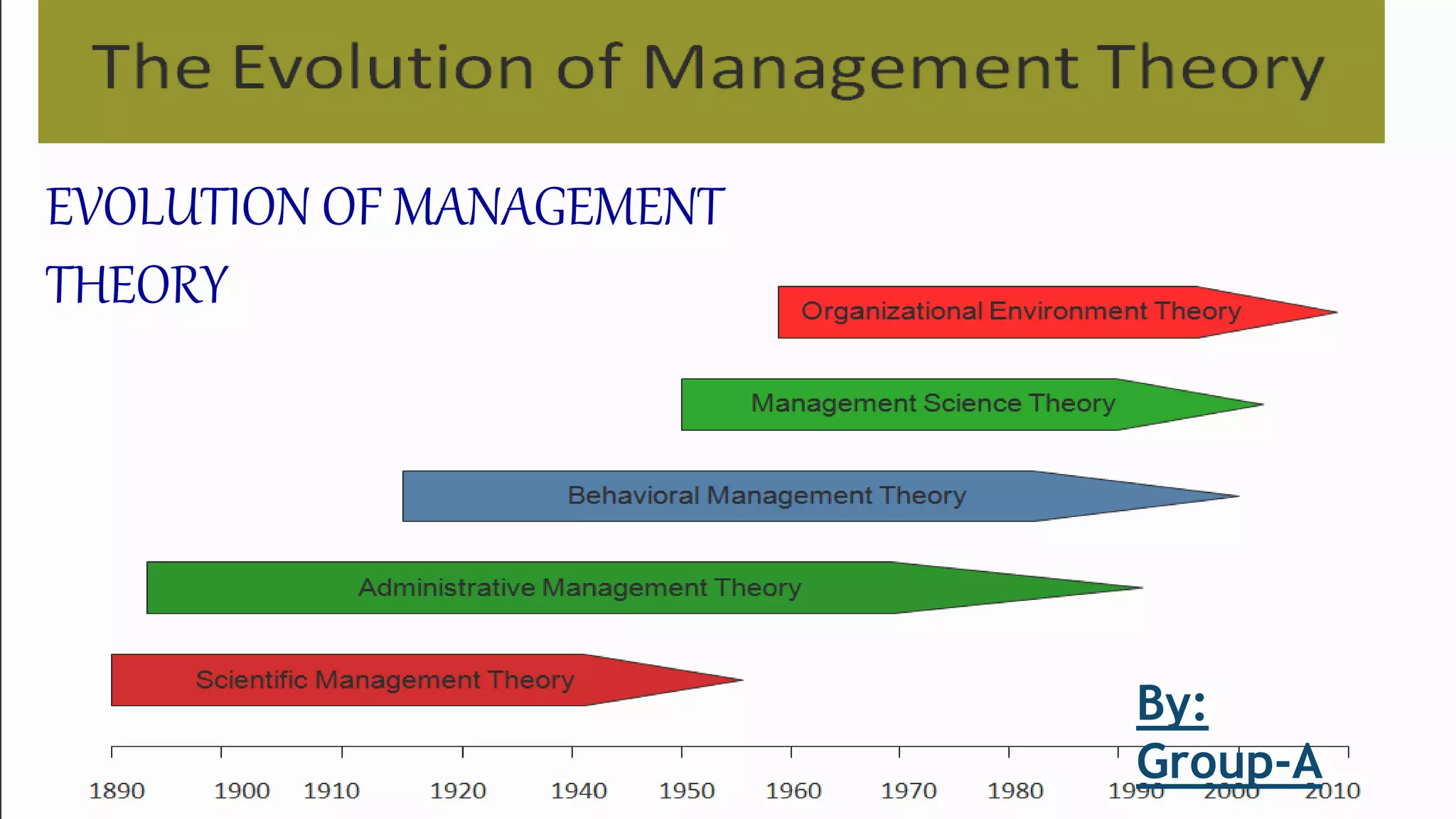
EVOLUTION OF MANAGEMENT
THEORY
By:
Group-A
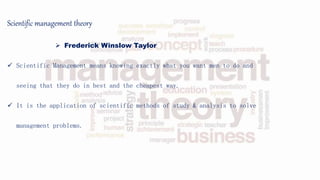
Scientific management theory
 Frederick Winslow Taylor
 Scientific Management means knowing exactly what you want men to do and
seeing that they do in best and the cheapest way.
 It is the application of scientific methods of study & analysis to solve
management problems.
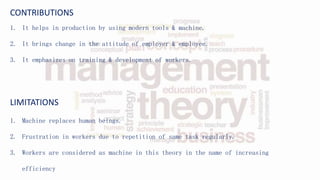
CONTRIBUTIONS
1. It helps in production by using modern tools & machine.
2. It brings change in the attitude of employer & employee.
3. It emphasizes on training & development of workers.
LIMITATIONS
1. Machine replaces human beings.
2. Frustration in workers due to repetition of same task regularly.
3. Workers are considered as machine in this theory in the name of increasing
efficiency
Administrative management theory
 Henry Fayol
It defines management as the process of getting things done through & with people
in organized groups.
Depending on his experience Fayol gave 14 principles of management:
1. Division of work
2. Authority
3. Discipline
4. Unity of command
5. Unity of direction
6. Subordinates choice
7. Remuneration
8. Centralization
9. The scalar chain
10. Order
11. Equity
12. Stability of Tenure
13. Initiative
14. Esprit De Corps
CONTRIBUTIONS
1. Administrative management theory laid heavy emphasis on universal principles of
management
2. This theory laid the foundation for the study of management function-POSDC.
3. This theory has provided the conceptual framework for analyzing the management
process
LIMITATIONS
1. This theory has not paid proper attention to the human behavior aspect.
2. This principle is based on personal experience & little observation
3. This theory is inconsistent as it has not considered situational factors.
Behavior science Theory
 Behavior science Theory is an improved & more modern vision of human relation approach
 Famous Behavior Scientist have made Notable contribution which are listed:
 Need Hierarchy Theory
 Theory X and Y
 Two Factor Theory
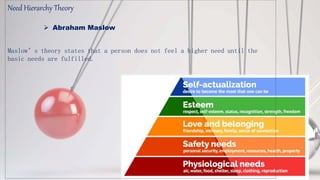
Need Hierarchy Theory
 Abraham Maslow
Maslow’s theory states that a person does not feel a higher need until the
basic needs are fulfilled.
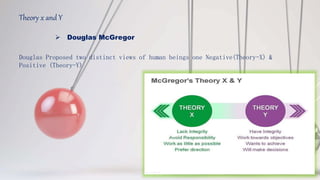
Theory x and Y
 Douglas McGregor
Douglas Proposed two distinct views of human beings one Negative(Theory-X) &
Positive (Theory-Y)
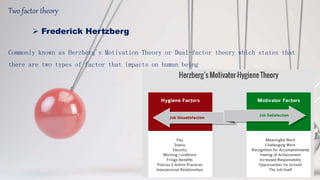
Two factor theory
 Frederick Hertzberg
Commonly known as Herzberg's Motivation Theory or Dual-factor theory which states that
there are two types of factor that impacts on human being
CONTRIBUTIONS
1. This theory has identified the role of human element in organization
2. It has focused on Non-financial rewards
Limitation
1. It has clinical bias & Lacks scientific validity
2. It has viewed Management only form behavioral aspect
Management science theory
 Joel Dean & PMS Blackett
 Management Science Theory focuses on Mathematical & Statistical aspect for decision
making, Linear programming, Game theory and solving Management problems.
 It’s main feature is the use of mixed terms of science from several disciplines
CONTRIBUTIONS
1. This theory encourages disciplined thinking while defining the problems and
establishing relations among variables.
2. Complex relations among variables can be expressed effectively.
Limitation
1. It doesn’t deals with human aspect.
2. It requires unrealistic or unfounded assumptions.
The systemapproach theory
 It is a concept that regards an organization as comprising three purposively designed
parts that are interconnected: input, process and output
 Systems theory treats an organization as a system which can be either closed or open, but
most approaches treat an organization as an open system.
 An open system interacts with its environment by way of inputs, throughputs, and
outputs
Contributions
 It provides a conceptual framework for a meaningful analysis of management
 It tries to integrate various management theories by emphasizing the physical aspect,
behavioral aspect & environmental considerations.
 It exhorts managers to analyze and understand every element of problem.
Limitations
 It is too abstract & cannot be easily applied to practice.
 It does not offer any tools & techniques of integration.
The contingency theory
According to this theory there is no one best way of organizing and leading an organizational
or leadership style that is effective in some situations may not be successful in others.
Contingency variables that determine management practices are:
1. Organizational size
2. Routines of task technology
3. Environmental uncertainty
4. Individual differences
CONTRIBUTIONS
 There is no universal or one best way to manage
 Managers are given more freedom
 It gives them the capability to think in analytical, critical & multidimensional ways
LIMITATIONS
 It ignores the universally applicable principles.
 It fails to enlist all the contingency variables.
 It focuses on more situation but which tools should be used in what situation is not
specified.
ANY QUERIES ???

Evolution of management theories

  • 1.
  • 3.
    Scientific management theory Frederick Winslow Taylor  Scientific Management means knowing exactly what you want men to do and seeing that they do in best and the cheapest way.  It is the application of scientific methods of study & analysis to solve management problems.
  • 4.
    CONTRIBUTIONS 1. It helpsin production by using modern tools & machine. 2. It brings change in the attitude of employer & employee. 3. It emphasizes on training & development of workers. LIMITATIONS 1. Machine replaces human beings. 2. Frustration in workers due to repetition of same task regularly. 3. Workers are considered as machine in this theory in the name of increasing efficiency
  • 5.
    Administrative management theory Henry Fayol It defines management as the process of getting things done through & with people in organized groups. Depending on his experience Fayol gave 14 principles of management: 1. Division of work 2. Authority 3. Discipline 4. Unity of command 5. Unity of direction 6. Subordinates choice 7. Remuneration 8. Centralization 9. The scalar chain 10. Order 11. Equity 12. Stability of Tenure 13. Initiative 14. Esprit De Corps
  • 6.
    CONTRIBUTIONS 1. Administrative managementtheory laid heavy emphasis on universal principles of management 2. This theory laid the foundation for the study of management function-POSDC. 3. This theory has provided the conceptual framework for analyzing the management process LIMITATIONS 1. This theory has not paid proper attention to the human behavior aspect. 2. This principle is based on personal experience & little observation 3. This theory is inconsistent as it has not considered situational factors.
  • 7.
    Behavior science Theory Behavior science Theory is an improved & more modern vision of human relation approach  Famous Behavior Scientist have made Notable contribution which are listed:  Need Hierarchy Theory  Theory X and Y  Two Factor Theory
  • 8.
    Need Hierarchy Theory Abraham Maslow Maslow’s theory states that a person does not feel a higher need until the basic needs are fulfilled.
  • 9.
    Theory x andY  Douglas McGregor Douglas Proposed two distinct views of human beings one Negative(Theory-X) & Positive (Theory-Y)
  • 10.
    Two factor theory Frederick Hertzberg Commonly known as Herzberg's Motivation Theory or Dual-factor theory which states that there are two types of factor that impacts on human being
  • 11.
    CONTRIBUTIONS 1. This theoryhas identified the role of human element in organization 2. It has focused on Non-financial rewards Limitation 1. It has clinical bias & Lacks scientific validity 2. It has viewed Management only form behavioral aspect
  • 12.
    Management science theory Joel Dean & PMS Blackett  Management Science Theory focuses on Mathematical & Statistical aspect for decision making, Linear programming, Game theory and solving Management problems.  It’s main feature is the use of mixed terms of science from several disciplines
  • 13.
    CONTRIBUTIONS 1. This theoryencourages disciplined thinking while defining the problems and establishing relations among variables. 2. Complex relations among variables can be expressed effectively. Limitation 1. It doesn’t deals with human aspect. 2. It requires unrealistic or unfounded assumptions.
  • 14.
    The systemapproach theory It is a concept that regards an organization as comprising three purposively designed parts that are interconnected: input, process and output  Systems theory treats an organization as a system which can be either closed or open, but most approaches treat an organization as an open system.  An open system interacts with its environment by way of inputs, throughputs, and outputs
  • 15.
    Contributions  It providesa conceptual framework for a meaningful analysis of management  It tries to integrate various management theories by emphasizing the physical aspect, behavioral aspect & environmental considerations.  It exhorts managers to analyze and understand every element of problem. Limitations  It is too abstract & cannot be easily applied to practice.  It does not offer any tools & techniques of integration.
  • 16.
    The contingency theory Accordingto this theory there is no one best way of organizing and leading an organizational or leadership style that is effective in some situations may not be successful in others. Contingency variables that determine management practices are: 1. Organizational size 2. Routines of task technology 3. Environmental uncertainty 4. Individual differences
  • 17.
    CONTRIBUTIONS  There isno universal or one best way to manage  Managers are given more freedom  It gives them the capability to think in analytical, critical & multidimensional ways LIMITATIONS  It ignores the universally applicable principles.  It fails to enlist all the contingency variables.  It focuses on more situation but which tools should be used in what situation is not specified.
  • 18.