Histocompatibility in Kidney Transplantation
DR SCIENTHIA SANJEEVANI
 first human leukocyte antigens (HLAs) were discovered in 1958 by Jean Dausset,
Rose Payne, and Jon van Rood. characterized using antibodies

 in sera obtained from multiparous women andfrom patients after multiple blood
transfusions
THE HLA SYSTEM
 recognized as the human equivalent of the major histocompatibility complex
(MHC), previously identified in inbred rodents, the products of which control the
recognition of self and foreign antigen
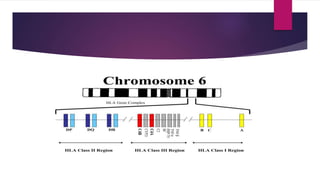
 encoded on the short arm of chromosome 6
 most intensively studied region of the human genome.
 The region spans over 4 mega bases and contains in excess of 250 expressed
genes, making it the most gene dense region characterized to date.
 about 28% ofthese genes encode proteins with immune-related functions.
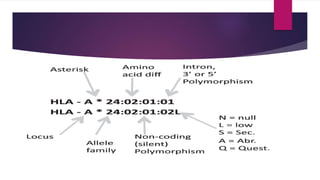
 complex multigene family consisting of more than 10 loci.
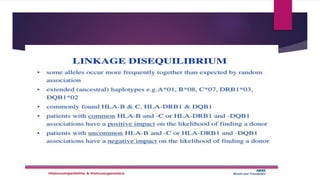
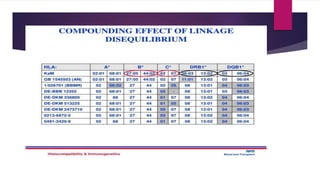
 HLA types are codominantly inherited on a maternal and paternal haplotype and
transmitted as a single Mendelian trait
HLA CLASS I
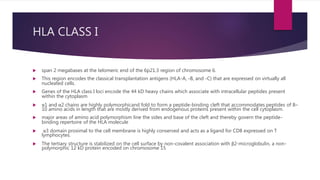
 span 2 megabases at the telomeric end of the 6p21.3 region of chromosome 6.
 This region encodes the classical transplantation antigens (HLA-A, -B, and -C) that are expressed on virtually all
nucleated cells.
 Genes of the HLA class I loci encode the 44 kD heavy chains which associate with intracellular peptides present
within the cytoplasm
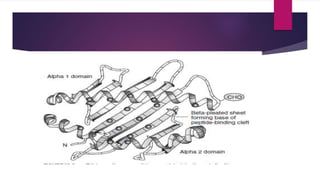
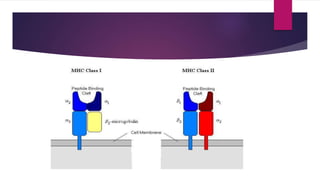
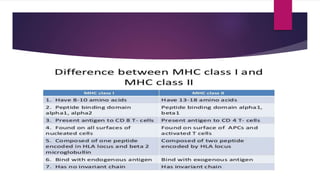
 α1 and α2 chains are highly polymorphicand fold to form a peptide-binding cleft that accommodates peptides of 8–
10 amino acids in length that are mostly derived from endogenous proteins present within the cell cytoplasm.
 major areas of amino acid polymorphism line the sides and base of the cleft and thereby govern the peptide-
binding repertoire of the HLA molecule
 α3 domain proximal to the cell membrane is highly conserved and acts as a ligand for CD8 expressed on T
lymphocytes.
 The tertiary structure is stabilized on the cell surface by non-covalent association with β2-microglobulin, a non-
polymorphic 12 kD protein encoded on chromosome 15
CLASS I LOCI
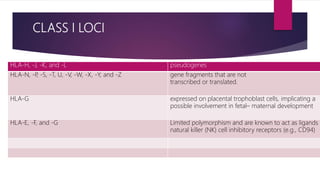
HLA-H, -J, -K, and -L pseudogenes
HLA-N, -P, -S, -T, U, -V, -W, -X, -Y, and -Z gene fragments that are not
transcribed or translated.
HLA-G expressed on placental trophoblast cells, implicating a
possible involvement in fetal– maternal development
HLA-E, -F, and -G Limited polymorphism and are known to act as ligands
natural killer (NK) cell inhibitory receptors (e.g., CD94)
HLA Class II
 consists of three main loci: HLA-DR, -DQ, and -DP.
 The glycoprotein products are heterodimers with non-covalently associated alpha and beta chains of molecular weight
approximately 33 kD and 28 kD, respectively.
 Both chains have two extracellular immunoglobulin- like domains, a transmembrane region and a cytoplasmic tail
 The membrane distal domains α1 and α1 form a peptide binding , accommodating peptides of 10–20 amino acids that
are derived predominantly from ingested (endocytosed or phagocytosed) extracellular (exogenous) proteins
 The α1 domains of HLA-DR, -DQ, and -DP are highly polymorphic and so govern the peptide binding repertoire. They
are constitutively expressed on cells with immune function such as B lymphocytes, activated T lymphocytes, and antigen
presenting cells (monocytes, macrophages, and cells of dendritic lineage).
 The conserved membrane proximal domain associates with CD4 on T lymphocytes with predominantly helper/inducer
function and thereby confers HLA class II restriction and forms the basis of cellular and humoral immunity to circulating
pathogens such as bacteria.
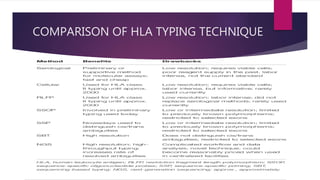
COMPARISON OF HLA TYPING TECHNIQUE
HLA-SPECIFIC ALLOSENSITIZATION
Routes of Sensitization
 blood transfusion
 Pregnancy
 previous organ transplantation-poorly HLAmatched kidneys can result in allosensitization to the
mismatched donor HLA.
 idiopathic (natural) HLAspecific antibodies result from cross-reactivity with infectious agents,
reactive with specific epitopes expressed on denatured HLA proteins but absent on HLA proteins in their
native form do not react with native antigen in cell-based assays and are considered non-harmful to a
transplanted kidney
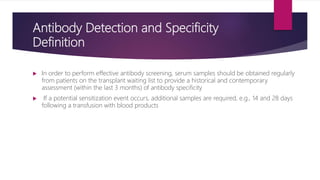
Antibody Detection and Specificity
Definition
 In order to perform effective antibody screening, serum samples should be obtained regularly
from patients on the transplant waiting list to provide a historical and contemporary
assessment (within the last 3 months) of antibody specificity
 If a potential sensitization event occurs, additional samples are required, e.g., 14 and 28 days
following a transfusion with blood products
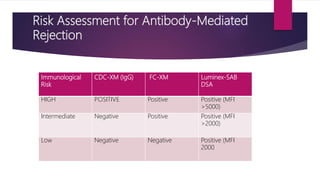
Risk Assessment for Antibody-Mediated
Rejection
Immunological
Risk
CDC-XM (IgG) FC-XM Luminex-SAB
DSA
HIGH POSITIVE Positive Positive (MFI
>5000)
Intermediate Negative Positive Positive (MFI
>2000)
Low Negative Negative Positive (MFI
2000
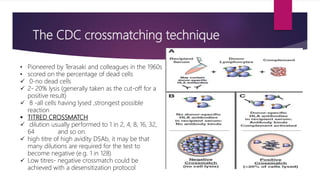
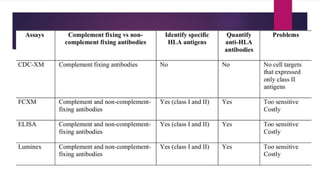
The CDC crossmatching technique
• Pioneered by Terasaki and colleagues in the 1960s
• scored on the percentage of dead cells
 0-no dead cells
 2- 20% lysis (generally taken as the cut-off for a
positive result)
 8 -all cells having lysed ,strongest possible
reaction
 TITRED CROSSMATCH
 dilution usually performed to 1 in 2, 4, 8, 16, 32,
64 and so on.
 high titre of high avidity DSAb, it may be that
many dilutions are required for the test to
become negative (e.g. 1 in 128)
 Low titres- negative crossmatch could be
achieved with a desensitization protocol
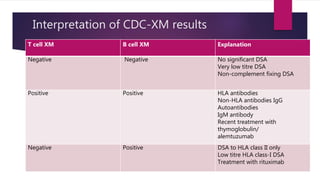
Interpretation of CDC-XM results
T cell XM B cell XM Explanation
Negative Negative No significant DSA
Very low titre DSA
Non-complement fixing DSA
Positive Positive HLA antibodies
Non-HLA antibodies IgG
Autoantibodies
IgM antibody
Recent treatment with
thymoglobulin/
alemtuzumab
Negative Positive DSA to HLA class II only
Low titre HLA class-I DSA
Treatment with rituximab
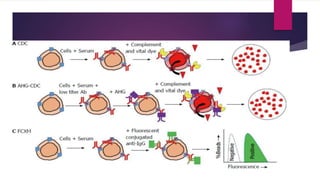
The Flow-Cytometry Crossmatch (FCXM)
 1990’s
 depends on donor lymphocytes
being incubated with recipient
serum and flourocein dye
 semi-quantitative and more
objective
Solid Phase Immunoassay (SPI)
 commercial kits of purified recombinant HLA molecules coated on a microtitre
plate or synthetic beads
 specific for HLA antibodies
 Can be done by
 ELISA-purified recombinant HLA molecules coated on a microtitre plate
more sensitive than CDCXM
 LUMINEX- synthetic beads, more sensitive than CDCXM AND FCXM
SAB
 relevant beads are all coated with a single cloned antigen.
 most precise and specific in detecting DSA against a specific antigen
Epitope matching
 limited area of the HLA molecule comprising a 15-25 amino acid sequence
 Can be private and public
 public epitopes result in numerous cross-reactions during HLA testing that result in
false positive results
 can be done both in the laboratory (in-vitro) and from a computed based system (in-
silico)
 highly specific SAB system is the commonest in-vitro epitope based matching system
 The most widely used computer-based algorithm is the ‘HLA Matchmaker
algorithm’- allows donor and recipient matching based on epitopes and has been
used especially in relation to transplanting highly sensitized recipients.
The Virtual Crossmatch (VXM)
 Advancement from wet XM
 The antigens against which DSA are detected are referred to as Unacceptable
Antigens (UA), which can trigger HAR
 compares the recipient’s UA against the HLA screening of the potential donor,
by a virtual matching process rather than an actual laboratory ‘wet’ crossmatch
Panel Reactive Antibodies
 Testing recipient sera against a panel of donor lymphocytes from a sample of
donors representing the potential local donor population
 recipient’s %PRA indicates the probability of having a positive crossmatch against
a given donor from that population and thereby the chances of receiving a
crossmatch negative kidney
Histocompatibility in kidney transplantation

Histocompatibility in kidney transplantation

  • 1.
    Histocompatibility in KidneyTransplantation DR SCIENTHIA SANJEEVANI
  • 2.
     first humanleukocyte antigens (HLAs) were discovered in 1958 by Jean Dausset, Rose Payne, and Jon van Rood. characterized using antibodies  in sera obtained from multiparous women andfrom patients after multiple blood transfusions
  • 3.
    THE HLA SYSTEM recognized as the human equivalent of the major histocompatibility complex (MHC), previously identified in inbred rodents, the products of which control the recognition of self and foreign antigen  encoded on the short arm of chromosome 6  most intensively studied region of the human genome.  The region spans over 4 mega bases and contains in excess of 250 expressed genes, making it the most gene dense region characterized to date.  about 28% ofthese genes encode proteins with immune-related functions.
  • 5.
     complex multigenefamily consisting of more than 10 loci.  HLA types are codominantly inherited on a maternal and paternal haplotype and transmitted as a single Mendelian trait
  • 6.
    HLA CLASS I span 2 megabases at the telomeric end of the 6p21.3 region of chromosome 6.  This region encodes the classical transplantation antigens (HLA-A, -B, and -C) that are expressed on virtually all nucleated cells.  Genes of the HLA class I loci encode the 44 kD heavy chains which associate with intracellular peptides present within the cytoplasm  α1 and α2 chains are highly polymorphicand fold to form a peptide-binding cleft that accommodates peptides of 8– 10 amino acids in length that are mostly derived from endogenous proteins present within the cell cytoplasm.  major areas of amino acid polymorphism line the sides and base of the cleft and thereby govern the peptide- binding repertoire of the HLA molecule  α3 domain proximal to the cell membrane is highly conserved and acts as a ligand for CD8 expressed on T lymphocytes.  The tertiary structure is stabilized on the cell surface by non-covalent association with β2-microglobulin, a non- polymorphic 12 kD protein encoded on chromosome 15
  • 7.
    CLASS I LOCI HLA-H,-J, -K, and -L pseudogenes HLA-N, -P, -S, -T, U, -V, -W, -X, -Y, and -Z gene fragments that are not transcribed or translated. HLA-G expressed on placental trophoblast cells, implicating a possible involvement in fetal– maternal development HLA-E, -F, and -G Limited polymorphism and are known to act as ligands natural killer (NK) cell inhibitory receptors (e.g., CD94)
  • 8.
    HLA Class II consists of three main loci: HLA-DR, -DQ, and -DP.  The glycoprotein products are heterodimers with non-covalently associated alpha and beta chains of molecular weight approximately 33 kD and 28 kD, respectively.  Both chains have two extracellular immunoglobulin- like domains, a transmembrane region and a cytoplasmic tail  The membrane distal domains α1 and α1 form a peptide binding , accommodating peptides of 10–20 amino acids that are derived predominantly from ingested (endocytosed or phagocytosed) extracellular (exogenous) proteins  The α1 domains of HLA-DR, -DQ, and -DP are highly polymorphic and so govern the peptide binding repertoire. They are constitutively expressed on cells with immune function such as B lymphocytes, activated T lymphocytes, and antigen presenting cells (monocytes, macrophages, and cells of dendritic lineage).  The conserved membrane proximal domain associates with CD4 on T lymphocytes with predominantly helper/inducer function and thereby confers HLA class II restriction and forms the basis of cellular and humoral immunity to circulating pathogens such as bacteria.
  • 19.
    COMPARISON OF HLATYPING TECHNIQUE
  • 20.
    HLA-SPECIFIC ALLOSENSITIZATION Routes ofSensitization  blood transfusion  Pregnancy  previous organ transplantation-poorly HLAmatched kidneys can result in allosensitization to the mismatched donor HLA.  idiopathic (natural) HLAspecific antibodies result from cross-reactivity with infectious agents, reactive with specific epitopes expressed on denatured HLA proteins but absent on HLA proteins in their native form do not react with native antigen in cell-based assays and are considered non-harmful to a transplanted kidney
  • 21.
    Antibody Detection andSpecificity Definition  In order to perform effective antibody screening, serum samples should be obtained regularly from patients on the transplant waiting list to provide a historical and contemporary assessment (within the last 3 months) of antibody specificity  If a potential sensitization event occurs, additional samples are required, e.g., 14 and 28 days following a transfusion with blood products
  • 22.
    Risk Assessment forAntibody-Mediated Rejection Immunological Risk CDC-XM (IgG) FC-XM Luminex-SAB DSA HIGH POSITIVE Positive Positive (MFI >5000) Intermediate Negative Positive Positive (MFI >2000) Low Negative Negative Positive (MFI 2000
  • 23.
    The CDC crossmatchingtechnique • Pioneered by Terasaki and colleagues in the 1960s • scored on the percentage of dead cells  0-no dead cells  2- 20% lysis (generally taken as the cut-off for a positive result)  8 -all cells having lysed ,strongest possible reaction  TITRED CROSSMATCH  dilution usually performed to 1 in 2, 4, 8, 16, 32, 64 and so on.  high titre of high avidity DSAb, it may be that many dilutions are required for the test to become negative (e.g. 1 in 128)  Low titres- negative crossmatch could be achieved with a desensitization protocol
  • 25.
    Interpretation of CDC-XMresults T cell XM B cell XM Explanation Negative Negative No significant DSA Very low titre DSA Non-complement fixing DSA Positive Positive HLA antibodies Non-HLA antibodies IgG Autoantibodies IgM antibody Recent treatment with thymoglobulin/ alemtuzumab Negative Positive DSA to HLA class II only Low titre HLA class-I DSA Treatment with rituximab
  • 27.
    The Flow-Cytometry Crossmatch(FCXM)  1990’s  depends on donor lymphocytes being incubated with recipient serum and flourocein dye  semi-quantitative and more objective
  • 30.
    Solid Phase Immunoassay(SPI)  commercial kits of purified recombinant HLA molecules coated on a microtitre plate or synthetic beads  specific for HLA antibodies  Can be done by  ELISA-purified recombinant HLA molecules coated on a microtitre plate more sensitive than CDCXM  LUMINEX- synthetic beads, more sensitive than CDCXM AND FCXM
  • 32.
    SAB  relevant beadsare all coated with a single cloned antigen.  most precise and specific in detecting DSA against a specific antigen
  • 34.
    Epitope matching  limitedarea of the HLA molecule comprising a 15-25 amino acid sequence  Can be private and public  public epitopes result in numerous cross-reactions during HLA testing that result in false positive results  can be done both in the laboratory (in-vitro) and from a computed based system (in- silico)  highly specific SAB system is the commonest in-vitro epitope based matching system  The most widely used computer-based algorithm is the ‘HLA Matchmaker algorithm’- allows donor and recipient matching based on epitopes and has been used especially in relation to transplanting highly sensitized recipients.
  • 35.
    The Virtual Crossmatch(VXM)  Advancement from wet XM  The antigens against which DSA are detected are referred to as Unacceptable Antigens (UA), which can trigger HAR  compares the recipient’s UA against the HLA screening of the potential donor, by a virtual matching process rather than an actual laboratory ‘wet’ crossmatch
  • 36.
    Panel Reactive Antibodies Testing recipient sera against a panel of donor lymphocytes from a sample of donors representing the potential local donor population  recipient’s %PRA indicates the probability of having a positive crossmatch against a given donor from that population and thereby the chances of receiving a crossmatch negative kidney