A Conservative
Realignment: 1977-
1990
Chapter 33
The Reagan Revolution
The Making of a President
Ronald Reagan was a movie star before running for governor of California.
Reagan ran against Gerald Ford in 1976, but lost in the Republican primary
He was previously divorced and not particularly religious
The move to Reagan
Corresponded with a national revival and realignment of evangelical
Christians to conservative political causes
Jimmy Carter was Southern Baptist and openly practiced his faith. Reagan was not
particularly religious but evangelical Christians, particularly in the South backed Reagan
Concerns about social equality between African Americans and whites
Concerns about the feminist movement as undermining the traditional role of women as wife and
mother
Reagan Revolution
Economic recession propelled by the Middle East Oil Crisis
Iranian Hostage Crisis
Resurgence of a new conservative movement energized by Evangelical
Christians
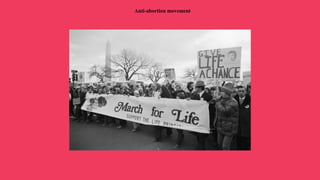
Anti-abortion movement
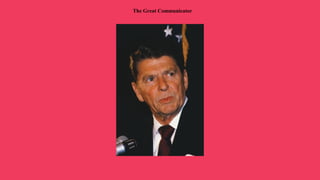
The Great Communicator
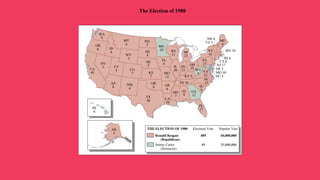
The Election of 1980
Reagan’s First Term
Reaganomics
Cut income taxes and Capital Gains Taxes but not Payroll Taxes
Income taxes and Capital Gains taxes are paid by wealthiest
Payroll taxes are paid by everyone who is paid a salary but not by people who live
off of the income from their investments
Trickle Down or Supply Side Economics
By returning money to spend on items or to reinvest in business, the wealthiest
Americans would create jobs and cause unemployment to lessen.
More people employed = more people paying payroll taxes = more revenue for
government tax coffers
See policies of Andrew Mellon following WWI
Reagan’s First Term
The defense buildup
Reagan argued that most of the political trouble in the world was caused by
the Soviet Union.
“Evil Empire”
Initiated a dramatic buildup of nuclear and conventional weapons and the creation of the
“Strategic Defense Initiative” a space-based anti-weapons platform
Tax cuts and the exponential defense buildup caused the federal deficit to increase
The Americas
Reagan wanted to combat Communism in Central America
El Salvador; Nicaragua; Grenada,
The Middle East
Lebanon
Arab-Israeli Conflict
Reagan’s Second Term
The election of 1984
Won landslide victory over Walter Mondale
The Reagan doctrine
1985 State of the Union Address
Support anti-Communist forces throughout the world
Reagan’s foreign policy coincided with Mikhail Gorbachev’s program to
modernize the Soviet Union, experiment with capitalism gradually, and
ease relations with the U.S. and the West.
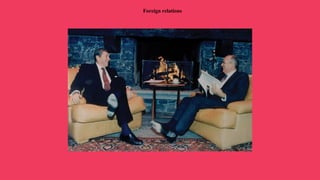
Reagan and Gorbachev met to secure a treaty to eliminate medium range nuclear
missiles
Reagan’s Second Term
The Iran-Contra Affair
Illicit Arms sales in to Iran in exchange for Iran using influence to secure the
release of American hostages in Lebanon. Money from the arms sales to
Iran was used to fund the Contra forces fighting in Nicaragua
Congress had previously banned arm sales to Iran and monetary
assistance to Contra forces in Nicaragua
Lieutenant Colonel Oliver North was the leader of the Iran-Contra
conspiracy
Further investigation revealed that members of the Reagan administration
knew about the plan and North was fired
North was convicted of lying to Congress but the judgment was overturned
on appeal because the prosecution could not prove that they had not used
testimony that North gave to Congress under a limited grant of immunity, as
the basis of his prosecution.
Foreign relations
Reagan’s Second Term
The poor, the homeless, and the victims of AIDS
Under Reagan the federal government ceased spending money on new
public housing for low-income families
Local urban renewal programs that displaced low income families to build
luxury high rise apartments, condominiums and business centers were not
required to locate new homes for the displaced low-income families.
Homelessness increased to the highest level since the Great Depression
AIDS: Acquired Immune Deficiency Syndrome
Cultural battle over whether the Federal government had a role in managing a public
health issue or whether homosexuals and intravenous drug users were reaping the
consequences of their actions
Public debate over the role of the federal government continued
What was the Reagan Legacy?
The Reagan legacy: Greatly reduced role for Federal government in domestic policy;
greatly increased role of American military in foreign policy and foreign conflicts
Continued debate over the Reagan legacy
Redefining the role of the federal government
Did Reagan’s economic policies set the nation on a road to the extreme income inequality that
exists today or did these policies increase opportunity for low income families to move into
higher income brackets through hard work?
Would Reagan have supported the more extreme tax cuts and deficit spending policies of the
G.W. Bush administration?
Active engagement with Soviets in the Cold War
Did Reagan’s foreign policy effectively fight Communism and Soviet aggression or did it lay
the groundwork for later problems in Afghanistan, the Middle East and Central America?
Would the Soviet Union have fallen from its own weight as a result of economic stagnation
and the cost of maintaining a military presence in Eastern Europe or did Reagan’s more
active engagement of the Soviet Union help to bring down the Soviet Union?

His 122 ch 33 a conservative realignment 1977 1990

  • 1.
  • 2.
    The Reagan Revolution TheMaking of a President Ronald Reagan was a movie star before running for governor of California. Reagan ran against Gerald Ford in 1976, but lost in the Republican primary He was previously divorced and not particularly religious The move to Reagan Corresponded with a national revival and realignment of evangelical Christians to conservative political causes Jimmy Carter was Southern Baptist and openly practiced his faith. Reagan was not particularly religious but evangelical Christians, particularly in the South backed Reagan Concerns about social equality between African Americans and whites Concerns about the feminist movement as undermining the traditional role of women as wife and mother
  • 3.
    Reagan Revolution Economic recessionpropelled by the Middle East Oil Crisis Iranian Hostage Crisis Resurgence of a new conservative movement energized by Evangelical Christians
  • 4.
  • 5.
  • 6.
  • 7.
    Reagan’s First Term Reaganomics Cutincome taxes and Capital Gains Taxes but not Payroll Taxes Income taxes and Capital Gains taxes are paid by wealthiest Payroll taxes are paid by everyone who is paid a salary but not by people who live off of the income from their investments Trickle Down or Supply Side Economics By returning money to spend on items or to reinvest in business, the wealthiest Americans would create jobs and cause unemployment to lessen. More people employed = more people paying payroll taxes = more revenue for government tax coffers See policies of Andrew Mellon following WWI
  • 8.
    Reagan’s First Term Thedefense buildup Reagan argued that most of the political trouble in the world was caused by the Soviet Union. “Evil Empire” Initiated a dramatic buildup of nuclear and conventional weapons and the creation of the “Strategic Defense Initiative” a space-based anti-weapons platform Tax cuts and the exponential defense buildup caused the federal deficit to increase The Americas Reagan wanted to combat Communism in Central America El Salvador; Nicaragua; Grenada, The Middle East Lebanon Arab-Israeli Conflict
  • 9.
    Reagan’s Second Term Theelection of 1984 Won landslide victory over Walter Mondale The Reagan doctrine 1985 State of the Union Address Support anti-Communist forces throughout the world Reagan’s foreign policy coincided with Mikhail Gorbachev’s program to modernize the Soviet Union, experiment with capitalism gradually, and ease relations with the U.S. and the West. Reagan and Gorbachev met to secure a treaty to eliminate medium range nuclear missiles
  • 10.
    Reagan’s Second Term TheIran-Contra Affair Illicit Arms sales in to Iran in exchange for Iran using influence to secure the release of American hostages in Lebanon. Money from the arms sales to Iran was used to fund the Contra forces fighting in Nicaragua Congress had previously banned arm sales to Iran and monetary assistance to Contra forces in Nicaragua Lieutenant Colonel Oliver North was the leader of the Iran-Contra conspiracy Further investigation revealed that members of the Reagan administration knew about the plan and North was fired North was convicted of lying to Congress but the judgment was overturned on appeal because the prosecution could not prove that they had not used testimony that North gave to Congress under a limited grant of immunity, as the basis of his prosecution.
  • 11.
  • 12.
    Reagan’s Second Term Thepoor, the homeless, and the victims of AIDS Under Reagan the federal government ceased spending money on new public housing for low-income families Local urban renewal programs that displaced low income families to build luxury high rise apartments, condominiums and business centers were not required to locate new homes for the displaced low-income families. Homelessness increased to the highest level since the Great Depression AIDS: Acquired Immune Deficiency Syndrome Cultural battle over whether the Federal government had a role in managing a public health issue or whether homosexuals and intravenous drug users were reaping the consequences of their actions Public debate over the role of the federal government continued
  • 13.
    What was theReagan Legacy? The Reagan legacy: Greatly reduced role for Federal government in domestic policy; greatly increased role of American military in foreign policy and foreign conflicts Continued debate over the Reagan legacy Redefining the role of the federal government Did Reagan’s economic policies set the nation on a road to the extreme income inequality that exists today or did these policies increase opportunity for low income families to move into higher income brackets through hard work? Would Reagan have supported the more extreme tax cuts and deficit spending policies of the G.W. Bush administration? Active engagement with Soviets in the Cold War Did Reagan’s foreign policy effectively fight Communism and Soviet aggression or did it lay the groundwork for later problems in Afghanistan, the Middle East and Central America? Would the Soviet Union have fallen from its own weight as a result of economic stagnation and the cost of maintaining a military presence in Eastern Europe or did Reagan’s more active engagement of the Soviet Union help to bring down the Soviet Union?

Editor's Notes

  • #5 Bettmann/Corbis
  • #6 Bettmann/Corbis
  • #8 Believing that government was not the solution to the economic malaise affecting the country, but the problem itself, Reagan pushed through a series of bills that would cut income taxes, capital gains taxes, and other concessions to revitalize the people. By doing so, he returned money to the richest Americans, who then had more money to spend on items, which raised demand, which created jobs, caused unemployment to lessen, and increased the tax coffers. This is known as supply side economics. In addition, the federal government’s budget was cut in areas that were deemed not for the truly needy.
  • #9 Reagan charged that most of the political trouble in the world lay at the hands of the Soviet Union in Moscow. Labeling them an “evil empire,” he initiated a dramatic buildup of nuclear and conventional weapons and announced the creation of the Strategic Defense Initiative, a space-based anti-weapons platform. Closer to home, Central America was rife with Communist activity. In El Salvador, where Communist-supported forces had been attempting to overthrow the elected government since 1980. Reagan dispatched military advisers and funds to prevent the overthrow of the government. However, this did not have the intended effect; the revolutionaries used his actions to their advantage and won control of the nation. In Nicaragua, Reagan empowered the CIA to train and supply anti-Communist rebels to fight against the Soviet and Cuban government, which had itself had come to power by overthrowing the previous dictator.
  • #10 The 1984 election was another victory for Reagan. With the economy revitalized, the Republicans renominated him for a second term. The Democrats nominated Carter’s vice-president, Walter Mondale. Mondale nominated Geraldine Ferraro for vice-president. Reagan won 59 percent of the vote. Reagan announced in his State of the Union Address in 1985 that he would support anti-Communist forces throughout the world that sought to “defy Soviet-supported aggression.” He actively met with Gorbachev and secured a treaty to eliminate intermediate-range nuclear missiles.
  • #11 For his last two years in office, Reagan faced an opposition Congress. Reports began circulating about illicit arms sales to Iran in exchange for Iran working to secure American hostages in Lebanon. Money from these sales were in turn used to fund the Contra forces fighting in Nicaragua. Eventually, the charges proved true, and Lieutenant Colonel Oliver North, aide to the National Security Council, would be discovered as the ring leader of the plan. Further investigation proved that members of the Reagan administration had known about the plan, and North was fired. He was convicted, but the judgment was overturned on appeal.
  • #12 AP Photo
  • #13 The federal government had given up on building new public housing for low-income families, and urban renewal programs were not required to locate new homes for those who were displaced. As a result, the number of homeless rose during the 1980s. In addition, the discovery of acquired immunodeficiency syndrome (AIDS), brought to the forefront of society the risk of unprotected homosexual relations and some kinds of drug use. Originally thought of as a gay disease, AIDS emerged as one of the nation’s greatest healthcare problems.
  • #14 During his administration, Reagan was able to redefine the role of the government and promote a more active engagement with the Soviets in an attempt to win, or at least end, the cold war.