ANCIENT
HISTORY
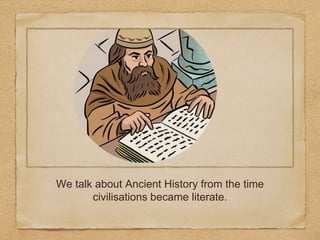
We talk about Ancient History from the time
civilisations became literate.
COLONISATION
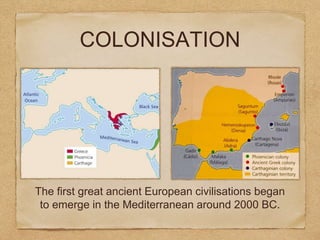
The first great ancient European civilisations began
to emerge in the Mediterranean around 2000 BC.
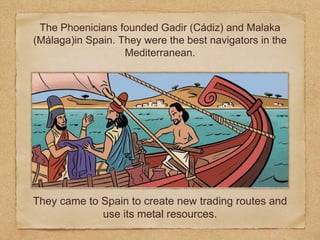
They came to Spain to create new trading routes and
use its metal resources.
The Phoenicians founded Gadir (Cádiz) and Malaka
(Málaga)in Spain. They were the best navigators in the
Mediterranean.
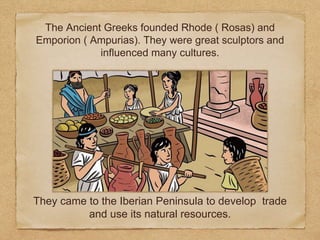
They came to the Iberian Peninsula to develop trade
and use its natural resources.
The Ancient Greeks founded Rhode ( Rosas) and
Emporion ( Ampurias). They were great sculptors and
influenced many cultures.
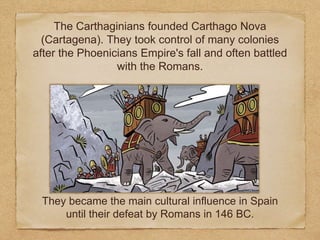
They became the main cultural influence in Spain
until their defeat by Romans in 146 BC.
The Carthaginians founded Carthago Nova
(Cartagena). They took control of many colonies
after the Phoenicians Empire's fall and often battled
with the Romans.
THE ROMANS
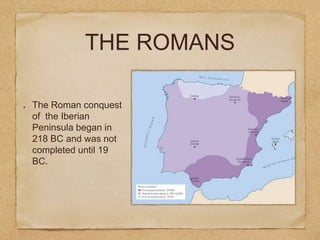
The Roman conquest
of the Iberian
Peninsula began in
218 BC and was not
completed until 19
BC.
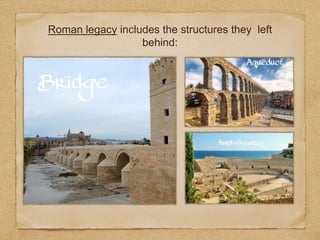
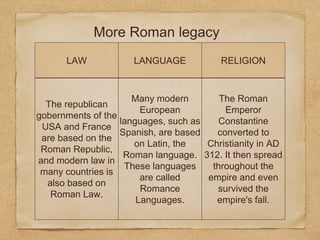
Roman legacy includes the structures they left
behind:
LAW LANGUAGE RELIGION
The republican
gobernments of the
USA and France
are based on the
Roman Republic,
and modern law in
many countries is
also based on
Roman Law.
Many modern
European
languages, such as
Spanish, are based
on Latin, the
Roman language.
These languages
are called
Romance
Languages.
The Roman
Emperor
Constantine
converted to
Christianity in AD
312. It then spread
throughout the
empire and even
survived the
empire's fall.
More Roman legacy
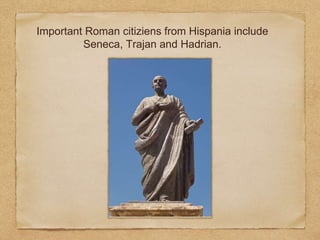
Important Roman citiziens from Hispania include
Seneca, Trajan and Hadrian.
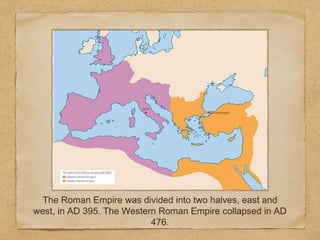
The Roman Empire was divided into two halves, east and
west, in AD 395. The Western Roman Empire collapsed in AD
476.
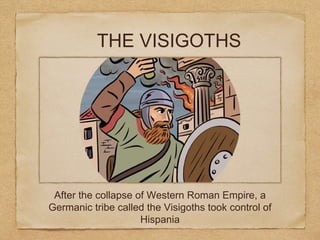
THE VISIGOTHS
After the collapse of Western Roman Empire, a
Germanic tribe called the Visigoths took control of
Hispania
Like other Germanic tribes, they were illiterate warriors
who originally came from Dacia (Romania).
After attacking Rome in AD 410, the Visigoths settled in
southern Gaul (France) first, and then moved onto the
Iberian Peninsula.
The Visigothic Kingdom ruled over Hispania from AD 456
until AD 711. During this time they became Romanised.
They learnt to speak Latin, learnt to read and write,
adopted Roman law and Catholicism as their official
religion.
They established their capital in Toledo.

Ancient History

  • 1.
  • 2.
    We talk aboutAncient History from the time civilisations became literate.
  • 3.
    COLONISATION The first greatancient European civilisations began to emerge in the Mediterranean around 2000 BC.
  • 4.
    They came toSpain to create new trading routes and use its metal resources. The Phoenicians founded Gadir (Cádiz) and Malaka (Málaga)in Spain. They were the best navigators in the Mediterranean.
  • 5.
    They came tothe Iberian Peninsula to develop trade and use its natural resources. The Ancient Greeks founded Rhode ( Rosas) and Emporion ( Ampurias). They were great sculptors and influenced many cultures.
  • 6.
    They became themain cultural influence in Spain until their defeat by Romans in 146 BC. The Carthaginians founded Carthago Nova (Cartagena). They took control of many colonies after the Phoenicians Empire's fall and often battled with the Romans.
  • 7.
    THE ROMANS The Romanconquest of the Iberian Peninsula began in 218 BC and was not completed until 19 BC.
  • 8.
    Roman legacy includesthe structures they left behind:
  • 9.
    LAW LANGUAGE RELIGION Therepublican gobernments of the USA and France are based on the Roman Republic, and modern law in many countries is also based on Roman Law. Many modern European languages, such as Spanish, are based on Latin, the Roman language. These languages are called Romance Languages. The Roman Emperor Constantine converted to Christianity in AD 312. It then spread throughout the empire and even survived the empire's fall. More Roman legacy
  • 10.
    Important Roman citiziensfrom Hispania include Seneca, Trajan and Hadrian.
  • 11.
    The Roman Empirewas divided into two halves, east and west, in AD 395. The Western Roman Empire collapsed in AD 476.
  • 12.
    THE VISIGOTHS After thecollapse of Western Roman Empire, a Germanic tribe called the Visigoths took control of Hispania
  • 13.
    Like other Germanictribes, they were illiterate warriors who originally came from Dacia (Romania). After attacking Rome in AD 410, the Visigoths settled in southern Gaul (France) first, and then moved onto the Iberian Peninsula. The Visigothic Kingdom ruled over Hispania from AD 456 until AD 711. During this time they became Romanised. They learnt to speak Latin, learnt to read and write, adopted Roman law and Catholicism as their official religion. They established their capital in Toledo.