HIPAA For Research Understanding how the Health Insurance Portability & Accountability Act of 1996  Affects Clinical Research
HIPAA History Health Insurance Portability & Accountability Act of 1996 (Kennedy-Kassebaum Act) Effective April 14, 2001 Compliance Required by April 14, 2003 (October 2003)
HIPAA – General Provisions  Standardization of electronic patient health, administrative and financial data; Unique identifiers for individuals, employers, health plans, and health care providers; Security standards protecting the confidentiality and integrity of health information.
What Is PHI? * PHI is all individually identifiable health information, including demographic data and biological specimens, that is transmitted or maintained by a covered entity. * PHI can be in any form, including written, electronic, and verbal.
Protected Health Information (PHI) Is created or received by a health care provider, health plan, or health care clearinghouse Relates to past, present, or future: Provision of care to an individual Physical or mental condition(s) Payment for provision of health care to an individual
De-identification of PHIs Medical institutions can release de-identified health information without patient authorization. The following 18 specific identifiers must be deleted:
De-identification Names All geographic subdivisions smaller than a state. All dates (except year) Telephone numbers Fax numbers Electronic mail addresses Social Security numbers Medical record numbers Health plan beneficiary numbers Account numbers Certificate/license numbers Vehicle identifiers, including license plate numbers
De-identification cont… Device identifiers and serial numbers URLs Internet Protocol (IP) Addresses Biometric identifiers, including finger and voice prints Full face photographic images and any comparable images Any other unique identifying number, characteristic, or code.
Impact on WVSOM Human Subject Research -Access to PHI Researcher must understand the permissible routes of access to PHI for research activity AND -Restrictions on Use and Disclosure of PHIs Researcher must implement necessary  safeguards to protect the PHI
The Privacy Rule permits a covered entity (WVSOM or Affiliated Hospitals) to use and disclose PHI for research When an individual Authorization has been obtained from a research participant,  OR When a Waiver of Authorization has been obtained.
There are other limited situations where PHI can be used/disclosed without an Authorization e.g use of PHI on decedents, use of PHI for Reviews Preparatory to Research, limited data sets, etc.
Existing IRB-Approved Studies The ‘Transition Provision’ in the Privacy Rule permits covered entities (USF) to continue to use and disclose PHI for research, if it has obtained  prior to April 14, 2003, An IRB approved consent form,  or An IRB approved waiver of consent,  or An express legal permission (e.g., a signed authorization)
New Studies To use/disclose PHI in research, the researcher must obtain 1) An Authorization from the individual participant. OR 2) A Waiver of Authorization for the study.  An Authorization is the HIPAA equivalent of consent to use and disclose data.
AUTHORIZATIONS Valid authorization must include the following elements: A description that identifies the information in a specific and meaningful fashion; The name of the person(s) authorized to make the requested use or disclosure The name of the person(s) to whom the covered entity may make the requested use or disclosure
Patient Authorization (Cont.) An expiration date/event that relates to the purpose of the use or disclosure; A statement of the individual’s right to revoke the authorization in writing and the exceptions to the right to revoke, together with a description of how the individual may revoke the authorization;
Patient Authorization (Cont.) A statement that information used may be subject to re-disclosure by the recipient and no longer be protected by this rule; Signature of the individual and date; If the authorization is signed by a personal representative of the individual, a description of such representative’s authority to act for the individual;
Patient Authorization (Cont.) The authorization must be written in plain language. Can be combined with consent if research involves treatment, but not at WVSOM. Research including existing records would require a separate authorization.
Waiver Disclosure involves no more than minimal risk to the individual The waiver will not adversely affect the privacy rights of the individual Research could not be conducted without the waiver Research could not be conducted without access to protected health information
Waiver (Cont.) The privacy risks are reasonable in relation to the anticipated benefits to the individuals and the importance of the knowledge gained through research There is a plan to protect patient identifiers from improper use and disclosure There is a plan to destroy patient identifiers at the earliest opportunity
Waiver (Cont.) There are adequate written assurances that protected health information will not be reused or disclosed to others except as provided by the regulations and restricts most disclosures of information to the minimum intended purpose.
Research Use/Disclosures That Do Not Require Authorizations or Waivers 1. Review of PHI Preparatory to Research 2.  Use of PHI of Decedents for Research Purposes
Special Rules Regarding Databases Creating and maintaining databases containing PHI is considered research. If you will use existing databases containing PHI for research after April 14, 2003,  you must obtain Authorizations or Waivers. If you will create or maintain databases for future analysis, you must comply with HIPAA in addition to obtaining IRB approval.
Research Subject Recruitment Recruitment for research is subject to the general authorization requirement unless the researcher has a direct treatment relationship with the patient. Researchers could use the Waiver of Authorization mechanism to access PHI for recruiting prospective research subjects.
A researcher who has a  direct treatment relationship  with the patient can engage in conversations related to recruitment without having to obtain Authorizations or Waivers. Research Subject Recruitment cont…
Revocation of Authorization Research subjects can revoke their Authorization in writing at any time.  This is subject to an exception know as the ‘Reliance Exception.’ A subject wishing to revoke the Authorization must be given a form for Revocation of Authorization
If the subject does not sign and return the form, then the researcher may continue to use the PHI and treat the Authorization as valid. Revocation of Authorization cont…
Reliance Exception to Revocation The Reliance Exception allows researchers to use and disclose a subject’s PHI that was obtained before the subject’s revocation in the following ways: To account for a subject’s withdrawal from the study To conduct investigations of scientific misconduct To report adverse events As necessary to incorporate the information of a marketing application to FDA
Research Subject’s Rights Accounting of the following research related disclosures of PHI are required: Disclosures as allowed by a Waiver of Authorization Reviews preparatory to research Research on PHI of decedents Disclosures made as allowed by law
Research Subject’s Rights cont… The Following Disclosures are NOT required: Disclosures made to the individual subject. Disclosures authorized by the subject (i.e., the research subject has signed an Authorization for this use/disclosure of PHI). De-identified data and limited data sets.
Summary Yes No Decedents  No No Record Review (No Identifiers) Yes Exempt No Record Review (Identifiers) Yes (2) Preexisting and Research Yes Clinical Research HIPAA IRB
Sanctions for Non-Compliance Significant penalties may be imposed against WVSOM, Affiliate Hospitals, and individual researchers. Civil Penalties:  Based on patient complaints: $100 per violation with $25,000 maximum per year
Criminal Penalties:  Knowingly wrongful disclosures: fines up to $50,000 and/or up to 1 year in prison Under false pretenses: fines up to $100,000 and/or up to 5 years in prison With intent to sell: fines up to $250,000 and/or up to 10 years in prison
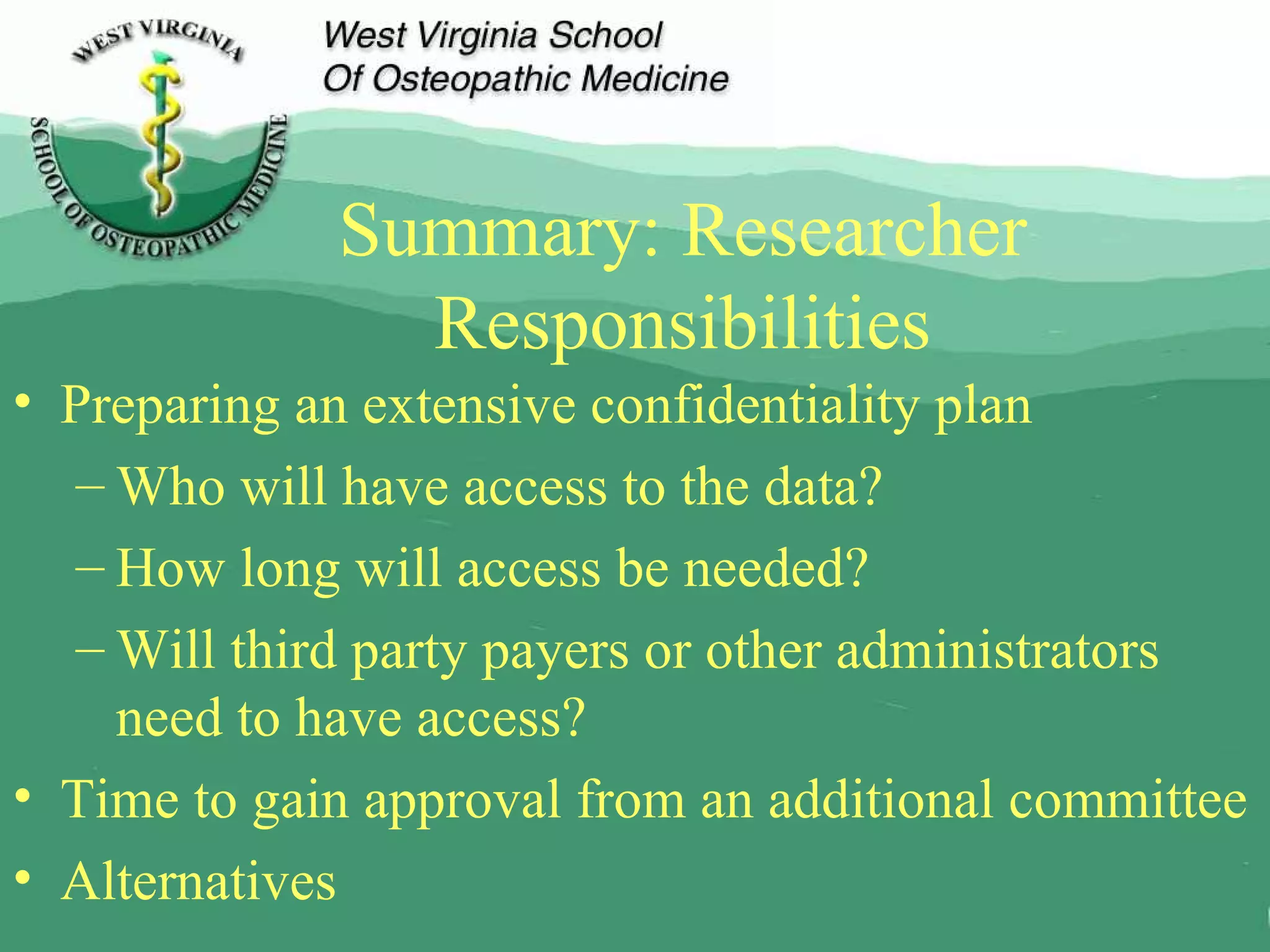
Summary: Researcher Responsibilities Preparing an extensive confidentiality plan Who will have access to the data? How long will access be needed? Will third party payers or other administrators need to have access? Time to gain approval from an additional committee Alternatives
Summary: IRB Responsibilities Have appropriate expertise in privacy and confidentiality concerns. Ensure that consent forms contain appropriate authorization requirements if applicable.
Understand waiver criteria and document appropriately. Coordinate with Privacy Board, if applicable. Summary: IRB Responsibilities
HIPAA &IRB AT WVSOM David Brown, Ph.D. Chair of the IRB [email_address] Brentz Thompson HIPAA Compliance Officer [email_address]
You must demonstrate both IRB and HIPAA Compliance by Passing the Following Courses and Quizzes: IRB:  http://cme.nci.nih.gov/ HIPAA:  http://www.wvu.edu/~rc/irb/hipwebct.htm
QUESTIONS!? Prepared By: Jason S. Wrench, Ed. D. Medical Education Specialist West Virginia School of Osteopathic Medicine

Hipaa

  • 1.
    HIPAA For ResearchUnderstanding how the Health Insurance Portability & Accountability Act of 1996 Affects Clinical Research
  • 2.
    HIPAA History HealthInsurance Portability & Accountability Act of 1996 (Kennedy-Kassebaum Act) Effective April 14, 2001 Compliance Required by April 14, 2003 (October 2003)
  • 3.
    HIPAA – GeneralProvisions Standardization of electronic patient health, administrative and financial data; Unique identifiers for individuals, employers, health plans, and health care providers; Security standards protecting the confidentiality and integrity of health information.
  • 4.
    What Is PHI?* PHI is all individually identifiable health information, including demographic data and biological specimens, that is transmitted or maintained by a covered entity. * PHI can be in any form, including written, electronic, and verbal.
  • 5.
    Protected Health Information(PHI) Is created or received by a health care provider, health plan, or health care clearinghouse Relates to past, present, or future: Provision of care to an individual Physical or mental condition(s) Payment for provision of health care to an individual
  • 6.
    De-identification of PHIsMedical institutions can release de-identified health information without patient authorization. The following 18 specific identifiers must be deleted:
  • 7.
    De-identification Names Allgeographic subdivisions smaller than a state. All dates (except year) Telephone numbers Fax numbers Electronic mail addresses Social Security numbers Medical record numbers Health plan beneficiary numbers Account numbers Certificate/license numbers Vehicle identifiers, including license plate numbers
  • 8.
    De-identification cont… Deviceidentifiers and serial numbers URLs Internet Protocol (IP) Addresses Biometric identifiers, including finger and voice prints Full face photographic images and any comparable images Any other unique identifying number, characteristic, or code.
  • 9.
    Impact on WVSOMHuman Subject Research -Access to PHI Researcher must understand the permissible routes of access to PHI for research activity AND -Restrictions on Use and Disclosure of PHIs Researcher must implement necessary safeguards to protect the PHI
  • 10.
    The Privacy Rulepermits a covered entity (WVSOM or Affiliated Hospitals) to use and disclose PHI for research When an individual Authorization has been obtained from a research participant, OR When a Waiver of Authorization has been obtained.
  • 11.
    There are otherlimited situations where PHI can be used/disclosed without an Authorization e.g use of PHI on decedents, use of PHI for Reviews Preparatory to Research, limited data sets, etc.
  • 12.
    Existing IRB-Approved StudiesThe ‘Transition Provision’ in the Privacy Rule permits covered entities (USF) to continue to use and disclose PHI for research, if it has obtained prior to April 14, 2003, An IRB approved consent form, or An IRB approved waiver of consent, or An express legal permission (e.g., a signed authorization)
  • 13.
    New Studies Touse/disclose PHI in research, the researcher must obtain 1) An Authorization from the individual participant. OR 2) A Waiver of Authorization for the study. An Authorization is the HIPAA equivalent of consent to use and disclose data.
  • 14.
    AUTHORIZATIONS Valid authorizationmust include the following elements: A description that identifies the information in a specific and meaningful fashion; The name of the person(s) authorized to make the requested use or disclosure The name of the person(s) to whom the covered entity may make the requested use or disclosure
  • 15.
    Patient Authorization (Cont.)An expiration date/event that relates to the purpose of the use or disclosure; A statement of the individual’s right to revoke the authorization in writing and the exceptions to the right to revoke, together with a description of how the individual may revoke the authorization;
  • 16.
    Patient Authorization (Cont.)A statement that information used may be subject to re-disclosure by the recipient and no longer be protected by this rule; Signature of the individual and date; If the authorization is signed by a personal representative of the individual, a description of such representative’s authority to act for the individual;
  • 17.
    Patient Authorization (Cont.)The authorization must be written in plain language. Can be combined with consent if research involves treatment, but not at WVSOM. Research including existing records would require a separate authorization.
  • 18.
    Waiver Disclosure involvesno more than minimal risk to the individual The waiver will not adversely affect the privacy rights of the individual Research could not be conducted without the waiver Research could not be conducted without access to protected health information
  • 19.
    Waiver (Cont.) Theprivacy risks are reasonable in relation to the anticipated benefits to the individuals and the importance of the knowledge gained through research There is a plan to protect patient identifiers from improper use and disclosure There is a plan to destroy patient identifiers at the earliest opportunity
  • 20.
    Waiver (Cont.) Thereare adequate written assurances that protected health information will not be reused or disclosed to others except as provided by the regulations and restricts most disclosures of information to the minimum intended purpose.
  • 21.
    Research Use/Disclosures ThatDo Not Require Authorizations or Waivers 1. Review of PHI Preparatory to Research 2. Use of PHI of Decedents for Research Purposes
  • 22.
    Special Rules RegardingDatabases Creating and maintaining databases containing PHI is considered research. If you will use existing databases containing PHI for research after April 14, 2003, you must obtain Authorizations or Waivers. If you will create or maintain databases for future analysis, you must comply with HIPAA in addition to obtaining IRB approval.
  • 23.
    Research Subject RecruitmentRecruitment for research is subject to the general authorization requirement unless the researcher has a direct treatment relationship with the patient. Researchers could use the Waiver of Authorization mechanism to access PHI for recruiting prospective research subjects.
  • 24.
    A researcher whohas a direct treatment relationship with the patient can engage in conversations related to recruitment without having to obtain Authorizations or Waivers. Research Subject Recruitment cont…
  • 25.
    Revocation of AuthorizationResearch subjects can revoke their Authorization in writing at any time. This is subject to an exception know as the ‘Reliance Exception.’ A subject wishing to revoke the Authorization must be given a form for Revocation of Authorization
  • 26.
    If the subjectdoes not sign and return the form, then the researcher may continue to use the PHI and treat the Authorization as valid. Revocation of Authorization cont…
  • 27.
    Reliance Exception toRevocation The Reliance Exception allows researchers to use and disclose a subject’s PHI that was obtained before the subject’s revocation in the following ways: To account for a subject’s withdrawal from the study To conduct investigations of scientific misconduct To report adverse events As necessary to incorporate the information of a marketing application to FDA
  • 28.
    Research Subject’s RightsAccounting of the following research related disclosures of PHI are required: Disclosures as allowed by a Waiver of Authorization Reviews preparatory to research Research on PHI of decedents Disclosures made as allowed by law
  • 29.
    Research Subject’s Rightscont… The Following Disclosures are NOT required: Disclosures made to the individual subject. Disclosures authorized by the subject (i.e., the research subject has signed an Authorization for this use/disclosure of PHI). De-identified data and limited data sets.
  • 30.
    Summary Yes NoDecedents No No Record Review (No Identifiers) Yes Exempt No Record Review (Identifiers) Yes (2) Preexisting and Research Yes Clinical Research HIPAA IRB
  • 31.
    Sanctions for Non-ComplianceSignificant penalties may be imposed against WVSOM, Affiliate Hospitals, and individual researchers. Civil Penalties: Based on patient complaints: $100 per violation with $25,000 maximum per year
  • 32.
    Criminal Penalties: Knowingly wrongful disclosures: fines up to $50,000 and/or up to 1 year in prison Under false pretenses: fines up to $100,000 and/or up to 5 years in prison With intent to sell: fines up to $250,000 and/or up to 10 years in prison
  • 33.
    Summary: Researcher ResponsibilitiesPreparing an extensive confidentiality plan Who will have access to the data? How long will access be needed? Will third party payers or other administrators need to have access? Time to gain approval from an additional committee Alternatives
  • 34.
    Summary: IRB ResponsibilitiesHave appropriate expertise in privacy and confidentiality concerns. Ensure that consent forms contain appropriate authorization requirements if applicable.
  • 35.
    Understand waiver criteriaand document appropriately. Coordinate with Privacy Board, if applicable. Summary: IRB Responsibilities
  • 36.
    HIPAA &IRB ATWVSOM David Brown, Ph.D. Chair of the IRB [email_address] Brentz Thompson HIPAA Compliance Officer [email_address]
  • 37.
    You must demonstrateboth IRB and HIPAA Compliance by Passing the Following Courses and Quizzes: IRB: http://cme.nci.nih.gov/ HIPAA: http://www.wvu.edu/~rc/irb/hipwebct.htm
  • 38.
    QUESTIONS!? Prepared By:Jason S. Wrench, Ed. D. Medical Education Specialist West Virginia School of Osteopathic Medicine