Khondokar Tazakka Tanzim
Md. Ismail hossain
Presentation about checking ROM & MS
MS : Oxford muscle scale brief explanation &
Position how to check grade 2 and 3 in every
motion of given joint.
ROM: Position when checking & position of
Goniometer axis and hands in every motion of
given joint.
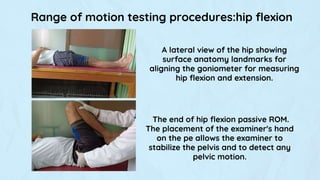
Range of motion testing procedures:hip flexion
A lateral view of the hip showing
surface anatomy landmarks for
aligning the goniometer for measuring
hip flexion and extension.
The end of hip flexion passive ROM.
The placement of the examiner's hand
on the pe allows the examiner to
stabilize the pelvis and to detect any
pelvic motion.
We find on him: 120
degree
Normal:120-100
Hip flexion
At the end of the left hip flexion ROM, the examiner uses one hand to align the distal goniometer arm and to
maintain the hip in flexion. The examiner's other hand shifts from the pelvis to hold the proximal goniometer arm
aligned with the lateral midline of the subject's pelvis.
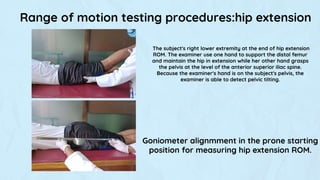
Range of motion testing procedures:hip extension
The subject's right lower extremity at the end of hip extension
ROM. The examiner use one hand to support the distal femur
and maintain the hip in extension while her other hand grasps
the pelvis at the level of the anterior superior iliac spine.
Because the examiner's hand is on the subject's pelvis, the
examiner is able to detect pelvic tilting.
Goniometer alignmment in the prone starting
position for measuring hip extension ROM.
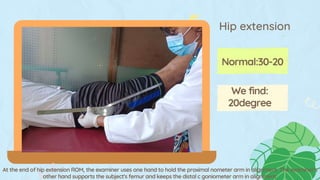
Normal:30-20
We find:
20degree
Hip extension
At the end of hip extension ROM, the examiner uses one hand to hold the proximal nometer arm in alignment. The examiner's
other hand supports the subject's femur and keeps the distal c goniometer arm in alignment.
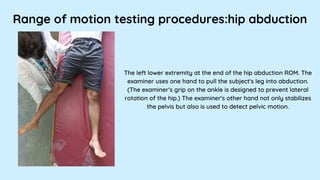
Range of motion testing procedures:hip abduction
The left lower extremity at the end of the hip abduction ROM. The
examiner uses one hand to pull the subject's leg into abduction.
(The examiner's grip on the ankle is designed to prevent lateral
rotation of the hip.) The examiner's other hand not only stabilizes
the pelvis but also is used to detect pelvic motion.
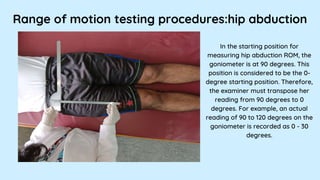
Range of motion testing procedures:hip abduction
In the starting position for
measuring hip abduction ROM, the
goniometer is at 90 degrees. This
position is considered to be the 0-
degree starting position. Therefore,
the examiner must transpose her
reading from 90 degrees to 0
degrees. For example, an actual
reading of 90 to 120 degrees on the
goniometer is recorded as 0 - 30
degrees.
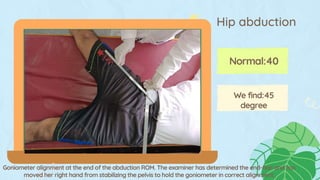
We find:45
degree
Normal:40
Hip abduction
Goniometer alignment at the end of the abduction ROM. The examiner has determined the end-feel and has
moved her right hand from stabilizing the pelvis to hold the goniometer in correct alignment.
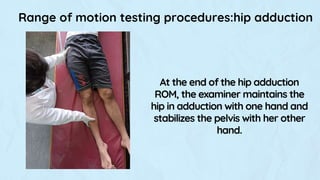
Range of motion testing procedures:hip adduction
At the end of the hip adduction
ROM, the examiner maintains the
hip in adduction with one hand and
stabilizes the pelvis with her other
hand.
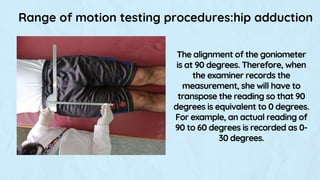
Range of motion testing procedures:hip adduction
The alignment of the goniometer
is at 90 degrees. Therefore, when
the examiner records the
measurement, she will have to
transpose the reading so that 90
degrees is equivalent to 0 degrees.
For example, an actual reading of
90 to 60 degrees is recorded as 0-
30 degrees.
We find:20
degree
Normal:20
Hip adduction
At the end of the hip adduction ROM, the examiner uses one hand to hold the goniometer
body over the subject's anterior superior iliac spine. The examiner prevents hip rotation by
maintaining a firm grasp at the subject's knee with her other hand.
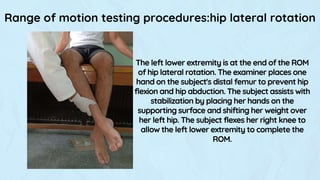
Range of motion testing procedures:hip lateral rotation
The left lower extremity is at the end of the ROM
of hip lateral rotation. The examiner places one
hand on the subject's distal femur to prevent hip
flexion and hip abduction. The subject assists with
stabilization by placing her hands on the
supporting surface and shifting her weight over
her left hip. The subject flexes her right knee to
allow the left lower extremity to complete the
ROM.
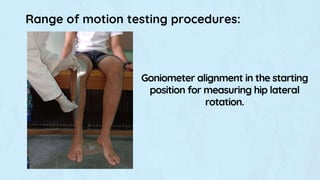
Range of motion testing procedures:
Goniometer alignment in the starting
position for measuring hip lateral
rotation.
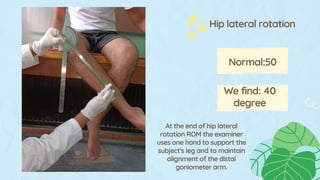
We find: 40
degree
Normal:50
Hip lateral rotation
At the end of hip lateral
rotation ROM the examiner
uses one hand to support the
subject's leg and to maintain
alignment of the distal
goniometer arm.
We find: 40
degree
Normal:50
Hip lateral rotation
Hip lateral rotation in the prone
testing position with the
goniometer aligned at the end of
the motion. Note that a strap is
placed across the pelvis for
stabilization.
Range of motion testing procedures:hip medial rotation
The left lower extremity at the end
of the ROM of hip medial rotation.
One of the examiner's hands is
placed on the subject's distal femur
to prevent hip flexion and
abduction. Her other hand pulls the
lower leg laterally.
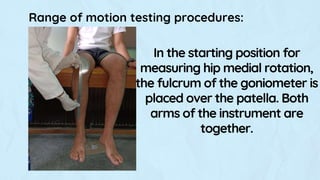
Range of motion testing procedures:
In the starting position for
measuring hip medial rotation,
the fulcrum of the goniometer is
placed over the patella. Both
arms of the instrument are
together.
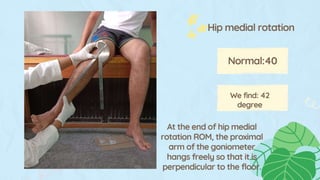
We find: 42
degree
Normal:40
Hip medial rotation
At the end of hip medial
rotation ROM, the proximal
arm of the goniometer
hangs freely so that it is
perpendicular to the floor.
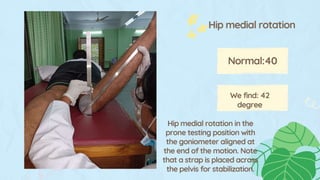
We find: 42
degree
Normal:40
Hip medial rotation
Hip medial rotation in the
prone testing position with
the goniometer aligned at
the end of the motion. Note
that a strap is placed across
the pelvis for stabilization.
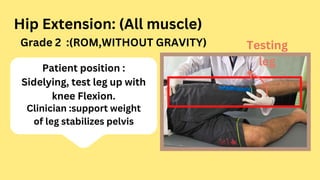
Hip Extension: (All muscle)
Patient position :
Sidelying, test leg up with
knee Flexion.
Clinician :support weight
of leg stabilizes pelvis
Grade 2 :(ROM,WITHOUT GRAVITY) Testing
leg
Hip extension (All muscle)
Grade 3:(ROM,WITH GRAVITY)
Pt position :prone with
knee Flexion slightly.
Clinician force :down
for what the floor
Testing
leg
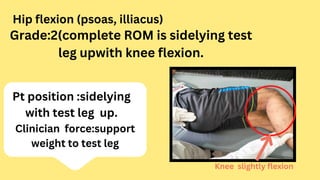
Hip flexion (psoas, illiacus)
Grade:2(complete ROM is sidelying test
leg upwith knee flexion.
Pt position :sidelying
with test leg up.
Clinician force:support
weight to test leg
Knee slightly flexion
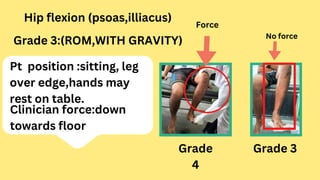
Hip flexion (psoas,illiacus)
Grade 3:(ROM,WITH GRAVITY)
Pt position :sitting, leg
over edge,hands may
rest on table.
Clinician force:down
towards floor
Grade
4
Grade 3
Force
No force
Hip adduction (All muscle)
Grade 3:
Pt position :Sidelying, test
leg on table, non-test leg
held in abduction.
Clinician force:
toward the floor.
Testing
leg
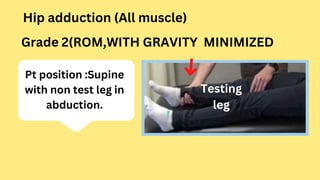
Hip adduction (All muscle)
Grade 2(ROM,WITH GRAVITY MINIMIZED
Pt position :Supine
with non test leg in
abduction.
Testing
leg
Hip Abduction :(All muscle)
Grade 2:(ROM,WITHOUT GRAVITY)
Pt position :Supine
with knee straight.
Hip abduction (all muscle)
Grade 3:ROM,WITH GRAVITY
Pt position : sidelying,
test leg up, in slightly
hip extension.
Clinician force :
towards the floor.
Testing leg up
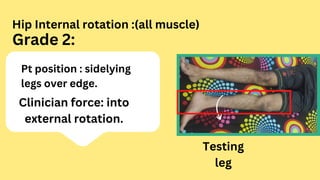
Hip Internal rotation :(all muscle)
Grade 2:
Pt position : sidelying
legs over edge.
Clinician force: into
external rotation.
Testing
leg
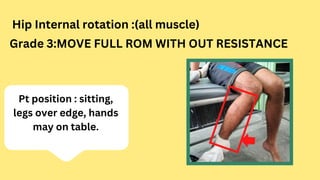
Hip Internal rotation :(all muscle)
Grade 3:MOVE FULL ROM WITH OUT RESISTANCE
Pt position : sitting,
legs over edge, hands
may on table.
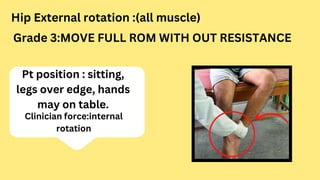
Hip External rotation :(all muscle)
Grade 3:MOVE FULL ROM WITH OUT RESISTANCE
Pt position : sitting,
legs over edge, hands
may on table.
Clinician force:internal
rotation
Hip External rotation :(all muscle)
Grade 2:MOVE FULL ROM without gravity
Pt position : sidelying
legs over edge.
Clinician force:observes
motion.
Testing leg rotated internal
References
:
https://books.google.com.bd/books?id=aepKjwEACAAJ&dq=inauthor:%22D.+Joyce
+White%22&hl=en&sa=X&redir_esc=y
-Measurement of joint motion:a guide to goniometry
-Evidence-based Physical Therapy for the Pelvic Floor: Bridging Science
Thank you
Thank you for listening

hip joint (rom&ms) 2.pptx

  • 1.
    Khondokar Tazakka Tanzim Md.Ismail hossain Presentation about checking ROM & MS
  • 2.
    MS : Oxfordmuscle scale brief explanation & Position how to check grade 2 and 3 in every motion of given joint. ROM: Position when checking & position of Goniometer axis and hands in every motion of given joint.
  • 4.
    Range of motiontesting procedures:hip flexion A lateral view of the hip showing surface anatomy landmarks for aligning the goniometer for measuring hip flexion and extension. The end of hip flexion passive ROM. The placement of the examiner's hand on the pe allows the examiner to stabilize the pelvis and to detect any pelvic motion.
  • 5.
    We find onhim: 120 degree Normal:120-100 Hip flexion At the end of the left hip flexion ROM, the examiner uses one hand to align the distal goniometer arm and to maintain the hip in flexion. The examiner's other hand shifts from the pelvis to hold the proximal goniometer arm aligned with the lateral midline of the subject's pelvis.
  • 6.
    Range of motiontesting procedures:hip extension The subject's right lower extremity at the end of hip extension ROM. The examiner use one hand to support the distal femur and maintain the hip in extension while her other hand grasps the pelvis at the level of the anterior superior iliac spine. Because the examiner's hand is on the subject's pelvis, the examiner is able to detect pelvic tilting. Goniometer alignmment in the prone starting position for measuring hip extension ROM.
  • 7.
    Normal:30-20 We find: 20degree Hip extension Atthe end of hip extension ROM, the examiner uses one hand to hold the proximal nometer arm in alignment. The examiner's other hand supports the subject's femur and keeps the distal c goniometer arm in alignment.
  • 8.
    Range of motiontesting procedures:hip abduction The left lower extremity at the end of the hip abduction ROM. The examiner uses one hand to pull the subject's leg into abduction. (The examiner's grip on the ankle is designed to prevent lateral rotation of the hip.) The examiner's other hand not only stabilizes the pelvis but also is used to detect pelvic motion.
  • 9.
    Range of motiontesting procedures:hip abduction In the starting position for measuring hip abduction ROM, the goniometer is at 90 degrees. This position is considered to be the 0- degree starting position. Therefore, the examiner must transpose her reading from 90 degrees to 0 degrees. For example, an actual reading of 90 to 120 degrees on the goniometer is recorded as 0 - 30 degrees.
  • 10.
    We find:45 degree Normal:40 Hip abduction Goniometeralignment at the end of the abduction ROM. The examiner has determined the end-feel and has moved her right hand from stabilizing the pelvis to hold the goniometer in correct alignment.
  • 11.
    Range of motiontesting procedures:hip adduction At the end of the hip adduction ROM, the examiner maintains the hip in adduction with one hand and stabilizes the pelvis with her other hand.
  • 12.
    Range of motiontesting procedures:hip adduction The alignment of the goniometer is at 90 degrees. Therefore, when the examiner records the measurement, she will have to transpose the reading so that 90 degrees is equivalent to 0 degrees. For example, an actual reading of 90 to 60 degrees is recorded as 0- 30 degrees.
  • 13.
    We find:20 degree Normal:20 Hip adduction Atthe end of the hip adduction ROM, the examiner uses one hand to hold the goniometer body over the subject's anterior superior iliac spine. The examiner prevents hip rotation by maintaining a firm grasp at the subject's knee with her other hand.
  • 14.
    Range of motiontesting procedures:hip lateral rotation The left lower extremity is at the end of the ROM of hip lateral rotation. The examiner places one hand on the subject's distal femur to prevent hip flexion and hip abduction. The subject assists with stabilization by placing her hands on the supporting surface and shifting her weight over her left hip. The subject flexes her right knee to allow the left lower extremity to complete the ROM.
  • 15.
    Range of motiontesting procedures: Goniometer alignment in the starting position for measuring hip lateral rotation.
  • 16.
    We find: 40 degree Normal:50 Hiplateral rotation At the end of hip lateral rotation ROM the examiner uses one hand to support the subject's leg and to maintain alignment of the distal goniometer arm.
  • 17.
    We find: 40 degree Normal:50 Hiplateral rotation Hip lateral rotation in the prone testing position with the goniometer aligned at the end of the motion. Note that a strap is placed across the pelvis for stabilization.
  • 18.
    Range of motiontesting procedures:hip medial rotation The left lower extremity at the end of the ROM of hip medial rotation. One of the examiner's hands is placed on the subject's distal femur to prevent hip flexion and abduction. Her other hand pulls the lower leg laterally.
  • 19.
    Range of motiontesting procedures: In the starting position for measuring hip medial rotation, the fulcrum of the goniometer is placed over the patella. Both arms of the instrument are together.
  • 20.
    We find: 42 degree Normal:40 Hipmedial rotation At the end of hip medial rotation ROM, the proximal arm of the goniometer hangs freely so that it is perpendicular to the floor.
  • 21.
    We find: 42 degree Normal:40 Hipmedial rotation Hip medial rotation in the prone testing position with the goniometer aligned at the end of the motion. Note that a strap is placed across the pelvis for stabilization.
  • 23.
    Hip Extension: (Allmuscle) Patient position : Sidelying, test leg up with knee Flexion. Clinician :support weight of leg stabilizes pelvis Grade 2 :(ROM,WITHOUT GRAVITY) Testing leg
  • 24.
    Hip extension (Allmuscle) Grade 3:(ROM,WITH GRAVITY) Pt position :prone with knee Flexion slightly. Clinician force :down for what the floor Testing leg
  • 25.
    Hip flexion (psoas,illiacus) Grade:2(complete ROM is sidelying test leg upwith knee flexion. Pt position :sidelying with test leg up. Clinician force:support weight to test leg Knee slightly flexion
  • 26.
    Hip flexion (psoas,illiacus) Grade3:(ROM,WITH GRAVITY) Pt position :sitting, leg over edge,hands may rest on table. Clinician force:down towards floor Grade 4 Grade 3 Force No force
  • 27.
    Hip adduction (Allmuscle) Grade 3: Pt position :Sidelying, test leg on table, non-test leg held in abduction. Clinician force: toward the floor. Testing leg
  • 28.
    Hip adduction (Allmuscle) Grade 2(ROM,WITH GRAVITY MINIMIZED Pt position :Supine with non test leg in abduction. Testing leg
  • 29.
    Hip Abduction :(Allmuscle) Grade 2:(ROM,WITHOUT GRAVITY) Pt position :Supine with knee straight.
  • 30.
    Hip abduction (allmuscle) Grade 3:ROM,WITH GRAVITY Pt position : sidelying, test leg up, in slightly hip extension. Clinician force : towards the floor. Testing leg up
  • 31.
    Hip Internal rotation:(all muscle) Grade 2: Pt position : sidelying legs over edge. Clinician force: into external rotation. Testing leg
  • 32.
    Hip Internal rotation:(all muscle) Grade 3:MOVE FULL ROM WITH OUT RESISTANCE Pt position : sitting, legs over edge, hands may on table.
  • 33.
    Hip External rotation:(all muscle) Grade 3:MOVE FULL ROM WITH OUT RESISTANCE Pt position : sitting, legs over edge, hands may on table. Clinician force:internal rotation
  • 34.
    Hip External rotation:(all muscle) Grade 2:MOVE FULL ROM without gravity Pt position : sidelying legs over edge. Clinician force:observes motion. Testing leg rotated internal
  • 35.
    References : https://books.google.com.bd/books?id=aepKjwEACAAJ&dq=inauthor:%22D.+Joyce +White%22&hl=en&sa=X&redir_esc=y -Measurement of jointmotion:a guide to goniometry -Evidence-based Physical Therapy for the Pelvic Floor: Bridging Science
  • 36.
    Thank you Thank youfor listening