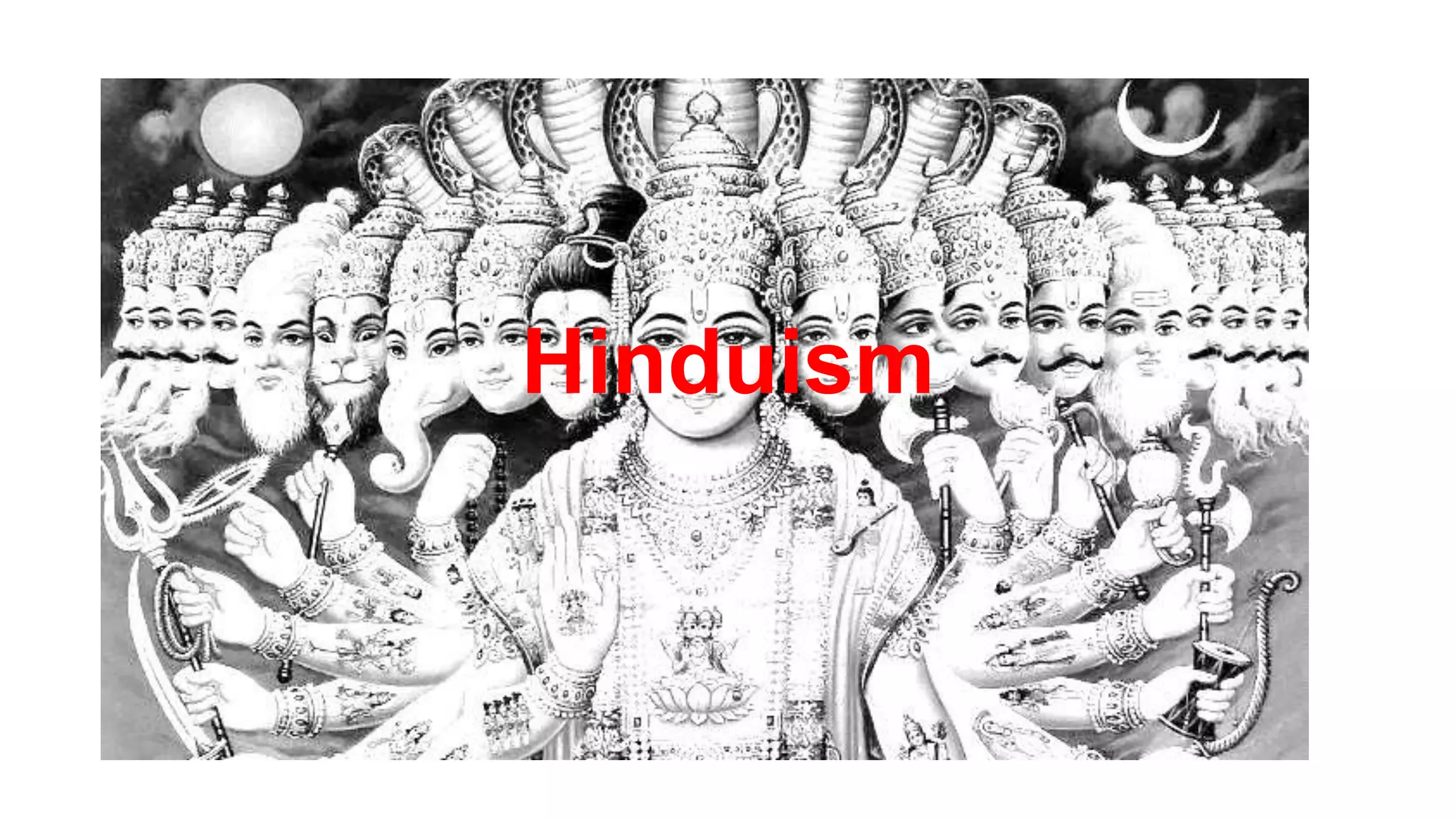
Hinduism
Gather as many words associated with the word Hinduism.
HINDUISM
Origin
Hinduism or Sanatana Dharma, which means eternal
faith, or the eternal way things are (truth) is more than a
religion. It is a culture, a way of life, and a code of
behavior. Hinduism has complex roots and involves a vast
array of practices and a host of deities. Hinduism derives
from the Persian word hindu and the Sanskrit word
Sindhu which means “river”. Hinduism began about 4000
years ago in India. It was the religion of an ancient people
known as the Aryans ("noble people") whose philosophy,
religion, and customs are recorded in their sacred texts
known as the Vedas.
The name Hinduism was given in the
nineteenth century to describe the wide array of
belief in India. Hinduism was originally known as
“Aryan Dharma” or the “Aryan Way”. Between 1750
B.C.E. and 1200 B.C.E., Aryan conquerors moved to
the Indus Valley and brought with them their own
sets of belief that eventually mingled with the
religion of the natives. Aryans brought with them
their sets of beliefs based on oral texts known as
Vedas.
Sacred Scriptures
The way of music, dances, drama and recitation were
the sacred text of Hinduism that is passed down
throughout the generations. The sacred writing of
Hindus are categorized into two classes, the shruti and
smriti.
Shruti
Literally means “that which is heard”, regarded as
eternal truth that were passed orally until the present
age wherein the Aryans came to write them down. The
four collections of the text of the Vedas form the shruti
and are considered primary sources and the most
authoritative texts of the Hindu faith.
Vedas
The word Veda means “knowledge” or Sacred
Lore”. The four basic Vedic books, which are sacrificial
hymns compiled from an earlier oral tradition, are
composed of Rig-veda, Sama-veda, Yajur-veda, and
Atharva-veda.
Rig Veda
The most important and oldest book that dates to
around 1500 B.C.E. The oldest work of literature in an
Indo-European language is also the oldest living
religious literature of the world. The book is a collection
of over a thousand hymns and more than a thousand
verses dedicated to the Aryan pantheon of gods.
•
Yajur- Veda
The “Knowledge of rites”. This book is a compilation of
materials recited during rituals and sacrifices to deities.
Sama-Veda
The “Knowledge of chants”. This book is a collection of
verses from the basic hymns recited by priests during
sacrifices.
Atharva- Veda
The “Knowledge given by the sage Atharva”. This book
contains rituals used in homes and popular prayers to
gods. Atharva contains numerous spells and
incantations for medical purposes and magical aids to
victory in battle, among others. Each Vedas consist of
four main parts.
•Mantras- are hymns and chants for praising god.
•Brahmanas- are explanations of the Mantras with
detailed descriptions of the sacrificial ceremonies
related to them.
•Aranyakas- are meditations that explicate their
meaning.
•Upanishads- secret teaching transcend rituals to
elucidate the nature of the universe and human’s
connectedness to it.
Smriti
Smriti literally means “that which has been
remembered. Most of the text are sectarian and of
lesser importance than shruti
• Ramayana- translated as the “Story of Rama” or “Rama’s
Journey”. The epic Sanskrit poem was written by the poet
Valmiki between 200 B.C.E. to 200 C.E. The story is centered
in Rama, a prince and later portrayed as avatar (incarnation)
of the Hindu god Vishnu. Presently, this story is danced out
and acted in Southeast Asia where Hindu influence is
observed.
• Mahabharata- the world’s longest poem and another major
Sanskrit literature of old India which is composed of around
one hundred thousand verses.
• Bhagavad Gita- which is translated as “the Lord’s Song” a
celebrated episode within the Mahabharata. Considered as
one of the holiest books by the Hindus.
Beliefs and Doctrines
• Devotion to Trimurti
Brahman- the ultimate reality, one and undivided.
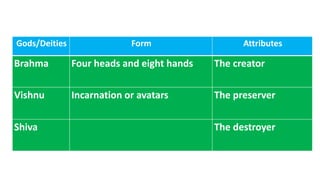
Brahman is often seen in three forms called the Trimurti
(creation, preservation, and destruction). These functions are
expressed in gods’ form:
Gods/Deities Form Attributes
Brahma Four heads and eight hands The creator
Vishnu Incarnation or avatars The preserver
Shiva The destroyer
THREE PRINCIPAL AND INTER-RELATED
DOCTRINES
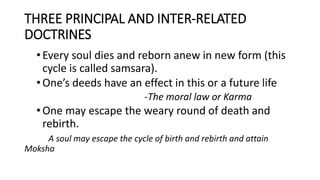
•Every soul dies and reborn anew in new form (this
cycle is called samsara).
•One’s deeds have an effect in this or a future life
-The moral law or Karma
•One may escape the weary round of death and
rebirth.
A soul may escape the cycle of birth and rebirth and attain
Moksha
Yoga
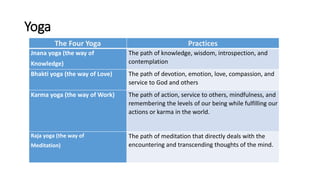
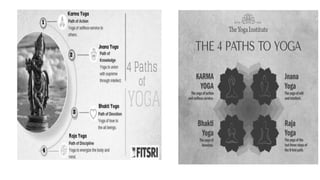
The Four Yoga Practices
Jnana yoga (the way of
Knowledge)
The path of knowledge, wisdom, introspection, and
contemplation
Bhakti yoga (the way of Love) The path of devotion, emotion, love, compassion, and
service to God and others
Karma yoga (the way of Work) The path of action, service to others, mindfulness, and
remembering the levels of our being while fulfilling our
actions or karma in the world.
Raja yoga (the way of
Meditation)
The path of meditation that directly deals with the
encountering and transcending thoughts of the mind.
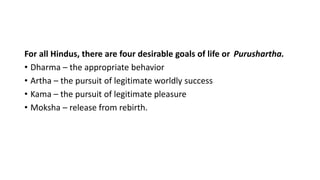
For all Hindus, there are four desirable goals of life or Purushartha.
• Dharma – the appropriate behavior
• Artha – the pursuit of legitimate worldly success
• Kama – the pursuit of legitimate pleasure
• Moksha – release from rebirth.
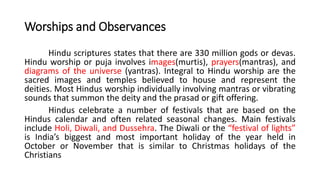
Worships and Observances
Hindu scriptures states that there are 330 million gods or devas.
Hindu worship or puja involves images(murtis), prayers(mantras), and
diagrams of the universe (yantras). Integral to Hindu worship are the
sacred images and temples believed to house and represent the
deities. Most Hindus worship individually involving mantras or vibrating
sounds that summon the deity and the prasad or gift offering.
Hindus celebrate a number of festivals that are based on the
Hindus calendar and often related seasonal changes. Main festivals
include Holi, Diwali, and Dussehra. The Diwali or the “festival of lights”
is India’s biggest and most important holiday of the year held in
October or November that is similar to Christmas holidays of the
Christians
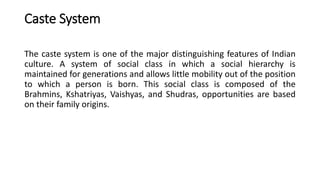
Caste System
The caste system is one of the major distinguishing features of Indian
culture. A system of social class in which a social hierarchy is
maintained for generations and allows little mobility out of the position
to which a person is born. This social class is composed of the
Brahmins, Kshatriyas, Vaishyas, and Shudras, opportunities are based
on their family origins.
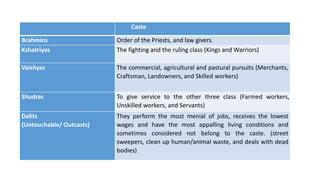
Caste
Brahmins Order of the Priests, and law givers.
Kshatriyas The fighting and the ruling class (Kings and Warriors)
Vaishyas The commercial, agricultural and pastural pursuits (Merchants,
Craftsman, Landowners, and Skilled workers)
Shudras To give service to the other three class (Farmed workers,
Unskilled workers, and Servants)
Dalits
(Untouchable/ Outcasts)
They perform the most menial of jobs, receives the lowest
wages and have the most appalling living conditions and
sometimes considered not belong to the caste. (street
sweepers, clean up human/animal waste, and deals with dead
bodies)

Hinduism.pptx

  • 1.
  • 2.
    Gather as manywords associated with the word Hinduism. HINDUISM
  • 3.
    Origin Hinduism or SanatanaDharma, which means eternal faith, or the eternal way things are (truth) is more than a religion. It is a culture, a way of life, and a code of behavior. Hinduism has complex roots and involves a vast array of practices and a host of deities. Hinduism derives from the Persian word hindu and the Sanskrit word Sindhu which means “river”. Hinduism began about 4000 years ago in India. It was the religion of an ancient people known as the Aryans ("noble people") whose philosophy, religion, and customs are recorded in their sacred texts known as the Vedas.
  • 4.
    The name Hinduismwas given in the nineteenth century to describe the wide array of belief in India. Hinduism was originally known as “Aryan Dharma” or the “Aryan Way”. Between 1750 B.C.E. and 1200 B.C.E., Aryan conquerors moved to the Indus Valley and brought with them their own sets of belief that eventually mingled with the religion of the natives. Aryans brought with them their sets of beliefs based on oral texts known as Vedas.
  • 5.
    Sacred Scriptures The wayof music, dances, drama and recitation were the sacred text of Hinduism that is passed down throughout the generations. The sacred writing of Hindus are categorized into two classes, the shruti and smriti.
  • 6.
    Shruti Literally means “thatwhich is heard”, regarded as eternal truth that were passed orally until the present age wherein the Aryans came to write them down. The four collections of the text of the Vedas form the shruti and are considered primary sources and the most authoritative texts of the Hindu faith.
  • 7.
    Vedas The word Vedameans “knowledge” or Sacred Lore”. The four basic Vedic books, which are sacrificial hymns compiled from an earlier oral tradition, are composed of Rig-veda, Sama-veda, Yajur-veda, and Atharva-veda.
  • 8.
    Rig Veda The mostimportant and oldest book that dates to around 1500 B.C.E. The oldest work of literature in an Indo-European language is also the oldest living religious literature of the world. The book is a collection of over a thousand hymns and more than a thousand verses dedicated to the Aryan pantheon of gods. •
  • 9.
    Yajur- Veda The “Knowledgeof rites”. This book is a compilation of materials recited during rituals and sacrifices to deities.
  • 10.
    Sama-Veda The “Knowledge ofchants”. This book is a collection of verses from the basic hymns recited by priests during sacrifices.
  • 11.
    Atharva- Veda The “Knowledgegiven by the sage Atharva”. This book contains rituals used in homes and popular prayers to gods. Atharva contains numerous spells and incantations for medical purposes and magical aids to victory in battle, among others. Each Vedas consist of four main parts.
  • 12.
    •Mantras- are hymnsand chants for praising god. •Brahmanas- are explanations of the Mantras with detailed descriptions of the sacrificial ceremonies related to them. •Aranyakas- are meditations that explicate their meaning. •Upanishads- secret teaching transcend rituals to elucidate the nature of the universe and human’s connectedness to it.
  • 13.
    Smriti Smriti literally means“that which has been remembered. Most of the text are sectarian and of lesser importance than shruti
  • 14.
    • Ramayana- translatedas the “Story of Rama” or “Rama’s Journey”. The epic Sanskrit poem was written by the poet Valmiki between 200 B.C.E. to 200 C.E. The story is centered in Rama, a prince and later portrayed as avatar (incarnation) of the Hindu god Vishnu. Presently, this story is danced out and acted in Southeast Asia where Hindu influence is observed. • Mahabharata- the world’s longest poem and another major Sanskrit literature of old India which is composed of around one hundred thousand verses. • Bhagavad Gita- which is translated as “the Lord’s Song” a celebrated episode within the Mahabharata. Considered as one of the holiest books by the Hindus.
  • 15.
    Beliefs and Doctrines •Devotion to Trimurti Brahman- the ultimate reality, one and undivided. Brahman is often seen in three forms called the Trimurti (creation, preservation, and destruction). These functions are expressed in gods’ form:
  • 16.
    Gods/Deities Form Attributes BrahmaFour heads and eight hands The creator Vishnu Incarnation or avatars The preserver Shiva The destroyer
  • 17.
    THREE PRINCIPAL ANDINTER-RELATED DOCTRINES •Every soul dies and reborn anew in new form (this cycle is called samsara). •One’s deeds have an effect in this or a future life -The moral law or Karma •One may escape the weary round of death and rebirth. A soul may escape the cycle of birth and rebirth and attain Moksha
  • 18.
    Yoga The Four YogaPractices Jnana yoga (the way of Knowledge) The path of knowledge, wisdom, introspection, and contemplation Bhakti yoga (the way of Love) The path of devotion, emotion, love, compassion, and service to God and others Karma yoga (the way of Work) The path of action, service to others, mindfulness, and remembering the levels of our being while fulfilling our actions or karma in the world. Raja yoga (the way of Meditation) The path of meditation that directly deals with the encountering and transcending thoughts of the mind.
  • 20.
    For all Hindus,there are four desirable goals of life or Purushartha. • Dharma – the appropriate behavior • Artha – the pursuit of legitimate worldly success • Kama – the pursuit of legitimate pleasure • Moksha – release from rebirth.
  • 21.
    Worships and Observances Hinduscriptures states that there are 330 million gods or devas. Hindu worship or puja involves images(murtis), prayers(mantras), and diagrams of the universe (yantras). Integral to Hindu worship are the sacred images and temples believed to house and represent the deities. Most Hindus worship individually involving mantras or vibrating sounds that summon the deity and the prasad or gift offering. Hindus celebrate a number of festivals that are based on the Hindus calendar and often related seasonal changes. Main festivals include Holi, Diwali, and Dussehra. The Diwali or the “festival of lights” is India’s biggest and most important holiday of the year held in October or November that is similar to Christmas holidays of the Christians
  • 22.
    Caste System The castesystem is one of the major distinguishing features of Indian culture. A system of social class in which a social hierarchy is maintained for generations and allows little mobility out of the position to which a person is born. This social class is composed of the Brahmins, Kshatriyas, Vaishyas, and Shudras, opportunities are based on their family origins.
  • 23.
    Caste Brahmins Order ofthe Priests, and law givers. Kshatriyas The fighting and the ruling class (Kings and Warriors) Vaishyas The commercial, agricultural and pastural pursuits (Merchants, Craftsman, Landowners, and Skilled workers) Shudras To give service to the other three class (Farmed workers, Unskilled workers, and Servants) Dalits (Untouchable/ Outcasts) They perform the most menial of jobs, receives the lowest wages and have the most appalling living conditions and sometimes considered not belong to the caste. (street sweepers, clean up human/animal waste, and deals with dead bodies)