Introduction to Hinduism
Historical Background
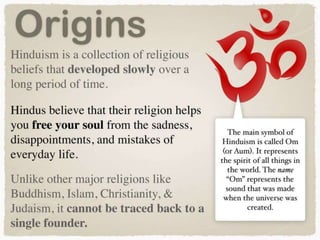
- Hinduism is the primordial religion in India and
- probably the oldest religion in the world
- no official founder unlike most of the world’s religions.
- a multi-colored collection of religious traditions that
traces its origin to Indus Valley in North India
- The seeds of Hinduism were planted in the fusion of
cultures when Aryan invaders from Europe swept into the
Indus valley around 1,500 BCE.
- historical development of Hinduism took place because of
recurring influence brought by the invasion by other
cultures and religious groups (Wostyn, 2004).
- followers believe that Hinduism is the fountainhead of all
religions.
Historical Background
- the term HINDU originated from the Persian word hindu
(Sanskrit sindhu)which means “river”.
- the name HINDUISM was given in the 19th century to
describe the wide array of belief systems in India originally
known as “Arya Dharma” or the “Aryan Way”
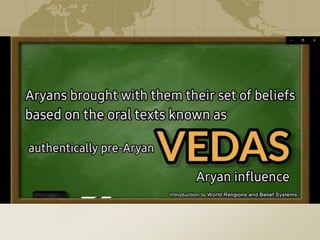
- Aryans brought with them their set of beliefs based on
oral texts known as Vedas.
- Aryans brough with them a polytheistic religion similar
to that of other Indo-European peoples
- the sun, moon and the storms are personified in
reference to the pantheon of gods and goddesses
worshipped by the Aryans
- sacrifice was the principal form of worship to the Aryan
gods (offerings like animals, dairy products)
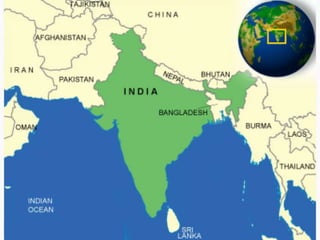
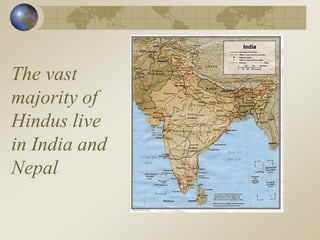
The vast
majority of
Hindus live
in India and
Nepal
SACRED SCRIPTURES
- it is passed down throughout generations by way of
music, recitation, dance, and drama
- Sanskrit has been the language of the earliest writings
(Coogan 2005).
- The sacred writings of Hindus are categorized into
two classes (Shruti and Smriti)
SHRUTI (that which is heard) – one of the four collections
of text in Vedas
- regarded as eternal truths that were passed orally until
the beginning of the present age.
- considered primary sources and he most authoritative
texts of he Hindu faith
-other writings: Samhitas, Brahmanas, Upanishads, Sutras
SACRED SCRIPTURES
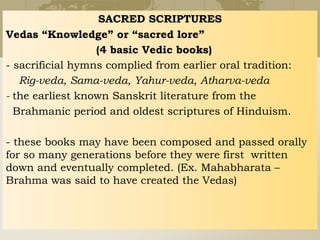
Vedas “Knowledge” or “sacred lore”
(4 basic Vedic books)
- sacrificial hymns complied from earlier oral tradition:
Rig-veda, Sama-veda, Yahur-veda, Atharva-veda
- the earliest known Sanskrit literature from the
Brahmanic period and oldest scriptures of Hinduism.
- these books may have been composed and passed orally
for so many generations before they were first written
down and eventually completed. (Ex. Mahabharata –
Brahma was said to have created the Vedas)
SACRED SCRIPTURES
Vedas “Knowledge” or “sacred lore”
(4 basic Vedic books)
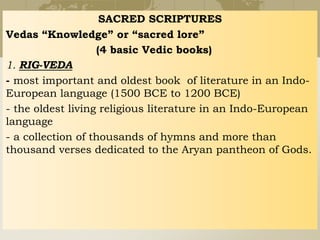
1. RIG-VEDA
- most important and oldest book of literature in an Indo-
European language (1500 BCE to 1200 BCE)
- the oldest living religious literature in an Indo-European
language
- a collection of thousands of hymns and more than
thousand verses dedicated to the Aryan pantheon of Gods.
SACRED SCRIPTURES
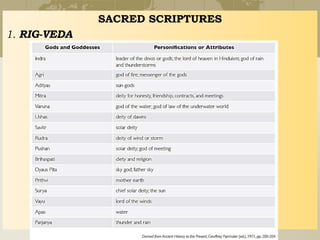
1. RIG-VEDA
SACRED SCRIPTURES
Vedas “Knowledge” or “sacred lore”
(4 basic Vedic books)
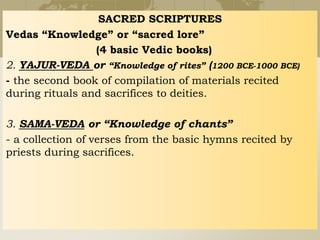
2. YAJUR-VEDA or “Knowledge of rites” (1200 BCE-1000 BCE)
- the second book of compilation of materials recited
during rituals and sacrifices to deities.
3. SAMA-VEDA or “Knowledge of chants”
- a collection of verses from the basic hymns recited by
priests during sacrifices.
SACRED SCRIPTURES
Vedas “Knowledge” or “sacred lore”
(4 basic Vedic books)
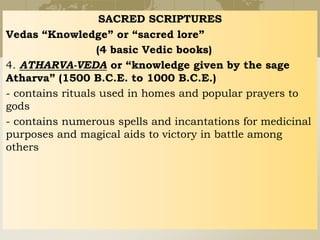
4. ATHARVA-VEDA or “knowledge given by the sage
Atharva” (1500 B.C.E. to 1000 B.C.E.)
- contains rituals used in homes and popular prayers to
gods
- contains numerous spells and incantations for medicinal
purposes and magical aids to victory in battle among
others
SACRED SCRIPTURES
Vedas 4 main parts:
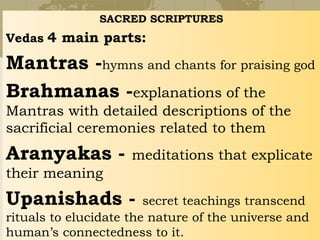
Mantras -hymns and chants for praising god
Brahmanas -explanations of the
Mantras with detailed descriptions of the
sacrificial ceremonies related to them
Aranyakas - meditations that explicate
their meaning
Upanishads - secret teachings transcend
rituals to elucidate the nature of the universe and
human’s connectedness to it.
SACRED SCRIPTURES
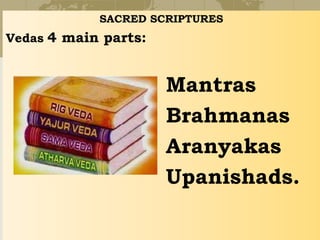
Vedas 4 main parts:
Mantras
Brahmanas
Aranyakas
Upanishads.
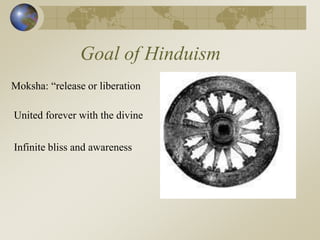
Goal of Hinduism
Moksha: “release or liberation
United forever with the divine
Infinite bliss and awareness
Reincarnation
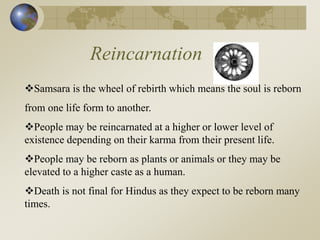
Samsara is the wheel of rebirth which means the soul is reborn
from one life form to another.
People may be reincarnated at a higher or lower level of
existence depending on their karma from their present life.
People may be reborn as plants or animals or they may be
elevated to a higher caste as a human.
Death is not final for Hindus as they expect to be reborn many
times.
Karma & Dharma
Karma: “action” or “deeds”
 Every action produces a Justified effect based on its
moral worthiness.
Karma determines all the particular circumstances
and Situations of one’s life.
Dharma: ethical duty based on the divine order of
reality. The word is the closest equivalent to “religion.”
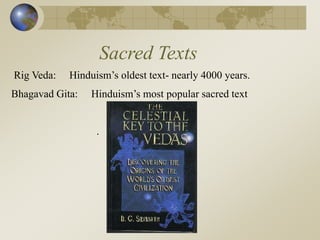
Sacred Texts
Rig Veda: Hinduism’s oldest text- nearly 4000 years.
.
Bhagavad Gita: Hinduism’s most popular sacred text
.
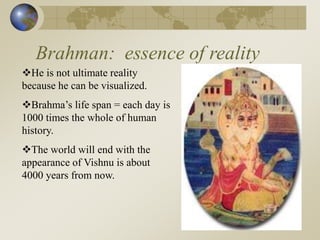
Brahman: essence of reality
He is not ultimate reality
because he can be visualized.
Brahma’s life span = each day is
1000 times the whole of human
history.
The world will end with the
appearance of Vishnu is about
4000 years from now.
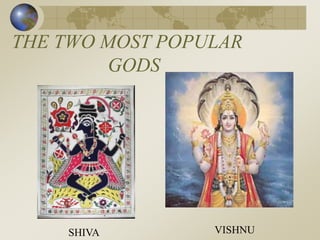
THE TWO MOST POPULAR
GODS
SHIVA VISHNU
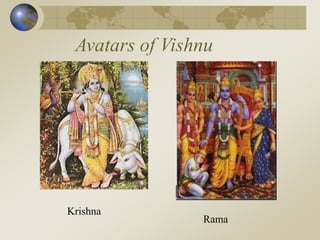
Krishna
Rama
Avatars of Vishnu
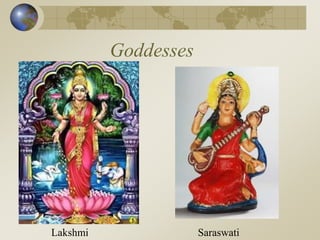
Goddesses
Lakshmi Saraswati
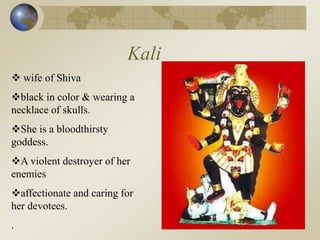
Kali
 wife of Shiva
black in color & wearing a
necklace of skulls.
She is a bloodthirsty
goddess.
A violent destroyer of her
enemies
affectionate and caring for
her devotees.
.
Festivals and Holy Days
no set day of the week is holy-each days has its possibilities
Religious festivals may be solar or lunar-lunar is preferred
In order to keep festivals consistent, an additional lunar month
is added to the calendar about every three years.
Some numbered days of the month are more important than
others. There are 125 special days in the Hindu year.
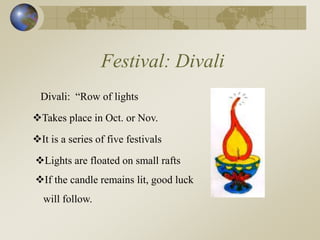
Festival: Divali
Divali: “Row of lights
Takes place in Oct. or Nov.
It is a series of five festivals
Lights are floated on small rafts
If the candle remains lit, good luck
will follow.
The Ganges River
Falling from
Its source of
Vishnu’s feet
onto Shiva’s
head and out
from his hair,
the water of
the Ganges is
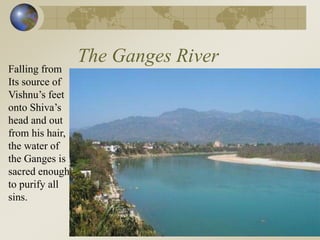
sacred enough
to purify all
sins.
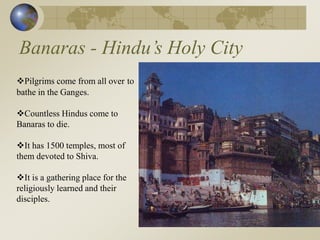
Banaras - Hindu’s Holy City
Pilgrims come from all over to
bathe in the Ganges.
Countless Hindus come to
Banaras to die.
It has 1500 temples, most of
them devoted to Shiva.
It is a gathering place for the
religiously learned and their
disciples.
Sacred Cow of India
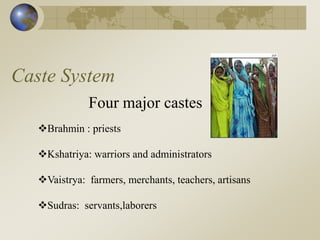
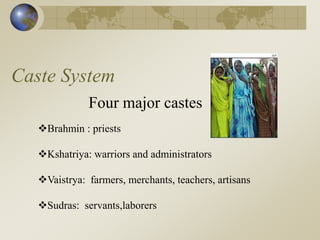
Caste System
Four major castes
Brahmin : priests
Kshatriya: warriors and administrators
Vaistrya: farmers, merchants, teachers, artisans
Sudras: servants,laborers
Caste System
Four major castes
Brahmin : priests
Kshatriya: warriors and administrators
Vaistrya: farmers, merchants, teachers, artisans
Sudras: servants,laborers
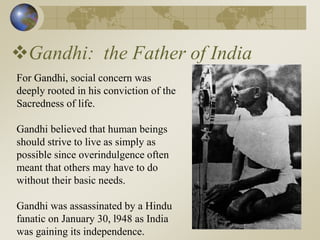
Gandhi: the Father of India
For Gandhi, social concern was
deeply rooted in his conviction of the
Sacredness of life.
Gandhi believed that human beings
should strive to live as simply as
possible since overindulgence often
meant that others may have to do
without their basic needs.
Gandhi was assassinated by a Hindu
fanatic on January 30, l948 as India
was gaining its independence.
One Ocean, Many Names

ryan_hinduism.ppt

  • 1.
  • 2.
    Historical Background - Hinduismis the primordial religion in India and - probably the oldest religion in the world - no official founder unlike most of the world’s religions. - a multi-colored collection of religious traditions that traces its origin to Indus Valley in North India - The seeds of Hinduism were planted in the fusion of cultures when Aryan invaders from Europe swept into the Indus valley around 1,500 BCE. - historical development of Hinduism took place because of recurring influence brought by the invasion by other cultures and religious groups (Wostyn, 2004). - followers believe that Hinduism is the fountainhead of all religions.
  • 4.
    Historical Background - theterm HINDU originated from the Persian word hindu (Sanskrit sindhu)which means “river”. - the name HINDUISM was given in the 19th century to describe the wide array of belief systems in India originally known as “Arya Dharma” or the “Aryan Way” - Aryans brought with them their set of beliefs based on oral texts known as Vedas. - Aryans brough with them a polytheistic religion similar to that of other Indo-European peoples - the sun, moon and the storms are personified in reference to the pantheon of gods and goddesses worshipped by the Aryans - sacrifice was the principal form of worship to the Aryan gods (offerings like animals, dairy products)
  • 7.
    The vast majority of Hinduslive in India and Nepal
  • 8.
    SACRED SCRIPTURES - itis passed down throughout generations by way of music, recitation, dance, and drama - Sanskrit has been the language of the earliest writings (Coogan 2005). - The sacred writings of Hindus are categorized into two classes (Shruti and Smriti) SHRUTI (that which is heard) – one of the four collections of text in Vedas - regarded as eternal truths that were passed orally until the beginning of the present age. - considered primary sources and he most authoritative texts of he Hindu faith -other writings: Samhitas, Brahmanas, Upanishads, Sutras
  • 9.
    SACRED SCRIPTURES Vedas “Knowledge”or “sacred lore” (4 basic Vedic books) - sacrificial hymns complied from earlier oral tradition: Rig-veda, Sama-veda, Yahur-veda, Atharva-veda - the earliest known Sanskrit literature from the Brahmanic period and oldest scriptures of Hinduism. - these books may have been composed and passed orally for so many generations before they were first written down and eventually completed. (Ex. Mahabharata – Brahma was said to have created the Vedas)
  • 10.
    SACRED SCRIPTURES Vedas “Knowledge”or “sacred lore” (4 basic Vedic books) 1. RIG-VEDA - most important and oldest book of literature in an Indo- European language (1500 BCE to 1200 BCE) - the oldest living religious literature in an Indo-European language - a collection of thousands of hymns and more than thousand verses dedicated to the Aryan pantheon of Gods.
  • 11.
  • 12.
    SACRED SCRIPTURES Vedas “Knowledge”or “sacred lore” (4 basic Vedic books) 2. YAJUR-VEDA or “Knowledge of rites” (1200 BCE-1000 BCE) - the second book of compilation of materials recited during rituals and sacrifices to deities. 3. SAMA-VEDA or “Knowledge of chants” - a collection of verses from the basic hymns recited by priests during sacrifices.
  • 13.
    SACRED SCRIPTURES Vedas “Knowledge”or “sacred lore” (4 basic Vedic books) 4. ATHARVA-VEDA or “knowledge given by the sage Atharva” (1500 B.C.E. to 1000 B.C.E.) - contains rituals used in homes and popular prayers to gods - contains numerous spells and incantations for medicinal purposes and magical aids to victory in battle among others
  • 14.
    SACRED SCRIPTURES Vedas 4main parts: Mantras -hymns and chants for praising god Brahmanas -explanations of the Mantras with detailed descriptions of the sacrificial ceremonies related to them Aranyakas - meditations that explicate their meaning Upanishads - secret teachings transcend rituals to elucidate the nature of the universe and human’s connectedness to it.
  • 15.
    SACRED SCRIPTURES Vedas 4main parts: Mantras Brahmanas Aranyakas Upanishads.
  • 16.
    Goal of Hinduism Moksha:“release or liberation United forever with the divine Infinite bliss and awareness
  • 17.
    Reincarnation Samsara is thewheel of rebirth which means the soul is reborn from one life form to another. People may be reincarnated at a higher or lower level of existence depending on their karma from their present life. People may be reborn as plants or animals or they may be elevated to a higher caste as a human. Death is not final for Hindus as they expect to be reborn many times.
  • 18.
    Karma & Dharma Karma:“action” or “deeds”  Every action produces a Justified effect based on its moral worthiness. Karma determines all the particular circumstances and Situations of one’s life. Dharma: ethical duty based on the divine order of reality. The word is the closest equivalent to “religion.”
  • 20.
    Sacred Texts Rig Veda:Hinduism’s oldest text- nearly 4000 years. . Bhagavad Gita: Hinduism’s most popular sacred text
  • 21.
  • 22.
    Brahman: essence ofreality He is not ultimate reality because he can be visualized. Brahma’s life span = each day is 1000 times the whole of human history. The world will end with the appearance of Vishnu is about 4000 years from now.
  • 23.
    THE TWO MOSTPOPULAR GODS SHIVA VISHNU
  • 24.
  • 25.
  • 26.
    Kali  wife ofShiva black in color & wearing a necklace of skulls. She is a bloodthirsty goddess. A violent destroyer of her enemies affectionate and caring for her devotees. .
  • 27.
    Festivals and HolyDays no set day of the week is holy-each days has its possibilities Religious festivals may be solar or lunar-lunar is preferred In order to keep festivals consistent, an additional lunar month is added to the calendar about every three years. Some numbered days of the month are more important than others. There are 125 special days in the Hindu year.
  • 28.
    Festival: Divali Divali: “Rowof lights Takes place in Oct. or Nov. It is a series of five festivals Lights are floated on small rafts If the candle remains lit, good luck will follow.
  • 29.
    The Ganges River Fallingfrom Its source of Vishnu’s feet onto Shiva’s head and out from his hair, the water of the Ganges is sacred enough to purify all sins.
  • 30.
    Banaras - Hindu’sHoly City Pilgrims come from all over to bathe in the Ganges. Countless Hindus come to Banaras to die. It has 1500 temples, most of them devoted to Shiva. It is a gathering place for the religiously learned and their disciples.
  • 31.
  • 32.
    Caste System Four majorcastes Brahmin : priests Kshatriya: warriors and administrators Vaistrya: farmers, merchants, teachers, artisans Sudras: servants,laborers
  • 33.
    Caste System Four majorcastes Brahmin : priests Kshatriya: warriors and administrators Vaistrya: farmers, merchants, teachers, artisans Sudras: servants,laborers
  • 34.
    Gandhi: the Fatherof India For Gandhi, social concern was deeply rooted in his conviction of the Sacredness of life. Gandhi believed that human beings should strive to live as simply as possible since overindulgence often meant that others may have to do without their basic needs. Gandhi was assassinated by a Hindu fanatic on January 30, l948 as India was gaining its independence.
  • 35.