HINDU GODS - TRIMURTI
Hinduism
Hinduism     is the religion of the majority of people in India and
Nepal, as well as being an important cultural force in all other
continents.
There   are innumerable wayside shrines to local goddesses or
divinized ancestors, majestic temples to the great deities such as
Brahma, Vishnu and Shiva, festivals, pilgrimages to rivers and
sacred places.
Hindus   will often say that Hinduism also contains developed and
elaborate traditions of philosophy and theology, which can be very
different from those of the west.
Trimurti
 Many Hindus believe in one supreme god, whom
  they call Brahman, but they worship that one god
  in various forms.
 that god may be represented in masculine and
  feminine ways.
 The most important of the Hindu gods who
  represent some aspect of Brahman are Brahma,
  Vishnu, and Siva (or Shiva).
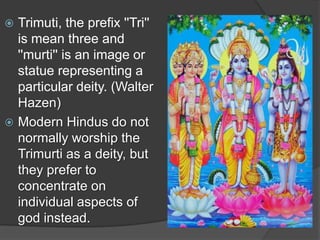
 Trimuti, the prefix ''Tri''
  is mean three and
  ''murti'' is an image or
  statue representing a
  particular deity. (Walter
  Hazen)
 Modern Hindus do not
  normally worship the
  Trimurti as a deity, but
  they prefer to
  concentrate on
  individual aspects of
  god instead.
Brahma
   -Brahma is the creator of the universe.
   All living things and beings are said to
            have evolved from him.

-Brahma is also believed to be responsible
   for the four Vedas, the most important
  Hindu sacred writings, which are said to
          have come from his head.
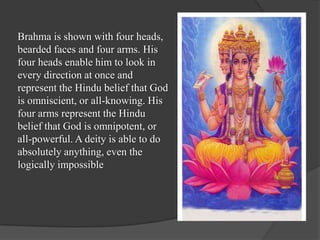
Brahma is shown with four heads,
bearded faces and four arms. His
four heads enable him to look in
every direction at once and
represent the Hindu belief that God
is omniscient, or all-knowing. His
four arms represent the Hindu
belief that God is omnipotent, or
all-powerful. A deity is able to do
absolutely anything, even the
logically impossible
Vishnu
  -Vishnu is the preserver of the universe.

 -He is said to protect the world from evil,
   and represents mercy and goodness.

-Vishnu is believed to have come to earth
     in nine different forms, known as
          avatars, or incarnations
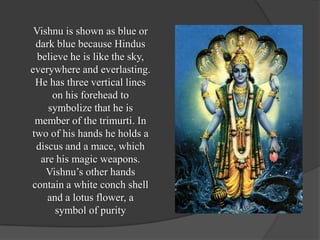
Vishnu is shown as blue or
 dark blue because Hindus
  believe he is like the sky,
everywhere and everlasting.
 He has three vertical lines
      on his forehead to
     symbolize that he is
 member of the trimurti. In
two of his hands he holds a
 discus and a mace, which
   are his magic weapons.
    Vishnu’s other hands
contain a white conch shell
     and a lotus flower, a
       symbol of purity
Shiva
- Shiva is the deity of destruction and a reproductive power.

- Shiva has been described as a deity of paradoxes because he
  is simultaneously a renunciant and a householder, a celibate
                     yogin and a husband .

 -   Shiva is described as the supreme deity, equated with
            Brahman as the source of the universe.
                 (Shvetasvatara Upanishad)

  - In the Shaiva Puranas, Shiva is the Absolute, the God
 responsible for creation, preservation and destruction of the
                            cosmos.
Shiva
     - There are 2 aspects of Shiva which are the masculine
                  Shiva and the feminine Shakti.

-   Shakti is the active power of the divine which is the agent
     of creation. She becomes manifest in all the names and
                        forms of the cosmos.

-   These two aspects is illustrated in an image of Shiva with
           the right half is male and the left is female.
Shiva
    - Shiva is also known as Nataraj, the Lord of the dance.

     -       It represents creation and destruction, control and
                  abandon, transcendence and immanence.

         -    The dance is called as the dance of destruction.

     -       On the cosmic level, destruction is the prelude to
                               recreation.

-   On the personal level, destruction is the means to remove
     the bonds that hold the devotee to the cycle of rebirth.
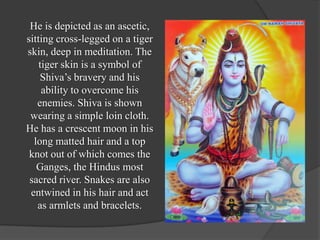
He is depicted as an ascetic,
sitting cross-legged on a tiger
skin, deep in meditation. The
    tiger skin is a symbol of
    Shiva’s bravery and his
     ability to overcome his
   enemies. Shiva is shown
 wearing a simple loin cloth.
He has a crescent moon in his
  long matted hair and a top
 knot out of which comes the
   Ganges, the Hindus most
 sacred river. Snakes are also
 entwined in his hair and act
   as armlets and bracelets.
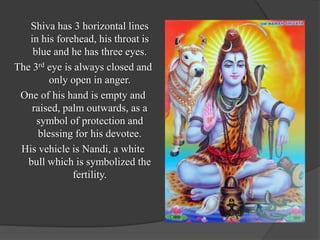
Shiva has 3 horizontal lines
   in his forehead, his throat is
    blue and he has three eyes.
The 3rd eye is always closed and
        only open in anger.
 One of his hand is empty and
    raised, palm outwards, as a
     symbol of protection and
     blessing for his devotee.
 His vehicle is Nandi, a white
   bull which is symbolized the
              fertility.
The Consort…
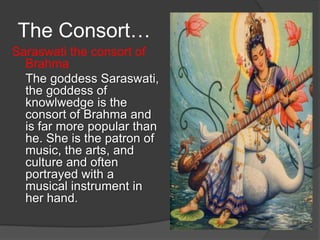
Saraswati the consort of
  Brahma
  The goddess Saraswati,
  the goddess of
  knowlwedge is the
  consort of Brahma and
  is far more popular than
  he. She is the patron of
  music, the arts, and
  culture and often
  portrayed with a
  musical instrument in
  her hand.
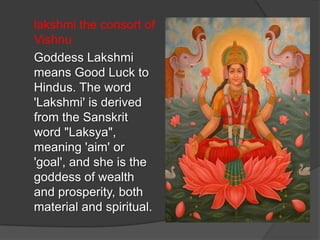
lakshmi the consort of
Vishnu
Goddess Lakshmi
means Good Luck to
Hindus. The word
'Lakshmi' is derived
from the Sanskrit
word "Laksya",
meaning 'aim' or
'goal', and she is the
goddess of wealth
and prosperity, both
material and spiritual.
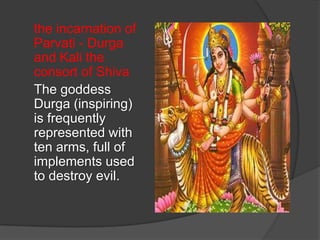
the incarnation of
Parvati - Durga
and Kali the
consort of Shiva
The goddess
Durga (inspiring)
is frequently
represented with
ten arms, full of
implements used
to destroy evil.
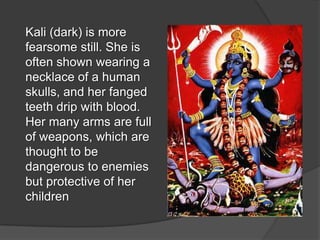
Kali (dark) is more
fearsome still. She is
often shown wearing a
necklace of a human
skulls, and her fanged
teeth drip with blood.
Her many arms are full
of weapons, which are
thought to be
dangerous to enemies
but protective of her
children
•The  concept of Gods in hindhuism
are significantly different with
islamic perspective.
•Holy Quran : Al-Ikhlas; 1-4
•Islam belief that God has no
partner but there are contrary with
hindhuism.
•According    to Tamara Sonn, the mystical belief that
all reality is in fact One seemed to be heretical.

•Al-Biruni stated that, the discussion of the concept
of God is closely related to the much-discussed
issue of the Indian idol worshipping or rather
associationism (Shirk). He is aware of the fact that
idol worshiping is abominable, and is the greatest
sin in Islam.

•Al-Biruni
         likens the custom of idol worshiping
among Hindus to the old Hellenistic belief that the
images or representations of divine being have no
magical power.
conclusion
briefly, the concept of god in hinduism
also regarded as a tribute to the genius
of the ancient Hindu sages, that this
concept of divine conciousness, which
they presented more than five thousand
years ago, has now become a key part
of the philosophical discussions on
religion and God all over the world.

Hinduism (2)

  • 1.
    HINDU GODS -TRIMURTI
  • 2.
    Hinduism Hinduism is the religion of the majority of people in India and Nepal, as well as being an important cultural force in all other continents. There are innumerable wayside shrines to local goddesses or divinized ancestors, majestic temples to the great deities such as Brahma, Vishnu and Shiva, festivals, pilgrimages to rivers and sacred places. Hindus will often say that Hinduism also contains developed and elaborate traditions of philosophy and theology, which can be very different from those of the west.
  • 3.
    Trimurti  Many Hindusbelieve in one supreme god, whom they call Brahman, but they worship that one god in various forms.  that god may be represented in masculine and feminine ways.  The most important of the Hindu gods who represent some aspect of Brahman are Brahma, Vishnu, and Siva (or Shiva).
  • 5.
     Trimuti, theprefix ''Tri'' is mean three and ''murti'' is an image or statue representing a particular deity. (Walter Hazen)  Modern Hindus do not normally worship the Trimurti as a deity, but they prefer to concentrate on individual aspects of god instead.
  • 6.
    Brahma -Brahma is the creator of the universe. All living things and beings are said to have evolved from him. -Brahma is also believed to be responsible for the four Vedas, the most important Hindu sacred writings, which are said to have come from his head.
  • 7.
    Brahma is shownwith four heads, bearded faces and four arms. His four heads enable him to look in every direction at once and represent the Hindu belief that God is omniscient, or all-knowing. His four arms represent the Hindu belief that God is omnipotent, or all-powerful. A deity is able to do absolutely anything, even the logically impossible
  • 8.
    Vishnu -Vishnuis the preserver of the universe. -He is said to protect the world from evil, and represents mercy and goodness. -Vishnu is believed to have come to earth in nine different forms, known as avatars, or incarnations
  • 9.
    Vishnu is shownas blue or dark blue because Hindus believe he is like the sky, everywhere and everlasting. He has three vertical lines on his forehead to symbolize that he is member of the trimurti. In two of his hands he holds a discus and a mace, which are his magic weapons. Vishnu’s other hands contain a white conch shell and a lotus flower, a symbol of purity
  • 10.
    Shiva - Shiva isthe deity of destruction and a reproductive power. - Shiva has been described as a deity of paradoxes because he is simultaneously a renunciant and a householder, a celibate yogin and a husband . - Shiva is described as the supreme deity, equated with Brahman as the source of the universe. (Shvetasvatara Upanishad) - In the Shaiva Puranas, Shiva is the Absolute, the God responsible for creation, preservation and destruction of the cosmos.
  • 11.
    Shiva - There are 2 aspects of Shiva which are the masculine Shiva and the feminine Shakti. - Shakti is the active power of the divine which is the agent of creation. She becomes manifest in all the names and forms of the cosmos. - These two aspects is illustrated in an image of Shiva with the right half is male and the left is female.
  • 12.
    Shiva - Shiva is also known as Nataraj, the Lord of the dance. - It represents creation and destruction, control and abandon, transcendence and immanence. - The dance is called as the dance of destruction. - On the cosmic level, destruction is the prelude to recreation. - On the personal level, destruction is the means to remove the bonds that hold the devotee to the cycle of rebirth.
  • 13.
    He is depictedas an ascetic, sitting cross-legged on a tiger skin, deep in meditation. The tiger skin is a symbol of Shiva’s bravery and his ability to overcome his enemies. Shiva is shown wearing a simple loin cloth. He has a crescent moon in his long matted hair and a top knot out of which comes the Ganges, the Hindus most sacred river. Snakes are also entwined in his hair and act as armlets and bracelets.
  • 14.
    Shiva has 3horizontal lines in his forehead, his throat is blue and he has three eyes. The 3rd eye is always closed and only open in anger. One of his hand is empty and raised, palm outwards, as a symbol of protection and blessing for his devotee. His vehicle is Nandi, a white bull which is symbolized the fertility.
  • 15.
    The Consort… Saraswati theconsort of Brahma The goddess Saraswati, the goddess of knowlwedge is the consort of Brahma and is far more popular than he. She is the patron of music, the arts, and culture and often portrayed with a musical instrument in her hand.
  • 16.
    lakshmi the consortof Vishnu Goddess Lakshmi means Good Luck to Hindus. The word 'Lakshmi' is derived from the Sanskrit word "Laksya", meaning 'aim' or 'goal', and she is the goddess of wealth and prosperity, both material and spiritual.
  • 17.
    the incarnation of Parvati- Durga and Kali the consort of Shiva The goddess Durga (inspiring) is frequently represented with ten arms, full of implements used to destroy evil.
  • 18.
    Kali (dark) ismore fearsome still. She is often shown wearing a necklace of a human skulls, and her fanged teeth drip with blood. Her many arms are full of weapons, which are thought to be dangerous to enemies but protective of her children
  • 19.
    •The conceptof Gods in hindhuism are significantly different with islamic perspective. •Holy Quran : Al-Ikhlas; 1-4 •Islam belief that God has no partner but there are contrary with hindhuism.
  • 20.
    •According to Tamara Sonn, the mystical belief that all reality is in fact One seemed to be heretical. •Al-Biruni stated that, the discussion of the concept of God is closely related to the much-discussed issue of the Indian idol worshipping or rather associationism (Shirk). He is aware of the fact that idol worshiping is abominable, and is the greatest sin in Islam. •Al-Biruni likens the custom of idol worshiping among Hindus to the old Hellenistic belief that the images or representations of divine being have no magical power.
  • 21.
    conclusion briefly, the conceptof god in hinduism also regarded as a tribute to the genius of the ancient Hindu sages, that this concept of divine conciousness, which they presented more than five thousand years ago, has now become a key part of the philosophical discussions on religion and God all over the world.