1
SAGAR INSTITUTE OF
RESEARCH &
TECHNOLOGY,BHOPAL
-UDIT GOUR
0133IT201054
IT(branch)
Submitted by:-
Submitted to:-
ANSHUL JAIN SIR,
Department of civil
engineering
HIGHWAY
ENGINEERING
e
n
g
i
n
e
e
r
i
n
g
h
i
g
h
w
a
y
3
Highway construction is generally preceded by detailed surveys and subgrade preparation. The
methods and technology for constructing highways has evolved over time and become increasingly
sophisticated. This advancement in technology has raised the level of skill sets required to manage
highway construction projects.
HIGHWAY
CONSTRUCTION
PAVEMENT IN
HIGHWAY
CONSTRUCTION
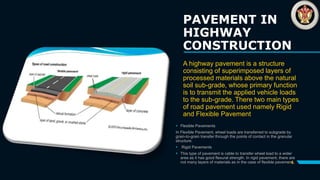
A highway pavement is a structure
consisting of superimposed layers of
processed materials above the natural
soil sub-grade, whose primary function
is to transmit the applied vehicle loads
to the sub-grade. There two main types
of road pavement used namely Rigid
and Flexible Pavement
 Flexible Pavements
In Flexible Pavement, wheel loads are transferred to subgrade by
grain-to-grain transfer through the points of contact in the granular
structure.
 Rigid Pavements
 This type of pavement is cable to transfer wheel load to a wider
area as it has good flexural strength. In rigid pavement, there are
not many layers of materials as in the case of flexible pavement..
4
GEOMETRIC
DESIGN
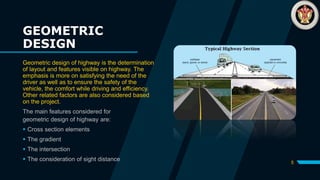
Geometric design of highway is the determination
of layout and features visible on highway. The
emphasis is more on satisfying the need of the
driver as well as to ensure the safety of the
vehicle, the comfort while driving and efficiency.
Other related factors are also considered based
on the project.
The main features considered for
geometric design of highway are:
 Cross section elements
 The gradient
 The intersection
 The consideration of sight distance 5
VIDEO SLIDE
6
7
Classification of
highways
Highways are further classified
into National Highways, State
Highways, district highways
and Rural Highways
8
National highway State highway
District road Village roads or rural roads
9
HIGHWAY
MANAGEMENT&
MAINTENANCE
Defects must be defined, understood, and
recorded in order to create an appropriate
maintenance plan. Maintenance planning is
solving an optimisation problem and it can
be predictive.
Activities could be the construction of infrastructure such as
highways and bridges or major and minor maintenance
activities related to constructing such infrastructure. The entire
project and involved activities must be handled in a professional
manner and completed within deadlines and budget.
Highway maintenance
Highway management
10
GROWTH OF
HIGHWAY
CONSTRUCTION
IN INDIA
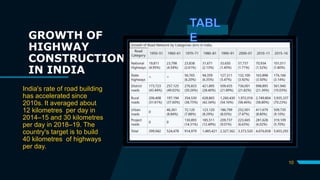
India's rate of road building
has accelerated since
2010s. It averaged about
12 kilometres per day in
2014–15 and 30 kilometres
per day in 2018–19. The
country's target is to build
40 kilometres of highways
per day.
11
 Highway traffic safety refers to the methods and measures
used to prevent road users from being killed or seriously
injured. Typical road users include pedestrians, cyclists,
motorists, vehicle passengers, horse riders, and passengers of
on-road public transport
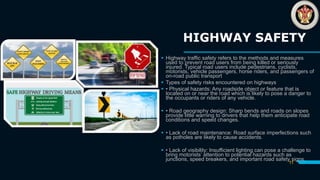
 Types of safety risks encountered on highways
 • Physical hazards: Any roadside object or feature that is
located on or near the road which is likely to pose a danger to
the occupants or riders of any vehicle.
 • Road geography design: Sharp bends and roads on slopes
provide little warning to drivers that help them anticipate road
conditions and speed changes.
 • Lack of road maintenance: Road surface imperfections such
as potholes are likely to cause accidents.
 • Lack of visibility: Insufficient lighting can pose a challenge to
bring motorists’ attention to potential hazards such as
junctions, speed breakers, and important road safety signs.
HIGHWAY SAFETY
THANK YOU!
END OF
PRESENTATION.
12

HIGHWAY ENGINEERING

  • 1.
    1 SAGAR INSTITUTE OF RESEARCH& TECHNOLOGY,BHOPAL -UDIT GOUR 0133IT201054 IT(branch) Submitted by:- Submitted to:- ANSHUL JAIN SIR, Department of civil engineering
  • 2.
  • 3.
    3 Highway construction isgenerally preceded by detailed surveys and subgrade preparation. The methods and technology for constructing highways has evolved over time and become increasingly sophisticated. This advancement in technology has raised the level of skill sets required to manage highway construction projects. HIGHWAY CONSTRUCTION
  • 4.
    PAVEMENT IN HIGHWAY CONSTRUCTION A highwaypavement is a structure consisting of superimposed layers of processed materials above the natural soil sub-grade, whose primary function is to transmit the applied vehicle loads to the sub-grade. There two main types of road pavement used namely Rigid and Flexible Pavement  Flexible Pavements In Flexible Pavement, wheel loads are transferred to subgrade by grain-to-grain transfer through the points of contact in the granular structure.  Rigid Pavements  This type of pavement is cable to transfer wheel load to a wider area as it has good flexural strength. In rigid pavement, there are not many layers of materials as in the case of flexible pavement.. 4
  • 5.
    GEOMETRIC DESIGN Geometric design ofhighway is the determination of layout and features visible on highway. The emphasis is more on satisfying the need of the driver as well as to ensure the safety of the vehicle, the comfort while driving and efficiency. Other related factors are also considered based on the project. The main features considered for geometric design of highway are:  Cross section elements  The gradient  The intersection  The consideration of sight distance 5
  • 6.
  • 7.
    7 Classification of highways Highways arefurther classified into National Highways, State Highways, district highways and Rural Highways
  • 8.
    8 National highway Statehighway District road Village roads or rural roads
  • 9.
    9 HIGHWAY MANAGEMENT& MAINTENANCE Defects must bedefined, understood, and recorded in order to create an appropriate maintenance plan. Maintenance planning is solving an optimisation problem and it can be predictive. Activities could be the construction of infrastructure such as highways and bridges or major and minor maintenance activities related to constructing such infrastructure. The entire project and involved activities must be handled in a professional manner and completed within deadlines and budget. Highway maintenance Highway management
  • 10.
    10 GROWTH OF HIGHWAY CONSTRUCTION IN INDIA India'srate of road building has accelerated since 2010s. It averaged about 12 kilometres per day in 2014–15 and 30 kilometres per day in 2018–19. The country's target is to build 40 kilometres of highways per day.
  • 11.
    11  Highway trafficsafety refers to the methods and measures used to prevent road users from being killed or seriously injured. Typical road users include pedestrians, cyclists, motorists, vehicle passengers, horse riders, and passengers of on-road public transport  Types of safety risks encountered on highways  • Physical hazards: Any roadside object or feature that is located on or near the road which is likely to pose a danger to the occupants or riders of any vehicle.  • Road geography design: Sharp bends and roads on slopes provide little warning to drivers that help them anticipate road conditions and speed changes.  • Lack of road maintenance: Road surface imperfections such as potholes are likely to cause accidents.  • Lack of visibility: Insufficient lighting can pose a challenge to bring motorists’ attention to potential hazards such as junctions, speed breakers, and important road safety signs. HIGHWAY SAFETY
  • 12.