Cloud Adoption
in Northern Europe:
Developer Survey
November 2015
Cygate and Apcera surveyed 188 IT professionals attending developer conferences Øredev (Malmö,
Sweden, Nov 4-6) and µcon (Stockholm, Sweden, Nov 5-6) about their usage and attitudes towards
public cloud. The majority of the respondents work in Sweden, Denmark, Norway, Finland or
Germany, and represent both multinational and regional companies.
72%
6% 6% 6% 6%
2% 2% 1% 1%
0%
10%
20%
30%
40%
50%
60%
70%
80%
Application
development
Enterprise
architecture
Other IT leadership QA/DevOps IT operations Testing CIO / CTO Security
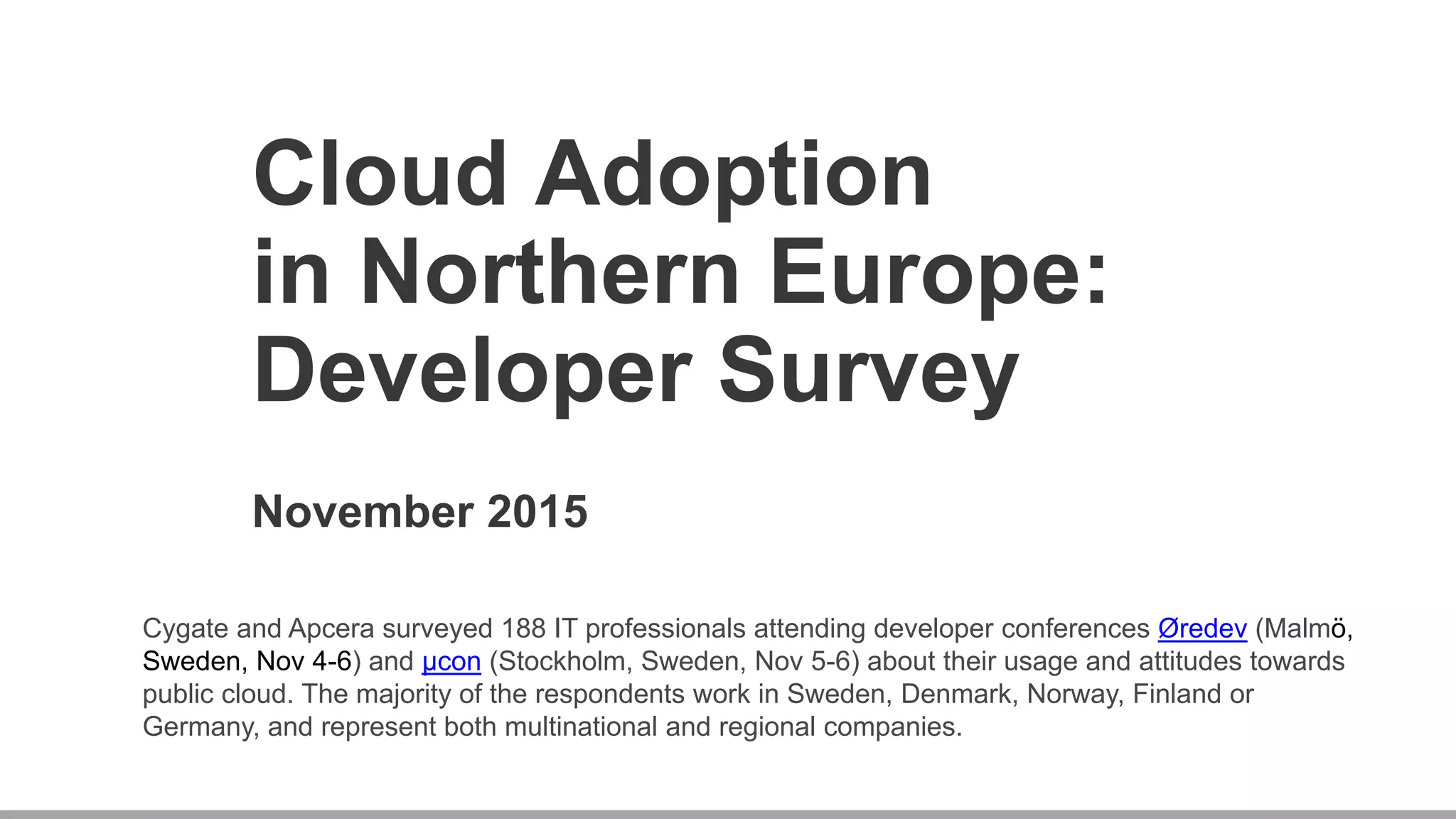
Question 1. What’s your primary area of responsibility?
Three out of four survey respondents have a developer background
Source: Cygate and Apcera Survey of 188 IT professionals attending Oredev and Mucon conferences, November 2015
42%
20%
14%
12%
8%
4%
0%
5%
10%
15%
20%
25%
30%
35%
40%
45%
Web applications Big data Containerized
workloads
Cloud native apps Internet-of-things Other
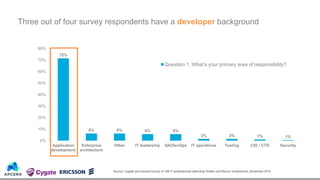
Question 2. What types of workloads at your
organization can benefit the most from cloud
computing? (Select all that apply)
Nordic enterprises are primarily running web applications in the cloud today
but big data workloads are already an important use case
Source: Cygate and Apcera Survey of 188 IT professionals attending Oredev and Mucon conferences, November 2015
39.0%
29.7%
22.0%
8.7%
0.3% 0.3%
0%
5%
10%
15%
20%
25%
30%
35%
40%
45%
Development Production or
Production
overflow
Test or Quality
Assurance
None Microservices Considering
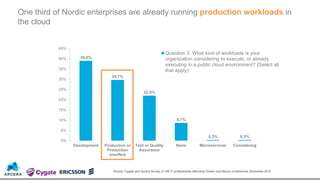
Question 3. What kind of workloads is your
organization considering to execute, or already
executing in a public cloud environment? (Select all
that apply)
One third of Nordic enterprises are already running production workloads in
the cloud
Source: Cygate and Apcera Survey of 188 IT professionals attending Oredev and Mucon conferences, November 2015
27%
16% 15% 14%
12%
7%
5%
3%
1% 1%
0%
5%
10%
15%
20%
25%
30%
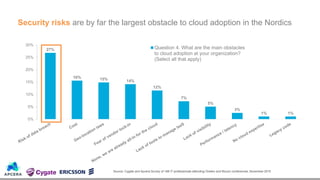
Question 4. What are the main obstacles
to cloud adoption at your organization?
(Select all that apply)
Security risks are by far the largest obstacle to cloud adoption in the Nordics
Source: Cygate and Apcera Survey of 188 IT professionals attending Oredev and Mucon conferences, November 2015
34%
23%
18%
15%
9%
1%
0%
5%
10%
15%
20%
25%
30%
35%
40%
Infrastructure on
demand
Pay as you go
model
Faster time to
market
Disaster recovery Outsourcing of non-
core competencies
High availability
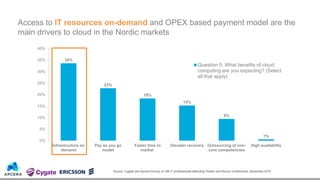
Question 5. What benefits of cloud
computing are you expecting? (Select
all that apply)
Access to IT resources on-demand and OPEX based payment model are the
main drivers to cloud in the Nordic markets
Source: Cygate and Apcera Survey of 188 IT professionals attending Oredev and Mucon conferences, November 2015
36%
26%
16%
14%
7%
0%
5%
10%
15%
20%
25%
30%
35%
40%
Nice to have Not really that important Public is not an option
for us
It’s in our Roadmap Absolutely imperative
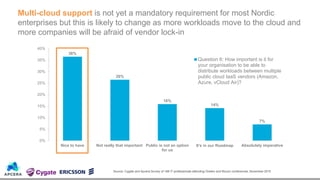
Question 6: How important is it for
your organisation to be able to
distribute workloads between multiple
public cloud IaaS vendors (Amazon,
Azure, vCloud Air)?
Multi-cloud support is not yet a mandatory requirement for most Nordic
enterprises but this is likely to change as more workloads move to the cloud and
more companies will be afraid of vendor lock-in
Source: Cygate and Apcera Survey of 188 IT professionals attending Oredev and Mucon conferences, November 2015
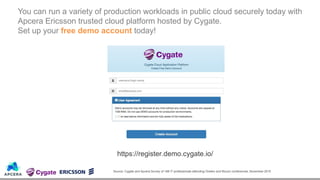
You can run a variety of production workloads in public cloud securely today with
Apcera Ericsson trusted cloud platform hosted by Cygate.
Set up your free demo account today!
https://register.demo.cygate.io/
Source: Cygate and Apcera Survey of 188 IT professionals attending Oredev and Mucon conferences, November 2015

Oredev Mucon Survey Nov 2015

  • 1.
    Cloud Adoption in NorthernEurope: Developer Survey November 2015 Cygate and Apcera surveyed 188 IT professionals attending developer conferences Øredev (Malmö, Sweden, Nov 4-6) and µcon (Stockholm, Sweden, Nov 5-6) about their usage and attitudes towards public cloud. The majority of the respondents work in Sweden, Denmark, Norway, Finland or Germany, and represent both multinational and regional companies.
  • 2.
    72% 6% 6% 6%6% 2% 2% 1% 1% 0% 10% 20% 30% 40% 50% 60% 70% 80% Application development Enterprise architecture Other IT leadership QA/DevOps IT operations Testing CIO / CTO Security Question 1. What’s your primary area of responsibility? Three out of four survey respondents have a developer background Source: Cygate and Apcera Survey of 188 IT professionals attending Oredev and Mucon conferences, November 2015
  • 3.
    42% 20% 14% 12% 8% 4% 0% 5% 10% 15% 20% 25% 30% 35% 40% 45% Web applications Bigdata Containerized workloads Cloud native apps Internet-of-things Other Question 2. What types of workloads at your organization can benefit the most from cloud computing? (Select all that apply) Nordic enterprises are primarily running web applications in the cloud today but big data workloads are already an important use case Source: Cygate and Apcera Survey of 188 IT professionals attending Oredev and Mucon conferences, November 2015
  • 4.
    39.0% 29.7% 22.0% 8.7% 0.3% 0.3% 0% 5% 10% 15% 20% 25% 30% 35% 40% 45% Development Productionor Production overflow Test or Quality Assurance None Microservices Considering Question 3. What kind of workloads is your organization considering to execute, or already executing in a public cloud environment? (Select all that apply) One third of Nordic enterprises are already running production workloads in the cloud Source: Cygate and Apcera Survey of 188 IT professionals attending Oredev and Mucon conferences, November 2015
  • 5.
    27% 16% 15% 14% 12% 7% 5% 3% 1%1% 0% 5% 10% 15% 20% 25% 30% Question 4. What are the main obstacles to cloud adoption at your organization? (Select all that apply) Security risks are by far the largest obstacle to cloud adoption in the Nordics Source: Cygate and Apcera Survey of 188 IT professionals attending Oredev and Mucon conferences, November 2015
  • 6.
    34% 23% 18% 15% 9% 1% 0% 5% 10% 15% 20% 25% 30% 35% 40% Infrastructure on demand Pay asyou go model Faster time to market Disaster recovery Outsourcing of non- core competencies High availability Question 5. What benefits of cloud computing are you expecting? (Select all that apply) Access to IT resources on-demand and OPEX based payment model are the main drivers to cloud in the Nordic markets Source: Cygate and Apcera Survey of 188 IT professionals attending Oredev and Mucon conferences, November 2015
  • 7.
    36% 26% 16% 14% 7% 0% 5% 10% 15% 20% 25% 30% 35% 40% Nice to haveNot really that important Public is not an option for us It’s in our Roadmap Absolutely imperative Question 6: How important is it for your organisation to be able to distribute workloads between multiple public cloud IaaS vendors (Amazon, Azure, vCloud Air)? Multi-cloud support is not yet a mandatory requirement for most Nordic enterprises but this is likely to change as more workloads move to the cloud and more companies will be afraid of vendor lock-in Source: Cygate and Apcera Survey of 188 IT professionals attending Oredev and Mucon conferences, November 2015
  • 8.
    You can runa variety of production workloads in public cloud securely today with Apcera Ericsson trusted cloud platform hosted by Cygate. Set up your free demo account today! https://register.demo.cygate.io/ Source: Cygate and Apcera Survey of 188 IT professionals attending Oredev and Mucon conferences, November 2015

Editor's Notes

  • #3 In fact a recent study of 285 IT professionals by ClusterHQ confirms that Security is a number one concern with Docker in production
  • #4 In fact a recent study of 285 IT professionals by ClusterHQ confirms that Security is a number one concern with Docker in production
  • #5 In fact a recent study of 285 IT professionals by ClusterHQ confirms that Security is a number one concern with Docker in production
  • #6 In fact a recent study of 285 IT professionals by ClusterHQ confirms that Security is a number one concern with Docker in production
  • #7 In fact a recent study of 285 IT professionals by ClusterHQ confirms that Security is a number one concern with Docker in production
  • #8 In fact a recent study of 285 IT professionals by ClusterHQ confirms that Security is a number one concern with Docker in production
  • #9 In fact a recent study of 285 IT professionals by ClusterHQ confirms that Security is a number one concern with Docker in production